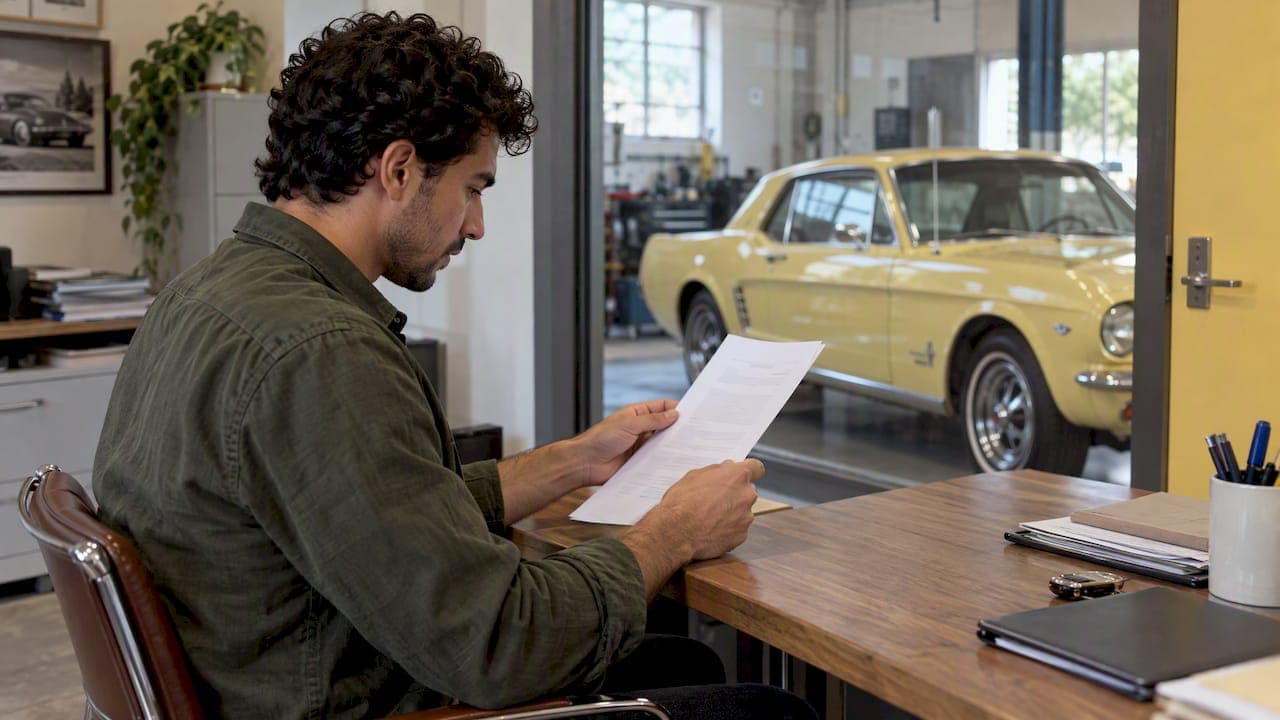
A classic car price quote is a written number from a seller or dealer for one specific car, ideally with the terms attached. To get a useful one, send the exact year, make, model, VIN, photos, and the paperwork you have, then ask what the price includes, how long it holds, and what could change it. This guide shows you how, in plain steps.
We built Butter Classics for people who love these cars, so we see quote requests from both sides: buyers who want a clear number and owners who want to know what their car could bring. The same habits help in both cases.
TL;DR
- A quote is a price for one specific car. An offer is a commitment to buy or sell at a price. An appraisal and an insurance agreed value are different documents with different jobs.
- Give the VIN, trim, options, mileage, photos, and title status up front. Vague requests get vague numbers.
- Ask four things every time: what is included, how long the price holds, what conditions apply, and what fees come on top.
- Arrange financing and a pre-purchase inspection before you negotiate. Both make your position stronger.
- If you are selling, a quote from a marketplace is a starting point. Consignment terms are where the real numbers get settled.
Table of Contents
- What a classic car price quote actually is
- What to have ready before you ask
- How to request a classic car price quote, step by step
- What moves the number in a classic quote
- Is the quote firm, time-limited, or conditional?
- Red flags in a classic car quote
- Using a quote to negotiate
- Quote, appraisal, and agreed value: which do you need?
- Our perspective: a quote should make the next step easy
- Ready to get a real number?
- FAQ
- Sources
What a classic car price quote actually is
Think of a quote as an answer to a question: "What would this car cost me, or what could it sell for?" It is not the same as the sticker number on a listing, and it is not a promise until it is written down with terms.
In mainstream car buying, Edmunds describes a dealer price quote as a price given by the dealership's internet sales department, while an asking price is the figure a buyer can raise when negotiating. Classic cars follow the same logic, with one big twist: no two are alike. A numbers-matching 1966 Mustang with a documented restoration and a driver-quality one with a repaint can share a badge and sit thousands of dollars apart.
That is why a good classic quote reads more like a short description than a single figure. It names the car, states the price, and lists what comes with it.

Quote, offer, appraisal, agreed value
These four words get mixed up all the time. Here is how we keep them straight.
| Term | Who gives it | What it means | Does it bind anyone? |
|---|---|---|---|
| Price quote | Seller, dealer, or marketplace | The price for a specific car, with stated terms | Only if it is written and says how long it holds |
| Offer | Buyer (or a buying company) | A proposal to buy at a set price | Becomes binding once accepted under the stated conditions |
| Appraisal | Independent appraiser | An opinion of value based on the car's condition and the market | No. It informs a decision |
| Agreed value | Insurer and policyholder | A contract amount paid on a total loss | Yes, within the policy terms |
The last row matters more than most people expect. Hagerty's classic automobile policy for New York describes guaranteed (agreed) value as a specific contractual amount set between insurer and policyholder that is paid in a total or constructive loss. That number comes from your documentation, not from a seller's quote. If you want the full comparison with stated value, we wrote it up in Agreed Value vs. Stated Value.
If you are storing a classic for long stretches, it is also worth reading about insurance for a stored car, because the coverage you keep while a car sits is part of the real cost of ownership.
What to have ready before you ask
The quality of the quote you get is capped by the quality of the information you send. Here is the short list.
If you are buying
- The exact car or cars you are asking about. A listing link or stock number beats "a '69 Camaro."
- Your budget range and how you plan to pay. Cash, financing, or a trade. Each can change the final figure.
- Delivery location. Transport is a real cost on a nationwide purchase, so say where the car is going.
- Questions about condition. Ask for service records, restoration receipts, and any known issues.
Walking in with money lined up helps. Consumer Reports notes that arranging financing before you visit gives used-car buyers a big advantage in negotiations. If you want to set that budget first, see our guide to classic car loan preapproval.
If you are selling
- VIN, year, make, model, trim. Include engine and transmission, and say whether they are original.
- Mileage and whether it is verified. Say "actual" only if you can document it.
- Title status. Clean, salvage, rebuilt, lien, or lost title. This changes the price more than most owners expect.
- Photos. Exterior from all corners, interior, engine bay, undercarriage, VIN plate, and any flaws. Honest flaw photos save time later.
- Documents. Build sheet, window sticker, restoration receipts, service history, previous appraisals, awards, and ownership history.
- Modifications. List every change, including reversible ones.
A seller who shows the bad with the good usually gets a firmer number back, because there are fewer surprises left for an inspection to find.
How to request a classic car price quote, step by step
- Pick the car or describe yours. Use a listing for a buy, or the full details above for a sale.
- Use the request form or call. On our site you can request a quote on a vehicle in our inventory, or start a consignment inquiry if you own the car.
- Ask for the quote in writing. An email or a form confirmation works. A verbal number is easy to forget and hard to rely on.
- Ask what is included. Doc fees, transport, taxes, title and registration, and any reconditioning should each be a line, not a mystery.
- Ask how long it holds. A number that is good for a week is different from one that is good "for now."
- Ask what could change it. An inspection result, a title problem, or a change in the car's condition are common reasons.
- Compare like with like. Two quotes only compare if they cover the same car, the same fees, and the same timeline.
If you are looking for a car you have not found yet, our Car Finder is a better starting point than a generic request, because we can match what you want against what is actually available.
What moves the number in a classic quote
Nobody publishes one formula for classic value, and anyone who claims otherwise is selling something. These are the factors that consistently matter, and the ones a thoughtful quote should reflect.
Make, model, and year
Some combinations are simply more wanted. Early Broncos, big-block muscle cars, and certain trucks have deep buyer pools. That demand shows in price and in how fast a car sells.
Condition
Buyers talk about driver-quality cars and show-quality cars, and the gap is large. Rust repair, paint quality, interior wear, and mechanical health all feed the number. Our guide to evaluating vintage car condition walks through what to look at.
Originality
Original engines, matching numbers, and factory-correct parts usually carry a premium. A well-done restomod can also be valuable, but it is a different market with different buyers.
Rarity and options
Production numbers, rare colors, and factory options can lift a car above its siblings. This is where documents like a build sheet earn their keep.
Documentation and history
A thick folder of receipts and photos reassures buyers. It also makes a quote easier to stand behind.
Market demand
Tastes shift. A model can be hot one year and quiet the next. A quote is a snapshot, which is another reason to ask how long it holds.
How you sell
Private sale, auction, dealer purchase, and consignment all produce different net amounts. The gross price a car brings is not the same as what lands in your pocket after fees and timing. If you are weighing venues, see our look at inspection gaps in online auctions versus marketplaces.
Is the quote firm, time-limited, or conditional?
This is the question that separates a useful quote from a nice-sounding number. Online price tools in particular can drift from the final figure. One company that buys cars online says its instant offers can differ from final prices because an algorithm cannot see the physical car or react to changing inventory. We would add the same caution to any number given without a look at the car.
Use this quick test on any quote you receive.
| Question | A firm quote | A soft quote |
|---|---|---|
| Is it in writing? | Yes, with the car identified by VIN | Verbal or generic |
| Is there an expiration? | A stated date or number of days | None mentioned |
| Is it tied to an inspection? | Conditions are listed | "Subject to review" with no detail |
| Are fees itemized? | Yes | "Plus applicable fees" |
| Does it say what voids it? | Yes (title issues, undisclosed damage) | No |
None of this means a conditional quote is bad. Most honest quotes on a 60-year-old car are conditional. What matters is that you can read the conditions before you commit.
Quote versus offer on a car you are selling
When someone gives you a quote on your car, they are telling you what they think it is worth or what they might pay. When they give you an offer, they are ready to buy under stated terms. Ask which one you are holding. If it is an offer, ask what inspection or paperwork step could change it, and by how much.
Red flags in a classic car quote
- A price with no VIN. It cannot be about your car or theirs.
- Pressure to decide today. Real classics do sell fast, but a good seller will still give you time to inspect.
- Fees that appear late. Ask for the out-the-door figure.
- No title discussion. Title problems are a common trap with sight-unseen deals. Read our guide on avoiding title scams when buying sight unseen.
- Refusal to allow an inspection. Consumer Reports recommends that a trusted mechanic inspect a used car before you buy, and that goes double for a vintage car.
If you want to know what to expect from an inspection, we cover the typical spend in classic car inspection costs and what a good dealer checks in our dealer inspection checklist.
Using a quote to negotiate
A written quote gives you something to work from. Here is how we suggest buyers use it.
- Line it up against the inspection. If the inspection finds items the listing did not mention, you have a factual reason to revisit the price.
- Separate the car from the extras. Negotiate the car, then transport and fees.
- Keep financing separate. Know your pre-approved rate so a monthly payment figure does not hide the real price.
- Be ready to walk. There is almost always another good car.
For more detail, read our piece on inspection-backed ways to negotiate a classic car price. And before you commit, a drive tells you things photos cannot, so use our test drive checklist.
Quote, appraisal, and agreed value: which do you need?
It depends on what you are trying to do.
- Buying: You want a seller's quote, plus your own inspection. An appraisal can help on a high-value car.
- Selling or consigning: You want a quote from the party who will sell the car, plus enough market awareness to judge it.
- Insuring: You want an agreed value, which is built from documentation and often an appraisal. Our guide to getting agreed value through appraisals and photos shows what insurers typically want to see.
- Settling a disagreement: Hagerty's policy language says that when insurer and policyholder disagree on the amount of loss, each side picks a competent, impartial appraiser to determine the value. That is a good reason to keep your own records current.
A seller's quote is never a substitute for an agreed value. If your car is worth more to you than a stated-value policy would pay, fix that before something happens, not after.
Our perspective: a quote should make the next step easy
We run a marketplace, so we see a lot of numbers. Here is what we have learned about good ones.
The best quote is the one that does not surprise anyone later. When a buyer asks us about a car, we want them to know what they are paying for, what condition the car is in, and how it gets to their driveway. Our model is built around nationwide inventory, detailed listings with plenty of photos and specifications, and certified vehicles backed by our Worry Free Guarantee. We also help with delivery or pickup, so the logistics are part of the conversation, not an afterthought.

For owners, the question is usually different: "Should I sell this myself or hand it to someone who does this every day?" Consignment is our answer for people who want their car in front of serious buyers without running the process alone. We do not publish a flat price for it, because every car and every owner is different. We would rather talk through your car than quote a number from a form.
One piece of advice we repeat often: do not chase the highest number. Chase the clearest one. A price you understand, from someone you trust, with terms you can read, beats a flashy figure with a long list of ifs.
— Tony
Ready to get a real number?
If you are buying, browse our classic car inventory and request a quote on the car you like, or tell our Car Finder what you are hunting for. If you want financing lined up first, we can help with pre-qualification. If you own a car and want to sell it, start with consigning your vehicle and we will walk you through what happens next.
FAQ
How do I request a classic car price quote?
Use the quote or contact form on the car's listing, or call the seller, and include the VIN or stock number, your location, and how you plan to pay. Ask for the answer in writing with fees itemized and an expiration. If you are selling, send photos, title status, and documents along with the details.
What is the difference between a quote and an offer?
A quote states a price for a specific car, usually with terms, and is the start of a conversation. An offer is a proposal to buy or sell at a set price that becomes binding once accepted under its stated conditions. Ask which one you have, and what could change it.
Is a seller's quote the same as an appraisal or agreed value?
No. A quote reflects what a seller will charge or pay. An appraisal is an independent opinion of value, and an agreed value is a contract amount between you and your insurer, as Hagerty's policy language describes. Each serves a different purpose.
Can I get a classic car appraised for free?
Some dealers and marketplaces will give a no-cost opinion or quote when you are considering selling or consigning, but a formal written appraisal from an independent appraiser is usually a paid service. Ask what the free option includes and whether it is in writing before you rely on it.
How long is a classic car quote good for?
There is no standard. Some hold for days, others until the car sells or an inspection is complete. Ask for the expiration in writing, and treat any quote without one as a starting point.
Sources
- How to Get an Internet Price Quote for a Car | Edmunds
- Classic Automobile Policy, New York | Hagerty
- How to Buy a Used Car: CR's Expert Step-by-Step Guide | Consumer Reports
- How Instant Car Offers Work Online