
If you own a collector car, the single most important insurance question is this: does your policy guarantee what it pays you, or can the insurer pay you less? Agreed value insurance locks in a specific payout you and the insurer agree on upfront. Stated value insurance often pays the lesser of your stated amount or the vehicle's actual cash value at the time of loss, which can leave you thousands short. For classic and specialty vehicle owners, agreed value is almost always the smarter choice.
Pro Tip: Before you sign anything, find the exact payout language in your policy. "We pay the agreed value" protects you. "We pay the lesser of the stated amount or actual cash value" does not.
Key Takeaways
Agreed value insurance guarantees your payout; stated value often pays the lesser of your declared amount or actual cash value, a gap that can reach $15,000 or more on a single total-loss claim.
| Point | Details |
|---|---|
| Agreed value guarantees the payout | The insurer pays the agreed amount minus deductible, with no depreciation calculation at claim time. |
| Stated value carries "lesser of" risk | Most stated value policies pay whichever is lower: your stated amount or ACV, leaving a potential gap. |
| Appraisal is your best protection | A certified appraisal documents value upfront and limits disputes under either policy type. |
| Review agreed value at every renewal | Reappraise after major restorations, market shifts, or significant modifications to avoid being underinsured. |
| Policy wording is the deciding factor | Find "we pay the agreed value" in writing before signing; "lesser of" language signals stated value exposure. |
Table of Contents
- What agreed value insurance means for your classic car
- How stated value insurance and its 'lesser of' language can cost you
- How claims and payouts actually work under each policy type
- Agreed value vs. stated value: a side-by-side look
- Questions to ask before you choose your coverage
- How the agreed value process works from appraisal to renewal
- What a $60,000 total-loss claim looks like under each policy
- Common myths about agreed and stated value coverage
- My honest recommendation for collector owners
- Sources
What agreed value insurance means for your classic car
Agreed value is exactly what it sounds like: you and your insurer agree on a dollar amount before the policy starts, and that number is recorded in the policy. If your car is totaled, you receive that amount minus any applicable deductible, no argument, no depreciation calculation. Classic car insurance programs commonly use agreed value because collector vehicles often hold or increase in value, making standard depreciation-based payouts a poor fit.
To establish an agreed value, most insurers ask for:
- A professional appraisal from a certified appraiser, with photos and a written report
- Receipts or invoices for restoration work, modifications, or major parts
- A bill of sale or provenance documentation showing acquisition cost
- High-resolution photos of the vehicle's interior, exterior, and engine bay
Specialty insurers like Hagerty are well known for their collector-focused agreed value programs, and they walk owners through the documentation process. Programs vary on whether they require a formal appraisal at every renewal, but most expect you to reconfirm or update the agreed value whenever the car's condition or market value changes significantly. If you've completed a major restoration since your last renewal, that's the moment to push for a new appraisal and a higher agreed figure.
How stated value insurance and its 'lesser of' language can cost you
Stated value sounds reassuring. You declare a value, the insurer notes it, and you assume that's what you'll collect. The problem is the fine print. Most stated value policies include language that limits the payout to whichever is lower: your stated amount or the vehicle's actual cash value at the time of loss.
"We will pay the lesser of the stated amount or the actual cash value at the time of loss" is the phrase that quietly caps your recovery. Actual cash value means market value minus depreciation, and for a car that has appreciated, that number can be far below what you paid or what you'd need to replace it.
Actual cash value (ACV) is calculated by taking the vehicle's market value and subtracting depreciation. For a modern daily driver that loses value every year, ACV is a reasonable benchmark. For a restored 1967 Mustang fastback that has appreciated, it's a trap. Stated value policies can reduce the payout for collector cars precisely because the ACV calculation doesn't account for the collector market's appreciation.
Stated value coverage can make sense in a few situations: when agreed value isn't available through your current carrier, when you're insuring a modified daily driver where some depreciation is expected, or when budget constraints make the lower premium worth the trade-off. Just go in with clear eyes about the exposure.
How claims and payouts actually work under each policy type
Understanding the payout mechanics before a loss happens is how you avoid a nasty surprise at the worst possible moment.
- File the claim. You report the loss to your insurer and provide initial documentation: photos of the damage, a police report if applicable, and your policy number.
- Adjuster evaluation. The insurer sends an adjuster to assess the vehicle. Under an agreed value policy, the adjuster's job is to confirm the loss qualifies under the policy terms. Under a stated value policy, the adjuster also determines ACV, which becomes the ceiling for your payout.
- Deductible applied. Both policy types subtract your deductible from the payout. If your agreed value is $60,000 and your deductible is $500, you receive $59,500. Under stated value, if the adjuster finds ACV of $45,000 and your stated value is $60,000, you receive $44,500 after the deductible.
- Payout issued. Agreed value pays the agreed figure. Stated value pays whichever is lower.
For partial losses, both policy types typically cover repair costs up to the policy limit. The real divergence happens at total loss. Under stated value, the insured often carries the burden of proving the vehicle was worth more than the adjuster's ACV estimate, which means gathering your own appraisals and documentation after the fact. Under agreed value, the insurer is obligated to pay the agreed amount, removing that burden entirely.
Salvage and restoration costs can complicate partial-loss claims further. If a car is repairable but the parts are rare or expensive, the repair estimate may approach or exceed ACV under a stated value policy, triggering a total-loss declaration at a lower payout than you expected.
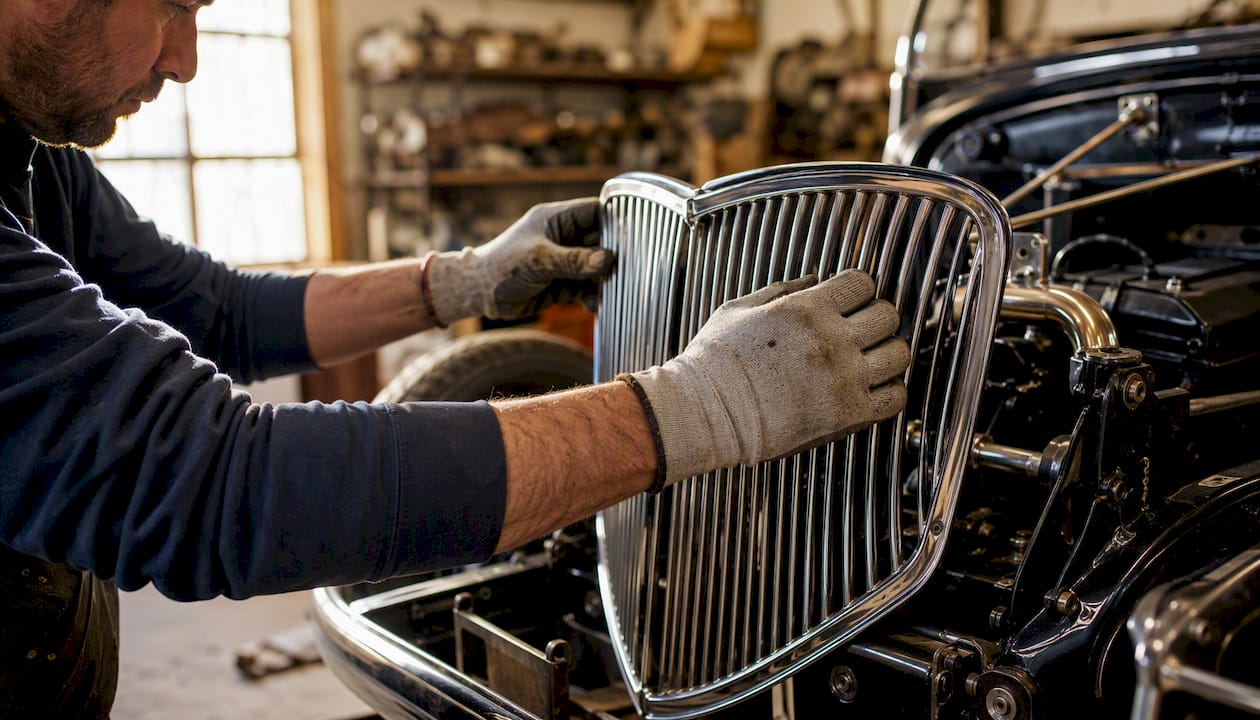
Pro Tip: Keep a dedicated folder, physical or digital, with your appraisal report, restoration receipts, bill of sale, and dated photos. Store a copy offsite or in cloud storage. This documentation speeds up any claim and limits the adjuster's room to dispute value.
Agreed value vs. stated value: a side-by-side look
The differences between these two coverage types come down to a handful of practical factors that matter most when you're standing in front of an adjuster.
| Feature | Agreed Value | Stated Value |
|---|---|---|
| Payout guarantee | Yes, pays the agreed amount (minus deductible) | No, pays the lesser of stated amount or ACV |
| How value is set | Mutual agreement between owner and insurer, backed by appraisal | Owner declares a value; insurer may apply ACV at claim time |
| Appraisal required | Usually yes, at policy inception and after major changes | Rarely required; owner self-declares |
| Premium cost | Higher, reflects the guaranteed payout and specialty underwriting | Lower, but payout exposure is greater |
| Best use case | Fully restored collectibles, appreciating classics, specialty vehicles | Budget-conscious owners, modified daily drivers, when agreed value is unavailable |
| Availability | Specialty and collector-focused insurers | Mainstream carriers and some specialty programs |
| Claim burden | Insurer obligated to pay agreed amount | Insured may need to prove higher value after a loss |
Best for a fully restored collectible: Agreed value, no question. The car's worth is documented and locked in. Best for a modified daily driver: Stated value can work if you attach a recent appraisal and understand the ACV exposure. Best for a standard collector car with no appraisal yet: Get the appraisal first, then pursue agreed value.
Questions to ask before you choose your coverage
Picking the right policy comes down to asking the right questions and knowing which answers are red flags.
Ask your agent or underwriter:
- Do you pay the agreed value, or the lesser of stated value and ACV?
- How often do I need to reappraise, and what triggers a required update?
- How are aftermarket modifications or restoration upgrades handled in the agreed value?
- Are there mileage limits or usage restrictions that could affect a claim?
- Does the policy cover spare parts, tools, or restoration-in-progress vehicles?
Red flags in policy wording:
- Any "lesser of" language in the payout section
- Vague appraisal requirements with no defined process or accepted appraiser list
- Language that shifts the burden of proof to the insured at claim time
- Exclusions for vehicles used in shows, parades, or occasional pleasure driving
Trust signals that indicate a solid collector program:
- Explicit "agreed value" or "guaranteed value" language in the declarations page
- A defined appraisal process with accepted appraiser credentials
- Coverage for spare parts, memorabilia, and restoration costs
- Diminished value options for partial losses
- A claims team with collector-car experience
If a stated value policy is your only option, you can tighten your exposure. Supply a recent professional appraisal and ask the insurer to attach it to the policy as supporting documentation. It won't convert the policy to agreed value, but it gives you a stronger starting point if you need to dispute an ACV calculation.
How the agreed value process works from appraisal to renewal
Getting an agreed value policy isn't complicated, but it does require a few deliberate steps.
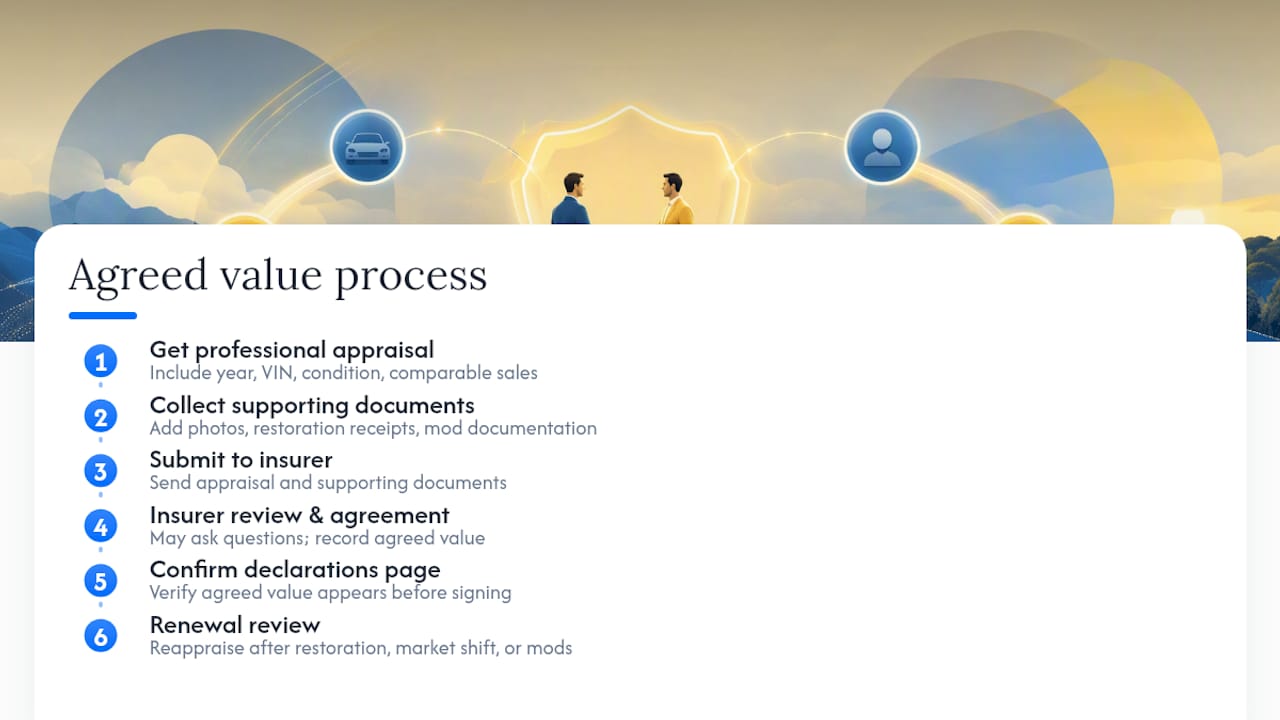
Start with a professional appraisal from a certified appraiser, ideally one who specializes in collector vehicles. A solid appraisal report includes the vehicle's year, make, model, VIN, current condition rating, comparable sales data, and a final appraised value. Photos are part of the report, and the more thorough, the better. For guidance on what appraisers look for, the classic car valuation methods guide at Butterclassics walks through the process in detail.
Once you have the appraisal, submit it to your insurer along with any restoration receipts and modification documentation. The insurer reviews the report, may ask follow-up questions, and then records the agreed value in your policy declarations. Confirm that number appears on the declarations page before you sign.
At renewal, review the agreed value against current market conditions. Specialty programs vary on whether they require a formal appraisal every renewal, but you should insist on a new appraisal after any significant restoration, a major market shift in your vehicle's category, or material modifications. Classic car markets can move quickly, and an agreed value set three years ago may underinsure a car that has appreciated.
Pro Tip: Store your appraisal report, photos, and all supporting documents in a cloud folder labeled with the vehicle's year, make, and model. Share access with a trusted family member. If a claim happens, you can pull everything up from your phone in minutes.
What a $60,000 total-loss claim looks like under each policy
Here's a concrete scenario. You own a fully restored classic, insured for $60,000. A fire totals the car. The adjuster determines the actual cash value is $45,000.
Under an agreed value policy, you receive $59,500 (the $60,000 agreed amount minus a $500 deductible). You have enough to replace the vehicle or fund a comparable restoration.
Under a stated value policy, the insurer pays the lesser of $60,000 or $45,000. You receive $44,500 after the deductible. That's a $15,000 gap you absorb out of pocket.
For context on how premiums vary, ValuePenguin's research on a 1969 Dodge Charger appraised at $73,000 found annual agreed-value premiums ranging from $492 to $1,425 depending on the insurer and coverage details. The premium difference between agreed value and stated value is real, but the payout gap in the scenario above can be significantly larger than any annual premium savings.
Statistic callout: For a 1969 Dodge Charger with an appraised value of $73,000, agreed-value annual premiums ranged from $492 to $1,425 across insurers — a spread that illustrates how much shopping around matters even within the specialty market. (Source: ValuePenguin)
Common myths about agreed and stated value coverage
A few persistent misconceptions send collectors toward the wrong policy.
- Myth: "Stated value means the insurer pays my stated amount." Reality: Most stated value policies pay the lesser of your stated amount or ACV. The stated figure is a cap, not a guarantee.
- Myth: "Agreed value and guaranteed value are different products." Reality: These terms are often used interchangeably in marketing copy. What matters is the actual policy language, not the label on the brochure.
- Myth: "A higher stated value always means a higher payout." Reality: If the insurer's ACV calculation comes in lower, your stated value is irrelevant. The ACV wins.
- Myth: "Mainstream carriers offer the same collector protection as specialty insurers." Reality: Many mainstream carriers offer stated value programs that still use "lesser of" language. Specialty and collector-focused programs are more likely to offer true agreed value coverage with documented appraisal processes.
- Myth: "I don't need an appraisal if I know what my car is worth." Reality: Without a documented appraisal, you have no leverage in a payout dispute. Your opinion of value and the adjuster's ACV calculation are not equal at claim time.
Depreciation-related language is where stated value policies hide their biggest exposure. Phrases like "market value at time of loss" or "current replacement cost" often signal an ACV calculation is coming, even when the word "depreciation" never appears.
My honest recommendation for collector owners
Agreed value is the right call for any vehicle you'd be financially hurt to lose at ACV. That covers fully restored classics, appreciating muscle cars, low-production specialty vehicles, and anything you've put significant restoration money into. The $15,000 gap illustrated in the scenario above is a conservative example. For a six-figure collectible, the exposure under stated value can be far larger.
Stated value is acceptable only when agreed value genuinely isn't available and you take steps to tighten the exposure: get a professional appraisal, attach it to the policy, and document every modification and restoration dollar spent. Even then, treat it as a temporary solution while you find a specialty carrier that offers true agreed value.
Here's what to do right now:
- Get a certified appraisal if you don't already have one
- Pull out your current policy and find the exact payout language
- Confirm the agreed value (or stated amount) appears on your declarations page
- Set a calendar reminder to review the agreed value at each renewal
- After any major restoration or market shift, schedule a new appraisal before renewal
For collectors actively shopping for their next vehicle, understanding how classic car insurance value works before you buy protects you from day one.
Ready to find a classic worth protecting? Browse the Butterclassics inventory to explore fully documented collector vehicles across every category, from muscle cars to vintage trucks.
Sources
These resources cover the core distinction from different angles. Start with The Zebra and Traction for the clearest side-by-side explanations of policy language, then go to ValuePenguin for premium range examples.
On policy wording: The Zebra's explainer on agreed value vs. stated value is one of the clearest consumer-facing breakdowns of how "lesser of" language works in practice and why it matters for collector owners.
- Agreed Value vs. Stated Value Insurance | The Zebra
- Agreed Value Car Insurance vs Stated Value Insurance - ValuePenguin
- Classic Car Insurance Coverage Options Explained - State Farm®
- Agreed value insurance - Progressive
- Stated Value vs. Agreed Value - Traction
This article is general information, not a substitute for advice from a qualified financial advisor. Consult a qualified financial professional about your own circumstances before acting on anything here.