
Depreciation in classic cars is defined as the change in a vehicle's market value over time, driven by collector demand, rarity, condition, and economic forces rather than simple age. Unlike a new sedan that loses value the moment it leaves the lot, a classic car can appreciate, depreciate, or hold flat depending on who wants it and why. Understanding what depreciation means for classic cars is the first step toward making smarter buying, selling, and insurance decisions. The Hagerty Market Rating and inflation-adjusted auction data both show that value trajectories in the collector market split sharply by vehicle tier, making this knowledge genuinely useful for anyone considering a vintage vehicle as an investment or a passion purchase.
What does depreciation mean for classic cars vs. modern vehicles?
Classic cars do not follow a standard depreciation curve the way modern vehicles do. A new car typically loses a significant portion of its value within the first few years of ownership. A 1969 Chevrolet Camaro Z/28 or a numbers-matching 1970 Plymouth 'Cuda, by contrast, can climb in value for decades.
The industry term for this phenomenon is collector car valuation, and it replaces the straightforward accounting concept of depreciation with something far more dynamic. Several forces drive this difference:
- Rarity. Limited production numbers shrink supply while demand from collectors grows. Scarcity pushes prices up rather than down.
- Originality. A car with its factory engine, paint code, and trim intact commands a premium over a modified or heavily restored example.
- Provenance. Documented ownership history, factory build sheets, and competition records add measurable value.
- Collector emotional value. Nostalgia and cultural significance create demand that has nothing to do with utility or depreciation schedules.
- Condition. A concours-quality restoration holds value differently than a driver-grade car, and the market prices each accordingly.
Both appreciation and depreciation scenarios exist in the classic car world. A barn-find muscle car with matching numbers can double in value after a careful, documented restoration. An over-restored car with incorrect parts, on the other hand, often struggles to hold value despite the money poured into it.
Pro Tip: Before buying a classic, request the build sheet, window sticker, or any factory documentation. Originality is the single biggest driver of long-term value retention.
How do 2026 market trends affect classic car value?
The collector car market in 2026 is not moving in one direction. It is moving in two, and which direction applies to your car depends almost entirely on where it sits in the market hierarchy.
High-end blue-chip classics remain stable or appreciate, while mainstream collector vehicles experience softening and struggle to outpace inflation. The gap between the Hagerty Blue Chip Index and the broader Hagerty Hundred widened to 27.22 points as of june 2026. That spread tells you everything about where the money is flowing.
"In june 2026, the auction median sale price hit an all-time inflation-adjusted low of 13.81. The collector car market's top tier is holding firm, but the broad middle is quietly losing ground in real terms." Hagerty Media, 2026
The table below shows how the two market tiers are behaving differently right now.
| Market Tier | Price Trend | Inflation-Adjusted Reality |
|---|---|---|
| Blue-chip classics (Ferrari, Porsche 911 RS, top muscle) | Stable to appreciating | Holding real value |
| Mainstream classics (popular American iron, common imports) | Nominally flat or soft | Losing real value |
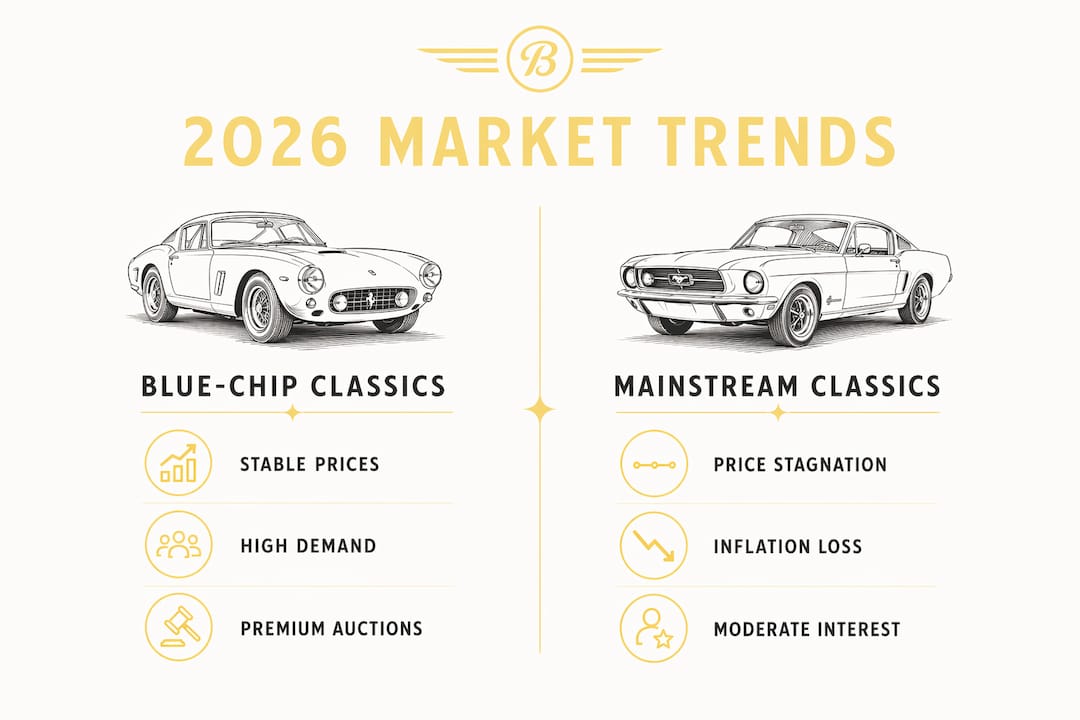
Inflation-adjusted prices of mainstream classics have stalled or declined since 2021, even when nominal prices appear stable. That means a car listed at the same dollar figure as three years ago is actually worth less in purchasing power terms. This is a form of depreciation that many collectors miss because they focus on the sticker price rather than the real value.
The K-shaped collector market describes this split precisely. Wealthy buyers sustain high-end values despite broader economic uncertainty, while mass-market classics face value decline due to tighter buyer budgets. If you own a well-documented, low-production blue-chip car, the market is your friend. If you own a popular but common model, you need to watch inflation-adjusted data closely.
How does insurance affect the depreciation experience?
Insurance is where many classic car owners discover the real cost of ignoring depreciation. Standard auto policies pay actual cash value (ACV) at the time of a total loss. ACV applies depreciation to the vehicle's value, which means you may receive far less than you paid or what the car is worth to collectors.
Agreed value coverage solves this problem directly. An agreed value policy pays a fixed, pre-negotiated amount at total loss, with no depreciation deduction applied. You and the insurer agree on the car's value upfront, and that number is what you collect if the worst happens.
Here is what to prioritize when insuring a classic:
- Get a formal appraisal. A certified appraisal from a recognized classic car appraiser gives you the documentation needed to set an agreed value.
- Choose agreed value over ACV. Without a formal appraisal, owners face significant depreciation losses on total loss claims despite what they believe the car is worth.
- Update your policy regularly. Classic car values shift with the market. Review your agreed value every one to two years to stay current.
- Keep records with your policy. Photos, receipts, and restoration documentation support your valuation and speed up any claims process.
Pro Tip: Pair your agreed value policy with a dedicated classic car insurance guide to understand exactly what your coverage does and does not protect against depreciation losses.
What steps protect your classic car's investment value?
Managing classic car depreciation is an active process, not a passive one. The choices you make about maintenance, storage, documentation, and model selection all shape your car's value trajectory over time.
-
Preserve originality above all else. Maintaining a classic's originality, documentation, and selective restoration is the most reliable way to avoid depreciation traps. Swapping a numbers-matching engine for a performance upgrade may make the car faster, but it will almost certainly make it worth less to serious collectors.
-
Choose models with proven market demand. Not every old car is a collectible. Research the Hagerty Price Guide and auction results for any model before you buy. Strong historical desirability and limited production numbers are the two clearest signals of long-term value stability.
-
Store the car properly. Climate-controlled storage prevents rust, paint fade, and rubber deterioration. Each of these issues directly reduces condition grade, and condition grade directly affects price. A car stored poorly for five years can lose more value than the market would have taken in the same period.
-
Document everything. Service records, restoration receipts, and ownership history all add to provenance. Buyers pay more for cars they can verify. A thick folder of documentation is worth real money at auction or in a private sale.
-
Account for total ownership costs. Collectible cars are costly to own. Maintenance, storage, insurance, and parts can offset gains from appreciation. Calculate net value, not just market price, when evaluating your investment.
-
Use market data tools. The Hagerty Price Guide and inflation-adjusted auction data give you a realistic picture of where your car sits. Check what makes a car investment worthy before committing capital to any specific model.
The collectors who protect their investment best treat their classic like a business asset and a passion project at the same time. They love the car and they track the numbers.
Key Takeaways
Classic car depreciation is not a single force moving in one direction. It is a market-driven, condition-sensitive, and inflation-influenced dynamic that rewards informed owners and punishes those who assume any old car will automatically gain value.
| Point | Details |
|---|---|
| Classic cars defy standard depreciation | Value depends on rarity, originality, and demand, not just age or mileage. |
| The market is K-shaped in 2026 | Blue-chip cars hold value; mainstream classics are losing ground in real terms. |
| Agreed value insurance is non-negotiable | ACV policies apply depreciation at total loss, costing owners thousands. |
| Originality drives value retention | Over-restored or undocumented cars consistently underperform at auction. |
| Ownership costs affect net returns | Storage, maintenance, and insurance can erase headline appreciation gains. |
The uncomfortable truth about classic car depreciation
I have watched collectors walk into the market with the best intentions and walk out having lost money they did not expect to lose. The cars were beautiful. The logic seemed sound. But the math did not work because they treated "classic car" as a single category rather than a spectrum.
The K-shaped market reality is the most important thing I can tell you right now. Wealthy buyers are keeping the top end alive. But if you are buying a popular, high-production American muscle car or a common import with no special provenance, you are competing in a market where inflation is quietly eating your real returns. That is depreciation, even if the price tag looks the same as it did three years ago.
My honest advice is this: buy the car you love, but buy it with your eyes open. Know the inflation-adjusted data. Know your insurance coverage. Know what originality means for that specific model. Classic car ownership as an investment carries real risk, and demographic shifts mean the pool of buyers for certain models is not growing. Passion is a legitimate reason to own a classic. Just do not let passion substitute for due diligence.
— Tony
Butterclassics: find classics worth owning
Understanding depreciation is one thing. Finding a car that holds its value is another challenge entirely.
At Butterclassics, we specialize in exactly that. Our certified classic inventory features vehicles that have been carefully evaluated for condition, originality, and documentation. Every listing includes the details you need to make a confident, informed decision. Whether you are looking for a blue-chip investment or a driver-grade classic you can enjoy every weekend, the Butterclassics team is here to help you find the right fit. Browse our full classic car inventory and see what is available right now. We make the process smooth as butter, from first look to final paperwork.
FAQ
What does depreciation mean for a classic car?
Depreciation in a classic car refers to any loss in market value over time, though many classics appreciate rather than depreciate based on rarity, condition, and collector demand. Unlike modern vehicles, classic car value is not tied to a predictable decline curve.
Do all classic cars appreciate in value?
No. Mainstream classics are losing real value when adjusted for inflation, even if nominal prices appear stable. Only blue-chip, low-production, or highly documented vehicles consistently hold or grow their value.
How does insurance relate to classic car depreciation?
Standard auto insurance applies depreciation at total loss, reducing your payout below the car's collector value. An agreed value policy locks in a fixed payout with no depreciation deduction, making it the right choice for classic car owners.
What is the biggest factor in classic car value retention?
Originality is the single most important factor. Cars with matching numbers, factory documentation, and unmodified drivetrains consistently outperform over-restored or modified examples at auction and in private sales.
How can I track my classic car's real value?
Use the Hagerty Price Guide alongside inflation-adjusted auction data to monitor real value trends. Also review what qualifies as an emerging collectible to spot models gaining collector interest before prices peak.