
Mileage is defined as the primary numeric indicator of use, wear exposure, and risk in classic car valuation, but its true importance only emerges when read alongside maintenance history, provenance, and driving conditions. Understanding why mileage matters for classic cars goes well beyond reading an odometer. A 1967 Ford Mustang with 28,000 documented miles and full service records tells a completely different story than one with the same number and zero paperwork. Classic car insurers like Hagerty and Heritage Insurance price policies around mileage because it directly correlates with exposure to accidents, wear, and theft. Investors and enthusiasts who treat mileage as an isolated number routinely overpay for neglected low-mileage cars or undervalue well-maintained high-mileage ones.
Why mileage matters for classic cars: value, condition, and provenance
Mileage signals use, but condition and documented history determine price. This distinction separates informed collectors from buyers who chase low numbers without context. Very low mileage commands a premium only when the mileage is provably genuine and the car has been properly maintained despite limited use. That means receipts, inspection certificates, dated photographs, and a continuous service record that matches the odometer reading.
The classic car market rewards defensible provenance above all else. Low mileage without documentation can actually underperform at auction compared to higher-mileage cars with strong, verifiable histories. A 1969 Chevrolet Camaro Z/28 with 62,000 miles and a complete dealer service file will consistently outbid a comparable car showing 31,000 miles with no paperwork to support the claim. The market has learned to price skepticism into undocumented numbers.
Collector preference patterns reflect this reality. Serious investors prioritize:
- Authenticated mileage backed by physical evidence such as service stamps, receipts, and MOT or state inspection records
- Maintenance continuity showing the car received regular care regardless of how often it was driven
- Restoration documentation that accounts for any mechanical work, parts replacement, or cosmetic upgrades
- Photographic history that places the car in context over time and confirms its condition at various mileage milestones
High-mileage cars with strong provenance regularly outvalue low-mileage cars with weak documentation. Verified mileage combined with restoration quality and maintenance records is more predictive of future reliability and value than the odometer reading alone. That is the core insight every serious buyer needs before making an offer.
Pro Tip: Before purchasing any classic car, request a full documentation package. If the seller cannot produce at least three independent records confirming mileage at different points in the car's life, treat the odometer reading as unverified.

How classic car insurance uses mileage as a risk indicator
Classic car insurance is structured differently from standard auto coverage, and mileage is the central variable that separates the two. Classic policies typically assume lower annual mileage than standard vehicles, commonly around 5,000 miles per year, because limited use reduces exposure to accidents, theft, and mechanical failure. This lower exposure is what allows insurers to offer agreed-value coverage at competitive premiums.

The logic is straightforward. A car driven 5,000 miles annually spends far less time on public roads than a daily driver logging 15,000 miles. Less road time means fewer opportunities for collision, vandalism, and weather-related damage. Owners driving their classics mainly for weekend events incur measurably less risk than daily drivers, and insurers price that difference directly into the premium structure.
Here is what you need to know about mileage and classic car insurance:
- Declare your mileage accurately. Underestimating annual mileage to reduce premiums is a coverage risk, not a savings strategy.
- Understand your policy's mileage cap. Most classic policies specify a maximum annual mileage, and exceeding it without notifying your insurer can affect your coverage.
- Notify your insurer before exceeding limits. If a road trip, rally, or driving season pushes you toward your cap, contact your insurer in advance to adjust your policy terms.
- Review your policy annually. Driving habits change, and your declared mileage should reflect your actual usage each policy year.
Surpassing declared mileage limits on classic policies can jeopardize insurance claims and result in premium reassessments. This is not a technicality. Claim refusals on agreed-value policies can leave you holding a total loss with no payout. Understanding how mileage shapes insurance value is as important as understanding how it shapes market value.
Does low or high mileage actually preserve a classic car better?
Neither extreme is ideal, and this is where the classic car mileage impact conversation gets genuinely interesting. The instinct to minimize mileage and store a car indefinitely is understandable, but it is often the wrong call for long-term preservation.
Regular moderate driving keeps seals lubricated, circulates fluids through the engine and transmission, and prevents the fuel system buildup that develops when gasoline sits stagnant. Experts recommend driving a classic at least once every two weeks to maintain mechanical health. A car that moves regularly is a car that stays alive.
The opposite is equally true. Extended inactivity causes dry seals, fluid stagnation, battery discharge, fuel degradation, and corrosion. These problems can develop within months of storage without regular use. A 1957 Chevrolet Bel Air sitting in a climate-controlled garage for three years without being started will likely need more mechanical attention than one driven 1,500 miles annually with consistent oil changes.
| Scenario | Effect on preservation |
|---|---|
| Regular moderate driving (every 1 to 2 weeks) | Seals stay lubricated, fluids circulate, fuel system stays clean |
| Extended storage without use | Dry seals, stagnant fluids, battery failure, corrosion risk |
| Harsh-condition driving (salt roads, extreme heat) | Accelerated wear regardless of total mileage |
| Climate-controlled storage with monthly starts | Better than full inactivity, but not a substitute for actual driving |
Driving conditions matter as much as distance. A car driven 3,000 miles on dry California highways ages differently than one driven 3,000 miles through Midwest winters on salted roads. Mileage and classic car condition are inseparable from the environment in which those miles were accumulated.
Pro Tip: If you store your classic for winter, do not just start it in the driveway. Take it for a 15-minute drive at operating temperature to fully circulate fluids and burn off moisture in the exhaust system.
How to verify mileage authenticity when evaluating a classic car
Odometer tampering is a documented risk in the classic car market, and buyers who skip verification pay for it. The good news is that documented provenance including service records and inspection certificates significantly strengthens appraisal value and gives you the tools to cross-check any mileage claim.
A credible mileage verification process covers these areas:
- Service records that show dated oil changes, tune-ups, and repairs with mileage logged at each visit
- State inspection or MOT certificates that record mileage at the time of each annual inspection, creating a year-by-year mileage timeline
- Restoration receipts from body shops, upholstery specialists, or mechanical rebuilders that note mileage at the time of work
- Dated photographs showing the odometer reading at various points in the car's history
- Title history and any available vehicle history reports that flag ownership transfers and recorded mileage at each transaction
"Appraisers prioritize maintenance and restoration history combined with mileage authenticity. A car with a coherent, documented story commands more confidence and more money than one with a suspiciously clean odometer and no paper trail." — Classic Car Pre-Appraisal Checklist, Southwest Auto Appraisal
Anomalies to watch for include odometer readings that decrease between documented dates, service records with mileage gaps that do not match the car's stated history, and wear patterns on pedals, steering wheels, and seat bolsters that contradict a claimed low-mileage figure. Physical wear tells its own story, and experienced appraisers read it fluently.
Practical mileage considerations for classic car investors in 2026
Putting all of this together into a working strategy is where the importance of mileage in classic cars becomes genuinely practical. Whether you are buying, driving, storing, or preparing a car for resale, mileage decisions have real financial consequences.
Here is how to approach mileage management as an investor or enthusiast:
- Set your annual mileage budget before you buy. Know how much you plan to drive the car each year and confirm that your insurance policy supports that usage level before the first drive.
- Drive deliberately, not sparingly. Regular use in good conditions preserves mechanical health better than minimal use. Aim for consistent short drives rather than occasional long ones.
- Document every mile you add. Keep a simple log of dates, mileage, and driving conditions. This record becomes part of the car's provenance and supports future resale value.
- Align restoration decisions with mileage reality. If you are restoring a car to show condition, the mileage added during test drives and transport should be documented and disclosed to future buyers.
- Anticipate buyer scrutiny at resale. Serious collectors will ask for documentation. A car with a clean mileage record and consistent maintenance history sells faster and at a stronger price than one without.
The impact of mileage on vintage cars is not static. Market expectations shift, and buyers in 2026 are more documentation-savvy than ever. Treating mileage management as an ongoing practice rather than a one-time consideration is the mark of a serious collector.
Key takeaways
Mileage matters for classic cars because it signals use and risk, but verified maintenance history and documented provenance determine whether that mileage adds or subtracts from value.
| Point | Details |
|---|---|
| Mileage without proof has limited value | Low mileage only commands a premium when supported by service records, receipts, and inspection certificates. |
| Insurance mileage caps are a real constraint | Classic policies commonly cap annual mileage around 5,000 miles; exceeding limits without notice can void claims. |
| Regular driving beats long-term storage | Driving every one to two weeks keeps seals lubricated and fluids circulating, preventing deterioration from inactivity. |
| Verified provenance outperforms raw numbers | A high-mileage car with strong documentation regularly outvalues a low-mileage car with no paper trail at auction. |
| Mileage management is an ongoing practice | Logging every mile driven and aligning usage with insurance terms protects both mechanical health and resale value. |
My honest take on mileage as a classic car metric
I have seen buyers walk away from genuinely exceptional cars because the odometer read higher than they expected. I have also watched those same buyers overpay for low-mileage cars that turned into money pits because nobody checked whether the engine had ever been properly serviced. Mileage is a useful signal, but it is never the whole story.
The collectors who build the strongest portfolios treat mileage as one data point in a larger picture. They ask for documentation before they ask for a price. They drive their cars on a schedule that keeps the mechanicals healthy rather than chasing a low number for its own sake. And they review their insurance policies every year to make sure their declared mileage still reflects how they actually use the car.
The uncomfortable truth is that a well-documented 80,000-mile car is often a better investment than a mysterious 12,000-mile car. Provenance is the real currency in this market. Mileage just gets you in the door.
— Tony
Find your next classic with verified mileage and full provenance
At Butterclassics, every vehicle in our inventory comes with the documentation that actually matters to serious buyers. We are talking service records, inspection history, and mileage authenticity you can verify before you make a move.
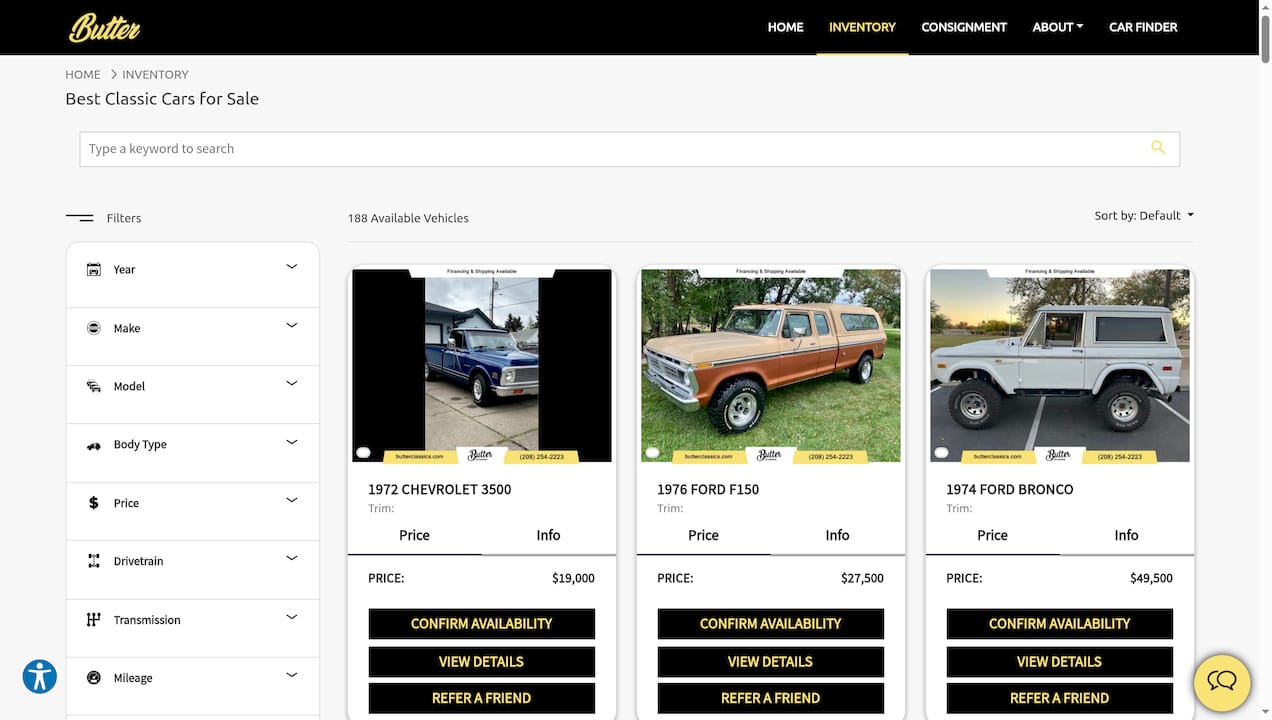
If you are ready to find a classic that is smooth as butter from the paperwork to the drive, browse our certified classic inventory or explore the full Butterclassics lineup to find investment-grade vehicles with the provenance to back up every mile on the clock. Our team is here to help you find the right car at the right price, with zero guesswork on the history.
FAQ
Does mileage affect classic car value?
Mileage affects classic car value, but only in context. Low mileage commands a premium when supported by authentic documentation; without proof, it adds little to the price and may raise red flags.
Should I worry about mileage in classics?
You should worry less about the number and more about what supports it. Verified mileage combined with maintenance records is far more predictive of value and reliability than the odometer reading alone.
What mileage limit do classic car insurance policies use?
Most classic car policies assume annual mileage of around 5,000 miles per year. Exceeding your declared limit without notifying your insurer can result in claim refusals or premium increases.
Is it bad to drive a classic car regularly?
Regular moderate driving is actually good for a classic car. Driving at least every two weeks keeps seals lubricated and fluids circulating, preventing the deterioration that comes from extended inactivity.
How do I verify mileage on a classic car?
Cross-reference service records, dated inspection certificates, restoration receipts, and title history to build a mileage timeline. Service records and inspection certificates that log mileage at each visit are the most reliable independent verification tools available.