The collector car market in 2026 is softer than it's been in years, and that creates both opportunity and real risk for anyone buying investment grade classic cars right now. Prices are negotiable. Selection is wide. But the gap between a true investment-grade vehicle and an expensive mistake has never been narrower. This guide walks you through exactly what you need before you buy, how to execute the purchase, what ownership actually costs, and how to protect your investment for the long haul.
Table of Contents
- Essential prerequisites for buying investment grade classic cars
- Step-by-step buying process for investment grade classics
- Evaluating and estimating ongoing ownership costs
- Common pitfalls and expert verification to avoid costly mistakes
- Expected investment results and portfolio strategy
- Why patience and provenance trump hype in today's classic car market
- Explore Butter Classics for your investment-grade classic car needs
- Frequently asked questions
Key Takeaways
| Point | Details |
|---|---|
| Market softness 2026 | The collector car market is cooling with fewer sales above insured values, requiring diligent negotiation. |
| Pre-purchase essentials | Comprehensive documentation and professional inspections are critical before buying investment-grade classics. |
| Ownership costs | Annual upkeep including storage, maintenance, and insurance can cost over 8% of car value. |
| Verification protects value | Authenticity checks and provenance dossiers prevent costly investment mistakes and preserve value. |
| Portfolio strategy | Allocate 2-5% of your portfolio across diversified classics and maintain patience for best investment outcomes. |
Essential prerequisites for buying investment grade classic cars
Before you make an offer on anything, get your paperwork and your team in order. Skipping this step is how collectors end up with beautiful cars that are worth 20% less than they paid.
Here's what you need to gather before any serious negotiation:
- Title and ownership history going back as far as possible
- Service records showing regular mechanical upkeep
- Restoration receipts with dates, parts sourced, and labor documented
- VIN verification photos confirming the number matches the dashboard, door jamb, and engine block
- A professional pre-purchase inspection (PPI) from a marque specialist
That last point matters more than most buyers realize. A pre-purchase inspection typically costs $500 to $2,000 and takes one to three days. For a $150,000 car, that's a rounding error. For the peace of mind it buys you, it's one of the best investments in the entire process.
Understanding auction fees vs. private sale dynamics
If you're buying at auction, build in 10 to 12% on top of the hammer price for buyer's premiums. Private sales offer more room to negotiate, especially right now. The market is cooling, and sellers know it.
| Buying channel | Typical buyer cost | Negotiation room |
|---|---|---|
| Major auction house | Hammer price + 10-12% | Low |
| Regional auction | Hammer price + 8-10% | Moderate |
| Private sale | Listed price | High (15-25% in 2026) |
| Dealer | Listed price | Moderate |
One more thing: investment-grade classic cars require agreed-value insurance policies, not standard collector car coverage. Agreed-value means the insurer pays the full insured amount if the car is totaled, with no depreciation applied. Most policies also come with annual mileage limits, typically 2,500 to 5,000 miles. Exceeding those limits can void your coverage entirely.
Pro Tip: Get your insurance quote before you close the deal. Some cars in certain storage situations are harder to insure than you'd expect, and finding that out after you've wired the money is not a fun conversation.
Step-by-step buying process for investment grade classics
With preparation complete, let's walk through the concrete steps to buy your investment-grade classic.
-
Research the market thoroughly. Use the Hagerty Price Guide as your baseline. Focus on the #2 (Excellent) condition rating as your benchmark. Private sale prices are currently running 15 to 25% below those benchmarks due to market softness, so don't anchor to asking prices.
-
Confirm the condition category honestly. Concours (#1) cars are rare and expensive to maintain at that level. Excellent (#2) cars offer the best balance of value and appreciation potential. Good (#3) cars can work if priced accordingly, but they require more capital to bring up.
-
Budget a 15 to 25% contingency beyond the purchase price. Transport, initial servicing, storage setup, and the PPI itself all add up fast.
-
Negotiate from data, not emotion. Come in with comparable sales, condition notes from your PPI, and a clear walk-away number. The market is on your side right now.
-
Close with all documents in hand. Title transfer, bill of sale, odometer disclosure, and any warranty or representation letters from the seller should all be signed before funds move.
-
Schedule agreed-value insurance before the car leaves the seller's possession. Coverage should be active the moment you take ownership.
Here's what strong research looks like in practice. Say you're eyeing a 1969 Camaro Z/28 listed at $95,000. The Hagerty #2 value might sit around $88,000. Your PPI turns up minor carburetor wear and a small stress crack in the frame rail. That's leverage. A well-documented negotiation gets you to $78,000 with the seller agreeing to address the carburetor before delivery.
Pro Tip: Always request the last three years of comparable auction results for the specific model and configuration you're buying. Sellers who resist sharing this data are often aware their asking price isn't supported by the market.
Bookmark a solid classic car buying guide so you have a reference point throughout the process.
Evaluating and estimating ongoing ownership costs
Having secured your car, understanding the ongoing costs ensures your investment stays profitable and enjoyable.
Most buyers focus entirely on the purchase price and underestimate what it costs to hold a classic car properly. Here's a realistic annual cost breakdown for a vehicle in the $100,000 to $200,000 range:
| Expense category | Annual cost estimate |
|---|---|
| Climate-controlled storage | $2,400 to $4,800 |
| Mechanical maintenance | $2,500 to $5,000 |
| Agreed-value insurance | $1,800 to $3,000 |
| Consumables (tires, fluids, belts) | $600 to $1,200 |
| Total | $8,300 to $14,000 |
Those annual holding costs are real, and they compound. At a 3.5% annual inflation rate on parts and specialized labor, your maintenance budget needs to grow every year whether you drive the car or not.
Climate-controlled storage is non-negotiable for serious collectors. Humidity above 50% accelerates rust in hidden seams and floor pans. Mold can destroy interior materials in a single season. A car stored improperly for two years can lose 10 to 15% of its value in ways that are expensive and sometimes impossible to fully reverse.
"The cars that hold value best are the ones that were never neglected. Consistent preventive maintenance isn't just good stewardship. It's the single most controllable factor in long-term appreciation."
Be especially careful about insurance policy conditions. If your agreed-value policy requires enclosed storage and you keep the car in an open carport, a claim can be denied entirely. Read the fine print before you sign.
Pro Tip: Track every maintenance expense in a dedicated log with receipts. This documentation becomes part of the car's provenance and directly supports its value at resale. Buyers pay more for cars with complete classic car ownership costs records.
Common pitfalls and expert verification to avoid costly mistakes
Before finalizing your purchase, verify the car thoroughly to avoid investment traps and costly surprises.
Numbers matching is the single biggest value driver in the muscle car and sports car segments. A numbers-matching engine verified by physical stamps can add 20 to 50% to a car's value compared to a replacement unit. That's not a small difference on a six-figure car.
Here's what to check during physical verification:
- Engine block stamp: Should match the VIN and build date. Look for machined surfaces, which can indicate a stamp has been altered.
- Transmission date code: Should predate the car's assembly date by no more than a few weeks.
- VIN plate rivets: Original rivets are uniform in size and finish. Replaced rivets often show size inconsistencies or disturbed paint around the plate.
- Frame and firewall stampings: Many manufacturers stamped partial VINs in multiple locations. All should match.
- Trim tags and broadcast sheets: These factory documents confirm original options and colors. Their presence significantly strengthens provenance.
Incomplete documentation is a real financial risk. Missing service records, absent restoration receipts, or an unclear ownership chain can reduce a car's market value by 10 to 30% compared to an identical, fully documented example. Buyers at the top of the market simply won't pay full price for a car they can't fully verify.
Pro Tip: Ask the seller for a provenance dossier before you arrange a PPI. If they can't produce one or seem unfamiliar with the concept, that tells you something important about how the car has been managed.
Check out these classic car inspection tips to go into any viewing fully prepared.
Expected investment results and portfolio strategy
Finally, understand what to expect from classic cars as an investment and how to strategically include them in your portfolio.
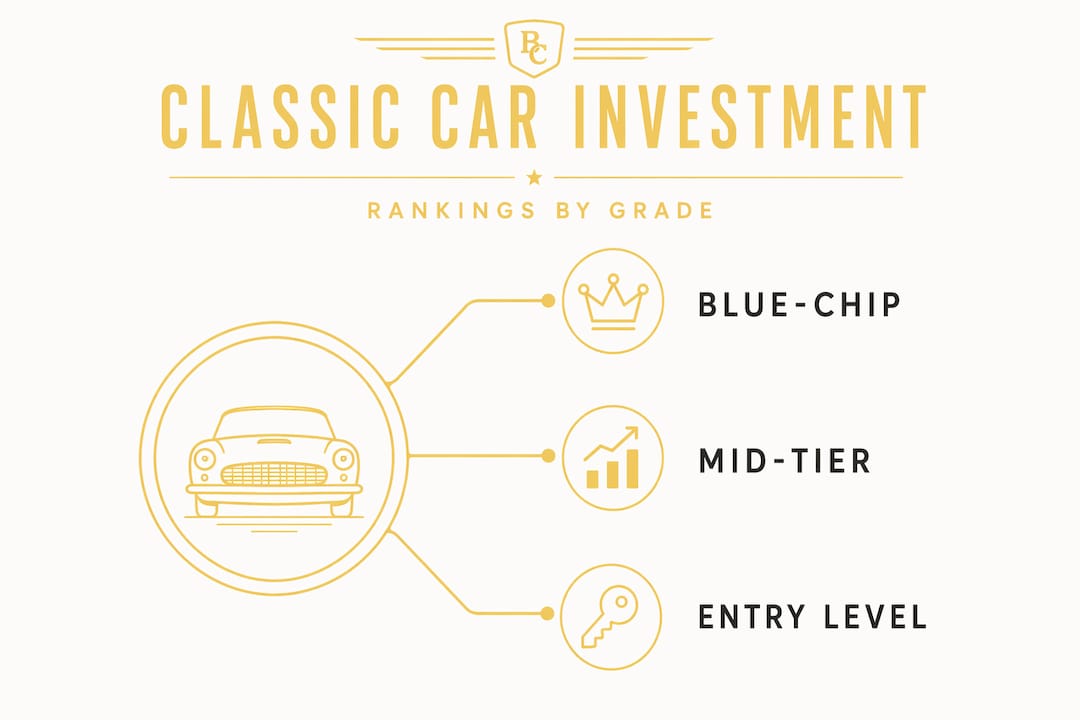
Blue-chip investment-grade classics, think first-generation Ford GT40s, early Ferrari 250 variants, and original Shelby Cobras, have historically appreciated at 5 to 8% annually over long hold periods. The broader collector car market is softer right now, but the top tier holds up because scarcity and cultural significance don't evaporate with economic cycles.
| Asset class | Avg. annual return | Liquidity | Holding cost | Enjoyment factor |
|---|---|---|---|---|
| Blue-chip classic cars | 5 to 8% | Low | High | Very high |
| S&P 500 index | 7 to 10% | Very high | Minimal | None |
| Investment-grade bonds | 3 to 5% | High | Minimal | None |
| Real estate | 4 to 6% | Low | Moderate | Variable |
The numbers make a clear case for classic cars as a diversifier, not a replacement for traditional assets. Portfolio allocation experts recommend keeping 2 to 5% of your total portfolio in three to five diversified investment-grade cars. Going beyond 20 to 30% concentration in any single alternative asset class introduces risk that most collectors underestimate.
Diversification within the classic car segment matters too. Owning one $500,000 Ferrari is a very different risk profile than owning five $100,000 cars across different eras and marques. The latter gives you more liquidity options and reduces your exposure to any single model's market cycle.
"Patience is the most underrated skill in classic car investing. The collectors who consistently win buy right, maintain well, and hold long."
Use a classic car investment strategy that accounts for both the financial and personal enjoyment dimensions of ownership.
Why patience and provenance trump hype in today's classic car market
Here's a perspective you won't hear from everyone: the current market softness is actually good news for serious collectors, if you know how to use it.
The buyers who get hurt in a cooling market are the ones who chased auction fever at the top of the cycle and bought cars with thin provenance because the model was hot. Right now, those same cars are sitting at 15 to 20% below their 2022 peaks, and the sellers are motivated.
The cars that are holding value best despite the broader slowdown share two traits: documented scarcity and cultural significance. A numbers-matching 1970 Plymouth Hemi 'Cuda convertible doesn't get cheaper just because the overall market is quiet. There are fewer than 20 known examples. Scarcity is its own floor.
What we've seen over and over is that rarity alone isn't enough. The car also needs to be drivable and in genuinely excellent condition. Barn finds with romantic backstories but deferred maintenance don't command the premiums they once did. Buyers at the top of the market are more sophisticated now. They want classic car market insights, full documentation, and a car they can actually enjoy.
Treat your garage like a portfolio. That means active management, not just acquisition. Monitor holding costs annually. Reassess each car's market position every two to three years. Know your exit before you buy. The collectors who do this consistently outperform the ones who buy on passion alone.
Explore Butter Classics for your investment-grade classic car needs
If you're ready to move from research to action, we're here to make that next step smooth as butter. At Butter Classics, we've built our investment-grade classic car inventory around exactly what serious collectors need: verified provenance, honest condition grading, and vehicles that are as strong on paper as they are in person.
Our team works with high net worth collectors to align acquisitions with both investment goals and genuine driving enjoyment. We know the current market inside and out, and we'll help you negotiate effectively and avoid the pitfalls that trip up even experienced buyers. From pre-purchase inspection coordination to ownership cost advisory, we've got you covered. Browse our inventory, get a quote, or reach out to talk through your strategy. You can also review our Butter Classics terms of use to understand exactly how we work with our clients.
Frequently asked questions
What documents do I need before buying an investment-grade classic car?
You should gather the car's title, service and restoration records, VIN verification photos, and full ownership history. A pre-purchase inspection is also essential before any offer is finalized.
How much should I expect to spend annually on maintaining a classic car?
Annual holding costs for classics valued at $100,000 or more typically run $8,300 to $14,000, covering climate-controlled storage, maintenance, and agreed-value insurance.
What pricing benchmarks should I use when negotiating a classic car purchase?
Start with the Hagerty Price Guide #2 (Excellent) value as your baseline, then expect to negotiate 15 to 25% lower in private sales given current market conditions.
How should I allocate classic cars in my investment portfolio?
Experts recommend 2 to 5% portfolio allocation spread across three to five diversified investment-grade classics to manage concentration risk effectively.
Why is provenance so important when buying investment-grade classic cars?
Strong provenance backed by date-stamped restoration records and third-party appraisals can protect or increase value by 10 to 30% compared to cars with incomplete documentation.