
Turning a classic car into cash is rarely as simple as posting it online and waiting for offers. Unlike stocks or real estate, liquidity in classic cars depends on a web of factors: market timing, provenance, carrying costs, and how you've structured your ownership. Whether you're holding a '69 Camaro as a passion investment or managing a multi-vehicle collection, understanding the full classic car liquidity considerations list before you buy or sell can mean the difference between a profitable exit and a costly wait. Here's what you actually need to know.
Table of Contents
- Key takeaways
- 1. The classic car liquidity considerations list starts with market dynamics
- 2. Carrying costs and their impact on net liquidity
- 3. Financing and lending options as liquidity enhancers
- 4. Provenance and documentation as a liquidity multiplier
- 5. Model and segment selection affecting liquidity profiles
- 6. Financial planning and portfolio allocation for vintage cars
- 7. Building your personal decision framework
- My honest take on classic car liquidity
- Ready to find your next classic at Butterclassics?
- FAQ
Key takeaways
| Point | Details |
|---|---|
| Liquidity goes beyond price | Selling speed, carrying costs, and financing options all shape your real return on a classic car. |
| Carrying costs erode returns | Insurance, storage, and maintenance typically consume 3 to 6% of vehicle value annually. |
| Provenance drives sellability | Complete service records and ownership history speed up sales and support higher price realization. |
| Financing beats forced selling | Asset-backed loans let you access cash without triggering capital gains or losing ownership. |
| Model choice matters most | Iconic, mass-appeal models like air-cooled Porsche 911s convert to cash faster than rare niche vehicles. |
1. The classic car liquidity considerations list starts with market dynamics
Before anything else, you need to understand what the market is actually doing right now. Classic cars currently spend about 188 days on the market in buyer-favored conditions, with prices sitting slightly below pre-COVID peaks. That's a long time to have capital tied up in a depreciating holding environment.
The overall market moves roughly 70,000 units per year, with monthly sales between 4,000 and 5,000 units. That sounds like solid volume until you realize your specific car competes against thousands of other listings for a narrow pool of qualified buyers.
Key market dynamics to watch:
- Pricing relative to comparables: Overpricing by even 10 to 15% can add months to your sale timeline.
- Seasonal demand cycles: Spring and summer consistently see higher buyer activity for most segments.
- Regional demand variation: Muscle cars move faster in the Midwest and South; European classics attract stronger bids on the coasts.
- Auction sell-through rates: Auction rates have softened to roughly 70% at major events, a sign that buyers have more negotiating power than sellers right now.
Understanding these dynamics helps you set a realistic timeline and price before committing to a sale.
2. Carrying costs and their impact on net liquidity
This is where most casual investors get surprised. The sticker price of a classic car is only the beginning. Carrying costs typically run 3 to 6% of the vehicle's value every single year. On a $300,000 car, that's $9,000 to $18,000 walking out the door annually before you've sold a thing.
Here's what that cost structure usually looks like:
- Insurance: Specialty premiums often run 5 to 6% of vehicle value annually, depending on usage and storage conditions.
- Climate-controlled storage: Expect $500 to $2,000 per month for proper storage that protects your investment.
- Maintenance and restoration: Even a well-preserved car needs periodic work. A single engine refresh or cosmetic restoration can run $10,000 to $50,000 or more.
- Transportation and logistics: Shipping a car to a buyer or auction adds another $500 to $3,000 depending on distance.
A $500,000 car appreciating at 8% annually still only nets you about 2 to 4% after expenses. That's a real return that competes poorly with other asset classes unless you've chosen the right car and managed costs tightly.
Pro Tip: Build a full annual cost model before you buy. Include insurance, storage, maintenance reserves, and transaction costs on both ends. If the numbers don't work at a conservative appreciation rate, the car is not the investment you think it is.
3. Financing and lending options as liquidity enhancers
Here's something a lot of owners don't realize: you don't always have to sell a car to get liquidity from it. Asset-backed lending against classic cars has become a real and practical tool for owners who need cash without triggering a taxable event.
Lenders typically offer Loan-to-Value ratios between 50 and 70% for classic cars. Where your car lands on that range depends on model popularity, documentation quality, and the lender's comfort with the segment. A well-documented Porsche 911 gets more favorable terms than an obscure prototype.
For larger collections, the options get even more interesting. Ultra-high-net-worth collectors often use securities-based lines of credit to unlock liquidity while retaining ownership, completely avoiding capital gains taxes. Custom financing packages can be structured against an entire collection, with terms that reflect the overall portfolio value rather than any single vehicle.
"Sophisticated collectors treat their cars the way other investors treat real estate. They borrow against the asset, preserve ownership, and let appreciation continue working for them." — J.P. Morgan Private Bank
The trade-off is real, though. Borrowing against a depreciating or stagnant car in a soft market means you're paying interest on a declining asset. Financing works best when the car is appreciating and you have a clear plan for repayment. You can also explore specialty auto financing options if you're working with a smaller collection or need more flexible terms.
4. Provenance and documentation as a liquidity multiplier
Think of provenance as the car's biography. A complete, well-organized history makes buyers confident and fast. Missing or inconsistent records make them cautious and slow, or they walk away entirely.
Strong provenance includes:
- Original build sheets and factory order documentation
- Complete service records from day one
- Full ownership history with supporting paperwork
- Photos documenting condition over time
- Receipts for any restoration work with shop credentials
Receipts and service history are directly tied to quicker sales and higher price realization at auction and in private sales. Provenance documentation often adds as much to sale price as mechanical condition. That's not a small thing.
The risk of poor documentation goes beyond just slower sales. In a forced-sale scenario, like a divorce settlement or estate liquidation, a car without clear provenance can sell for 20 to 40% below market value simply because buyers can't verify what they're getting.
Pro Tip: Start your provenance file the day you buy. Scan every receipt, photograph every service visit, and store digital copies in at least two locations. This costs almost nothing and can add tens of thousands to your eventual sale price.
5. Model and segment selection affecting liquidity profiles
Not all classic cars are created equal when it comes to sellability. The model you choose determines your buyer pool, your typical days on market, and how much pricing flexibility you actually have.
| Segment | Liquidity Profile | Why It Matters |
|---|---|---|
| Air-cooled Porsche 911 | High | Global buyer base, strong lender appetite, consistent demand |
| Ford Mustang (1964 to 1970) | High to medium | Large domestic market, broad price range attracts more buyers |
| Muscle cars (general) | Softening | Auction sell-through rates falling, buyer resistance growing |
| Million-dollar supercars | High at top tier | Prices keep climbing; narrow but motivated buyer pool |
| Rare prototypes or one-offs | Low | Exceptional upside but very long sales cycles and limited financing options |
The Porsche 356B is a good example of a model that sits in a sweet spot: desirable enough to attract serious collectors, documented enough to support financing, and rare enough to hold value without being so obscure that finding a buyer takes years.
Buyer profiles matter too. European sports car collectors tend to be more globally distributed, which means more competition among buyers and faster sales. Domestic muscle car buyers are more geographically concentrated and more price-sensitive in the current market.
6. Financial planning and portfolio allocation for vintage cars
Classic car investing works best when it fits within a disciplined financial plan, not as a standalone bet. Experts generally recommend that classic car portfolios require $10 to $20 million in total wealth to avoid dangerous concentration risk, with a 2 to 5% allocation being the practical ceiling for most investors.
Below that wealth level, a single classic car can represent a disproportionate share of your net worth. That concentration makes liquidity problems worse, not better. If you need cash and your only major asset is a car that's taking six months to sell, you're in a tough spot.
A few principles for sound classic car asset management:
- Never allocate more than you can afford to hold for three to five years without needing to liquidate.
- Treat the car as a passion asset first and an investment second unless you have the wealth level to absorb illiquidity risk.
- Keep liquid reserves separate from your classic car holdings so you're never forced to sell at the wrong time.
7. Building your personal decision framework
Once you've worked through the factors above, you need a way to synthesize them into a clear hold, sell, or buy decision. Here's a practical framework:
| Factor | Hold Signal | Sell Signal |
|---|---|---|
| Market timing | Buyer-favored market, prices soft | Seller-favored market, strong auction results |
| Carrying costs | Costs manageable relative to appreciation | Costs exceeding appreciation, negative carry |
| Provenance strength | Documentation complete and organized | Documentation gaps that reduce buyer confidence |
| Financing available | LTV favorable, rates reasonable | Financing unavailable or terms unfavorable |
| Personal liquidity | No immediate cash need | Cash need within 12 months |
Pro Tip: Review this framework every six months. Market conditions shift, your personal financial situation changes, and what made sense as a hold decision last year may be a clear sell signal today.
The best classic car investors treat each vehicle like a position in a portfolio. They set entry criteria, exit criteria, and a cost budget before they buy. Emotion is part of the hobby, but it should not be the only thing driving your financial decisions.
My honest take on classic car liquidity
I've worked with enough collectors and investors to say this plainly: most people overestimate how liquid their classic car is and underestimate how much it costs to own.
The classic car market is not like selling a house where there's a broad pool of buyers ready to move quickly. You're selling to a niche audience with specific tastes, real financing constraints, and plenty of alternatives. A car that feels priceless to you may feel merely interesting to the buyer you need.
What I've seen work consistently is the financing-first approach. Sophisticated collectors almost never sell under pressure because they've set up credit lines against their collections before they need them. They access cash when they need it and sell when the market is right. Casual owners do the opposite. They hold until they're forced to sell, then discover that 188 days on market is a real number, not a worst case.
The other thing I'd push back on is the idea that provenance is optional. I've watched cars with identical mechanical condition sell at a 30% spread at the same auction, purely because one had a complete paper trail and one didn't. Documentation is not paperwork. It's money.
If you're serious about classic cars as an investment, treat them with the same discipline you'd apply to any other asset class. Know your costs, know your exit, and have a financing plan before you need one.
— Tony
Ready to find your next classic at Butterclassics?
Whether you're building a collection with liquidity in mind or looking for a specific model that holds its value, Butterclassics has you covered. The Butterclassics inventory features carefully sourced classic and vintage vehicles across every major segment, from investment-grade muscle cars to high-demand European sports cars.
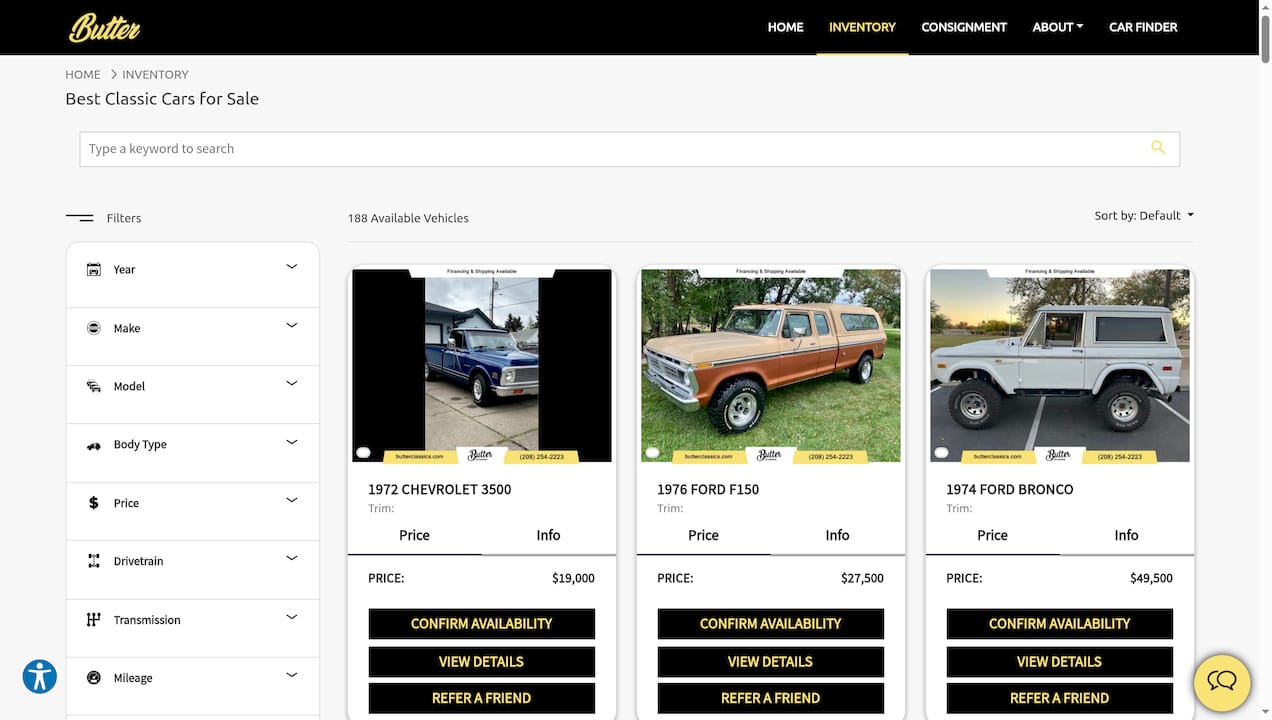
Our team understands that buying a classic car is both a passion decision and a financial one. We can help you evaluate models with strong resale profiles, connect you with financing resources, and make the whole process smooth as butter. Browse the current inventory, request a quote, or reach out directly to talk through your options. The right car for your goals is out there, and we'd love to help you find it.
FAQ
How long does it take to sell a classic car?
Classic cars average about 188 days on the market in current buyer-favored conditions. Well-documented, high-demand models in popular segments can sell significantly faster.
What are typical carrying costs for a classic car?
Carrying costs run 3 to 6% of vehicle value annually, covering insurance, storage, and maintenance. On a $200,000 car, that's $6,000 to $12,000 per year before any appreciation.
Can I borrow against a classic car instead of selling it?
Yes. Lenders typically offer LTV ratios of 50 to 70% against classic cars, and some collectors use securities-based credit lines to access cash without selling or triggering capital gains taxes.
Which classic cars have the best liquidity?
Air-cooled Porsche 911 variants and iconic American muscle cars with strong documentation tend to have the broadest buyer pools. Supercars maintain high liquidity at the top tier while general muscle car demand has softened recently.
How much does provenance affect sale price?
Strong documentation including service records and ownership history directly correlates with faster sales and higher prices. Cars with incomplete provenance can sell 20 to 40% below comparable well-documented examples.