
Yes, classic cars still need to meet your state's liability minimum. There's no free pass just because your car is old and beautiful. On top of that baseline, dedicated classic car policies add agreed-value protection, plus usage, mileage, and storage rules that standard auto insurance never asks about. Meet those, and you get a policy built for a car that's meant to be enjoyed, not just driven.
TL;DR:
- Classic car insurance uses agreed value, which requires professional appraisal and detailed documentation to ensure full payout in case of total loss.
- Insurers typically limit mileage between 1,000 and 7,500 miles annually and require secure, enclosed storage for the vehicle.
- State antique plates do not alter insurance requirements, but usage restrictions differ from DMV regulations and should be checked independently.
- Coverage options include comprehensive, collision, spare parts, restoration, and transport protection, with premiums influenced by mileage, car condition, and storage security.
- Proper preparation, including a full set of documents and realistic appraisal figures, speeds up application approval and claim processing.
Table of Contents
- What Classic Car Insurance Requirements Actually Cover
- Who Qualifies: Insurer Eligibility Rules You'll Run Into
- Getting Agreed Value: Appraisal and Paperwork Insurers Want
- Antique Plates Don't Change the Insurance Law
- Coverage Types That Actually Protect a Collector Car
- What Drives Your Premium and Coverage Limits
- Applying for Coverage: Your Step-by-Step Checklist
- Butter Classics Perspective: What Collectors Get Right and Wrong
- Sources
What Classic Car Insurance Requirements Actually Cover
A standard auto policy pays out actual cash value, which drops every year as your car ages. That's backwards for a collector car that's likely appreciating. Classic car insurance flips that model by using agreed value: you and the insurer agree on a dollar figure up front, backed by an appraisal, and that's what you get paid if the car is totaled. No depreciation schedule, no lowball settlement fight.
That fixed-payout structure changes how insurers underwrite the policy. Because they're on the hook for a set amount regardless of market swings, they want assurance the car won't rack up daily wear and tear. That's why classic policies are built around:
- Occasional use like car shows, club cruises, and weekend drives
- Enclosed, secure storage when the car isn't out
- A separate daily driver already insured in your household
- Documentation proving the car's condition and value
The Insurance Information Institute notes this agreed-value approach is the defining feature separating classic coverage from a standard policy, and it's the reason underwriters ask more questions before they say yes.
Who Qualifies: Insurer Eligibility Rules You'll Run Into
Insurers don't approve every old car or every driver automatically. Most run through a similar checklist before offering agreed-value terms.
- Vehicle age and condition. Many insurers set 20 to 25 years as a rough starting point, though some flexible carriers will consider younger "future classics" if the car is well maintained and low mileage.
- Driver history. Expect a clean driving record. Hagerty's guide notes that recent serious violations or alcohol-related offenses are common reasons for a decline.
- Household daily driver. You need another vehicle in the household, properly insured, that handles the actual commuting and errands. A motorcycle or a transit pass usually doesn't satisfy this requirement.
- Secure storage. An enclosed garage is typically mandatory when the car isn't in use. Parking it under a carport doesn't cut it for most carriers.
- Mileage caps. Expect limits between 1,000 and 7,500 miles a year, according to Coverage Criteria's breakdown of classic car insurance requirements.
Pro Tip: If you drive multiple collector cars, some insurers let you share a combined annual mileage allowance across a fleet policy instead of capping each car separately. Ask before you assume you need individual limits on every vehicle.
Getting Agreed Value: Appraisal and Paperwork Insurers Want
Agreed value only works if you can back the number. Insurers won't just take your word for what a restored 1969 Camaro is worth.
Most carriers ask for a professional appraisal, though some accept documentation from a recognized collector club or established valuation guide instead of a formal independent appraiser. Hagerty points out that requirements vary by company, so it pays to ask before you pay for an appraisal you didn't need.
Beyond the appraisal itself, build a file with, and remember to document car repair history:
- A clear title and bill of sale
- Dated, high-resolution photos of the exterior, interior, and engine bay
- Restoration receipts and parts invoices
- Maintenance logs showing ongoing care
If the car is mid-restoration, ask about spare-parts or restoration-in-progress coverage, and keep an itemized parts inventory with values attached. NJM's overview of how classic car insurance works confirms that a tight appraisal-plus-documentation package is what supports a full agreed-value payout after a total loss, not just a faster application. A detailed guide to agreed value versus stated value walks through why that distinction matters before you sign anything.
Antique Plates Don't Change the Insurance Law
Getting antique or classic plates from your state DMV feels like a milestone, but it doesn't touch your insurance obligation. Every state still requires you to carry at least the standard liability minimum any time that car touches a public road, full stop.
Where plates matter is usage. States commonly restrict antique-plated vehicles to:
- Car shows, parades, and exhibitions
- Club-sponsored events
- Occasional pleasure driving, sometimes with a stated mileage ceiling
Here's the trap: your state's plate rules and your insurer's mileage cap are two separate authorities, and they don't automatically match. You could be perfectly legal under DMV rules while quietly violating your policy's terms, or vice versa. Check both independently. WalletHub's classic car insurance guide flags this mismatch as one of the most common and costly misunderstandings among owners, sometimes leading to fines or voided claims. If you transport the car on a trailer or flatbed, comprehensive coverage typically handles transport-related damage, separate from the usage limits that govern actual driving.
Coverage Types That Actually Protect a Collector Car
Liability is the legal floor, not the whole plan. A well-built classic policy layers on:
- Comprehensive and collision, where applicable, for non-crash and crash-related damage
- Agreed value rather than stated value, since State Farm explains that stated-value policies can still pay out whichever is lower between the stated amount and actual cash value
- Spare parts coverage for stockpiled OEM components
- Restoration coverage for cars actively being rebuilt
- Automobilia coverage for memorabilia, tools, and collectibles stored with the car
- Guaranteed salvage or right-to-keep, letting you retain a totaled car instead of surrendering it
- Transport and flatbed towing protection for damage during shipping
For a heavily restored or investment-grade car, spare parts and restoration coverage tend to matter most, since replacement parts for rare models can be brutally expensive to source.
What Drives Your Premium and Coverage Limits
Pricing on a classic policy comes down to a handful of levers, and understanding them helps you compare quotes instead of just picking the cheapest number.
- Your mileage cap and how much driving you actually need
- The agreed value itself and whether the car is fully restored or a work in progress
- Your driving record, age, and how many collector cars your household insures
- Where you live and how secure your storage setup is
- Any performance or appearance modifications
Pro Tip: Ask about multi-policy discounts if you already insure your home or daily driver with the same company, plus club membership discounts if you belong to a marque-specific or regional car club. Both stack more often than people expect.
Applying for Coverage: Your Step-by-Step Checklist
- Gather your documentation: clear title, bill of sale, appraisal, dated photos, and restoration receipts.
- Confirm your household daily driver is insured separately and in your name.
- Decide on agreed value and schedule a professional appraisal if your insurer requires one.
- Request quotes from both specialty classic insurers and mainstream carriers that offer classic endorsements, and disclose every modification.
- Ask direct underwriting questions: What's the mileage cap? Which events count as permitted use? Is spare-parts coverage available? What are the transport terms?
Coming in prepared with a full document set tends to move applications through underwriting faster than showing up with just a VIN and a hope.
Butter Classics Perspective: What Collectors Get Right and Wrong
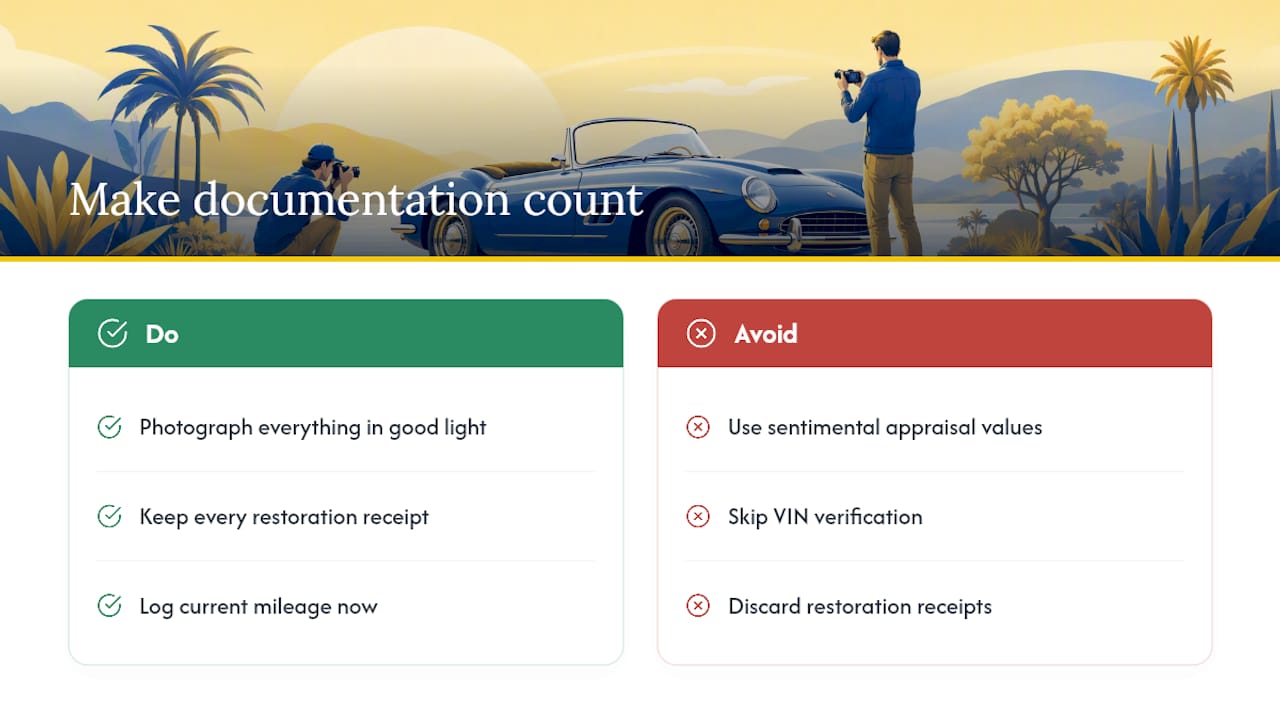
The same documentation that makes a listing sell well is almost identical to what an insurer wants for agreed-value coverage. High-resolution photos, a verified VIN, and itemized restoration receipts do double duty. Buyers trust a listing more when it's backed by paper trails, and underwriters approve claims faster for the same reason.
If you're shopping our inventory or thinking about consigning, align your appraisal number with realistic market pricing rather than sentimental value. Three quick moves before you request quotes: photograph everything in good light, keep every receipt from day one of restoration, and log your mileage now, before an insurer asks for it.
— Tony
Sources
- Insuring your classic car | Insurance Information Institute (III)
- Classic car insurance coverage options explained | State Farm
- Classic Car Insurance Explained: 10 Myths vs. Reality | Hagerty
- Classic Car Insurance Requirements 2026 | Coverage Criteria
- Classic Car Insurance (WalletHub guide)