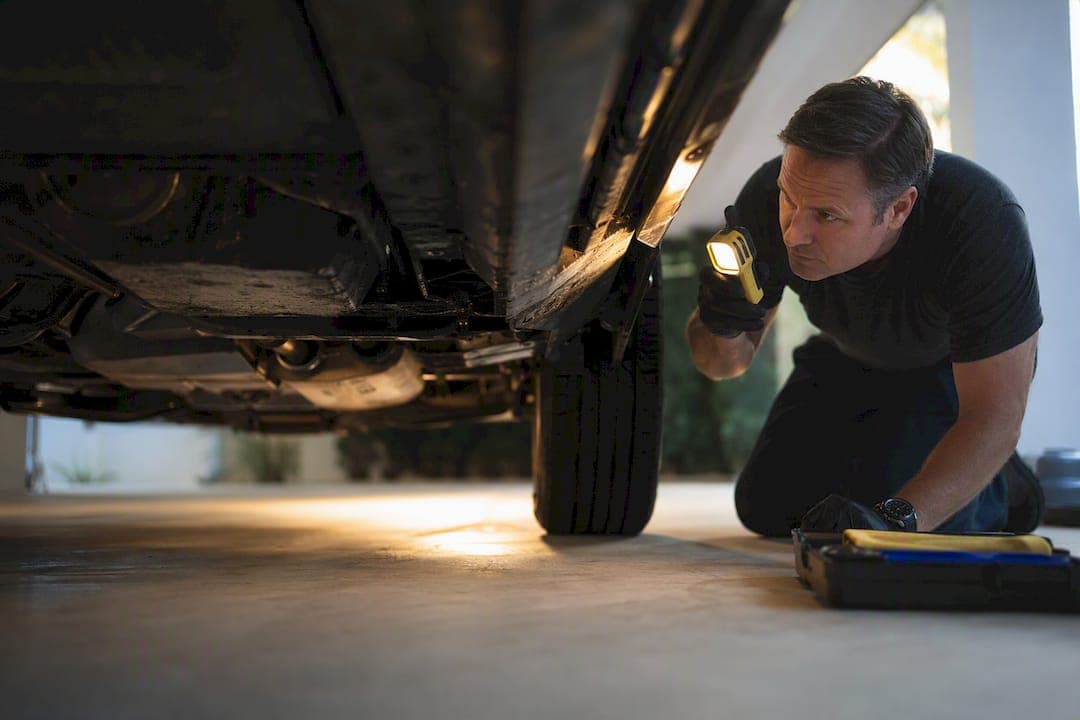
A basic classic car inspection typically runs $150 to $300, a standard pre-purchase inspection lands between $300 and $600, and a full concierge-level inspection with documentation research, travel, and specialty diagnostics can push past $600, sometimes into four figures once you add advanced testing. Rarer marques and matching-numbers verification sit at the top of that range. The rest of this guide breaks down what each tier buys, what drives the price up or down, and how to hire the right person without specific cost figures.
TL;DR:
- Basic inspections cost between $150 and $300 and include a visual check of paint, rust, tires, and a short test drive suitable for low-stakes purchases.
- Standard pre-purchase inspections range from $300 to $600 and add frame lifts, compression checks, and detailed reports, making them ideal for most buyers.
- Premium inspections start above $600 and can include specialized diagnostics, travel, and match verification, especially necessary for high-value or rare vehicles.
- Costs increase with rarity, vehicle complexity, and additional diagnostics, with European and low-production models requiring more expertise and expense.
- Structural rust and undercarriage issues are the most critical factors, as surface inspection often misses internal corrosion that could compromise safety and value.
Table of Contents
- What Does a Classic Car Inspection Cost, by Tier?
- What Does a Standard Classic Car Inspection Include?
- What Factors Raise or Lower the Inspection Price?
- Optional and Advanced Tests: What They Cost
- How Long Does an Inspection Take?
- How Do You Choose and Hire a Classic Car Inspector?
- Sample Budgets: Basic, Mid-Range, and Premium Inspections
- Does Inspection Cost Change by Vehicle Type or Model?
- What Other Costs Might Come Up After the Inspection?
- Why Do Structural Rust and Undercarriage Checks Matter So Much?
- State Inspection vs. Independent Pre-Purchase Inspection: What's the Difference?
- Butterclassics' Take on Making Inspection Reports Work for You
- How Butterclassics Can Help You Buy With Confidence
- Where to Verify Inspection Rules and Get a Professional Opinion
- Sources
What Does a Classic Car Inspection Cost, by Tier?
Think of pricing in three bands, and match the band to what you're actually buying.
A basic check in the $150 to $300 range covers a walk-around visual inspection: paint condition, obvious rust, tire wear, and a quick test drive. It's fine for a low-stakes purchase, like a project car you're buying mostly for parts or a weekend cruiser you don't plan to resell.
A standard pre-purchase inspection, priced from roughly $300 to $600, adds a lift inspection of the frame and undercarriage, a compression check on the engine, and a written report with photos. This is the tier most buyers should budget for on any car they intend to drive, show, or eventually flip.
A premium or concierge inspection starts around $600 and climbs from there once you add specialized diagnostics, travel to a seller's location, or deep documentation research to verify matching numbers. Some specialty providers publish tiered pricing that charge $449 for a domestic muscle car baseline versus $549 for European or concours-level work, with full matching-numbers verification and travel pushing $649 to $749.
| Cost Component | Low | Average | High |
|---|---|---|---|
| Base inspection fee | $150 | $300 | $600 |
| Specialized diagnostics (compression, electrical, paint) | $100 | $400 | $1,000+ |
| Documentation/numbers-matching research | $100 | $300 | $600+ |
| Travel/consultation fees | $50 | $150 | $449+ |
Several inspection services list starting fees in the $249 to $375 range as their baseline retail price, with add-ons itemized separately. Geography matters too. An inspector in a metro area with a lot of classic car traffic may charge less per visit than a specialist you fly in for a rare marque, simply because local competition keeps baseline rates lower.
Rarity moves the needle more than almost anything else. A common late-1960s domestic coupe is a familiar job for most inspectors. A low-production European sports car or an early muscle car with a documented racing history requires someone who already knows what "correct" looks like for that specific model, and that expertise costs more per hour.
What Does a Standard Classic Car Inspection Include?
A written quote should spell out scope before you pay a dime. If it doesn't, ask for one. A proper pre-purchase inspection for a classic car generally covers:
- Body and paint: panel gaps, filler use (some inspectors use a wrapped magnet to detect Bondo hidden under fresh paint), and mismatched paint that hints at prior collision repair
- Frame and structure: rust in floor pans, frame rails, and rocker panels, usually checked from underneath on a lift
- Drivetrain: engine compression, transmission behavior, and signs of fluid leaks or recent rebuilds
- Brakes and suspension: wear patterns, fluid condition, and any non-original components swapped in
- Electrical systems: wiring condition, gauges, and lighting, keeping in mind that modern OBD-II diagnostic tools don't work on most pre-1996 vehicles
- Fuel system: tank condition, lines, and carburetor or early fuel-injection function
- Test drive: how the car handles under load, idles, and shifts through gears
Beyond the mechanical checklist, a competent inspector also runs documentation checks. That means confirming the VIN matches title paperwork, cross-referencing the build sheet against the actual car, and verifying whether the engine and transmission are original to the chassis. Numbers-matching status alone can swing a car's value by thousands of dollars, so this step often matters as much as the mechanical findings.
What you get at the end should be tangible: a written report, a set of dated photos documenting condition (including problem areas), and usually a summary rating or condition grade. Some providers offer certification add-ons, useful if you plan to insure the car at an agreed value or sell it later with documentation buyers trust.
What Factors Raise or Lower the Inspection Price?
Four variables explain most of the price spread you'll see between quotes.
- Inspector experience and marque specialization. A generalist mechanic charges less than someone who has spent 20 years exclusively on early Porsches or first-generation Broncos, but that specialist catches trim-package mismatches and known failure points a generalist would miss entirely.
- Depth of documentation research. Confirming basic title history is quick. Tracing a car's full provenance, reconciling a build sheet, or verifying numbers-matching status for a high-value car takes hours of research that gets billed accordingly.
- Lift access and specialty testing. Inspections requiring a shop lift, paint-thickness gauges, or oil analysis cost more than a driveway walk-around, since they demand equipment and often a second location visit.
- Travel distance and vehicle condition. An inspector traveling two hours to a rural seller charges a travel fee on top of the base rate, and a barn find caked in decades of grime takes longer to properly assess than a freshly restored show car.
Condition complexity cuts both ways. A fully restored car might need less documentation digging but more careful scrutiny of restoration quality. A barn find might have obvious surface issues but require less time proving what's original, since so little of it has been touched.
Optional and Advanced Tests: What They Cost
Beyond the base inspection, certain add-on tests answer specific questions a general walk-around can't. Here's when each one earns its cost.
- Compression or leak-down test ($100 to $250): Reveals internal engine wear, valve seating, and ring condition. Worth adding whenever the seller can't produce recent maintenance records or the engine sounds rougher than expected on the test drive.
- Electrical system diagnostics ($150 to $400): Traces wiring faults, checks charging system output, and tests gauges. Recommended for cars with a history of "gremlins" or any vehicle that's had non-original wiring work done.
- Paint and metal thickness analysis ($100 to $300): Uses a gauge to detect filler or repainted panels invisible to the eye. Essential on any car marketed as "rust-free" or "all-original paint," since that claim is exactly what buyers get burned on.
- Oil and fluid analysis ($150 to $350): A lab checks for metal particulates or coolant contamination that signal internal engine problems before they become obvious.
- Build-sheet and numbers-matching verification ($300 to $1,000+): Cross-references casting numbers, VIN codes, and factory documentation. Reserved for higher-value cars where matching-numbers status materially changes the price you should pay.
Add these selectively. A $2,000 project truck doesn't need a $1,000 documentation deep-dive. A six-figure muscle car with a "numbers-matching" claim absolutely does.
How Long Does an Inspection Take?
Budget two to four hours on-site for a standard inspection. That covers the visual walk-around, lift time, test drive, and basic documentation checks. Cars requiring deeper diagnostics or extensive paperwork research can stretch the visit longer, sometimes into a second session.
Report turnaround typically runs one to three business days after the inspection. Some inspectors offer same-day or next-day expedited reports for an added fee, useful if you're competing against another buyer or working against a seller's deadline.
Timing matters more than it seems. If you're negotiating price contingent on inspection results, a slow report can cost you the deal if the seller has other interested buyers. Ask about turnaround before booking, especially for out-of-state purchases where you're coordinating shipping or escrow around the report's arrival.
How Do You Choose and Hire a Classic Car Inspector?
Picking the right inspector matters more than shaving $50 off the quote. A mediocre inspection on a $40,000 car is a bad trade no matter what it costs.
What to look for before you book:
- A sample report you can review, showing photo quality and level of detail
- Documented experience with your specific marque or era, not just "classic cars" in general
- A clear methodology: what gets checked, in what order, with what tools
- References from past clients, ideally other collectors or dealers
- Liability insurance, particularly if the inspection involves a test drive of someone else's car
Questions worth asking on the phone before you pay anything:
- Do you have lift access, or will the inspection be done on the ground?
- Will you verify VIN and casting numbers against factory documentation?
- What diagnostics are included in the base fee, and what costs extra?
- What's your travel fee if the car isn't local to you?
- How soon will I have the written report?
Red flags that should make you look elsewhere:
- No sample report or refusal to show one
- A flat fee quoted with no explanation of what's covered
- No mention of documentation or numbers-matching work, even when you ask
- Reluctance to put photo counts or report format in writing
Before hiring, get the scope in writing. A short agreement covering what's inspected, what the deliverable looks like, the travel and cancellation policy, and the estimated total cost protects both sides. It also gives you something to point to if the final invoice doesn't match what you expected.
Pro Tip: If the seller's location has no lift, some inspectors bring a heavy-duty carpet or towel to slide under the car for a safer look at the underside. Ask if your inspector has a workaround like this planned for private-sale inspections without shop access.
Sample Budgets: Basic, Mid-Range, and Premium Inspections
Seeing the numbers stacked together makes the tiers easier to plan around.
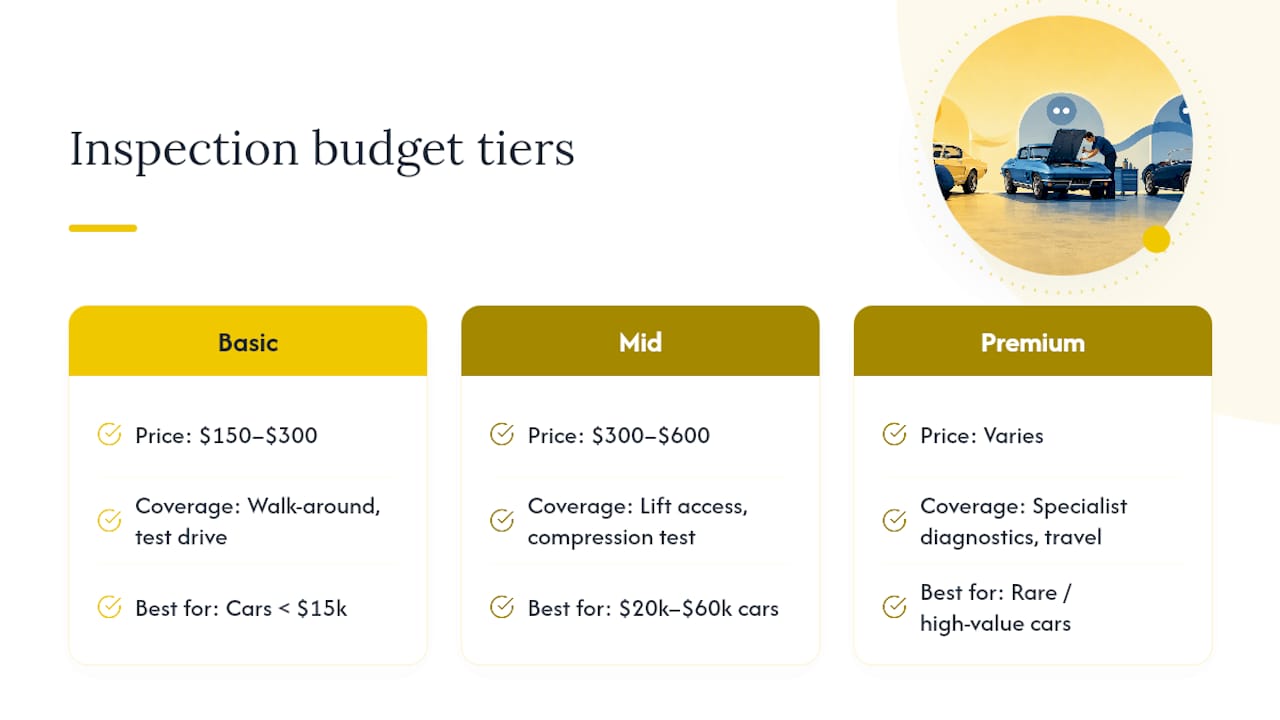
The basic scenario assumes a local, low-mileage seller and a car with no red flags on the listing. It's a reasonable budget for a car under $15,000 where the downside risk of a bad surprise is limited.
The mid-range scenario fits most buyers purchasing a $20,000 to $60,000 classic where mechanical condition genuinely affects the price you'd offer. Adding one diagnostic test, like the compression check, adds real information without doubling your cost.
The premium scenario applies when you're buying a rare or high-value car where numbers-matching status alone can shift value by tens of thousands of dollars; to better understand the process involved, see our guide to navigate the yacht inspection process for a confident buyer's perspective. The research and travel costs here are small next to what a misidentified engine or transmission would cost you later.
Does Inspection Cost Change by Vehicle Type or Model?
Yes, and the differences follow a predictable pattern. Domestic muscle cars from the 1960s and 1970s tend to sit at the lower end of inspection pricing because parts, common failure points, and documentation standards are well understood by most inspectors who work in this space regularly.
European classics, early sports cars, and low-production models push costs higher for two reasons. Fewer inspectors have deep experience with them, and sourcing correct documentation, like factory build sheets or original parts catalogs, takes more time. A tiered pricing structure reflecting exactly this split: $449 for domestic muscle inspections and $549 for European or concours-level work.
Trucks and Broncos occupy a middle ground. They're mechanically straightforward, similar to muscle cars in that respect, but rust patterns in frames and beds sometimes require more thorough undercarriage attention than a unibody coupe. If you're comparing quotes across different vehicle types, ask the inspector directly whether their base fee assumes your specific model, or whether it's a generic starting price that could climb once they see the car.
What Other Costs Might Come Up After the Inspection?
An inspection report is the start of your cost planning, not the end of it. If the report flags issues, get repair estimates before finalizing your offer, not after you've already bought the car. A shop quote for frame rust repair, for example, can run from a few hundred dollars for minor patch work to several thousand for structural replacement.
Follow-up inspections happen more often than buyers expect. If the initial report flags something ambiguous, like a possible non-original engine block, you may need a second, more specialized visit focused specifically on resolving that question. Budget for this possibility on any car where the first report raises more questions than it answers.
Negotiating leverage is the real payoff here. A documented rust or mechanical issue gives you a concrete number to bring back to the seller, either as a price reduction or a repair credit. Sellers who know their car has been professionally inspected are also more willing to negotiate seriously, since they know a walk-away buyer will just find another car with a cleaner report.
Insurance costs can shift too. A car with a documented condition report and confirmed numbers-matching status often qualifies for better agreed-value coverage than one with no paper trail behind it.
Why Do Structural Rust and Undercarriage Checks Matter So Much?
Structural rust is the single issue most likely to turn a promising purchase into a costly mistake. It's also the easiest thing for a seller, intentionally or not, to hide with a fresh coat of undercoating or a strategically parked car in a driveway.
Rust rarely announces itself from the top. It starts from the inside of floor pans and frame rails and works outward, which means a surface-level glance often misses corrosion that's already compromised structural integrity. That's exactly why a proper inspection insists on lift access or, at minimum, a thorough look at the underside with the car raised on jack stands.
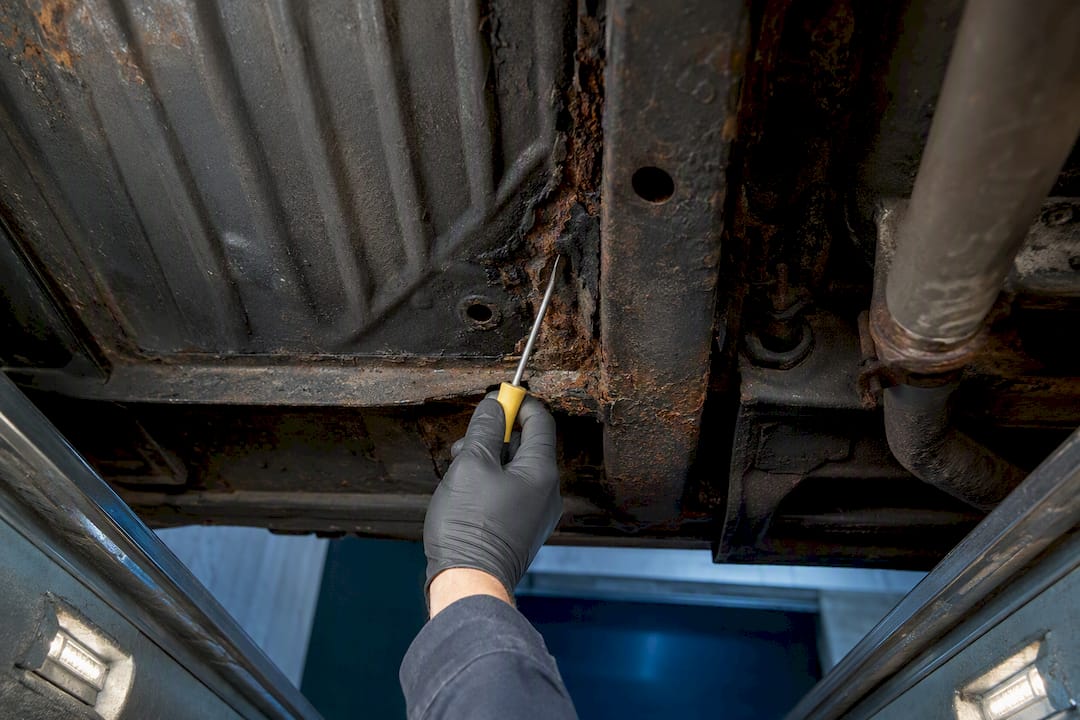
This is also where the price difference between a basic check and a standard inspection earns its keep. The $150 walk-around inspection typically can't include this step. The $300 to $600 standard inspection can, and should. If a seller resists letting an inspector put the car on a lift, treat that as a serious warning sign rather than an inconvenience.
Frame rot isn't always a dealbreaker, but it should always change the number you're willing to pay. Repair costs for structural rust vary enormously depending on severity, from a few hundred dollars in patch panels to a full frame replacement that can exceed the car's value. Knowing which situation you're in before you buy is the entire point of paying for this part of the inspection.
State Inspection vs. Independent Pre-Purchase Inspection: What's the Difference?
These are two completely different things, and confusing them is a common, costly mistake. A state inspection, where one is required, checks whether a vehicle meets your state's minimum safety or emissions standards for registration and road use. Requirements vary by state, and many states carve out different rules or exemptions for antique and classic vehicles specifically.
An independent pre-purchase inspection is a private, optional service you hire before buying, focused on mechanical condition, originality, and value, not legal compliance. Passing a state inspection tells you almost nothing about whether the engine is original, whether the frame has hidden rust, or whether you're paying a fair price. A car can pass state inspection and still hide five figures' worth of undisclosed problems.
Buyers sometimes skip the independent inspection because they assume state registration requirements already covered "the safety stuff." They haven't. If you're buying a classic car, especially across state lines, treat the independent pre-purchase inspection as a separate, non-optional step regardless of what your state's DMV requires for titling and plates.
Butterclassics' Take on Making Inspection Reports Work for You
Many sellers of classic and vintage vehicles agree that an independent inspection is the single best money a buyer spends before closing a deal. We're not the ones performing that inspection, and we think that's exactly how it should be. A marketplace that also inspected the cars it lists would be grading its own homework.
What we can tell you, from watching how these transactions actually play out, is that inspection findings are leverage, not just information. A documented rust spot or a non-matching engine block gives you something concrete to bring back to a seller, whether you're negotiating price, qualifying for financing, or arranging transport. Lenders and shippers both respond better to a buyer holding a written report than one working off gut feeling and listing photos.
The buyers who get burned aren't usually the ones who paid for a $600 inspection and found a problem. They're the ones who skipped it to save money and found the problem three months later.
— Tony
How Butterclassics Can Help You Buy With Confidence
Some websites provide a wide inventory of classic trucks, muscle cars, Corvettes, Broncos, and other collector vehicles, with detailed specs and photos to help you shortlist candidates before you ever schedule an inspector.
Once you find a car worth pursuing, our inventory listings let you request additional photos or documentation directly, and our test drive scheduling makes it simple to see a car in person before committing further. We'll always recommend arranging an independent pre-purchase inspection before you finalize a purchase, no matter which listing catches your eye. If narrowing down the right car feels like the harder part right now, our Car Finder tool can point you toward vehicles that match your budget and priorities. Browse the current inventory, save the listings you're serious about, and line up your inspector before you make an offer.
Where to Verify Inspection Rules and Get a Professional Opinion
For state-specific registration and safety inspection rules, Progressive's classic car inspection checklist breaks down how requirements differ by state and where antique vehicle exemptions typically apply. For a deeper look at what a marque-specific inspector actually checks and why documentation matters, GarageLore's pre-purchase inspection guide covers the details well. If you're weighing a higher-value purchase, Auto Appraisal Group's inspection service page outlines what a full appraisal-grade report includes and when that extra depth is worth paying for.
Sources
- CostInsider — Classic car inspection cost (2026)
- GarageLore — Classic car pre-purchase inspection tips (2026)
- Progressive — Classic car inspection checklist
- Vehicle Inspectors — Pricing for specialty classic inspections
- Auto Appraisal Group — Classic car prepurchase inspection