
The fastest way to buy a classic car you'll enjoy and keep affordable is to match a clearly defined purpose with a realistic all-in budget, then verify condition and paperwork before you pay. This guide gives you a step-by-step inspection checklist, documentation checks, channel comparisons, and financing tips so you can vet any listing with confidence.
- Set your all-in budget before you browse a single listing (purchase price plus restoration, insurance, storage, and a contingency fund).
- Run a VIN and title history check on every car you seriously consider.
- Schedule a professional pre-purchase inspection before you hand over any money.
Pro Tip: A fixer-upper is worth it only when you have a firm restoration quote in hand before you buy. Without one, fixer-upper projects frequently exceed initial estimates because vintage parts and specialized labor cost far more than most buyers expect.
Key Takeaways
Buying a classic car successfully comes down to five steps: define your purpose, set a realistic all-in budget, inspect thoroughly, verify every document, and close with a safe payment method.
| Point | Details |
|---|---|
| Set an all-in budget first | Include purchase price, restoration, insurance, storage, and a 20–30% contingency before you shop. |
| VIN and title verification | Run a history check and confirm all VIN stampings match the title before committing to any car. |
| Professional inspection | Hire a specialist for any car over $10,000; insist on a written report covering matching numbers, rust, and compression. |
| Buy for passion, not speculation | The classic car market is volatile; prioritize a car you'll enjoy owning over one you hope will appreciate. |
| Butterclassics simplifies the process | Browse verified listings, use the car finder, and access financing pre-qualification at Butterclassics. |
Table of Contents
- What's your classic car buying guide actually going to cost you?
- How to inspect a classic car before you buy it
- What paperwork do you need before buying a classic car?
- Where should you buy a classic car?
- How does financing and insurance work for classic cars?
- What are the most common classic car buying mistakes?
- What will a classic car cost you to maintain and restore?
- How do you close a classic car deal safely?
- Is a classic car a good investment?
- Your pre-purchase checklist: what to verify before you commit
- Butterclassics makes buying a classic car online straightforward
- Sources
What's your classic car buying guide actually going to cost you?
Before you fall in love with a specific car, you need to answer one question: what do you want it for? That single decision, made honestly, filters out most of the wrong cars and keeps your budget from blowing up.
Purpose categories and what they mean for your wallet
Defining your car's intended use early filters which models, conditions, and purchase channels make sense and dramatically reduces buyer's remorse.
- Daily driver: You need a car that runs reliably in modern traffic. Expect to pay more upfront for a well-sorted example and budget for regular maintenance. Fuel injection swaps and disc brake conversions are common and add cost.
- Weekend driver / show car: Condition matters more than mechanical perfection. Budget for cosmetic work, chrome care, and storage between events.
- Full restoration project: The most expensive category by far. You're buying potential, not a car. Budget for frame-off disassembly, bodywork, paint, mechanical rebuilds, and upholstery.
- Long-term storage / investment hold: Requires climate-controlled storage, annual fluid changes, and tire rotation even when the car never moves.
Building a realistic all-in budget
Most first-time buyers budget for the purchase price and forget everything else. Here's what actually goes into the number:
- Purchase price
- Immediate safety repairs (brakes, tires, fluids)
- Restoration labor and parts
- Specialized mechanic fees
- Agreed-value insurance premiums
- Storage (climate-controlled runs $100–$300/month in most US markets)
- Registration and title transfer fees
- Shipping or transport if buying out of state
- Contingency fund: add 20–30% on top of your restoration estimate
Pro Tip: Auction and online platform purchases often add a buyer's premium, sales tax, and shipping on top of the hammer price. Factor those fees into your all-in budget before you bid.
A real-world budget example
That $28,000 car costs $41,200 to own for the first year. If your budget is $30,000, you need to find a car priced around $18,000–$20,000 or accept a lower restoration scope.
How to inspect a classic car before you buy it
A thorough inspection is your single best protection against a money pit. Walk through this checklist at every viewing, and share it with your mechanic if you hire a specialist.
Prepare before you arrive
Bring a flashlight, a small magnet (to detect body filler), a phone for photos, and a notepad. Schedule viewings in daylight. Wet or freshly washed cars hide rust and paint defects. Ask the seller to have the car cold when you arrive so you can observe a cold start.
Exterior inspection
- Panel fit and gaps: Uneven gaps between doors, hood, and fenders suggest accident repair or replacement panels.
- Paint consistency: Shine a light at a low angle across each panel. Orange peel, overspray on trim, or color variation between panels signals a respray.
- Bondo and filler: Slide a magnet slowly across body panels. Where it loses grip, there's filler underneath.
- Rust hotspots: Check door sills, floor pans (from inside and underneath), trunk floor, wheel wells, and the base of the windshield. Surface rust is manageable; structural rust is a deal-breaker.
- Convertible frames: Flex the body gently. Excessive movement or cracking in the cowl area means the frame is compromised.
Undercarriage and frame
Get under the car with your flashlight. Look for:
- Fresh undercoating applied in patches (often used to hide rust or welds)
- Visible weld seams in structural areas that don't match factory construction
- Frame rails that are bent, patched, or show signs of straightening
Any structural repair is worth a specialist's second opinion before you proceed.
Engine and drivetrain
- Matching numbers: The engine stamp should match the VIN-decoded engine code on the title. A non-matching engine isn't automatically a problem, but it affects value significantly.
- Oil leaks: Look at the valve covers, oil pan, and rear main seal. Minor seepage is common; heavy leaks mean immediate work.
- Cold start behavior: Listen for knocking, ticking, or excessive smoke. Blue smoke means oil burning. White smoke on a warm day means coolant in the combustion chamber.
- Compression: A mechanic can run a compression test in 20 minutes. Low or uneven readings across cylinders indicate worn rings or valve issues.
Transmission and driveline
Shift through every gear on the test drive. Manual transmissions should engage cleanly with no grinding. Automatics should shift without slipping or hesitation. Check underneath for transmission fluid leaks and listen for driveshaft vibration at highway speed.

Electrical and interior
Wiring in classic cars degrades over decades. Check every switch, gauge, and light. Non-original wiring (visible splices, aftermarket fuse blocks) adds cost and fire risk. Original interior trim affects value; replaced or missing pieces are negotiating points.
Brakes, tires, and wheels
Look for seized calipers (uneven pad wear), warped rotors (pulsing under braking), and mismatched wheel sizes. Dry-rotted tires are a safety issue regardless of tread depth.
Test drive checklist
- Cold start and idle quality
- Brake pedal feel (firm vs. spongy)
- Steering pull or wander
- Clutch engagement point (too high or too low)
- Transmission shift quality through all gears
- Unusual noises at speed (wheel bearings, driveshaft, exhaust)
- Instrument gauge behavior
When to hire a professional inspector
Hire a specialist pre-purchase inspection for any car over $10,000 or any project car where you can't personally assess mechanical condition. Ask the inspector to provide:
- Matching numbers verification
- Rust severity rating by location
- Structural repair documentation (welds, patches, new panels)
- Compression or leak-down test results
- A photo log of every discovered issue
A professional inspection report gives you negotiating evidence and a clear repair priority list. Without it, you're guessing at costs that could easily run into the thousands.
Pro Tip: If the seller won't allow an independent inspection, walk away. That refusal is the loudest red flag in classic car buying.
What paperwork do you need before buying a classic car?
Vehicle history and documentation reveal provenance and maintenance frequency. Cars with comprehensive records are more reliable and typically more valuable.
Must-have documents
- Clear title in the seller's name (no lien, no salvage brand)
- Bill of sale with VIN, purchase price, and both parties' signatures
- Maintenance and service records
- Restoration invoices and receipts for major parts
- Original manufacturer data plates (where applicable)
How to verify the VIN
VIN stamping locations vary by make, model, and era. On most post-1968 vehicles, check the dashboard (driver's side, visible through the windshield), the driver's door jamb, the firewall, and the engine block. Pre-1981 vehicles used shorter, manufacturer-specific serial numbers rather than the standardized 17-character VIN. For pre-1954 vehicles, factory data plates and serial number registries maintained by marque clubs are often the only reliable verification method.
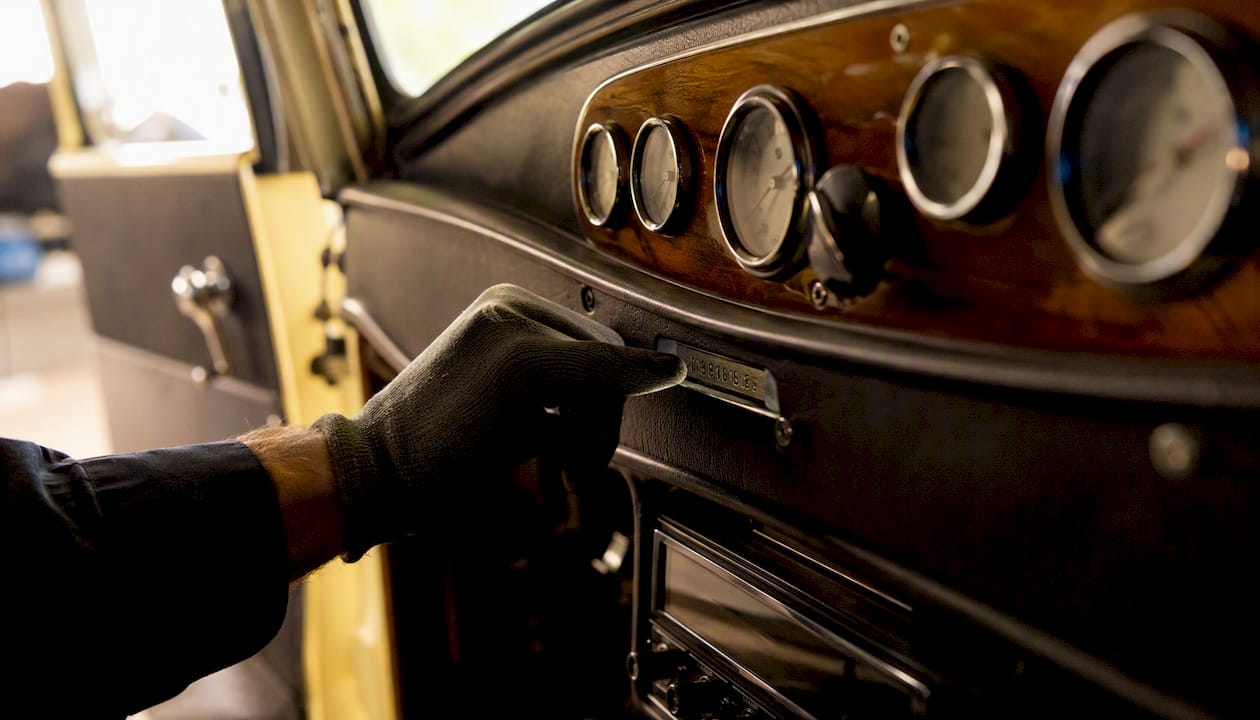
"Matching numbers" means the engine, transmission, and axle codes all correspond to what the factory installed for that specific VIN. A numbers-matching car commands a premium. A car with a replacement engine isn't worthless, but it should be priced accordingly.
Title red flags to check before you commit
- Salvage or rebuilt title: The car was declared a total loss at some point. Financing is nearly impossible, and resale value is permanently reduced.
- Missing title: Walk away unless you're prepared for a lengthy bonding process through your state DMV.
- Lien on title: The seller's lender still has a financial interest. The lien must be released before you can take clear title.
- Multiple rapid title transfers: Several owners in a short period often signals a problem car being passed along.
Step-by-step documentation process
- Request the title before you visit in person. Verify the VIN on the title matches the VIN on the car.
- Run a VIN history check through the National Motor Vehicle Title Information System (NMVTIS) or a service like Carfax or AutoCheck.
- Ask for all service records and restoration invoices in writing.
- Get a written seller statement confirming the car's known history, any accidents, and any major work performed.
- Use an escrow service or marketplace-facilitated payment for high-value transactions. Never wire money directly to a private seller you haven't met.
Where should you buy a classic car?
Each buying channel has a different risk profile, price range, and level of post-sale support. Private sellers may offer price flexibility and the chance to inspect, while online marketplaces provide larger inventories and conveniences like facilitated title transfer and financing tools.
Channel comparison
Private sellers offer the most negotiating room and direct access to the car's history from the person who owned it. The downside is zero post-sale recourse. If something goes wrong after the handshake, it's your problem.
Specialist classic car dealers typically charge more, but you get pre-sale reconditioning, documented history, and in many cases a short warranty or return window. They're also more likely to have financing relationships and can help with title work.
Local auctions let you inspect in person before bidding, but the "as-is" sale condition means no recourse if you miss something.
National auction houses offer the widest selection and often the most detailed documentation, but cars sell fast and remote bidding limits your ability to inspect. Budget for buyer's premium, shipping, and any applicable taxes.
Dedicated online marketplaces combine broad inventory with listing tools, VIN verification, and in some cases financing pre-qualification. When buying a classic car online, choose a platform that offers verified listings, detailed documentation, and post-sale support. Cars sold "as-is, where-is" on any platform still require independent verification or an on-site inspection.
For a broader look at how specialist marketplaces compare to general classifieds, the Butterclassics marketplace alternatives guide breaks down the key differences in verification standards and fees.
How to evaluate a listing
- High-quality photos from multiple angles, including undercarriage and engine bay, are a baseline requirement. Listings with only exterior shots hide problems by design.
- Ask the seller directly: "Has the car been in any accidents?" "Is the engine original to the car?" "What work has been done in the last two years?"
- Red flags in listing copy: "runs great," "just needs a little work," "selling as-is," or "no time to finish." Each phrase is a signal to dig deeper.
- Confirm what's original versus modified. Modifications aren't always bad, but they affect value and parts sourcing.
Pro Tip: When evaluating online listings, prioritize sellers who provide a full VIN, detailed service records, and clear undercarriage photos. If those three elements are missing, request them before scheduling a viewing or making any offer.
How does financing and insurance work for classic cars?
Classic car financing and insurance work differently from standard auto loans and policies. Getting both sorted before you find the right car puts you in a much stronger buying position.
Financing options
Standard bank auto loans often won't cover cars over a certain age or in project condition. Classic-focused lenders, including specialty finance companies and some credit unions, offer loans specifically for collector vehicles. Key differences:
- Loan terms are often shorter (36–72 months vs. 84+ for modern cars)
- Lenders may require an appraisal rather than relying on a standard book value
- Project cars or unrestored vehicles are harder to finance; lenders want collateral they can value
- Pre-approval before you shop gives you a firm spending ceiling and makes you a more credible buyer
Financing a restoration separately from the purchase is possible but complicated. Most lenders won't roll restoration costs into a vehicle loan. A personal loan or home equity line is a common workaround, though each carries its own risk profile.
Insurance differences
A standard auto policy pays actual cash value if your classic is totaled. For a restored or appreciating vehicle, that number is almost always less than what you've invested. Agreed-value (also called guaranteed-value) classic car insurance pays the full insured amount with no depreciation deduction.
Most agreed-value policies come with conditions:
- Annual mileage limits (typically 1,000–5,000 miles per year)
- Usage restrictions (pleasure driving, shows, and club events only)
- Secure storage requirements
- Driver age and experience minimums
Practical checklist before you buy
- Get insurance quotes from classic-focused insurers before you close on any car.
- Confirm the car qualifies for agreed-value coverage (some unrestored or heavily modified cars don't).
- Budget for higher premiums on rare models or cars with documented restoration value.
- Ask your lender about collateral rules for project cars before you apply.
Pro Tip: Agreed-value insurers typically require recent photos of the car from all angles, a professional appraisal, and maintenance records. Gather those documents as part of your pre-purchase inspection process so you're ready to bind coverage the day you take ownership.
What are the most common classic car buying mistakes?
Rookie mistakes are common and avoidable. The ones below account for the majority of buyer regret stories.
Top mistakes first-time buyers make
- Relying on photos alone. Photos are marketing. They don't show rust under the carpet, a leaking rear main seal, or a transmission that slips in third gear.
- Skipping the professional inspection. Even experienced buyers get fooled. A $200–$400 inspection fee is cheap insurance against a $10,000 surprise.
- Ignoring paperwork gaps. A missing title, undisclosed lien, or salvage brand can make a car nearly impossible to register or resell.
- Underestimating restoration costs. The $5,000 project car that needs $25,000 in work is one of the most common stories in the hobby.
- Overbidding at auction. Auction adrenaline is real. Set a hard ceiling before bidding starts and don't move it.
Listing and seller red flags
- Photos that cut off at the rocker panels or show only one side of the car
- Seller refuses an independent inspection or insists on a quick sale
- Title not available until after a deposit is paid
- Price significantly below market value with no explanation
- Seller can't answer basic questions about the car's history
Condition red flags during inspection
- Mismatched paint or undercoating applied in patches
- Fresh weld seams in structural areas (frame rails, floor pan edges)
- Floor pan replacements with inconsistent fit or visible seam tape
- Engine knocking or ticking that the seller dismisses as "normal"
- Transmission slip or hesitation between gears
A price that seems too good to be true almost always is. A $15,000 car listed for $8,000 with "no time to deal with it" is either hiding serious mechanical or title problems, or it's a scam. Either way, walk away until you have a clear answer.
Pro Tip: If a seller pressures you to skip the inspection or close the deal the same day, treat it as a deal-killer. Legitimate sellers with good cars have nothing to hide.
What will a classic car cost you to maintain and restore?
Ongoing maintenance for a classic is more demanding than for a modern car. Specialized maintenance and parts sourcing are an underappreciated ongoing cost. Confirm parts availability and a trusted mechanic for your specific model before you commit to buying.
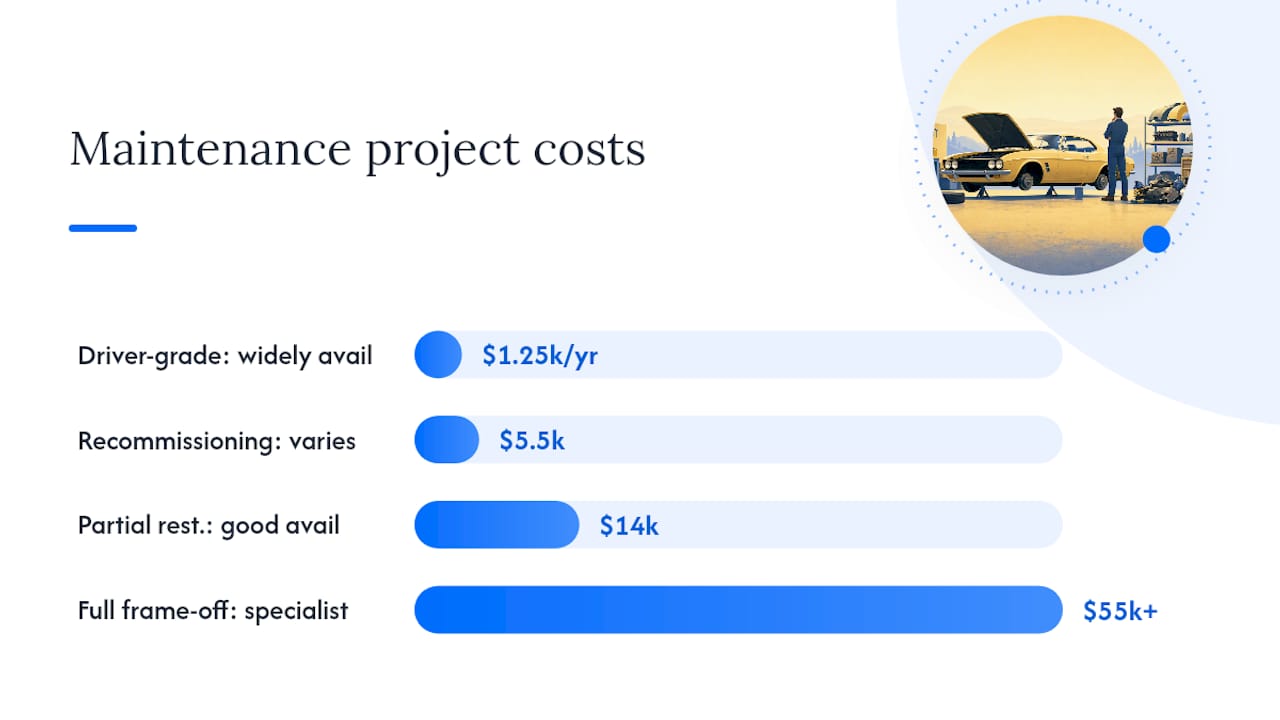
Project levels and typical cost ranges
- Driver-grade service: Minor tune-up, fluid changes, brake inspection. Budget $500–$2,000 annually.
- Recommissioning: A car that's been sitting needs fuel system flush, new rubber seals, brake rebuild, and cooling system service. Budget $3,000–$8,000 for a thorough recommission.
- Partial restoration (bodywork and paint): Panel repair, prep, and a quality paint job run $8,000–$20,000 depending on the car's size and condition.
- Full frame-off restoration: Complete disassembly, media blasting, bodywork, paint, mechanical rebuild, and interior. Budget $30,000–$80,000+ for a quality result on a mainstream American classic.
Parts availability
Mainstream models (Ford Mustang, Chevrolet Camaro, Dodge Challenger, classic Bronco) have deep aftermarket support. Reproduction parts are widely available, and multiple suppliers compete on price. Rare makes and low-production models are a different story. A single trim piece can take months to source and cost several hundred dollars.
Before you buy any car, spend 30 minutes on marque-specific forums and owners' clubs to confirm that the parts you'll need are actually available and at what price. For chrome-specific restoration work, the Butterclassics chrome restoration guide covers what to expect from different restoration methods and suppliers.
Ongoing maintenance items unique to classics
- Fuel system care: ethanol-blended modern fuel degrades rubber fuel lines and carburetor components. Use fuel stabilizer and consider ethanol-resistant upgrades.
- Rubber seals: window seals, door seals, and gaskets dry out and crack. Budget for replacement every 5–10 years.
- Chrome preservation: regular polishing and protective wax extend chrome life significantly.
- Carburetor tuning: seasonal adjustments are normal; a neglected carb causes hard starts and poor fuel economy.
Pro Tip: Build your parts-and-labor network before you need it. Identify a local specialist, two or three national suppliers, and the primary owners' club for your model. Price-check major repairs through the club forum before you authorize any shop work.
| Project level | Typical cost range | Parts availability |
|---|---|---|
| Driver-grade service | $500–$2,000/year | Widely available for mainstream models |
| Recommissioning | $3,000–$8,000 | Varies by make and model |
| Partial restoration | $8,000–$20,000 | Good for popular models; limited for rare makes |
| Full frame-off restoration | $30,000–$80,000+ | Requires specialist sourcing for rare models |
How do you close a classic car deal safely?
Negotiating and closing a classic car purchase has its own rhythm. Move too fast and you miss something. Move too slow and someone else buys it.
Negotiation tips specific to classics
Use your inspection findings as leverage, not emotion. A compression test showing one weak cylinder is a documented repair cost, not a personal attack on the seller. Specific findings get specific price reductions. Service history gaps, non-matching numbers, and parts scarcity all justify lower offers.
Avoid emotional overbidding. If you've decided this is the only car in the world for you, you've already lost the negotiation.
Safe payment and escrow
- Cashier's check: Acceptable for in-person transactions with a seller you've met and verified. Confirm the check clears before the title changes hands.
- Escrow service: For high-value or out-of-state purchases, a third-party escrow service holds funds until both parties confirm the car matches its description. This protects both buyer and seller.
- Marketplace-facilitated payment: Some platforms handle payment processing and title transfer as part of the transaction, which reduces risk significantly.
- Wire transfer to a private seller: Avoid this. Wire fraud in vehicle sales is common and nearly impossible to recover from.
Title transfer and registration
Title transfer requirements vary by state. In most states, you'll need the signed title, a bill of sale, proof of insurance, and payment for title and registration fees. For out-of-state purchases, many states issue a temporary operating permit while the title processes. Some states require a physical VIN verification by a law enforcement officer or DMV inspector before they'll register a vehicle with an out-of-state title.
Arranging transport
If you're not driving the car home, you'll need enclosed or open transport. Enclosed transport costs more but protects the car from road debris and weather. Get a condition report signed by the driver before the car is loaded, and photograph the car thoroughly at pickup. Inspect it again at delivery before you sign the release.
Final 10–14 day transaction timeline
- Complete inspection and receive written report.
- Run VIN history check and confirm title is clear.
- Negotiate final price using inspection findings.
- Agree on payment method and escrow terms.
- Secure financing pre-approval if needed.
- Bind insurance coverage (effective on the purchase date).
- Sign bill of sale and receive signed title.
- Submit title transfer and registration at your state DMV.
- Arrange transport or plan your pickup route.
- Conduct delivery inspection and photograph the car on arrival.
Pro Tip: For any purchase over $15,000, use a third-party escrow service.
Is a classic car a good investment?
The short answer: sometimes, but don't count on it. The classic car market is volatile, and viewing a vehicle solely as an investment is risky. Buyers who prioritize enjoyment over speculation tend to make better decisions and end up with cars they actually want to own.
Markets for specific models can move sharply in either direction based on generational nostalgia, media exposure, and broader economic conditions. A model that doubled in value between 2015 and 2022 may have softened significantly since. For a detailed look at how classic car market indexes have moved over time, the Butterclassics market index guide provides useful context on long-term price trends.
The collectors who do best financially are almost always the ones who bought cars they genuinely wanted to own, maintained them properly, and held them long enough for the market to catch up. Buying purely for appreciation, without passion for the car itself, tends to produce impatient sellers who exit at the wrong time.
Pro Tip: To assess a car's investment potential alongside its enjoyment value, check recent auction results for the same model and condition grade on platforms that publish realized prices. Compare those results to the asking price, then ask yourself whether you'd be happy owning the car even if the value stayed flat for five years.
Your pre-purchase checklist: what to verify before you commit
Use this checklist at every in-person viewing and when evaluating online listings. The three absolute deal-killers are marked clearly.
Before the viewing
- Confirm your all-in budget (purchase + restoration + 12 months running costs)
- Run a VIN history check and verify title status
- Research the model's known problem areas and parts availability
- Prepare your inspection kit (flashlight, magnet, phone, notepad)
At the viewing
- [DEAL-KILLER] No clear title in the seller's name: Do not proceed without a clean title.
- [DEAL-KILLER] Seller refuses independent inspection: Walk away.
- [DEAL-KILLER] VIN mismatch between car and title: Do not buy.
- Check all VIN stamping locations against the title
- Complete the full exterior, undercarriage, engine, and interior inspection
- Test drive through all gears and at highway speed
- Photograph every defect and every VIN location
Documentation to secure
- Signed title (clear, no salvage brand, no lien)
- Bill of sale with VIN, price, and both signatures
- All service records and restoration invoices
- Written seller statement of known history
Before closing
- Confirm insurance coverage is bound and effective on purchase date
- Confirm financing pre-approval if applicable
- Agree on payment method (cashier's check or escrow for high-value deals)
- Arrange transport and get a signed condition report
Pro Tip: Screenshot or print this checklist and bring it to every viewing. Checking boxes in person keeps you from getting caught up in the excitement of a beautiful car and skipping steps that protect you.
- Confirm purpose and all-in budget before you search.
- Run a VIN and title check on every serious candidate.
- Complete the full inspection checklist or hire a specialist.
- Secure all documentation before you pay.
- Bind insurance and confirm financing before the title changes hands.
A word from Tony
Buying your first classic car is one of the most exciting things you can do as an automotive enthusiast. It's also where I've seen the most avoidable heartbreak. The buyer who skips the inspection because the car "looks perfect" is the same buyer calling me six months later with a $12,000 repair bill they didn't see coming. The checklist in this guide isn't bureaucracy. It's the difference between a car you'll love for decades and one you'll resent every time you open the garage door. Take your time, do the work, and buy the car that fits your life and your budget. The right one is out there.
Butterclassics makes buying a classic car online straightforward
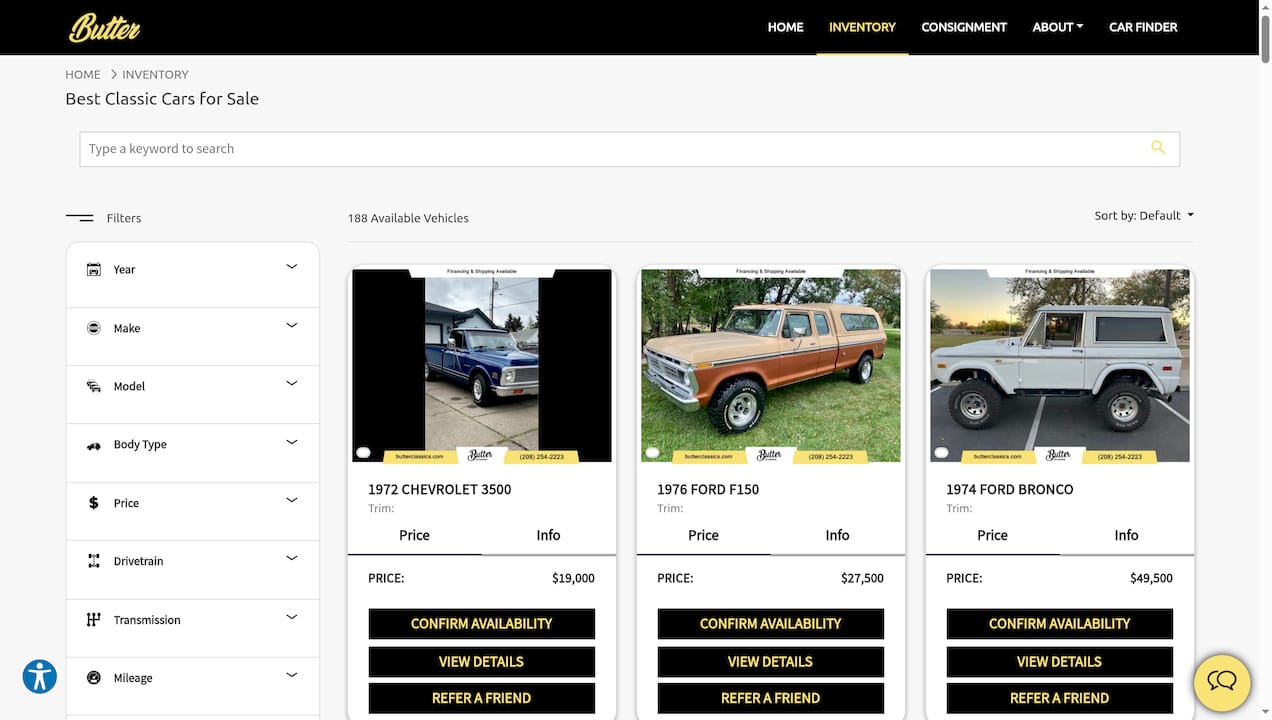
Finding a verified classic car you can actually trust used to mean months of sifting through private listings, chasing sellers for documentation, and hoping the car matched its photos. Butterclassics cuts through that. The marketplace features detailed listings with high-quality images, transparent vehicle specs, and financing pre-qualification so you know your budget before you fall for a car. You can use the car finder tool to locate a specific model or condition grade, browse the full Butterclassics inventory by price or type, and schedule a test drive directly through the platform.
Ready to find your next classic? Browse current listings or submit a car finder request and let the team match you with the right vehicle.
Sources
These US-focused resources cover VIN checks, valuation, inspection guidance, and insurance research.
- Classic Car Buyer's Guide - State Farm®
- A guide to buying classic cars | Progressive
- How to buy a classic car | Classic & Sports Car
Pro Tip: Use Hagerty's valuation tool to establish a condition-grade price range for any car you're seriously considering. Compare that range to the asking price before you make an offer.
Pro Tip: NMVTIS reports are available for a few dollars through authorized providers. Run one on every car, even when the seller provides a Carfax, because the two databases don't always contain the same records.
Pro Tip: Marque-specific owners' clubs maintain registries, parts supplier lists, and forums where experienced members can flag known problem areas for specific model years. Join the relevant club before you buy, not after.
Pro Tip: For out-of-state purchases, contact your state DMV before you close the deal to confirm what documents you'll need for title transfer and whether a physical VIN inspection is required. Requirements vary significantly by state.