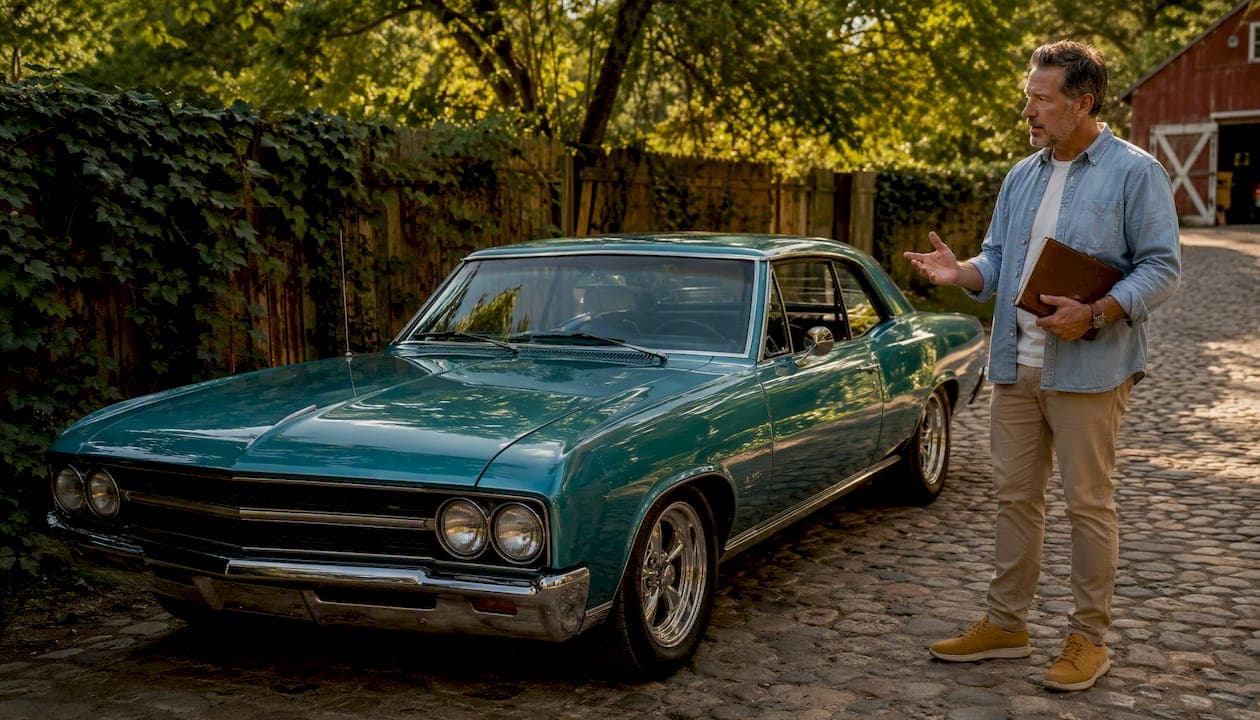
For most U.S. classic-car buyers and sellers looking for a trustworthy alternative to ClassicCars.com, Butterclassics is the recommended starting point. It combines curated inventory, consignment support, and financing pre-qualification in one place, so you're not juggling three different platforms to close a deal.
Here's the quick breakdown by category:
- Curated consignment marketplaces (like Butterclassics): Best for sellers who want professional presentation and for buyers who want verified, high-quality listings without the auction-day pressure.
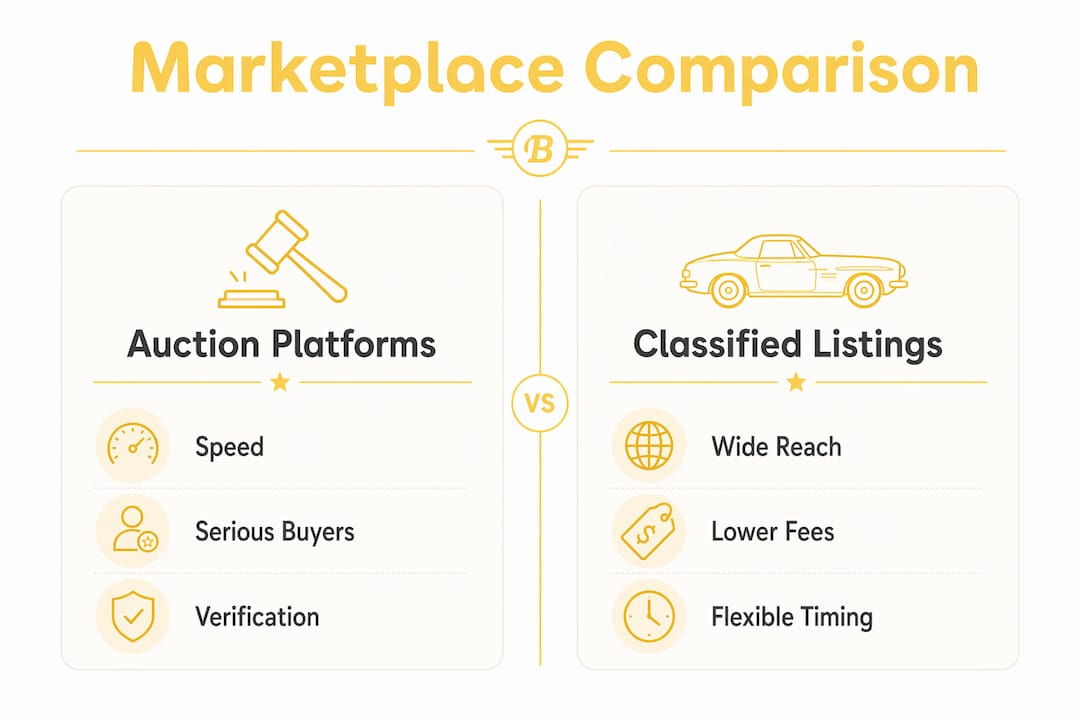
- Specialist auction formats (Bring a Trailer, Hagerty Marketplace, Cars & Bids): Best for sellers with desirable, well-documented cars who want competitive bidding and a defined sale timeline.
- Large classified marketplaces (Hemmings, AutoTrader Classics, eBay Motors): Best for sellers who want maximum exposure and buyers who prefer browsing a wide pool at their own pace.
- Aggregator tools (AutoTempest, Facebook Marketplace): Best for buyers hunting rare finds across multiple sources simultaneously.
Ready to browse or list? Head straight to the Butterclassics inventory or jump to the how-to-choose section below.
Table of Contents
- How do the best ClassicCars.com alternatives compare?
- What each platform type does best (and where Butterclassics fits in)
- How do you pick the right marketplace for your car?
- Auction vs. classified vs. consignment: which model fits your goal?
- Why Butterclassics is a recommended starting point
- Key Takeaways
- The part most sellers get wrong about online marketplaces
- Butterclassics makes selling and buying classic cars smooth as butter
- Useful sources and further reading
How do the best ClassicCars.com alternatives compare?
Picking the right platform comes down to your car, your timeline, and how much hand-holding you want. Transparent fee schedules and clear seller protections are the baseline to look for on any platform you consider.
| Best for | Listing type | Fees & seller costs | Audience / buyer pool | Seller services | Transaction / security features | Typical time-to-sale | U.S. availability |
|---|---|---|---|---|---|---|---|
| Patient sellers, collector buyers | Classified (indefinite) | Low flat listing fee or free tier | Collectors, enthusiasts, dealers | Basic listing tools; some offer consignment add-ons | Varies; limited built-in escrow | Weeks to months | Nationwide |
| Sellers wanting top dollar fast | Specialist auction | Seller fee + buyer premium (commission-based) | Serious collectors, investors | Photography guidance, condition review | Bidding transparency; some escrow on close | 7–14 days from listing | Nationwide |
| Modern enthusiast cars, 1980s–2000s | Enthusiast auction marketplace | Seller fee + buyer premium | Enthusiast community, younger collectors | Listing support, community Q&A | Platform-mediated payment on close | 7–10 days | Nationwide |
| Discovery across many sources | Aggregator / search tool | Free to low-cost for buyers; no seller listing | Serious collectors, bargain hunters | Alerts, saved searches | No direct transaction layer | Ongoing monitoring | Nationwide |
| Low-effort, full-service sale | Consignment / curated marketplace | Commission on sale; no upfront listing fee in many cases | Collectors, investors, enthusiasts | Photography, consignment, financing, shipping help, inspection coordination | Escrow-style workflows, identity verification | Weeks to months | Nationwide |
| Local / casual buyers and sellers | Social marketplace channel | Free | General public, local buyers | None | None built-in; high fraud risk | Days to weeks | Nationwide |
Quick caveats worth knowing:
- Large classifieds give you the widest raw exposure, but indefinite listing duration means your car can sit without urgency unless you price aggressively.
- Specialist auctions create competitive bidding pressure that can push prices above private-sale estimates, but a reserve not met means starting over.
- Aggregator tools are discovery engines for buyers, not transaction platforms. Use them to find cars, then close elsewhere.
- Social marketplace channels carry the highest fraud risk of any category. Never complete a high-value transaction without independent escrow.
What each platform type does best (and where Butterclassics fits in)
Butterclassics
Butterclassics is built specifically for the U.S. collector car market, and it shows in the details. Listings feature high-quality photography and full vehicle specs, so buyers get a real sense of the car before they ever pick up the phone. The consignment service handles the heavy lifting for sellers: presentation, inquiries, and transaction coordination. Financing pre-qualification is available directly on the platform, which opens the door for buyers who don't want to sort out funding separately. For sellers who want a smooth-as-butter experience without the chaos of managing multiple platforms, Butterclassics is a natural first call.

Large classified marketplaces
Hemmings is the granddaddy of classic car classifieds, with decades of collector trust behind it. AutoTrader Classics pulls in a broader general-car audience alongside enthusiasts. eBay Motors adds auction-style urgency as an option within a classified framework. These platforms work best when you have a well-priced car and the patience to field inquiries over weeks or months. Pre-1980 traditional classics tend to perform especially well here because collector-focused buyer pools on dedicated marketplaces match the era better than general-car sites.
Specialist auction formats
Bring a Trailer and Hagerty Marketplace attract serious, well-funded collectors who do their homework. Listings go through a community vetting process, and the comment sections function as a live inspection forum. A well-documented car with matching numbers and a clean title history can fetch prices that beat private-sale estimates. The tradeoff: if your car doesn't generate bidding momentum, you may walk away with nothing after the listing window closes.
Modern enthusiast auction marketplaces
Cars & Bids focuses on enthusiast vehicles from roughly the 1980s through the 2000s, a segment that ClassicCars.com doesn't serve as well. The platform's community skews younger and more digitally engaged. If you're selling a clean Fox-body Mustang, an air-cooled Porsche, or a JDM-era import, this format often outperforms traditional collector classifieds.

Aggregator tools
AutoTempest pulls listings from multiple classified sources into a single search, saving buyers hours of tab-switching. For buyers hunting ultra-rare or matching-numbers examples, specialist aggregator services go further, monitoring auctions, forums, private groups, and social listings simultaneously. Many museum-grade cars change hands before they ever reach a public auction, and aggregators are how serious collectors stay ahead of that market.
Social marketplace channels
Facebook Marketplace generates real local interest for lower-value classics and project cars. The audience is broad but unvetted, and there's no transaction infrastructure. Use it for exposure, but never close a significant deal without moving the payment to a proper escrow workflow.
Pro Tip: If you're listing on more than one platform at once, mark your car as "sale pending" the moment you accept an offer anywhere. Maintain one central record of all active inquiries so you can notify other interested buyers quickly and avoid the nightmare of a double-sale.
How do you pick the right marketplace for your car?
The right platform depends on four things: your car's profile, your urgency, your target buyer, and the fees you're willing to absorb. Get those four right and the choice becomes obvious.
Core criteria checklist:
- Car profile: Pre-1980 collector classic? Lean toward specialist classifieds or auction formats. Post-1980 enthusiast car? Modern auction marketplaces or curated consignment.
- Urgency: Need to sell in two weeks? Auction formats with defined close dates. Happy to wait for the right buyer? Classified or consignment.
- Target buyer: Serious collector with deep pockets? Specialist auction or curated marketplace. Broader audience? Large classifieds or eBay Motors.
- Fees and hidden costs: Always check whether the platform charges a listing fee, a success commission, a buyer's premium, or all three. Opaque fee structures are one of the top seller complaints across the industry.
- Seller protections: Does the platform offer identity verification, buyer funds verification, or an escrow-style payment workflow? For any sale above a few thousand dollars, these features aren't optional. Fraud and transaction risk are the primary concerns in high-value private-vehicle sales.
- Marketing reach: How many active buyers does the platform have? Large classic-car marketplaces with tens of thousands of listings signal a buyer pool large enough to find the right match.
- Inspection and consignment services: Does the platform coordinate pre-sale inspections, professional photography, or transport? These services reduce friction and often increase final sale price.
Questions to ask before you commit:
- Do you verify buyer identity and funds before releasing seller contact details?
- Is there an escrow workflow, or does payment happen directly between buyer and seller?
- What photography or inspection support is included in the listing fee?
- What happens if a buyer backs out after the auction closes?
- Are your fee schedules posted publicly, and are there any additional charges at closing?
Red flags that should stop you cold:
- No posted fee schedule or fees that only appear at closing
- No identity verification for buyers or sellers
- Pressure to complete payment outside the platform
- No recourse or dispute process if a deal falls through
- Requests for wire transfers or gift cards as payment
Common quick questions sellers ask:
How long does it typically take to sell a classic car online? Auction formats close in 7–14 days. Classified listings can run weeks to months depending on price and demand. Consignment timelines vary by platform and car profile.
What fees should I expect? Classified platforms often charge a flat listing fee. Auction platforms typically charge a seller fee plus a buyer's premium. Consignment services take a commission on the final sale price, usually with no upfront listing cost.
Is it safe to list on multiple platforms at once? Yes, with the right safeguards. Use a single-source transaction workflow so you can take offers from any platform and close safely without sharing personal details prematurely. Coordinating concurrent listings requires a clear process for marking a car sold and notifying other buyers quickly.
Pro Tip: When listing on multiple platforms simultaneously, keep a single "deal room" document that tracks every active inquiry, the platform it came from, and the current offer status. The moment you accept an offer, update that document and pull or mark the listing everywhere else within the hour.
Auction vs. classified vs. consignment: which model fits your goal?
The transaction model you choose shapes everything: your timeline, your net proceeds, and how much work you do.
Match your goal to the model:
- Fast sale → auction format (defined close date, competitive bidding)
- Highest net price with patience → classified or consignment (no deadline pressure, right buyer finds you)
- Low effort → consignment with inspection and photography services (platform does the work)
How each model works in practice:
- Auction: You list with a reserve price. Bidding runs for a set window (typically 7–14 days). If the reserve is met, the sale closes automatically. If not, you relist or negotiate with the high bidder. Fast, transparent, but outcome-dependent on bidder interest.
- Classified: You set the price and field inquiries indefinitely. No deadline. You negotiate directly with buyers. Patient sellers of high-demand collector cars consistently get better outcomes here than rushing to auction.
- Consignment: You hand the car (or its listing) to a platform or dealer. They handle photography, inquiries, and negotiation. You pay a commission on the final sale. Lowest effort, but you give up some control over timing and price.
- Aggregator-driven private sale: A buyer finds your listing through an aggregator tool and contacts you directly. The transaction then follows a private-sale workflow. Fast discovery, but you still need a secure payment process on your end.
Fee and risk tradeoffs at a glance:
- Upfront listing fees (classifieds) = low financial risk, slower pace
- Commission on sale (consignment) = no upfront cost, platform-aligned incentive to sell high
- Buyer's premium (auctions) = reduces your net if buyers factor it into bids
- No platform transaction layer (social channels) = highest fraud exposure
Pro Tip: For auction-ready cars, organize your provenance documentation before the listing goes live. Matching-numbers documentation, a clean title history, maintenance records, and a walkaround video all belong in the listing from day one. Buyers pay a premium for professionally verified condition reports, and that premium often exceeds the cost of getting one.
Why Butterclassics is a recommended starting point
Butterclassics is a leading marketplace option for U.S. sellers who want a full online marketplace experience with consignment and financing support built in. That combination is rarer than it sounds. Most platforms make you choose between a DIY classified listing and a full-service consignment house. Butterclassics handles both.
What the platform delivers for trust and conversions:
- High-quality photography and detailed vehicle specs in every listing
- Consignment services that cover presentation, inquiries, and transaction coordination
- Financing pre-qualification available directly on the platform
- Inspection and transport coordination support
- Escrow-style payment workflows that protect both buyer and seller
- Seller support throughout the process, not just at listing
When does Butterclassics make more sense than a pure auction or aggregator strategy? When you're selling a mid-to-high-value classic and you want the transaction to go smoothly without managing five different platforms. Auction formats are great for generating competitive bids, but they require a well-documented car and a willingness to accept the outcome. Aggregators are discovery tools, not transaction platforms. Butterclassics handles the full arc from listing to close.
For buyers, the curated inventory means you're browsing cars that have been presented with care, not a sea of phone-photo listings with missing VINs. The car finder tool helps you locate specific makes and models without scrolling through thousands of unrelated results.
Pro Tip: On any curated marketplace, the quality of your documentation directly affects how quickly your car sells and at what price. Pull together the title, any matching-numbers certification, service records, and a clean Carfax before you submit a consignment inquiry. Listings that arrive with complete paperwork move faster and attract stronger offers.
Key Takeaways
The most effective approach to finding ClassicCars.com alternatives is matching your car's profile and your urgency to the right transaction model, then choosing a platform with transparent fees and verified buyer protections.
| Point | Details |
|---|---|
| Match model to urgency | Auction formats close in about one to two weeks; classified and consignment listings suit patient sellers chasing top dollar. |
| Fees vary by model | Classifieds charge flat listing fees; auctions add a buyer's premium; consignment takes a commission with no upfront cost. |
| Security features matter | Always confirm identity verification, buyer funds verification, and escrow-style payment before listing a high-value car. |
| Aggregators are for discovery | Tools like AutoTempest surface off-market cars across many sources, but you still need a secure transaction workflow to close. |
| Butterclassics as your starting point | Butterclassics combines curated listings, consignment, financing pre-qualification, and escrow-style workflows in one U.S. marketplace. |
The part most sellers get wrong about online marketplaces
There's a persistent belief in the classic car world that the platform with the most listings automatically gives you the best outcome. It doesn't. Scale matters for buyer reach, but it's not the whole story.
What actually drives a successful sale is the match between your car's profile and the platform's buyer pool. A numbers-matching 1969 Camaro listed on a general-car classified site will underperform the same car listed on a specialist collector marketplace, even if the general site has ten times the traffic. The buyers who will pay full collector value aren't browsing general listings. They're on specialist platforms, monitoring aggregator alerts, and watching auction results.
The other thing sellers consistently underestimate is documentation. A walkaround video, a clean title history, matching-numbers certification, and a recent inspection report don't just build buyer confidence. They reduce the back-and-forth that kills deals. Buyers who have to ask for basic documentation often walk away, not because they lost interest, but because the friction felt like a red flag.
Platforms with built-in verification and escrow workflows reduce that friction on the transaction side. But the seller's job is to reduce it on the presentation side first. Get the documentation right, choose the platform that matches your buyer profile, and the transaction tends to take care of itself.
Butterclassics makes selling and buying classic cars smooth as butter
You've just compared every major platform category. Here's the short version of what Butterclassics brings to the table that most alternatives don't: a full-service U.S. marketplace where you can list, consign, get financing pre-qualified, and close a deal without bouncing between platforms.
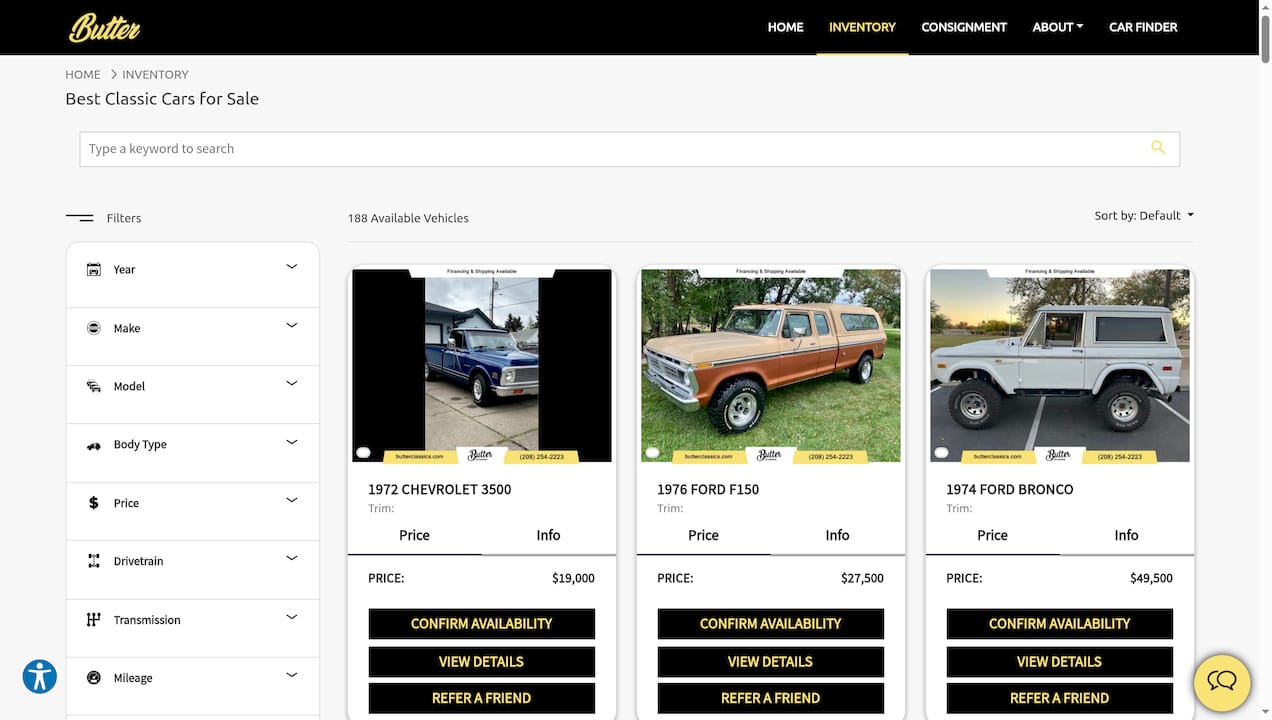
For sellers, the consignment service handles photography, inquiries, and transaction coordination. For buyers, the curated inventory means every listing comes with the detail you need to make a confident decision. Financing pre-qualification is available on-site, and test drive scheduling is a few clicks away.
- Ready to browse? Check the current inventory for trucks, muscle cars, Corvettes, Broncos, and more.
- Looking for something specific? Use the car finder to tell us what you want and we'll track it down.
Visit Butterclassics to get started today.
Useful sources and further reading
Butterclassics resources:
- Classic Cars For Sale — Butterclassics Inventory: Browse the full curated inventory of trucks, muscle cars, Corvettes, and more.
- Car Finder Tool: Tell us what you're looking for and we'll help locate it.
- Classic Car Valuation Methods: Your 2026 Owner's Guide: Understand how to price your car before you list it anywhere.
- Buying Investment-Grade Classic Cars: The Serious Collector's Guide: Deep guidance for buyers focused on collector-grade acquisitions.
- Classic Car Market Trends Checklist for 2026 Buyers: A practical checklist for buyers navigating the 2026 market.
- Best Facebook.com Alternatives for Classic Car Enthusiasts: Covers social and local marketplace options with honest pros and cons.
- Top 4 Highoctaneclassics.com Marketplace Alternatives 2026: Deeper platform-by-platform analysis for readers who want more options.
External research:
- 7 Best Places to Sell a Classic Car: Covers seller behavior, platform categories, and fee structures with practical guidance.
- Classic Car Hunter: Explains how aggregator and monitoring tools surface off-market collector cars before they reach public auctions.
- PrivateAuto — Sell Your Classic Car: Detailed guidance on secure transaction workflows, identity verification, and multi-platform listing strategy.
These links are for background research. The recommendations in this article focus on trusted practices and platform categories rather than any single brand outside of Butterclassics.