
A classic car market trends checklist is the structured framework collectors use to evaluate segment performance, condition grades, auction costs, and liquidity signals before committing to a purchase. The 2026 market rewards disciplined buyers who track data from sources like Hagerty, Black Book, and Morningstar rather than relying on gut feel. With market bifurcation sharpening between high-end modern classics and older vehicles, knowing exactly what to check before you bid or buy is the difference between a smart acquisition and an expensive lesson.
1. Understand segment-specific classic car market trends in 2026
Not every classic car segment moves in the same direction, and treating the market as one monolithic block is the fastest way to overpay. Q2 2026 data from Black Book shows Muscle Cars up 1.15% and Pony Cars up 0.92%, while American Classics dropped 2.38% and Sports Cars fell 6.29%. That spread tells you exactly where selective demand is concentrating.

The bifurcation is real and growing. Hagerty reports 27% of classic cars grew in value while 12% decreased, with the majority sitting flat. High-end modern classics and blue-chip vehicles are outperforming the broader market, while older, lower-condition cars are softening. This means your checklist needs a segment filter before anything else.
Emerging segments worth watching include vintage pickups and early SUVs, which are attracting younger collectors who want usability alongside collectibility. These categories are not yet fully priced in, which creates real opportunity for buyers paying attention.
- Muscle and Pony Cars: Modest positive momentum. Focus on documented, numbers-matching examples.
- American Classics: Declining segment. Require stronger condition and provenance to justify current asking prices.
- Sports Cars: Softening significantly. Patience is rewarded here.
- Vintage pickups and early SUVs: Emerging demand. Watch auction results closely for pricing signals.
Pro Tip: Cross-reference Black Book's quarterly collectible car updates with Hagerty's Price Guide before finalizing any segment focus. One source alone gives you half the picture.
2. Assess vehicle condition using standardized grading scales
Condition is the single biggest variable in classic car valuation, and most buyers underestimate how much a one-grade difference affects price. Hagerty's grading system runs from Condition #1 (show quality) through Condition #4 (driver), and the price spread between grades on the same model can exceed 50%. Tracking condition-specific price trends rather than aggregate averages gives you a far more accurate picture of what you are actually buying.
Originality is gaining weight in buyer decisions. Black Book notes that buyers are increasingly prioritizing originality and desirability, which means a numbers-matching car with original paint commands a premium that a restored example simply cannot match in today's market. Your checklist should include a dedicated originality verification step covering VIN decoding, build sheet confirmation, and date-coded component checks.
Structural rust is the condition factor that kills deals and budgets. A pre-purchase inspection from a qualified mobile inspector typically costs $300 to $800, and structural rust repairs can easily exceed $10,000. That math makes a PPI one of the highest-return investments in your buying process.
- Verify condition grade against Hagerty's published scale before comparing prices
- Request a full inspection report covering frame, floor pans, and rockers
- Budget $300 to $800 for a mobile pre-purchase inspection on any serious candidate
- Check for signs of prior accident repair, which affects both value and safety
- Confirm originality of major components: engine, transmission, and body panels
Pro Tip: Use Butterclassics' dealer inspection checklist as a starting template before you commission your own PPI. It covers the structural risk factors that most buyers miss on first walkthroughs.
3. Calculate the true cost of buying at auction
The hammer price is not what you pay. At major auction houses, the buyer's premium alone adds a substantial amount on top of the winning bid. Christie's charges 27% on the first $1.5 million of hammer price, 22% on the next $6.5 million, and 15% beyond that. For a $30,000 classic car, that premium adds over $8,000 before you factor in anything else.
Here is a practical cost breakdown for a $30,000 hammer price purchase:
- Hammer price: $30,000
- Buyer's premium at 27%: $8,100
- State sales tax (varies by state, estimate 6%): $1,800
- Pre-purchase inspection: $300 to $800
- Transport or shipping: $500 to $1,500 depending on distance
- Total acquisition cost: $40,700 to $42,200
That gap between hammer price and total cost is where buyers get burned. A car that looks like a deal at $30,000 may not pencil out at $42,000 when you factor in your intended resale or insurance value. Your classic car auction checklist must include a total cost calculator completed before you place a single bid.
Pro Tip: Set your maximum bid by working backward from your total acquisition budget, not forward from the hammer price. Subtract the premium, taxes, transport, and inspection first. Whatever is left is your ceiling.
4. Monitor liquidity signals as early market indicators
Price indexes tell you what cars sold for. Liquidity metrics tell you how easily they sold, and that distinction matters enormously for timing your purchase. The average days on market for classic cars currently sits at 188 days, which signals buyer's market conditions across most segments. That number gives you real negotiating leverage.
Private sales activity has reached a four-year low, and auction median sale prices have dipped to $26,513 with average sale prices at $25,421. These figures reflect a meaningful gap between what sellers expect and what buyers are willing to pay. Sellers anchored to 2022 peak prices are sitting on inventory longer, which creates opportunity for patient buyers.
The share of cars selling above insured value has dropped sharply. Only about 35% of cars now sell above insured value, compared to over 50% at the 2022 peak. This shift means insured value is now a reasonable ceiling for most negotiations rather than a floor.
- Days on market: 188-day average signals buyer's market. Use it to justify lower offers.
- Private sales volume: Four-year low means less competition from other buyers.
- Sales above insured value: Down to 35% from 50%+. Insured value is now a credible price anchor.
- Auction median: $26,513 gives you a realistic benchmark for mid-market vehicles.
5. Use expert valuation guides and cross-check your numbers
No single valuation source is complete on its own. The Hagerty Price Guide updates quarterly and covers 39,606 cars priced across condition grades, making it the most granular tool available for condition-specific comparisons. Black Book's collectible car updates add transaction-level data that reflects what buyers are actually paying, not just what cars are theoretically worth.
The Hagerty Price Guide's overall index is at its lowest point since 2012, while the blue-chip index remains nearly flat. That divergence confirms the K-shaped pattern in the market: trophy cars hold value while the broad market softens. If you are buying outside the blue-chip tier, your valuation work needs to be especially thorough.
Cross-checking auction results from the past 90 days against guide values is a non-negotiable step. Guides reflect historical data with a lag, while recent auction results show you where the market is right now. Butterclassics' classic car valuation guide walks through how to combine these sources for a balanced view that accounts for both condition and current demand.
- Pull the Hagerty Price Guide value for the specific condition grade you are evaluating
- Check Black Book's most recent quarterly update for segment-level trend direction
- Review the last 90 days of auction results for the same make, model, and condition
- Compare asking price to insured value as a quick sanity check on seller expectations
- Repeat this process quarterly, since guide values update and market conditions shift
Key takeaways
A disciplined classic car market trends checklist covering segment performance, condition grading, total acquisition cost, and liquidity signals is the most reliable way to buy well in 2026's bifurcated market.
| Point | Details |
|---|---|
| Segment selection matters | Muscle and Pony Cars show modest gains while Sports Cars and American Classics decline in 2026. |
| Condition grade drives value | A one-grade difference on Hagerty's scale can shift price by 50% or more on the same model. |
| Auction costs exceed hammer price | Buyer's premiums of 27% plus taxes and transport can add 35%+ to your total acquisition cost. |
| Liquidity signals favor buyers | With 188 average days on market and only 35% of cars selling above insured value, negotiating power is real. |
| Cross-check valuation sources | Combine Hagerty Price Guide, Black Book, and recent auction results for the most accurate picture. |
What I've learned from building a real buying checklist
I have watched buyers walk into auctions with a number in their head and walk out having paid 40% more than they planned. The buyer's premium is the most consistently underestimated cost in this hobby, and it catches even experienced collectors off guard when they get caught up in the moment of bidding.
The market bifurcation we are seeing in 2026 is not a temporary blip. It reflects a structural shift in who is buying and why. Younger collectors want cars they can actually drive and show, which is why vintage pickups and early Broncos are outperforming traditional American Classics. If your checklist was built for the 2018 or 2020 market, it needs a full update before you use it today.
The most valuable habit I have developed is separating liquidity analysis from price analysis. A car that is priced fairly but has been sitting for 180 days is telling you something. Either the condition does not match the listing photos, the seller's expectations are still anchored to 2022, or the segment has genuinely softened. All three of those scenarios change how you approach the negotiation. Patience combined with a well-built checklist is genuinely the edge most buyers do not have.
For anyone serious about buying investment-grade classics, the checklist is not a one-time document. It is a living tool you update every quarter as new data comes in from Hagerty and Black Book. The buyers who do that consistently are the ones who find the deals.
— Tony
Find your next classic at Butterclassics
You have done the research. Now it is time to put your checklist to work on real inventory.
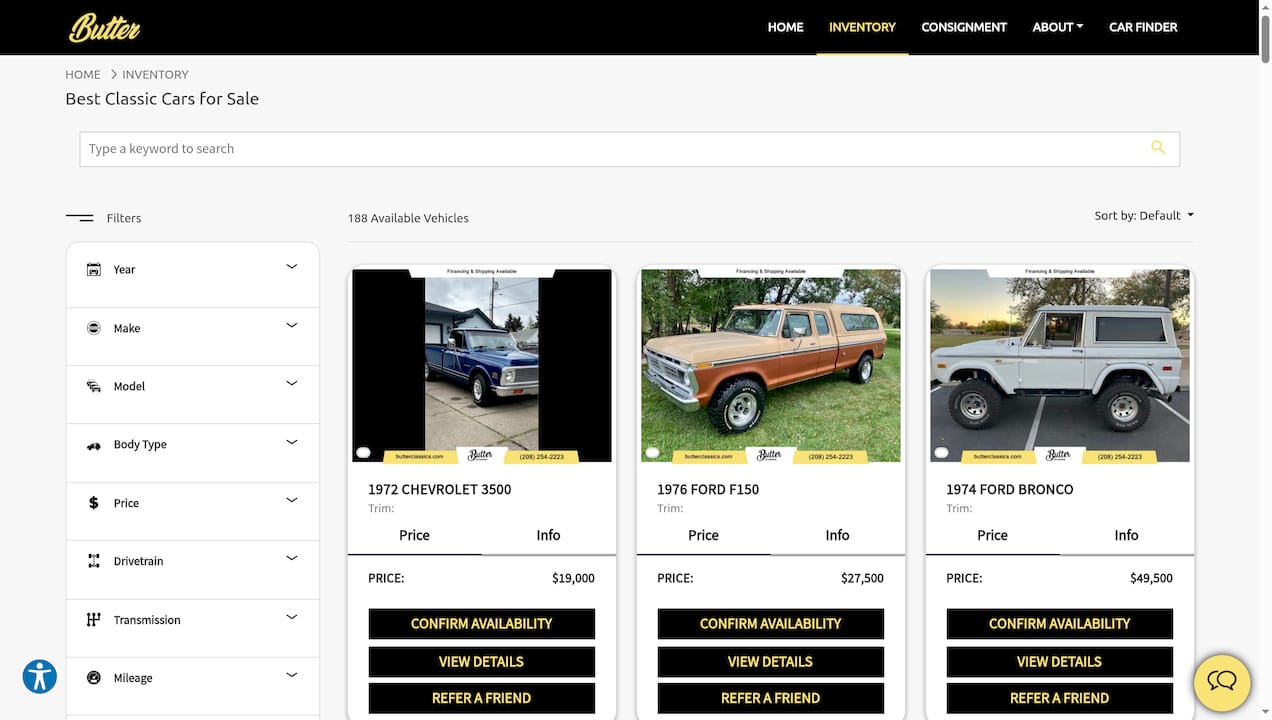
Butterclassics curates a hand-selected inventory of muscle cars, Corvettes, vintage trucks, Broncos, and investment-grade classics, each vetted for quality and desirability. The Butter Certified program gives you the confidence of knowing a car has met strict condition and originality standards before it ever reaches you. Browse the full Butterclassics inventory and connect your 2026 market knowledge with cars that are actually worth buying. Smooth as butter, every time.
FAQ
What is a classic car market trends checklist?
A classic car market trends checklist is a structured evaluation tool covering segment performance, vehicle condition, total acquisition cost, and liquidity signals. Buyers use it to make data-driven decisions rather than relying on asking prices alone.
Which classic car segments are performing best in 2026?
Muscle Cars and Pony Cars show modest positive growth in 2026, up 1.15% and 0.92% respectively, according to Black Book's Q2 update. American Classics and Sports Cars are declining, making segment selection a critical first step in any buying checklist.
How much does a pre-purchase inspection cost for a classic car?
A mobile pre-purchase inspection typically costs between $300 and $800. Structural rust discovered during inspection can add $10,000 or more in repair costs, making the PPI one of the most cost-effective steps in the buying process.
What buyer's premium should I expect at a classic car auction?
Major auction houses charge a buyer's premium that effectively adds 27% to 28% on top of the hammer price at common transaction tiers. Always calculate your total acquisition cost including premium, taxes, transport, and inspection before setting your maximum bid.
Is 2026 a good time to buy a classic car?
Current data points to buyer-friendly conditions. The average days on market sits at 188 days, private sales activity is at a four-year low, and only 35% of cars are selling above insured value. These signals give informed buyers real negotiating leverage.