
A blue chip classic car is a top-tier collectible vehicle defined by rarity, documented provenance, cultural significance, and a proven record of holding or growing in value over time. The term borrows directly from stock market language, where "blue chip" signals stability and prestige. Hagerty's Blue Chip Index tracks exactly 25 post-war collectible automobiles that represent this elite category, giving collectors a stock market-style benchmark for the segment. Cars like the Ferrari 250 GTO and the Mercedes-Benz 300SL Gullwing sit at the top of this list, not because of hype, but because decades of market data back their status.
What is a blue chip classic car, and what defines one?
The phrase "blue chip classic car" is a market term, not an official industry classification. The recognized collector industry vocabulary uses terms like "investment-grade" or "concours-quality" vehicles, but Hagerty popularized "blue chip" as a shorthand for the most sought-after post-war cars. Understanding both terms helps you speak the language of serious collectors and auction houses alike.
Five core traits separate a blue chip classic from a standard collectible:
- Rarity. Production numbers matter enormously. The Ferrari 250 GTO had only 36 examples built between 1962 and 1964. The Mercedes-Benz 300SL Gullwing, produced from 1954 to 1957, numbered just 1,400 units. Low survival rates from accidents, neglect, and racing attrition push rarity even further.
- Provenance. A car's documented ownership history, original factory build sheet, and matching chassis and engine numbers are non-negotiable. Matching-numbers authenticity and detailed history files are prerequisites at major auction houses like RM Sotheby's.
- Cultural impact. Blue chip cars shaped automotive history. The Porsche 911 Carrera RS 2.7 redefined sports car handling. The Lamborghini Miura invented the mid-engine supercar layout. These cars did not just sell well. They changed what cars could be.
- Timeless design. Blue chip classics look as striking today as they did at launch. Design longevity signals enduring desirability, which directly supports long-term value.
- Condition. Hagerty's index uses condition #2 "excellent" as its valuation standard, meaning the market benchmark is anchored to cars in near-perfect, show-ready shape.
Pro Tip: When evaluating any classic car for blue chip potential, request the full ownership history file before discussing price. A car without documented provenance is a collectible, not an investment.
How does the blue chip classic car market behave?

The blue chip collector car market behaves more like fine art than like the used car market. Blue chip classics appreciate steadily over decades, with rare corrections, driven by global wealth shifts and collector passion rather than short-term speculation. That stability is the core appeal for serious investors.
Hagerty's data makes this concrete. In early 2025, only 4 of the 25 cars in the Blue Chip Index showed any price movement at all. The index slid just 2% the prior year. That near-zero movement is a feature, not a flaw. It means blue chip cars resist the volatility that hits lower-tier collectibles when trends shift or the economy wobbles.
"Blue-chip classic cars are the post-war 'A-list' cars most sought-after by collectors worldwide, and they hold value better than the broader market." — Hagerty
Compare that to modern speculative collectibles, where values can swing 30% or more in a single year based on social media attention or celebrity ownership. Blue chip cars attract a different buyer profile entirely: global wealthy collectors who measure performance in decades, not quarters.
| Market segment | Price volatility | Primary value driver | Typical holding period |
|---|---|---|---|
| Blue chip classics | Very low | Rarity, provenance, cultural legacy | 10 to 30+ years |
| Mid-tier collectibles | Moderate | Nostalgia, condition | 5 to 15 years |
| Modern speculative cars | High | Hype, celebrity, trends | 1 to 5 years |
| Standard used cars | Moderate to high | Utility, mileage | 3 to 7 years |
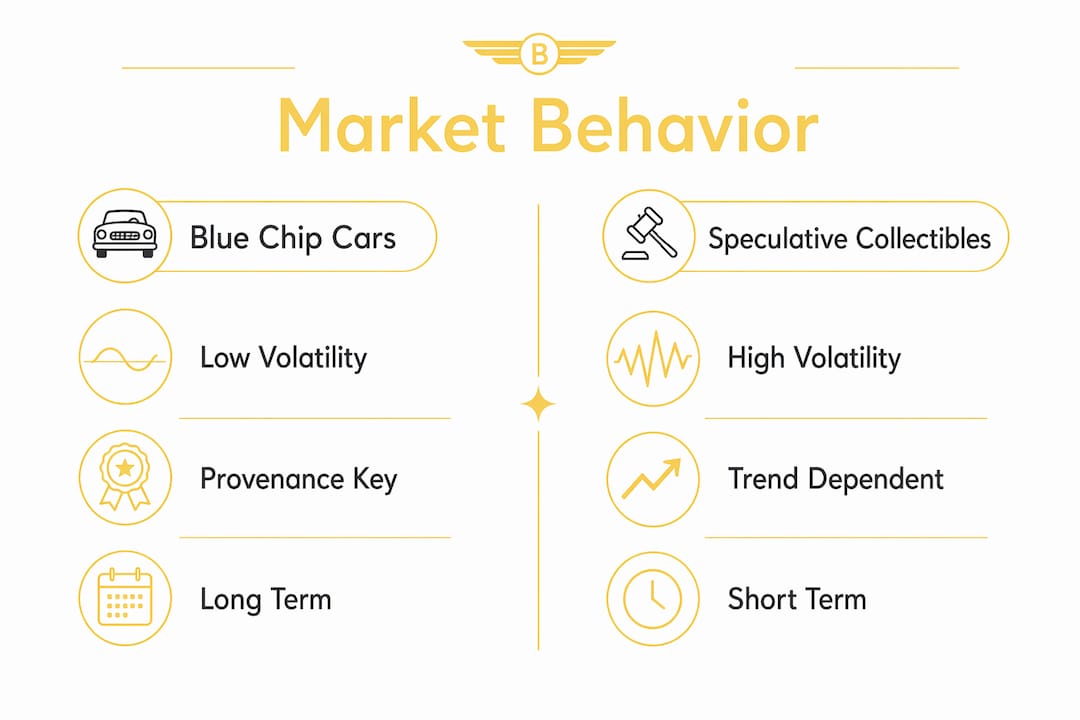
Provenance traceability is a key reason blue chip cars outperform. McKinsey identifies provenance histories as the primary tool for overcoming information gaps in collectible car investments. A car with a clear chassis number trail, factory documentation, and auction house certification carries far less valuation risk than one with gaps in its history.
Top blue chip classic cars and why they qualify
The following cars represent the gold standard of the collector market. Each earns its status through a combination of rarity, racing heritage, design legacy, and auction performance.
| Model | Production count | Key attribute | Notable market moment |
|---|---|---|---|
| Ferrari 250 GTO | 36 units | Racing pedigree, Enzo endorsement | Multiple sales above $50 million |
| Mercedes-Benz 300SL Gullwing | ~1,400 units | Iconic doors, first fuel-injected road car | Consistent six-figure auction results |
| Lamborghini Miura | ~764 units | Invented the mid-engine supercar | Values tripled over two decades |
| Porsche 911 Carrera RS 2.7 | ~1,580 units | Defined modern sports car dynamics | Regularly exceeds $1 million at auction |
| Mercedes-Benz 300 SLR Uhlenhaut Coupé | 2 units | Pinnacle of 1950s racing technology | Sold for $143 million in 2022 |
The Ferrari 250 GTO is the clearest example of what blue chip status means. Rarity, racing heritage, and Enzo Ferrari's personal involvement in its development make it the market-defining blue chip car. Every one of the 36 examples is individually documented and tracked by the collector community worldwide.
The Porsche 911 Carrera RS 2.7 deserves special mention for a different reason. It was a road car built to homologate a racing version, meaning Porsche had to produce a minimum number for public sale. That racing DNA, combined with its lightweight construction and the iconic "ducktail" spoiler, gave it a cultural footprint far larger than its production numbers suggest. You can explore a classic Porsche 356B to get a feel for the era's engineering philosophy before the RS era began.
Pro Tip: Auction results from RM Sotheby's, Gooding and Company, and Bonhams are the most reliable public benchmarks for blue chip valuations. Cross-reference at least three recent sales of the same model before forming a price opinion.
What to consider when investing in blue chip classic cars
Investing in blue chip classics rewards patience and punishes shortcuts. Here is what you need to get right before committing capital.
-
Verify matching numbers first. The engine number, chassis number, and body number must all correspond to the original factory records. A numbers-matching Ferrari 250 GTO and a non-matching example of the same model are not the same investment. Certification and auction house documentation significantly influence buyer confidence and market liquidity.
-
Assess the full provenance file. Request every document: the original build sheet, service records, past auction catalogues, and ownership history. Gaps in the record reduce value and increase risk. McKinsey's research confirms that provenance traceability is the primary tool for reducing information asymmetry in classic car investments.
-
Understand condition grading. Hagerty uses a 1 to 4 condition scale. Condition #1 is a perfect show car. Condition #2 is excellent, the standard for the Blue Chip Index. Condition #3 cars are good drivers but carry a meaningful valuation discount. Know exactly where any car you consider sits on that scale.
-
Plan for a long holding period. Blue chip classics are not a quick flip. The value appreciation cycle plays out over 10 to 30 years. Collectors who bought a Lamborghini Miura in the 1990s and held it through 2020 saw extraordinary returns. Those who bought at peak hype and sold within five years often broke even at best.
-
Use certified dealers and major auction houses. Private sales carry higher risk of misrepresentation. Established platforms with certification programs and independent inspection services reduce exposure to fakes and misrepresented cars. The Butterclassics certified program is one example of how dealers are formalizing provenance verification for buyers.
Pro Tip: Never skip an independent pre-purchase inspection by a marque specialist. A Ferrari specialist sees things a general mechanic misses, and a $500 inspection can save you from a $50,000 mistake.
Key takeaways
A blue chip classic car earns its status through rarity, verified provenance, and cultural legacy, not just age or brand name.
| Point | Details |
|---|---|
| Definition is market-driven | Hagerty's Blue Chip Index of 25 cars sets the benchmark for what qualifies as blue chip. |
| Provenance is non-negotiable | Matching numbers and documented history files are prerequisites for investment-grade status. |
| Market stability is the key advantage | The Blue Chip Index moved just 2% in a full year, far less than most collectible segments. |
| Condition grade determines value | Two identical models can have very different investment profiles based on condition alone. |
| Long-term horizon is required | Blue chip classics reward patient collectors who hold for decades, not years. |
Why blue chip classics still make sense to me
I have watched the collector car market cycle through several waves of enthusiasm and correction over the years. What strikes me most about blue chip classics is that they are genuinely immune to the noise that derails other collectible categories. When NFTs collapsed, when certain modern hypercars lost 40% of their value overnight, the Ferrari 250 GTO and the 300SL Gullwing barely moved. That is not luck. That is structural.
What I find underappreciated is the emotional dimension of this market. The buyers who hold blue chip cars for 20 years are not purely financial investors. They are people who genuinely love these objects. That passion creates a floor under prices that no spreadsheet can fully capture. A car that moved Enzo Ferrari to tears, that won Le Mans, that defined an era of design, will always find a buyer willing to pay for that story.
The one thing I would caution new collectors about is confusing the model name with blue chip status. The blue chip label is a market construct, as Hagerty's index makes clear. Two examples of the same model can have completely different investment profiles depending on condition, provenance, and history. Buying a famous nameplate without doing the documentation work is how collectors get burned.
The future looks interesting. Younger collectors are entering the market, and their tastes skew toward Japanese sports cars from the 1990s and early 2000s. Whether those cars eventually earn blue chip status remains to be seen. For now, the post-war European and American icons remain the safest ground for serious investment.
— Tony
Find your next blue chip classic at Butterclassics
Ready to move from research to ownership? Butterclassics specializes in investment-grade classic and vintage vehicles, with a hand-selected inventory that includes the kinds of provenance-verified, condition-graded cars serious collectors actually want. Every vehicle goes through a thorough review process so you know exactly what you are getting.
For buyers who want extra peace of mind, the Butter Certified program provides independent verification of condition and provenance documentation, giving you the confidence to buy with clarity. Whether you are adding a cornerstone piece to an existing collection or making your first serious acquisition, the Butterclassics team is here to make the process smooth as butter.
FAQ
What makes a classic car "blue chip"?
A blue chip classic car earns that status through rarity, verified provenance, cultural significance, and a track record of stable or appreciating value. Hagerty's Blue Chip Index tracks 25 post-war cars that meet these criteria as a market benchmark.
How is a blue chip car different from a regular classic car?
Regular classic cars may be old, desirable, or nostalgic, but they lack the combination of extreme rarity, documented history, and global collector demand that defines blue chip status. Blue chip cars also show far less price volatility than the broader collectible market.
Is investing in classic cars a good idea?
Investing in blue chip classic cars can deliver strong long-term returns, but it requires patience, deep due diligence, and a holding period measured in decades rather than years. Condition grading and provenance verification are the two factors that most directly determine investment quality.
What are the most famous blue chip classic cars?
The Ferrari 250 GTO, Mercedes-Benz 300SL Gullwing, Lamborghini Miura, and Porsche 911 Carrera RS 2.7 are among the most recognized blue chip classics. The Mercedes-Benz 300 SLR Uhlenhaut Coupé set the all-time auction record at $143 million in 2022.
How do I verify a blue chip car's provenance?
Request the full history file including the original build sheet, service records, and past auction documentation. Cross-reference chassis and engine numbers against factory records, and use a marque specialist or certified dealer to confirm matching-numbers status before purchase.