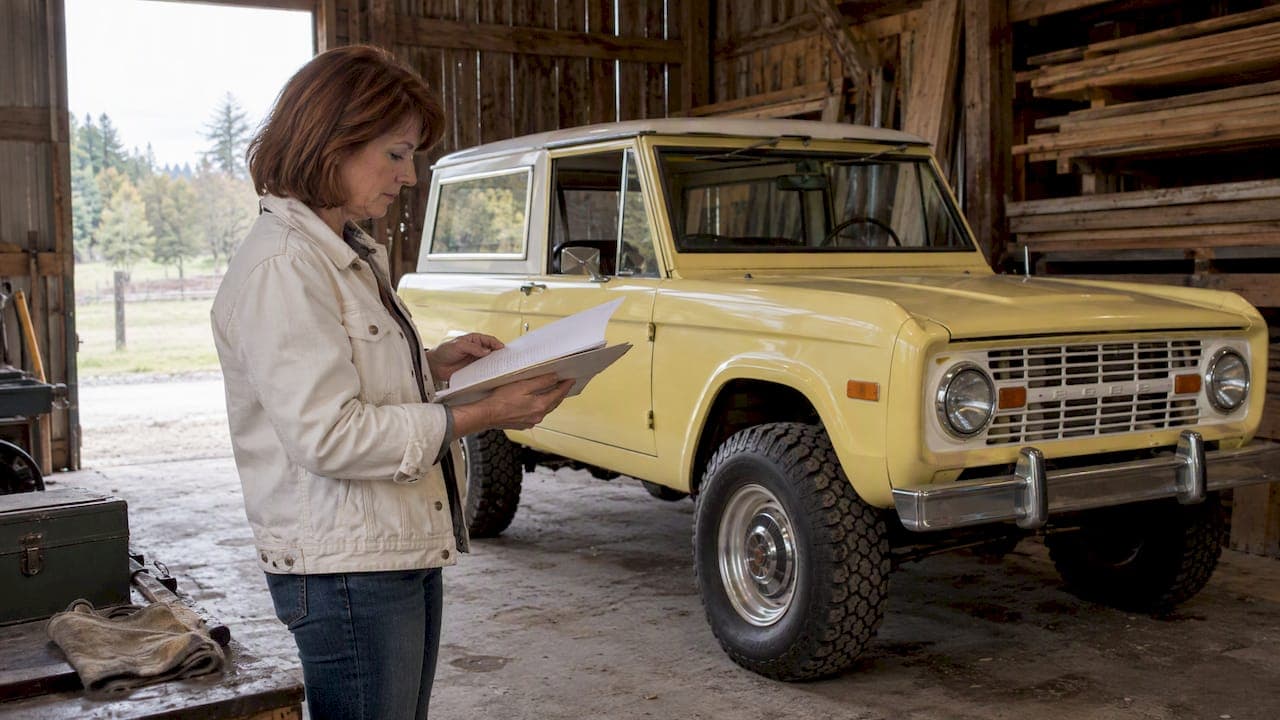
A title only classic car is a car the state has recorded you as the owner of, without issuing plates or registration. You own it, but you can't legally drive it on public roads. Title only is a perfectly normal way to hold a car during a restoration, in storage or in transit. It is not a special kind of title, and it says nothing about whether the car's paperwork is clean. Here's how it works, what it costs you, and how to buy one without getting burned.
TL;DR
- Title only means ownership without road use. The state records you as the owner, but you get no plates, no registration and no permission to drive.
- Rules differ by state. There is no federal title only process, so the state where you'll title the car sets the forms, fees and taxes.
- Title only is not the same as no title. A car with missing papers needs a different route, such as a bonded title or a special antique procedure.
- Call the DMV before you pay. Get the VIN, a signed bill of sale and the destination state's checklist first, then transport the car rather than driving it.
Table of Contents
- What "title only" actually means
- When a title only classic makes sense
- What you still owe when you skip registration
- Title only vs. no title: two different problems
- Is a 25-year-old car automatically a classic?
- Our take: the paperwork is part of the car
- A buyer's workflow, step by step
- Red flags on a title only listing
- Buying through us instead
- Selling a title only classic
- FAQ
- Sources
What "title only" actually means
Two documents get mixed up all the time. A title answers one question: who owns this vehicle? Registration, plates, insurance and inspection answer a different one: may it be driven? On an ordinary purchase, the state hands you both together, so most people never notice the difference.

Title only splits them apart. New Mexico, for example, issues a title without a registration certificate or a license plate under certain conditions. Massachusetts treats it as the transaction for a buyer who has purchased a vehicle but isn't ready to register it. California describes a title only vehicle as one not previously registered in the state, titled without registration.
So when a seller says "title only," translate it like this: the car can be legally owned, but it is not road legal today. That's all. It doesn't mean the history is clean, the VIN is right or the ownership chain is unbroken. You still have to check those yourself.
When a title only classic makes sense
Title only is handy when you want to own a car but can't or won't drive it yet. Common cases:
- A restoration in progress. The car has no working brakes, lights or drivetrain, and you won't insure it until it runs.
- Long-term storage. You're parking a collector car for a season or several years and don't want to pay for plates and coverage you aren't using.
- A purchase from out of state. The car is on a trailer, headed to your garage, and registration can wait until it's there.
- A nonresident buyer. New Mexico lists reconstruction, lack of insurance, nonresident transfers and certain dealer transactions as title only situations.
For a car that is being rebuilt, New Mexico lets a buyer who doesn't plan to operate it for an extended period pay the title fee and excise tax, take no plate, and register later once the car is operable and insured. That's the pattern most states follow in spirit, even though the details change at every border.
What you still owe when you skip registration
Here's the surprise for many first-time buyers: deferring registration doesn't mean deferring everything. Taxes and title fees can still be due. In New Mexico, the applicant pays the title fee and excise tax even without a plate. Louisiana's procedure for older vehicles lists title, handling, mortgage-recordation and sales or use tax fees.
Some states also want proof that you won't drive the car. California requires a Statement of Facts (REG 256) and a non-operation form (REG 102) for its title only procedure. Massachusetts requires title within 10 days of purchase and prohibits operating the car until it is registered.
The lesson: don't budget for a title only car as if it were free to hold. Ask the DMV for the full list of charges before you commit.
Title only vs. no title: two different problems
This is where buyers get into real trouble. A title only transaction assumes you have valid ownership paperwork to hand over. A car with no title at all is an ownership-evidence problem, and state agencies treat it that way. That's why the paths for missing titles involve inspections, notarized bills of sale, record searches and sometimes club letters or court orders.
Some examples of how far apart states can be:
| State | Route for a classic with missing paperwork | What it asks for |
|---|---|---|
| Louisiana | No-record procedure for antique, classic or vintage vehicles | Application, law-enforcement physical inspection, notarized bill of sale or invoice, any security agreement, organized automobile-club membership statement (policy) |
| Nebraska | Antique certificate for vehicles built before 1940 with no Nebraska title in the preceding 30 years | Notarized bill of sale, antique transfer affidavit, sheriff's inspection, DMV record statement (Nebraska DMV) |
| Illinois | Bond as a condition of title when standard ownership documents are missing | Where required, a bond of 1.5 times current wholesale value, generally returned after 3 calendar years under the regulation's conditions (Illinois rules) |
| Vermont | Bonded title | A surety bond that can be used to register, insure or sell the vehicle |
Notice that none of these is "title only." If a seller offers you a car with a bill of sale and a story, don't assume a title only application fixes the gap. Depending on the state, the fix could be a bond, a court order, an antique procedure or a records search. We break down the bond route in our guide on bonded titles for classic cars, including whether it holds up when you later sell.
Is a 25-year-old car automatically a classic?
No. Readers often ask whether age alone gets a car into a special category. It doesn't. Age labels and special plates vary by state and can depend on intended use, originality or inspection rules. Use the statutory definition in the state where you'll title the car, not the model year. Nebraska's antique route, for instance, hinges on a pre-1940 build date and on the car not having had major component parts replaced.
The same goes for the so-called "$3,000 rule." There's no nationwide rule that lets a private buyer claim title to a cheap old car. Abandoned-vehicle laws are local and aimed at qualifying possessors such as storage and repair operators. Ohio's statute, for example, uses a value below $3,500 for certain repair-garage and storage procedures, and it applies only after required notice and waiting periods. A buyer who picks up a project car for a few hundred dollars can't lean on it.

Our take: the paperwork is part of the car
We spend our days around classic trucks, muscle cars, Broncos and Corvettes, and we'll say it plainly: the paperwork is part of the car. A gorgeous '66 Bronco with a shaky ownership chain isn't a gorgeous Bronco. It's a project you haven't finished paying for yet.
That's why we push buyers to slow down at the exact moment the excitement peaks. A car looks great in photos, the price feels fair, and someone says "it's title only, you can sort it out later." Sometimes that's honest and routine. Sometimes it's a way of passing along a problem. The only way to tell the difference is to ask for the VIN first, check it against the car and the documents, and find out what your state needs before money moves.
A few things we'd tell a friend:
- Never treat "title only" as a discount excuse. If the car is road ready and titled, title only is a choice you make as the buyer, not a flaw the seller can price in.
- Ask what the seller can actually hand you. A signed, complete title, or a pile of informal receipts? Those are very different cars.
- Don't drive it home. A signed title doesn't authorize driving, and an old plate or insurance card isn't a substitute for registration.
- Run the history. Our guides on classic car history checks and provenance and NMVTIS records explain what to look for, especially on cars built before standardized VINs in 1981.
We built our process around making buying feel smooth as butter, and that starts with documents you can trust. We offer certified vehicles backed by what we call our Worry Free Guarantee, and we handle delivery or pickup so you're not improvising logistics on a car with sensitive paperwork.
— Tony
A buyer's workflow, step by step
No federal title only process exists, so the destination state controls. This sequence works for almost any state:
- Get the VIN before you pay anything. Compare it with the number on the car itself. Our VIN-first checklist shows five places to look.
- Check title, lien and theft history. Use the state title and lien checks available to you, plus national records where they apply.
- Find out what the seller really has. Is there a transferable title, or only informal paperwork? If it's the second, you're in missing-title territory, not title only.
- Call the DMV in the state where you'll title the car. Ask which route applies: title only, bonded, antique or court process. Ask for the full document list and every fee.
- Get a complete signed bill of sale. Include names, date, price, VIN and odometer information where required. Here's our guide to what a classic car bill of sale should include.
- Complete inspection and non-operation forms. Some states require a physical VIN inspection or a signed statement that the car won't be driven.
- Pay title and tax charges. Expect them even without registration.
- Transport the car, don't drive it. Open or enclosed trailer, depending on the car and your nerves. If you're shipping a car across the country, get the pickup and delivery terms in writing.
- Register last. Do it only after insurance, inspection and road-use requirements are met.
What to bring to the DMV
Exact lists vary, but plan on this at minimum:
- The assigned title or other ownership evidence
- Bill of sale
- Photo ID
- VIN information or verification
- Lien documentation or a lien release
- Any required inspection record
- Payment for tax and title fees
- State-specific non-operation or insurance forms
Confirm every item with the state first. New Mexico's special title chapter is a good example of how detailed these lists can get, and it's no guarantee for any other state.
Red flags on a title only listing
Most sellers are straightforward. A few aren't, and classic cars attract more than their share of scams, especially on sight-unseen deals. Slow down if you see any of these:
- The seller won't share the VIN until you send a deposit.
- The name on the title isn't the name of the seller, and there's no clean chain of signed transfers.
- The price is far below comparable cars, with a story about urgency.
- "Title only" is used to mean "no title." Ask them to define it.
- There's pressure to wire money before the car is verified.
- The paperwork comes from a third-party "title service" you've never heard of. Verify the exact legal entity and the state regulator, search attorney general or consumer-protection records and court filings, and ask for refund, bond and dispute terms in writing. Forum anecdotes aren't proof either way.
Two guides go deeper: how to avoid title scams when buying sight unseen and our wider rundown of classic car scams. If a car carries a damage brand, read about salvage title classics before you decide. When you want a single checklist to print, use the classic car documentation checklist.
Buying through us instead
If you'd rather skip the guesswork, you can browse a nationwide inventory of classic trucks, muscle cars, Broncos and Corvettes, with detailed listings, extensive photos and specifications, at our classic car inventory. When one catches your eye, you can schedule a test drive, request a quote or ask about financing pre-qualification. Have a collector car of your own that needs a new home? Our consignment service lets you sell without running the paperwork and the showings yourself.
Selling a title only classic
If you're on the other side, the same logic works in reverse. A buyer will ask what you can hand over, so get ahead of it. Gather the title, any lien release, the bill of sale you received, and records of what the car has been through. If you've held the car title only during a restoration, tell the buyer which state issued the title and whether registration was ever applied for. A clear story and clean documents are what get a project car sold at a fair price. Without them, even a great build sits.
FAQ
Can I get a title for a classic car that has none?
Sometimes, but the process is state-specific. Depending on where you live, it might be a bonded title, an antique procedure with inspections and a notarized bill of sale, a court order or a records search. Call your state DMV before you buy, since the answer decides whether the car is worth the price.
Can I drive a title only classic car?
No. Title only records ownership and issues no plates, registration or road-use authority. A signed title alone doesn't allow driving, and an old plate or insurance card doesn't replace registration. Transport the car until it's registered, insured and inspected as your state requires.
Is a 25-year-old car a classic or an antique?
Not automatically. Age cutoffs, special plates and originality or use restrictions differ by state, so rely on the definition in the state where you'll title the car. The model year alone doesn't create a nationwide category.
Do I still pay taxes on a title only car?
Often, yes. Title fees and taxes can be due even though registration is deferred. New Mexico charges a title fee and excise tax on title only transactions, and other states have their own charges, so ask the DMV for a full list before you pay.
Sources
- Chapter 8, Special Title Situations, New Mexico MVD
- How to Title a Vehicle, New Mexico MVD
- 11.160 Title Only, California DMV
- Title Only transaction overview, Massachusetts
- Titling antique, classic or vintage vehicles with no record of ownership, Louisiana
- Antique Motor Vehicle Certificate of Title, Nebraska DMV
- Section 1010, Illinois Administrative Code
- What is a Bonded Title, Vermont DMV
- Ohio Revised Code section 4505.101
- Car title vs. registration, Progressive