
Title work in classic car sales is the legal process of verifying and transferring vehicle ownership through official documents recognized by state DMVs. Without a clean, properly executed title, you cannot legally register a classic car, secure financing, or protect yourself from fraud. Whether you're buying a 1969 Chevrolet Camaro or selling a vintage Ford Bronco, the title is the single most important piece of paperwork in the deal. Skipping or rushing this step costs buyers and sellers time, money, and sometimes the car itself.
How does title work affect classic car value and marketability?
A clean, lien-free title maximizes classic car marketability, while branded titles like salvage or rebuilt significantly reduce resale value. This is not just a legal technicality. It directly affects what a buyer is willing to pay and whether a lender will finance the purchase.
Clean titles vs. branded titles
Here is how title status breaks down in terms of buyer confidence and resale potential:
| Title Type | Buyer Confidence | Resale Impact |
|---|---|---|
| Clean, lien-free | High | Full market value |
| Rebuilt/restored | Moderate | 20–40% reduction typical |
| Salvage | Low | Difficult to insure or finance |
| Bonded | Moderate | Accepted in most states, some hesitation |
| Missing/no title | Very low | Unmarketable without resolution |
Beyond the title status itself, documentation history adds real trust to a transaction. A car with a complete paper trail, including past registrations, notarized transfers, and maintenance records, commands a premium over an identical car with gaps in its ownership history. Buyers of investment-grade classic cars treat title history the same way art collectors treat provenance. A gap in the chain raises questions that are hard to answer after the fact.
Classic car valuation methods also factor in title condition directly. A numbers-matching 1970 Plymouth 'Cuda with a clean title is worth far more than the same car with a rebuilt title, even if the mechanical condition is identical. Understanding how valuation works helps you see why title integrity is not just paperwork. It is a core component of what makes a car worth buying.
What are common title issues in classic car sales?
Title problems in classic car transactions fall into predictable categories. Most stem from informal past sales, estate transfers, or decades of storage where paperwork was simply lost. Knowing the issue is the first step toward fixing it.
The most frequent title problems
- Lost or missing title. The original title was never transferred, or it was lost during storage. This is the most common issue with barn finds and estate sales.
- Title jumping. A previous owner sold the car without titling it in their own name first. Title jumping is a felony in most states and creates a broken ownership chain that is difficult and expensive to repair.
- Lien not released. A bank or finance company still appears on the title even though the loan was paid off. The seller must obtain a lien release letter before transfer.
- Estate title. The original owner passed away and the car is being sold by heirs without proper probate documentation. This requires additional legal steps before the title can transfer cleanly.
- Multiple missing links. The car changed hands several times informally, creating a chain of ownership with no paper trail at all.
How to resolve title problems
The good news is that most title issues have a legal fix. A bonded title is the most common solution when the original title is lost and the ownership chain cannot be fully reconstructed. You purchase a surety bond, file with your state DMV, and receive a bonded title after a waiting period. Vermont registration is another popular pathway. Vermont allows non-residents to register a vehicle using only a bill of sale, which then generates a Vermont title you can use to obtain a clean title in your home state.
Resolution timelines vary significantly by complexity. Duplicate titles take 2–6 weeks to process. Bill of sale only situations take 4–10 weeks. Estate transfers run 6–16 weeks. Cases with multiple missing ownership links can take 8–20 weeks. Plan your purchase timeline around these realities, especially if you are buying at auction or need the car registered by a specific date.
Pro Tip: For any title situation more complex than a simple duplicate, use a dedicated title service like Dirt Legal or a local automotive title attorney. The cost is modest compared to the time and risk of navigating state DMV bureaucracy on your own.
How do classic car title transfer and registration processes vary by state?
State classification of classic vehicles is not uniform. What Texas calls a "classic" may be labeled "antique" in California or "vintage" in Florida. These distinctions affect registration fees, inspection requirements, and the plates your car is eligible for.
State-by-state registration differences
| State | Classification Age | Key Requirement | Notable Feature |
|---|---|---|---|
| Texas | 25+ years | Safety inspection required | Sales tax applies to classics |
| California | 1975 or older | Smog exempt | Historical vehicle plates available |
| Florida | 30+ years | No annual inspection | Special antique or vintage plates |
| Montana | Varies | Flat fee registration | Permanent plates, popular for LLCs |
| Vermont | Any age | Bill of sale accepted | Used to generate titles for titleless cars |
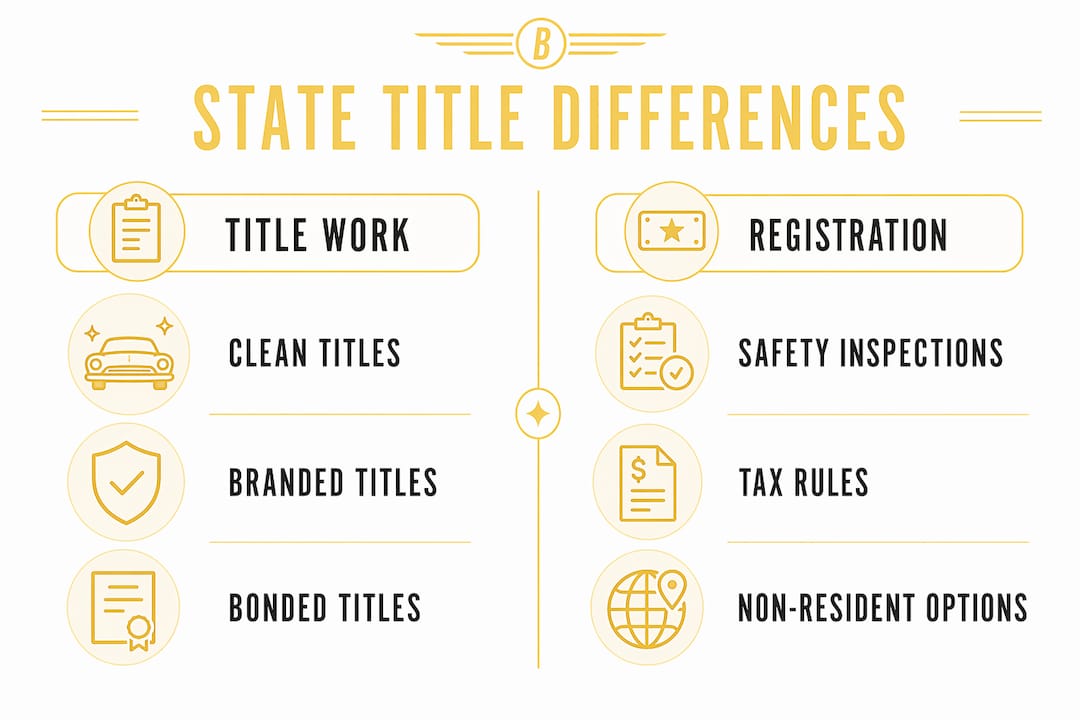
State DMV requirements vary greatly: Texas requires safety inspections and sales tax on classics, California exempts smog inspections on older cars, and Florida uses special antique or vintage plates with unique fees. These differences are not minor. They affect your total cost of ownership and what you can legally do with the car.
Many states allow non-residents to register classic cars via LLCs. Montana is the most well-known example, offering flat fee registrations and permanent plates that simplify long-term compliance. This strategy is legitimate when done correctly, but it requires proper LLC formation and ongoing compliance. Verify your home state's rules before pursuing an out-of-state registration strategy.
Always confirm your state's specific requirements before you complete a purchase. A car that is legally registered in Florida may require additional steps to register in California. Knowing this before you wire funds saves you from a frustrating and costly surprise.
What practical steps protect buyers and sellers during title transfers?
Managing classic car ownership paperwork correctly protects both sides of the transaction. These steps are not optional formalities. They are your legal protection if a dispute arises later.
Pro Tip: Always run a VIN check through the National Motor Vehicle Title Information System (NMVTIS) before purchasing any classic car. It reveals title brands, theft records, and odometer discrepancies that a seller may not disclose.
Here is what every buyer and seller should do before signing anything:
- Verify the seller's identity matches the title. To legally transfer ownership, the buyer must receive a signed original title from the seller whose name matches the title exactly. A bill of sale from someone who is not the titled owner is not sufficient for registration in most states.
- Never rely on a bill of sale alone. A bill of sale is a starting document for ownership proof but does not by itself allow vehicle registration or legal title transfer in most states. You need the actual title.
- Notarize the bill of sale. Notarizing the bill of sale adds an important layer of legal verification that protects both buyer and seller. Many states require it. Even when they do not, it is worth doing.
- Check for liens before purchase. A lien on the title means a lender has a legal claim on the vehicle. You can check this through your state DMV or a title search service. Buying a car with an unreleased lien means you inherit that legal problem.
- Keep copies of everything. Store physical and digital copies of the title, bill of sale, lien release letters, and any notarized documents. If a dispute arises months later, your paper trail is your defense.
Reviewing the dealer inspection checklist alongside your title review gives you a complete picture of the car's legal and mechanical status before you commit.
Key takeaways
Proper title work is the legal and financial foundation of every classic car transaction, protecting both buyer and seller from ownership disputes, registration failures, and loss of value.
| Point | Details |
|---|---|
| Clean titles maximize value | A lien-free, unbranded title is required to achieve full market value and easy resale. |
| Title issues have legal fixes | Bonded titles, Vermont registration, and court orders resolve most missing or broken title chains. |
| State rules differ significantly | Texas, California, Florida, and Montana each have unique registration rules that affect cost and compliance. |
| Bill of sale is not enough | A bill of sale alone cannot register a classic car in most states; you need the original signed title. |
| Notarization protects both parties | Notarizing transfer documents adds legal verification that prevents fraud and ownership disputes. |
Why i think most classic car buyers underestimate title work
After years of watching classic car deals go sideways, I can tell you the pattern is almost always the same. The buyer falls in love with the car, the seller is eager to close, and both parties treat the title as an afterthought. Then the DMV rejects the transfer, or a lien surfaces, or the ownership chain has a gap that takes months to untangle.
The uncomfortable truth is that title work is not the exciting part of buying a classic car. Nobody posts photos of their notarized bill of sale on Instagram. But I have seen a pristine 1967 Ford Mustang sit in a garage for eight months because the seller could not produce a clean title. The buyer paid a fair price and got nothing but frustration.
My advice to anyone entering the classic car market is to treat the title review with the same seriousness you give the mechanical inspection. Verify the VIN against the title. Confirm the seller's name matches exactly. Check for liens before you hand over a check. If anything looks off, pause the deal and get a title professional involved. The cost of due diligence is always less than the cost of a title dispute.
Clean title work also builds buyer confidence in a way that nothing else can. When you present a complete, organized ownership package, you signal that the car has been cared for and the transaction is legitimate. That confidence translates directly into faster sales and stronger offers.
— Tony
How Butterclassics makes title work smooth as butter
Dealing with title paperwork on your own can feel like a lot. That is exactly why Butterclassics built a process that takes the guesswork out of classic car ownership transfers.
Every vehicle in the Butterclassics inventory goes through a thorough title verification before it is listed. You get a car with a confirmed clean title, no hidden liens, and documentation that is ready for your state's registration process. The Butter Certified program means title integrity is checked, verified, and backed by the team before you ever sign anything. Whether you are buying your first vintage truck or adding a muscle car to your collection, Butterclassics handles the title coordination so you can focus on the fun part. Browse the inventory, get pre-qualified for financing, and drive away knowing your ownership paperwork is solid.
FAQ
What is title work in classic car sales?
Title work in classic car sales is the legal process of verifying vehicle ownership documents and completing the transfer of a title from seller to buyer through the state DMV. It includes confirming the title is clean, lien-free, and properly signed by the titled owner.
What happens if a classic car has no title?
A car without a title can still be legally titled through options like a bonded title, Vermont registration, or a court-ordered title. Resolution timelines range from 2–6 weeks for simple cases to 8–20 weeks for complex ownership chain gaps.
Can a bill of sale replace a title for a classic car?
No. A bill of sale is a supporting document but does not allow vehicle registration or legal title transfer in most states. You need the original signed title from the person whose name appears on it.
Why does title status affect classic car value?
A salvage or rebuilt title signals past damage or structural concerns, which reduces buyer confidence and resale value. A clean, lien-free title confirms unencumbered ownership and supports full market pricing.
Do classic car title transfer rules differ by state?
Yes, significantly. Texas requires safety inspections and charges sales tax, California exempts older cars from smog checks, and Montana offers permanent plates through flat fee LLC registrations. Always verify your state's specific rules before completing a purchase.