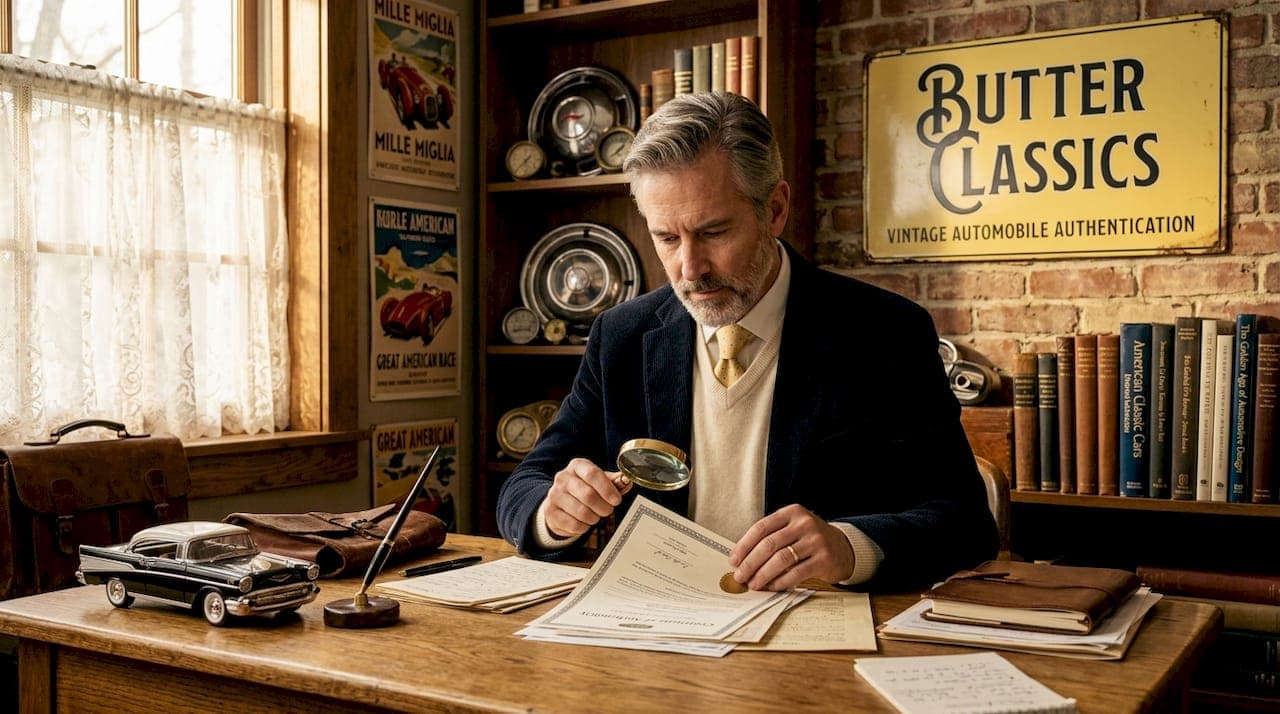
Classic car authentication is the process of verifying a vintage vehicle's provenance, originality, and condition through title history checks, physical inspection, and manufacturer-backed certification programs. For buyers and collectors, this process is the difference between a sound investment and a costly mistake. Whether you're eyeing a 1967 Shelby GT500, a Ferrari 250, or a numbers-matching Chevrolet Corvette, knowing how to authenticate classic cars protects your money and preserves the vehicle's long-term collectible value. This guide walks you through every layer of classic vehicle verification, from official documents to forensic inspection techniques.
What classic car authentication explained really means
Classic car authentication is the structured practice of confirming that a vehicle is what the seller claims it to be. It covers three core pillars: documentation review, physical inspection, and expert or factory certification. Each pillar catches different types of fraud or misrepresentation, and no single method alone is sufficient. A car can have clean paperwork and still carry a replaced engine block. A car can look factory-perfect and still have a title with a salvage brand buried in its history. Authentication works when all three pillars align.
The industry term most professionals use is provenance verification, which refers specifically to establishing an unbroken, documented chain of ownership and originality. Classic car authentication explained in practical terms means you are building a case, not just checking a box. The stronger your evidence across all three pillars, the more defensible your purchase decision becomes.
How to start with title history and official documents
The first step in any classic car history check is pulling an official title history report. The NMVTIS Consumer Access Program provides reports that include title information, salvage and flood brands, odometer data, and insurance total-loss history. This matters because a vehicle with a clean exterior can carry a hidden salvage title that slashes its value and signals prior structural damage.
Beyond the NMVTIS report, you need to track down the Manufacturer's Certificate of Origin (MCO). The MCO is accepted in all 50 states and serves as the factory-issued birth certificate for the vehicle. For classic cars, this document confirms the original specifications, options, and destination of the car as it left the production line.
Here are the key documents to gather before any purchase:
- NMVTIS Vehicle History Report: Reveals title brands, ownership transfers, and insurance write-offs
- Manufacturer's Certificate of Origin: Confirms factory specs and original build details
- Registration history: Shows geographic ownership trail and any gaps in title continuity
- Bill of sale records: Establishes chain of custody between private owners
- Service and restoration invoices: Documents what work was done, by whom, and when
Discrepancies between VINs across paperwork can arise from clerical errors but should trigger a detailed provenance review rather than automatic disqualification. A mismatched digit on a title transfer from 1974 may be a typo. A mismatched VIN on the chassis plate is a different conversation entirely.
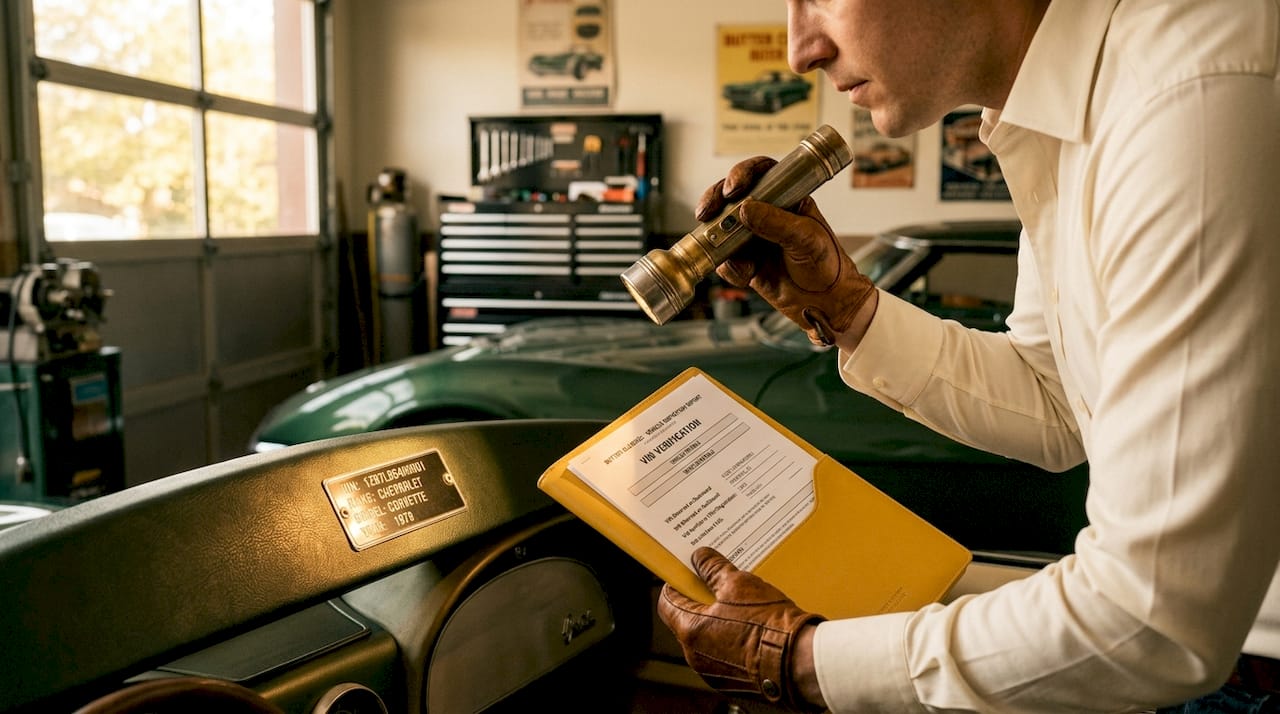
Pro Tip: Cross-reference the VIN stamped on the dashboard, the door jamb sticker, and the engine firewall. All three should match. If any one of them differs from the title, request a full explanation in writing before proceeding.
What factory certification programs actually verify
Factory certification programs are the gold standard in classic car appraisal tips, and for good reason. Ferrari Classiche verifies originality by comparing every major component against factory archives dating back to 1947, then issues a Certificate of Authenticity known as the Red Book. This document confirms that the components are either original or restored to factory specifications using genuine Ferrari parts. For a Ferrari 275 GTB or a 308 GTS, a Red Book certification can add six figures to the asking price.
Alfa Romeo Classiche offers a comparable service at their museum in Arese, providing technical and photographic documentation to verify originality. Maserati Classiche operates similarly, and factory certification programs reduce buyer uncertainty by benchmarking each chassis against factory records with non-negotiable identity verification as the first step.
Here is how factory certification compares to a generic third-party appraisal:
| Factor | Factory certification | Generic appraisal |
|---|---|---|
| Archive access | Direct factory records | Publicly available data only |
| Component verification | Every major part checked | Visual inspection only |
| Certificate authority | Manufacturer-issued | Appraiser-issued |
| Market impact | Significant value premium | Modest confidence boost |
| Fraud deterrence | Extremely high | Moderate |
Manufacturer certifications like Ferrari Classiche provide the strongest provenance assurance, giving buyers confidence that goes well beyond subjective expert opinions. If the car you are considering is eligible for a marque-specific program, pursuing that certification before purchase is one of the smartest moves you can make.
Pro Tip: Not every classic car qualifies for factory certification. Ferrari Classiche, for example, requires the vehicle to be at least 20 years old. Check eligibility criteria directly with the manufacturer's heritage division before budgeting for this step.
Physical inspection methods that reveal the truth
Authenticating a classic car requires verifying body panels, trim, interior, and mechanical originality, not just the engine. The matching numbers conversation is important, but it is only one piece of a much larger puzzle. A well-founded purchase investigation checks that structure, material, identity, and documentation form a coherent picture, using scientific and forensic methods including ultrasound, spectroscopy, and 3D geometry testing to detect inconsistencies.
In practice, this means a trained inspector will:
- Measure paint depth across all panels using a digital gauge. Factory paint sits at a consistent depth. Repainted panels read higher. Filler-covered damage reads much higher.
- Examine VIN plates and chassis stampings for signs of re-stamping, grinding, or welding around the plate area. Original stampings have a specific font, depth, and spacing that is difficult to replicate.
- Check secondary identifiers such as partial VINs stamped on the firewall, frame rails, and door hinges. These are harder to alter and often overlooked by fraudsters.
- Inspect material consistency using spectroscopy on metal components to confirm period-correct alloys and detect modern replacements.
- Review build sheet details against the physical car. A factory build sheet lists every option ordered. If the car has a factory air conditioning unit but the build sheet shows no A/C, something changed.
Pro Tip: Ask the seller for the original window sticker or broadcast sheet. For GM vehicles, these were often stored in the trunk or under the rear seat cushion. Finding one intact is a strong sign the car has not been heavily disassembled or misrepresented.
How to combine all evidence for confident verification
Combining forensic inspection, archival research, and documented chains of custody creates a defendable provenance record that is essential for high-value classic car transactions. The goal is not to find one perfect document. The goal is to build a file where every piece of evidence points in the same direction.
Here is a structured approach to integrating all your findings:
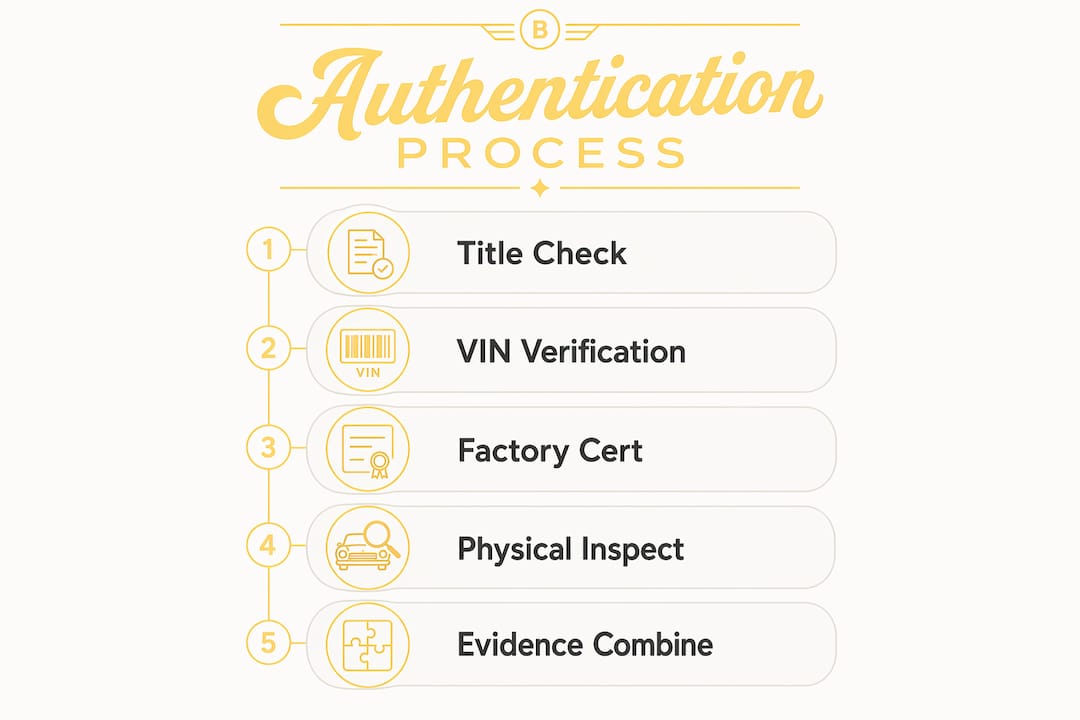
- Start with the NMVTIS report. Confirm there are no title brands, ownership gaps, or odometer rollbacks. This is your baseline. If the report raises red flags, stop here and investigate before spending money on inspection.
- Reconcile all VINs. Compare the title VIN, dashboard VIN, chassis stamping, and any secondary identifiers. Document every match and every discrepancy with photographs.
- Commission a physical inspection. Use a specialist familiar with the specific marque. A Porsche 911 inspector and a Chevrolet Camaro inspector are not interchangeable. Marque-specific knowledge catches details a generalist will miss.
- Cross-reference factory data. Contact the manufacturer's heritage division or a recognized marque club such as the Shelby American Automobile Club or the Ferrari Club of America. Many clubs maintain their own registries and can confirm production details.
- Pursue factory certification if eligible. For Italian exotics and certain British marques, this step transforms a strong provenance file into an officially verified one.
- Compile a structured inspection file. Verbal conclusions are insufficient; detailed reports with photos, documented findings, and clear reasoning provide proof and a permanent record for resale and insurance purposes.
Maintaining a digital and physical provenance file updated with inspections, invoices, and photographs is critical for ongoing value and resale. Every time the car changes hands, that file travels with it and compounds in value. A 1969 Dodge Charger R/T with a complete, documented history from new commands a premium that an identical car with a thin paper trail simply cannot match.
Key takeaways
Classic car authentication requires aligning documentation, physical inspection, and factory certification to build a provenance record that protects both value and buyer confidence.
| Point | Details |
|---|---|
| Start with title history | Pull an NMVTIS report to check for salvage brands, odometer fraud, and ownership gaps before anything else. |
| Factory certification is the gold standard | Programs like Ferrari Classiche and Alfa Romeo Classiche verify components against original factory archives. |
| Physical inspection goes beyond the engine | Paint depth, chassis stampings, and secondary VINs reveal alterations that documents alone will not catch. |
| Build a structured provenance file | Photos, invoices, and inspection reports create a permanent, defensible record for resale and insurance. |
| Discrepancies need investigation, not panic | VIN mismatches may be clerical errors, but every one requires a documented explanation before purchase. |
Why authentication is the one step you cannot skip
I have seen buyers skip the authentication process on cars that looked absolutely right. Clean paint, matching numbers on the door jamb, a confident seller with a folder full of paperwork. And more than once, a deeper look revealed a replaced engine block, a title with a buried flood brand, or body panels that had been swapped from a parts car. The car looked authentic. It was not.
The uncomfortable truth about classic car authentication is that the most convincing fakes are the ones where someone put real effort into the deception. A rushed inspection catches the obvious problems. A thorough one catches the rest. The Ferrari Classiche program exists precisely because even knowledgeable buyers cannot always tell the difference between a factory-correct car and a very good clone without access to the original build records.
My advice is to treat authentication as a non-negotiable line item in your purchase budget, not an optional add-on. For a six-figure vehicle, a $500 to $2,000 inspection and documentation review is the best money you will spend. For a factory-certified Italian exotic, the cost of the certification is already baked into the asking price, and rightly so. The certified classic cars that carry full provenance files sell faster, insure more easily, and hold value better through market cycles. That is not sentiment. That is the market telling you what it trusts.
— Tony
Find your next authenticated classic at Butterclassics
At Butterclassics, we know that buying a classic car should feel smooth as butter, not stressful. That is why every vehicle in our inventory goes through a thorough review process before it reaches our listings. You can browse cars backed by manufacturer-issued certifications, including Ferrari Red Books and other factory documentation, right from our certified classics collection. Whether you are hunting for a muscle car, a vintage Corvette, or a rare European exotic, our team is here to help you find a car with the provenance to back up its price tag. Head over to Butterclassics and call dibs on your next collector car with confidence.
FAQ
What is classic car authentication?
Classic car authentication is the process of verifying a vintage vehicle's provenance, originality, and condition through title history reports, physical inspection, and manufacturer-backed certification programs. It confirms that the car is what the seller claims and protects the buyer's investment.
How do I check a classic car's history?
Start with an NMVTIS Vehicle History Report, which reveals title brands, salvage history, and odometer data from official state and insurer records. Then cross-reference the VIN across the title, chassis, and secondary identifiers to confirm consistency.
What is a Ferrari Red Book certification?
The Ferrari Red Book is the Certificate of Authenticity issued by Ferrari Classiche after verifying that every major component matches factory archives dating back to 1947. It is the most authoritative form of provenance verification for Ferrari vehicles and significantly increases market value.
Are VIN discrepancies always a red flag?
Not always. Discrepancies between VINs on paperwork can result from clerical errors made during title transfers. Each discrepancy requires a documented explanation and deeper investigation rather than automatic rejection of the vehicle.
Why does provenance matter for classic car value?
A complete, documented provenance file, including inspection reports, service history, and factory certification, directly supports higher resale prices, easier insurance coverage, and stronger buyer confidence. Cars with thin or missing histories sell at a discount regardless of their physical condition.