
Yes, a bonded title is a real and widely accepted path to legally title a classic car when the original paperwork is gone, but it's not universal and it's not a fix-all. Most states offer this route, some require a court order instead, and the bond you buy typically stays active for a few years. It also will not help if the car is stolen or carries an active lien.
TL;DR:
- Bonded titles are available in most states but are not offered in states like New Jersey, which require court-ordered titles instead.
- The bond amount generally equals 1.5 times the vehicle's value, with premiums often costing between $100 and $700, and bonds lasting several years.
- Applicants need a VIN inspection, proof of purchase, lien releases if applicable, and a valuation before applying for a bonded title.
- The process involves verifying vehicle data, purchasing a licensed surety bond, and submitting all documents to the DMV, often with a critical call to clarify specific state rules.
- A bonded title does not validate stolen vehicles or active liens, but once the bond expires without claims, the title becomes a standard, unbranded title.
Table of Contents
- What a bonded title actually is
- Do all states offer bonded titles?
- What documents you need before you apply
- How to get a bonded title, step by step
- What a bonded title costs and how long the bond lasts
- Risks, insurance, and resale on a bonded title
- Field-tested tips from Butter Classics for classic-car title gaps
- Why the DMV paperwork gets more attention than the actual risk
- Skip the title headache entirely with verified listings
- Sources
What a bonded title actually is
A bonded title is a surety bond that stands in for a missing title. Instead of proving ownership with paperwork you don't have, you post a bond that protects anyone who might later show up with a stronger legal claim to the vehicle. Three parties are involved: you (the applicant), the surety company that issues the bond, and the state DMV (the obligee that requires it). If someone successfully challenges your ownership within the bond term, they can file a claim against that bond for compensation.
The DMV isn't asking for a bond because it doubts your story. It's covering a gap. Cars change hands informally all the time, especially barn finds, farm relics, and inherited classics that sat in a garage for thirty years with no paper trail. A bonded title lets the state issue you a title anyway, with the bond acting as insurance against a competing claim nobody has seen yet.
Here's where collectors often get confused about which path applies to their situation:
- Bonded title: You buy a surety bond and apply through your state DMV. No court involvement, no case file.
- Court-ordered title: A judge reviews your evidence and orders the state to issue a title. Some states require this instead of, or in addition to, a bond.
- Bill-of-sale titling: A handful of situations let you title a vehicle using nothing but a bill of sale and supporting affidavits, usually for older or lower-value vehicles.
Choose bonded title when your state supports it and you have a plausible ownership story but no clean title. Choose the court route when your state mandates it, when there's a disputed lien history, or when the DMV kicks your application back asking for judicial review. The biggest misconception collectors carry into this process is that a bonded title is somehow "less legal" than a standard one. It's not. Once the bond term expires cleanly, the title converts to a normal, unbranded title with full resale value.
Do all states offer bonded titles?
No, and this is the single most important thing to check before you spend a dollar. Some states, including New Jersey, don't offer a bonded-title program at all and instead require a court-ordered title for vehicles with missing paperwork. If you're restoring a car registered in one of these states, skip straight to researching the court process rather than shopping for a surety bond.
Where bonded titles are available, the rules vary enough that you can't assume one state's process matches another's. A few representative examples:
- Texas: The Texas Department of Motor Vehicles requires a surety bond set at 1.5 times the vehicle's value as determined by TxDMV, a completed Notice of Determination, and a VIN inspection. Lien releases are required for liens under ten years old.
- Nebraska: The Nebraska DMV requires a sheriff's inspection, a bond equal to 1.5 times the vehicle's value, and a $50 processing fee. The bond term runs three years.
- Nevada: The Nevada DMV requires the surety company to be licensed in Nevada and typically bases the bond on 1.5 times the MSRP or a state-determined valuation, with a three-year term.
Before you buy anything, search your own state DMV's website for "bonded title" or "certificate of title bond" and pull the specific form numbers. Don't assume Texas rules apply in Nebraska or vice versa.
What documents you need before you apply
Get your paperwork in order before you contact the DMV. Most states ask for a similar core packet, though a few add extra steps.
- VIN inspection report. Nearly every state requires a physical VIN check, sometimes performed by law enforcement, sometimes by a licensed inspection station.
- VIN history check. Run the number through the NHTSA VIN decoder to confirm the manufacturing data matches the vehicle and to flag any open recalls.
- Proof of purchase. Bills of sale, old invoices, canceled checks, or a signed affidavit of ownership if you inherited the car or bought it informally.
- Appraisal or valuation documentation. Many states use NADA guides or a licensed appraiser's report to set the vehicle's value, which in turn sets your bond amount.
- Lien release paperwork. If any lien shows up on the vehicle within the state's lookback window (commonly ten years), you'll need a formal release, sometimes requiring certified mail to the lienholder.
Some states, Nebraska among them, also require a sheriff's office inspection form as part of the packet, so confirm this early rather than discovering it after your appointment.
How to get a bonded title, step by step
The process follows roughly the same sequence in every state that offers it, even though the paperwork and fees differ.
- Contact your state DMV first. Confirm bonded titles are available where the car is registered and request the exact forms you'll need. This single call saves more wasted effort than any other step.
- Run the VIN checks. Use the NHTSA decoder to confirm vehicle data, then schedule any required law-enforcement or official inspection.
- Get an appraisal. A written valuation sets your bond amount, so this step happens before you can shop for the bond itself.
- Buy the surety bond. Purchase it from a licensed surety company for the state-required amount, commonly 1.5 times the appraised value.
- Submit everything to the DMV. File the bond certificate, inspection report, application, and supporting documents with your county or state title office, then follow up if you don't hear back within a few weeks.
Pro Tip: Call the DMV title division directly instead of relying only on the website FAQ. State bonded-title rules change more often than the published guides, and a five-minute call can save you a rejected application weeks later.
What a bonded title costs and how long the bond lasts
States commonly calculate the required bond at 1.5 times the vehicle's appraised value, using sources like NADA guides or a county valuation. That's the bond face amount, not what you pay out of pocket.
- The actual premium you pay to the surety company is a fraction of that face amount, often running from around $100 up to several hundred dollars depending on the vehicle's appraised worth.
- Add DMV title fees and appraisal costs on top of the premium. Guides covering lower-valued classics put the full out-of-pocket total commonly in the $200 to $700 range.
- The bond stays active for a set term, typically a few years depending on the state, before the bonded notation can be cleared from the title.
Once the term passes without a claim, you file paperwork with the DMV to remove the bonded brand, and the title converts to standard, unrestricted status.
Risks, insurance, and resale on a bonded title
A bonded title does not launder a stolen car or erase an active lien. Confirm the vehicle isn't flagged before you spend a dime on an appraisal or bond premium.
- If someone files a valid claim against your bond during the term, you may still be personally liable beyond what the bond covers.
- Insurers generally still write policies on bonded-title vehicles, but agreed-value coverage for a classic often requires extra documentation and a fresh appraisal.
- Disclose the bonded status to any future buyer. Serious collectors expect it and will ask.
- The bonded brand itself rarely tanks resale value once it's understood, but an unexplained gap in ownership history can spook cautious buyers.
Pro Tip: Keep a copy of your surety bond certificate with the car's paperwork even after the term expires. Buyers doing due diligence appreciate seeing the full history, not just a clean title.
Field-tested tips from Butter Classics for classic-car title gaps
Rare, low-volume models create a specific headache: appraisers sometimes lean toward optimistic "wish" prices instead of grounded comparable sales, which inflates your bond amount for no good reason. Ask any appraiser you hire to cite actual comparable sales, not aspirational market chatter, and you'll usually land a fairer bond figure.
- Build a title packet: photos of the car, prior registration cards, purchase receipts, and any correspondence with previous owners.
- Organize everything before you call the DMV. A complete packet reduces the odds a clerk kicks your file over to a court process.
- If the lien history is murky or you suspect any fraud in the chain of ownership, talk to a title-recovery specialist or an attorney before filing anything.
- If you're selling rather than keeping the car, consigning with Butter Classics can simplify the transfer since the platform helps sellers navigate title gaps as part of the listing process.
Why the DMV paperwork gets more attention than the actual risk
The internet treats bonded titles like a legal gray area, and that reputation isn't earned. Every state that offers the program publishes exact rules, exact multipliers, exact bond terms. This isn't a workaround; it's a designed process that state DMVs built specifically for situations like inherited barn finds and long-lost titles.
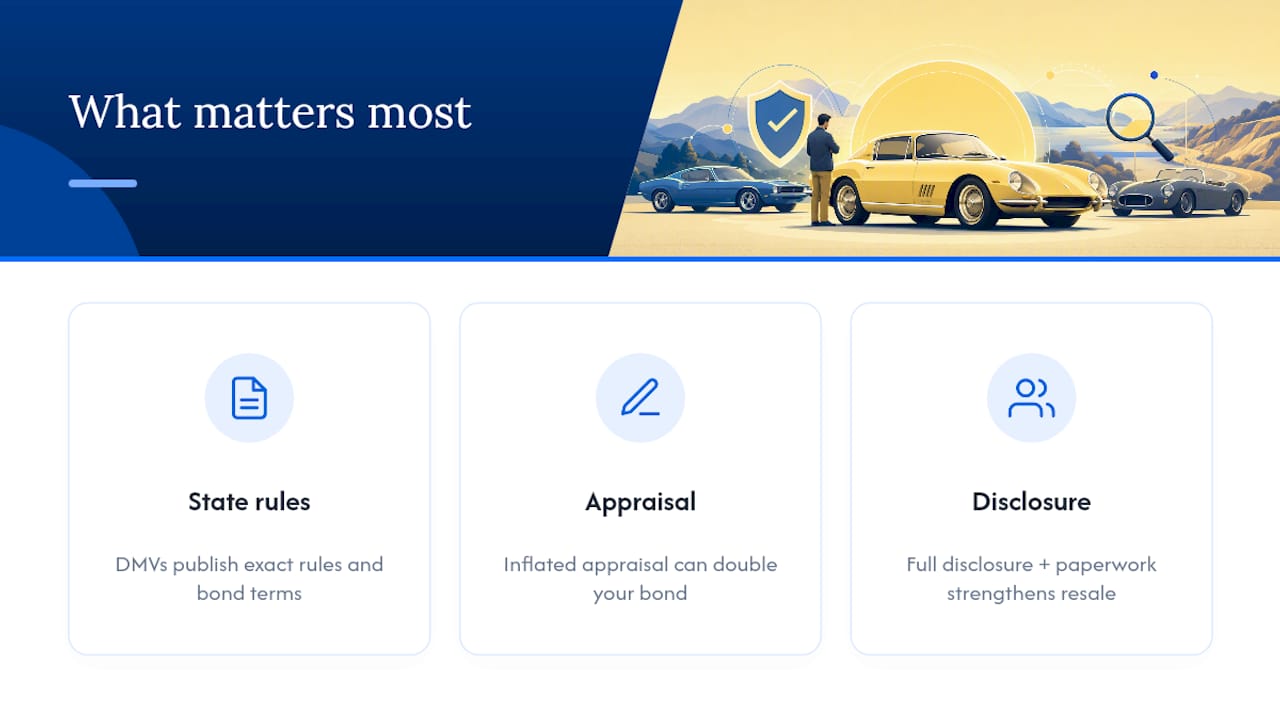
What collectors underestimate isn't the paperwork. It's the appraisal step. A sloppy or inflated valuation drives your bond amount up for no reason, and I've seen owners pay double what they needed to simply because nobody pushed back on the appraiser's number. Ask for comparables, not guesses.
The other blind spot is disclosure. Some owners treat a bonded title like a scarlet letter to hide from future buyers. Serious collectors don't care about a cleared bond from four years ago. They care about a seller who explains it plainly and has the paperwork to back it up. That's a stronger position at resale than pretending the gap never happened.
— Tony
Skip the title headache entirely with verified listings
If chasing DMV forms and surety bonds sounds like more hassle than you want for your next classic, Butterclassics offers a different route to the same destination: a vehicle you can register the day you buy it. Every listing on the Butterclassics inventory goes through documentation checks before it ever hits the site, so you're not the one untangling ownership history.
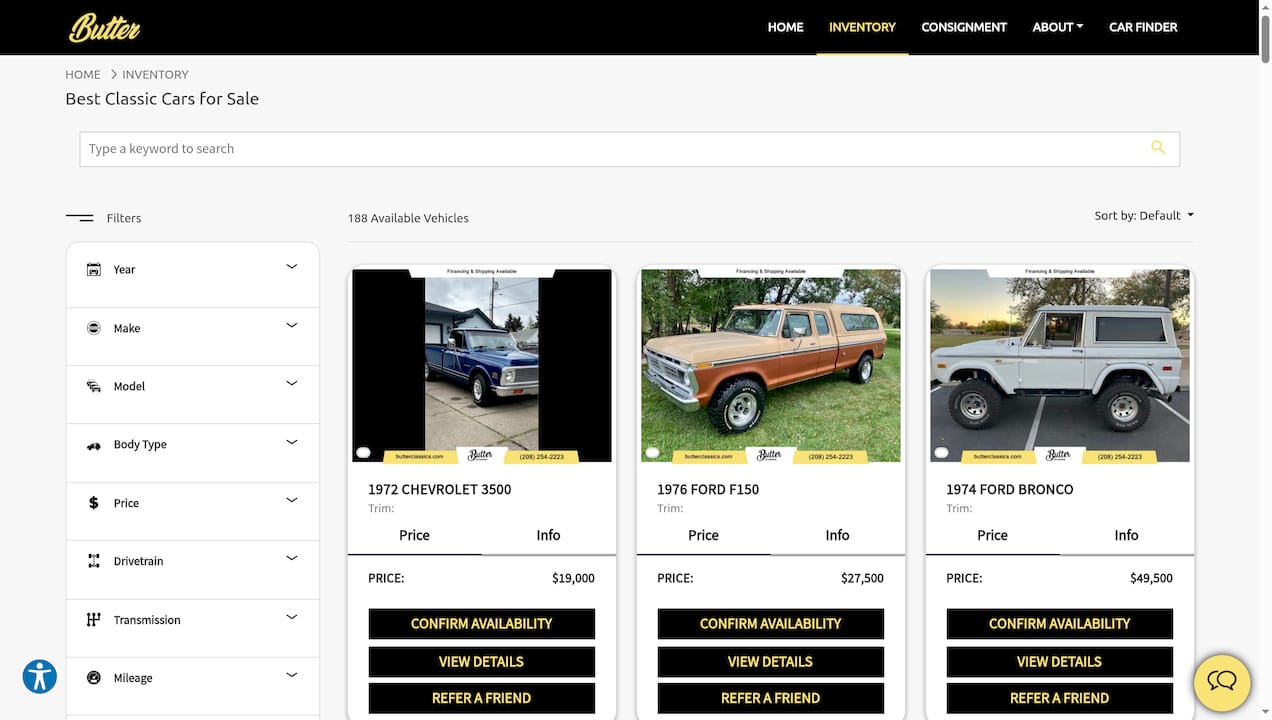
If you're on the selling side and staring down a title gap of your own, the consignment program handles the paperwork legwork so you're not the one filing bond certificates and chasing lien releases. Butterclassics also works with partners like Bavarian Autohaus on consignment best practices, and the platform's own car finder tool can help you locate a comparable model with a clean title if a specific bonded-title car isn't worth the wait. Start by browsing current inventory or submitting a consignment request to see how much simpler the next transfer can be.
Sources
- TxDMV — Bought a vehicle without a title?
- Nebraska DMV — Bonded Certificate of Title (motor vehicle/trailer)
- Nevada DMV — Bonded title guidance
- New Jersey Motor Vehicle Commission — Vehicle registration & titles (example of state restrictions)
- LegalClarity — How to get a title for an old car with no title