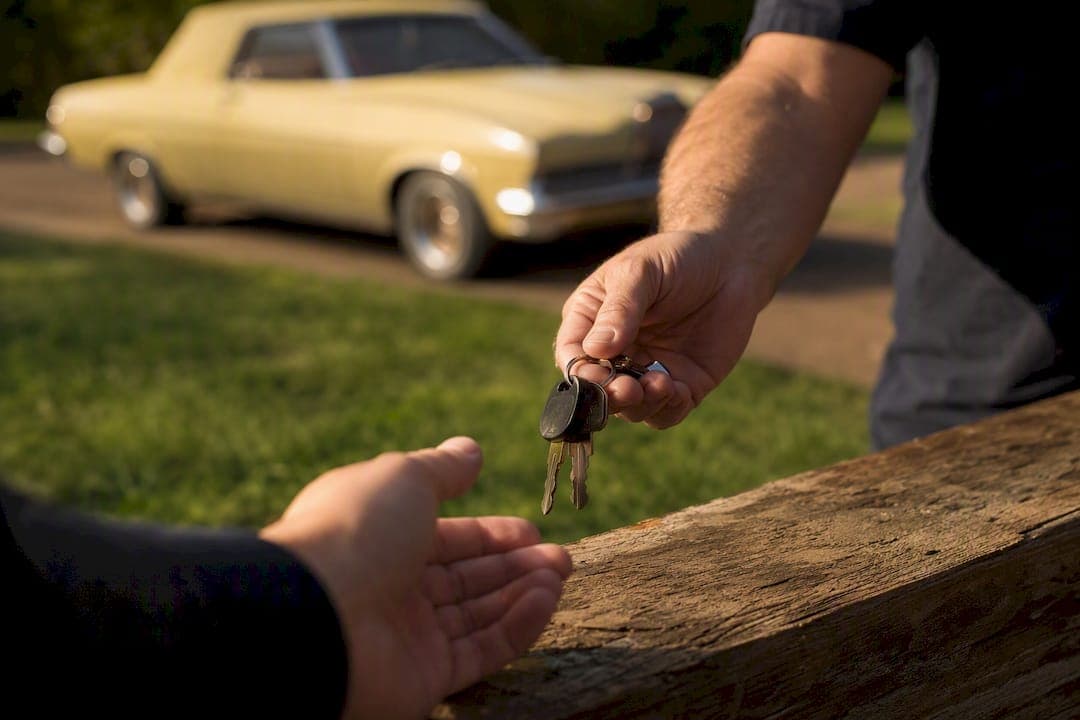
Car escrow is a service where a neutral third party holds the buyer's payment until the vehicle is delivered and accepted, then releases funds to the seller. For classic and collector cars, where a buyer might be wiring six figures to a stranger three states away, that middle step is what makes the deal possible in the first place. Platforms like Escrow run this process for vehicle sales, and the typical cycle takes about one to two weeks from funding to disbursement.
- Escrow protects the money, not the metal. It won't catch a bad VIN, a title problem, or an overstated restoration.
- On Butterclassics, escrow-style protections fit naturally alongside consignment and inspection workflows already built for high-value collector sales.
Key Takeaways
Car escrow protects the payment step of a classic-car transaction, but it never replaces independent inspection, VIN checks, or title verification.
| Point | Details |
|---|---|
| Escrow holds funds, not judgment | The provider follows written instructions and does not verify vehicle condition or history. |
| Expect one to two weeks | Shipping distance, inspection length, and title work all extend the standard escrow timeline. |
| Fees run 1.9% to 2.6% | Costs scale with sale price, often with a minimum fee and a buyer/seller split. |
| Never use a seller's escrow link | Initiating escrow independently is the single biggest scam prevention step. |
| Butterclassics supports the surrounding steps | Consignment, title work, and test-drive scheduling reduce friction around any escrow agreement. |
Table of Contents
- How Does the Car Escrow Process Work Step by Step?
- How Long Does Car Escrow Take and What Does It Cost?
- What Does Car Escrow Actually Protect You From?
- How Do You Use Car Escrow Safely for a Classic Car Deal?
- When Is Car Escrow Worth It for a Classic Car?
- What Types of Car Escrow Providers Exist?
- How Are Escrow Disputes and Refunds Handled?
- Why Butterclassics Treats Escrow as One Layer, Not the Whole Plan
- Ready to Buy or Sell With Fewer Escrow Headaches?
- Frequently Asked Questions
- Sources
How Does the Car Escrow Process Work Step by Step?
The mechanics are simple once you see the sequence. Every legitimate transaction moves through the same five stages, whether you're buying a numbers-matching Corvette from two states over or selling a Bronco to a collector you've never met.
- Agree on written terms. Buyer and seller put the VIN, odometer reading, condition notes, inspection window, shipping arrangement, and fee split in writing before any money moves.
- Buyer funds the escrow account. The buyer deposits the agreed price with the escrow provider, and the provider verifies the funds have actually cleared before telling the seller to proceed.
- Seller ships or hands off the vehicle. Only after funds are confirmed does the seller arrange transport or an in-person handoff, per Escrow.com's documented process.
- Buyer inspects within the agreed window. This is the buyer's chance to confirm the car matches what was promised, whether that's a paint code, an engine number, or a documented restoration history.
- Escrow disburses funds. Acceptance triggers payment to the seller; rejection within the window triggers a return of funds under the terms of the written agreement.
For classic cars specifically, this process often carries extra weight. Title collection and lien payoff services are common add-ons, since escrow providers can hold the title until the buyer confirms acceptance and pay off any existing lien directly from sale proceeds. That single step prevents a scenario collectors dread: paying in full for a car that still has a bank's name on the title. A solid bill of sale drafted before funding makes every later step faster.
Pro Tip: Write your inspection criteria as specific, checkable items ("no rust below the beltline," "engine matches build sheet #4521") rather than vague language like "good condition." Escrow providers follow instructions, not judgment calls.
How Long Does Car Escrow Take and What Does It Cost?
The typical vehicle escrow cycle runs about one to two weeks from the moment funds are deposited to final disbursement. A few things stretch that window:
- Shipping distance. A car moving from Oregon to Florida takes longer to arrive than one going across town.
- Inspection window length. Buyers of rare or highly original classics often negotiate a longer look, sometimes several days instead of one.
- Title and lien paperwork. Payoff letters and title transfers add processing time on top of shipping.
Fees typically run in bands. LegalClarity's research puts common vehicle escrow charges around 1.9% to 2.6% of the sale price, often with a minimum fee for lower-value transactions. On a $60,000 classic, that lands somewhere between roughly $1,140 and $1,560. Buyer and seller frequently split the fee, though some deals put the full cost on whichever party pushed for escrow in the first place.
What Does Car Escrow Actually Protect You From?
Escrow solves one specific problem: the trust gap between two strangers exchanging a large sum of money for a car neither has physically confirmed. It does that by splitting the transaction into verified phases instead of one leap of faith.
- It prevents the buyer from paying before receiving the car. Funds sit with a neutral party, not in the seller's account, until delivery happens.
- It prevents the seller from shipping a car and never getting paid. The seller can confirm funds are secured before releasing the vehicle.
- It reduces fraud exposure on both sides by keeping money out of either party's direct control during the riskiest window of the deal.
Here's where collectors get tripped up: escrow does not verify the car. It won't run a VIN history report, confirm the odometer is accurate, or act as an independent judge if the paint code doesn't match what was promised. Escrow.com's own vehicle service description is clear that title collection and lien payoff are administrative services, not condition guarantees. The provider follows the written instructions you gave it, nothing more.
Before choosing a provider, verify its bonded or audited status, check for state licensing, read customer reviews, and confirm it offers title-collection or lien-payoff handling if your deal needs it.
Pro Tip: Treat escrow and vehicle inspection as two separate jobs. Escrow handles the money. You (or a hired inspector) handle the car.
How Do You Use Car Escrow Safely for a Classic Car Deal?
Safety starts before you ever touch an escrow platform. Run a VIN history report, arrange an independent inspection, and confirm the seller's identity and title ownership match. Only after that groundwork is solid should money enter the picture.
The single biggest scam signal in the entire process: the seller recommending or supplying the escrow link. Consumer safety guidance from Bumper is blunt about this. A real buyer chooses and initiates escrow independently, never through a URL a seller emails over.
The moment a seller says "use this escrow site," treat it as a red flag rather than a convenience. Legitimate escrow providers don't need a seller's referral link to function, and fake ones depend entirely on it.
Before funding anything, put these in writing:
- The exact inspection window and what "acceptance" and "rejection" mean.
- Shipping method and tracking requirements.
- Title and lien payoff instructions, if the car isn't free and clear.
- Who verifies the escrow provider's licensing and bonding with your state regulator.
Watch for unusual payment requests, too. Wire transfers to unfamiliar accounts, Western Union, or gift cards have no place in a legitimate escrow flow. And check the URL carefully. Scam sites often mimic a trusted provider's name with a slightly altered domain.
When Is Car Escrow Worth It for a Classic Car?
- High-value purchases, generally anything above a few thousand dollars where losing the payment would genuinely hurt.
- Long-distance or cross-state deals, where buyer and seller can't simply meet at a bank and swap a check for a title.
- Cars with complicated provenance, rare parts, or authenticated documentation, where the paperwork trail matters as much as the car.
Local, in-person sales where cash or a cashier's check changes hands at the same moment the title transfers usually don't need it. Escrow earns its fee when distance or dollar amount removes that simultaneous handoff.
What Types of Car Escrow Providers Exist?
Licensed online platforms like Escrow.com handle standard vehicle transactions end to end, including title collection and lien payoff. Specialized providers, such as Guaranty Escrow, build workflows specifically for private-party, dealer, and collector transactions, coordinating funds, title, lien payoff, inspection milestones, and shipping logistics in one place. Some sellers and buyers use alternative approaches entirely, and PrivateAuto's research documents fee ranges and workflow tradeoffs worth comparing before committing to one method.
Whichever route you pick, evaluate the same handful of things: bonded and audited status, title-collection capability, lien payoff handling, a documented dispute process, and how well the provider's process meshes with your transport and inspection vendors.

How Are Escrow Disputes and Refunds Handled?
By default, escrow simply follows the written instructions in your agreement.
Disagreements happen when the two sides interpret "acceptable condition" differently. In that case, escrow typically holds the funds while buyer and seller negotiate, and may escalate to mediation if the original agreement specifies that route. Until it's resolved, the money stays put rather than going to either party.
- Document everything during inspection: photos, video, timestamped notes.
- Keep shipping and tracking receipts on hand.
- Contact escrow support the moment a disagreement surfaces.
- Preserve every written communication tied to the deal.
Why Butterclassics Treats Escrow as One Layer, Not the Whole Plan
We think of escrow as one tool in a layered approach to protecting collector transactions, not a substitute for good paperwork or a real inspection. On consignments through Butterclassics, we can help coordinate inspection scheduling and title workflows so escrow terms are clean and specific from day one.
Ready to Buy or Sell With Fewer Escrow Headaches?
Escrow solves the payment trust problem, but it can't schedule your inspection, verify your title, or line up a test drive. That's the part of the deal that usually eats the most time, and it's exactly where Butterclassics fits in.
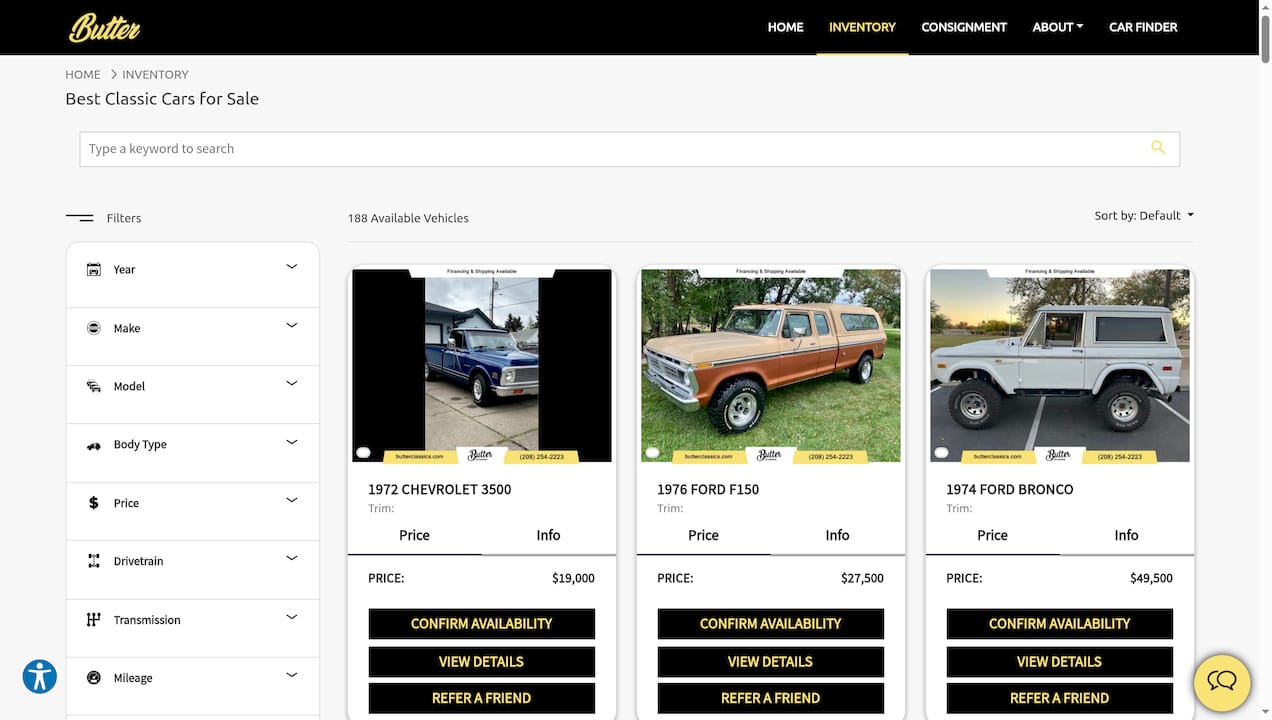
Every listing on Butterclassics comes with the documentation and support to make escrow terms simple to write, because the inspection scheduling and title groundwork are already part of how the marketplace operates. If you're selling, our consignment program handles the paperwork side so your buyer's escrow terms are clear from the first conversation. If you're buying, browse current inventory or schedule a test drive before you ever fund an escrow account. Start with the car, and the money side gets a lot smoother.
Frequently Asked Questions
Is car escrow legally required for a private sale? No. It's optional in nearly every private transaction. Buyers and sellers choose it voluntarily to reduce payment risk, especially on high-value or long-distance deals.
Who usually pays the escrow fee? It varies by agreement. Some deals split the fee evenly, others put the cost on whoever requested escrow. Settle this in writing before funding.
Can escrow handle a car that still has a loan on it? Yes. Many providers offer lien payoff services, paying off the existing loan directly from sale proceeds before releasing the remaining balance and title to the buyer.
What happens if the car doesn't match the description? If you reject the vehicle within your agreed inspection window, the escrow provider returns your funds according to the written terms, not based on a subjective judgment call.
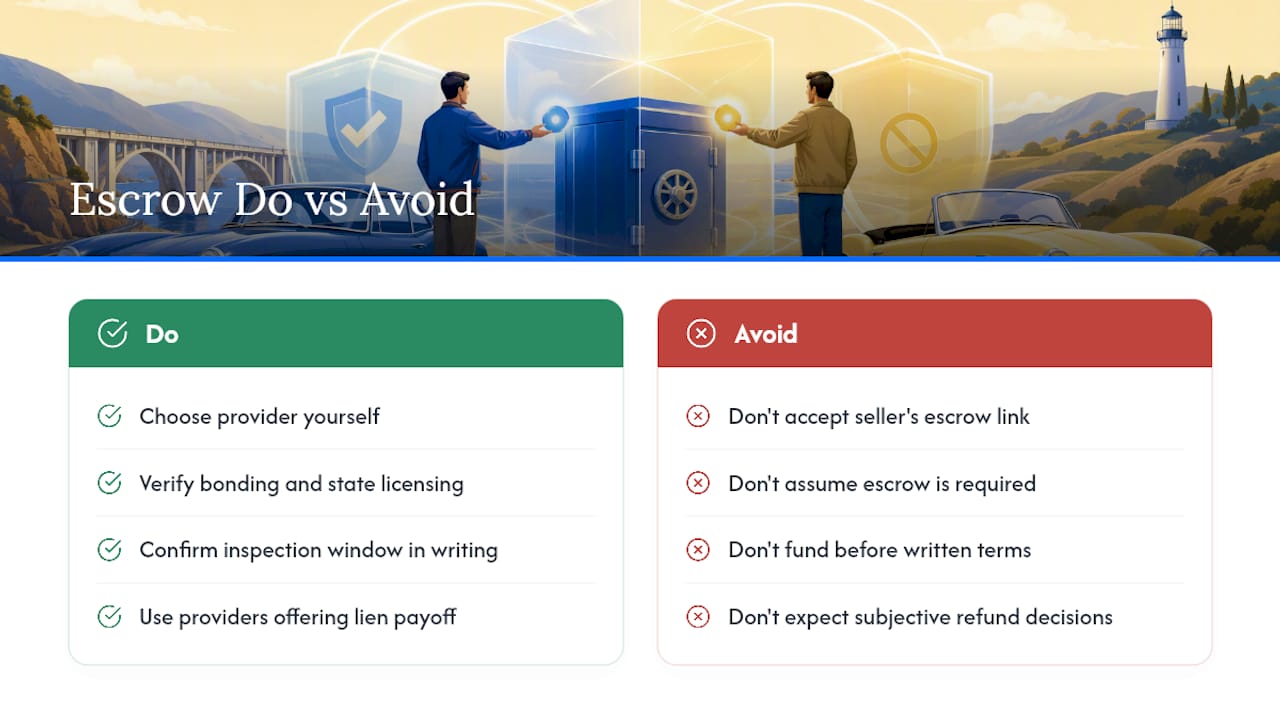
How do I know an escrow provider isn't a scam? Choose it yourself rather than accepting a seller's link, verify bonding and state licensing, check reviews, and confirm it offers documented inspection windows and title-collection services.
Sources
- Escrow
- Vehicle Escrow Services for Private Car Sales: How It Works - LegalClarity
- Do I Need an Escrow Service for a Car Sale? - PrivateAuto