
A classic car bill of sale documents the transaction between buyer and seller, but it usually does not replace a state-issued certificate of title for registration purposes. As Cornell Law's Legal Information Institute explains, a bill of sale records a property transfer but does not itself create title where a state requires one. Before you sign anything, take three steps: confirm the title is clean and in the seller's name, pull the state DMV's required forms, and run a title search or pursue a bonded title if no title exists.
Three named checkpoints worth knowing right away:
- California DMV accepts bills of sale in specific transfer scenarios but requires accurate chain-of-ownership documentation alongside them.
- NHTSA's odometer disclosure rule (49 U.S.C. § 32705) applies to vehicles under 20 years old, so many classic cars are exempt from the federal odometer statement requirement.
- IRS guidance on collectibles means sellers of appreciated classic cars may owe capital gains tax and should keep thorough records of both purchase price and sale proceeds.
Key Takeaways
A classic car bill of sale documents the transaction but does not replace a state-issued title, so pairing it with proper title transfer, a VIN search, and DMV-compliant forms is the only way to register the vehicle cleanly.
| Point | Details |
|---|---|
| Bill of sale vs. title | A bill of sale records the sale; a state title certificate is still required for registration in most states. |
| Essential fields | Include full legal names, 17-character VIN, sale price in numbers and words, date, and odometer reading or age exemption. |
| State rules vary | Notarization, antique-vehicle forms, and title deadlines differ by state; always check your state DMV before signing. |
| Tax and IRS records | Keep all purchase receipts, appraisals, and restoration invoices; IRS taxes long-term collectible gains at up to 28%. |
| Butterclassics consignment | Butterclassics handles professional listings, buyer vetting, and paperwork coordination for sellers and buyers of classic vehicles. |
Table of Contents
- What is a classic car bill of sale, and when does it actually help?
- What every classic car bill of sale must include
- How states differ on DMV rules, notarization, and title alternatives
- How sale price, fair market value, and taxes affect the transfer
- What buyers and sellers should do after signing
- A copy-ready template and key clause examples
- How to protect yourself on high-value classic car deals
- Butterclassics makes the transfer process smoother
- Sources
What is a classic car bill of sale, and when does it actually help?
A bill of sale is a written record that a vehicle changed hands on a specific date, for a specific price, between named parties. Think of it as a receipt with legal teeth. It is not the same as a title certificate, which is the state-issued document that proves legal ownership and is required to register the car in your name.
When a bill of sale is enough on its own:
- States that do not issue titles for vehicles above a certain age (sometimes 25 or more years old) may accept a bill of sale as the primary ownership document.
- Private proof of sale for insurance claims, tax filings, or IRS recordkeeping when no title transfer is involved.
- Documenting a partial payment or deposit before the full transaction closes.
When a bill of sale alone will not get you registered:
- Title states require a properly assigned certificate of title plus the bill of sale at the DMV window.
- Liened vehicles need a lien release from the lender before any transfer is valid.
- Out-of-state purchases typically require both documents at the time of title application.
Attorney-drafted and state-customized templates are available from providers like LegalTemplates, but generic versions can miss state-specific fields. Always cross-check against your state DMV's own form before printing.
Warning: A bill of sale cannot protect you from a stolen vehicle or an undisclosed lien. If the seller cannot produce a clean title, stop the deal and investigate before handing over any money. The seller's warranty of title clause in the document is your contractual protection, but it is only as good as the seller's ability to make you whole if something goes wrong.
What every classic car bill of sale must include
A DMV-acceptable, legally defensible bill of sale for a collector vehicle covers more ground than a standard car receipt. Here is the field-by-field breakdown, followed by sample clause language you can adapt.
Mandatory identifiers and transaction details
| Field | What to Include |
|---|---|
| Seller's full legal name and address | Match the name on the title exactly |
| Buyer's full legal name and address | As it will appear on the new title |
| Sale date | Month, day, and year written out |
| Sale price | Numerals AND written words (e.g., "$18,500 — Eighteen Thousand Five Hundred Dollars") |
| 17-character VIN | Copy directly from the dashboard plate or door jamb |
| Year, make, and model | As listed on the existing title |
| Odometer reading | Required for vehicles under 20 years old per NHTSA's odometer disclosure rule; note "exempt" for qualifying classics |
| Signature lines | Both parties; notarization block if state-mandated |
Sample clause language
The Berkeley School of Law's sample automobile contract demonstrates how standard clauses should read in practice. Adapt these for your deal:
- As-is condition: "Buyer accepts the vehicle in its present condition, as-is, with no warranties expressed or implied by Seller regarding mechanical condition, fitness for a particular purpose, or future performance."
- Warranty of title: "Seller warrants that they hold clear title to the vehicle, free of all liens and encumbrances, and have full authority to sell."
- Lien disclosure: "Seller represents that no outstanding loans, security interests, or judgments are attached to the vehicle. If any lien is discovered after closing, Seller agrees to satisfy it at their own expense."
- Payment terms: "Buyer has paid the full purchase price of $[amount] in [cash / certified funds / wire transfer] on the date above."
- Salvage / repaired declaration: "Seller discloses that the vehicle [has / has not] been declared a total loss or issued a salvage title. Any known prior damage is described in Exhibit A attached hereto."
Printable checklist
- Full legal names and addresses for both parties
- Sale date
- Sale price in numbers and words
- 17-character VIN
- Year, make, and model
- Odometer reading or exemption notation
- As-is condition clause
- Warranty of title clause
- Lien disclosure
- Payment method and amount
- Salvage/repaired declaration if applicable
- Signature lines for both parties
- Notarization block (if required or desired)
Pro Tip: Print two originals, sign both in wet ink, and each party keeps one. Then scan both signed copies and store them in a cloud folder alongside the title, any lien release, and your payment confirmation. Even when your state does not require notarization, getting the document notarized on a high-value deal adds a layer of forgery protection that is hard to argue against later.
How states differ on DMV rules, notarization, and title alternatives
No two states handle classic vehicle transfers exactly the same way. The differences that trip up most buyers and sellers fall into four categories: whether the bill of sale alone can trigger a title transfer, notarization requirements, special antique-vehicle forms, and deadlines for submitting the title application.
The California example
California DMV guidance confirms that a bill of sale is acceptable in specific transfer scenarios and must accurately establish chain of ownership. California uses REG 262 (Vehicle/Vessel Transfer and Reassignment Form) for title reassignment and REG 135 (Bill of Sale) as a supporting document. A bill of sale alone does not replace the title in California, but it can fill gaps in the chain of ownership when the title has been lost or when a dealer is involved in the transfer. California also requires a smog certification for most vehicles before a title transfer, though certain pre-1976 vehicles are exempt.
Notarization and state-specific requirements
Notarization requirements vary widely. States that commonly require notarization on vehicle bills of sale or title-transfer documents include Louisiana, Maryland, Montana, Nebraska, New Hampshire, New York, and West Virginia, among others. For high-value transactions, notarization is worth doing regardless of state law because it reduces the risk of a later signature dispute. Consult Document.com's free bill-of-sale template for a notarization block you can add to a generic form, but always verify with your state DMV's own instructions.
Some states require special affidavit forms or bonded-title procedures when a title is missing for an older vehicle. Relying solely on a generic bill of sale in those jurisdictions will likely fail at the DMV counter.
Out-of-state purchases
Buying a classic car across state lines adds one more layer. Most DMVs expect the following at the time of title application:
- The original out-of-state title, properly assigned to the buyer
- A completed bill of sale showing the purchase price
- A VIN inspection or verification (some states require this for out-of-state vehicles)
- Proof of insurance in the new state
- Payment of any applicable sales or use tax based on the purchase price or fair market value
Check the titling state's DMV website before the deal closes, not after. Requirements for antique or historic vehicle plates often differ from standard registration, and some states offer reduced fees or emissions exemptions for vehicles over a certain age.
How sale price, fair market value, and taxes affect the transfer
Most state DMVs compute sales or use tax on the higher of the purchase price or the vehicle's fair market value. Writing "$500" on a bill of sale for a 1969 Camaro Z/28 worth $80,000 will not fool the DMV appraiser, and it can trigger a tax audit or a penalty assessment. Use the actual sale price, and if you negotiated a below-market deal, document why with a written appraisal or comparable sales data.
Odometer disclosure: Under the federal odometer disclosure rule, the requirement applies to motor vehicles under 20 years old. Most true classics fall outside that threshold, so you can note "odometer disclosure not required — vehicle is exempt by age" on the bill of sale. For vehicles that do fall within the rule, the odometer statement must appear on the title itself or on a separate federal disclosure form.
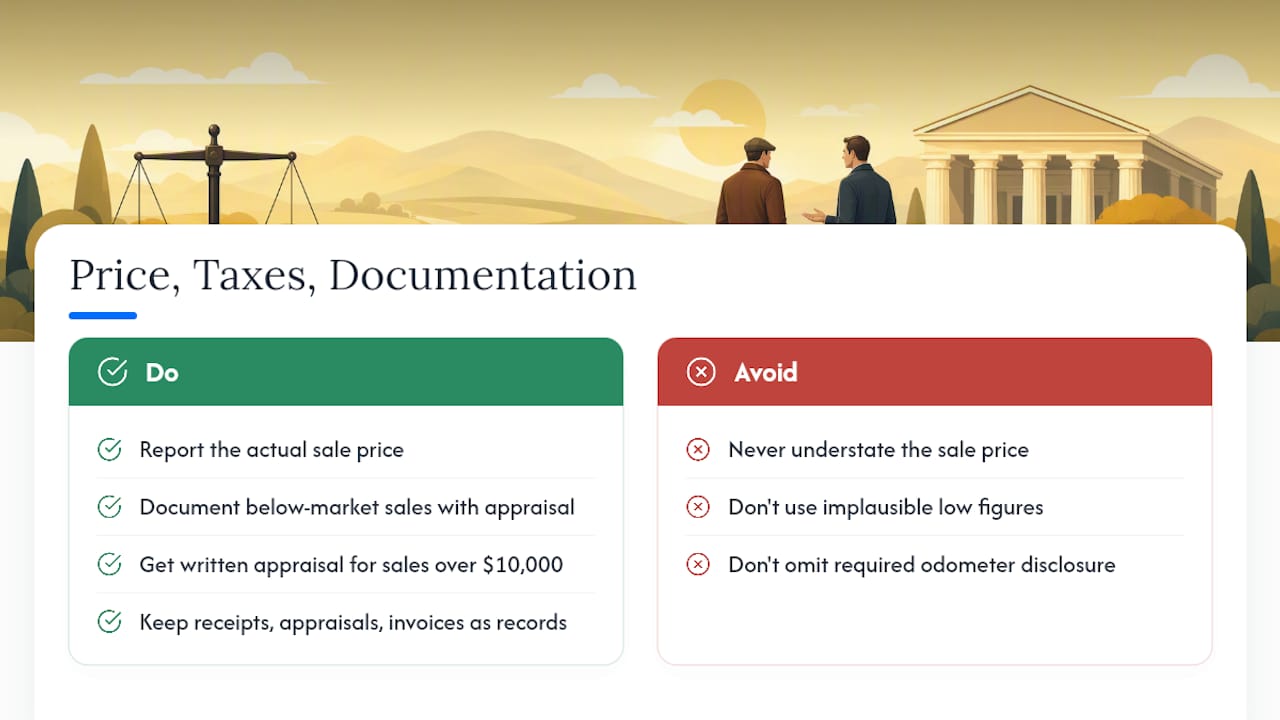
Capital gains and IRS reporting: IRS Topic No. 409 covers the tax treatment of collectibles, including classic cars that have appreciated in value. If you sell a collector vehicle for more than you paid, that gain may be taxable. The IRS taxes long-term gains on collectibles at a maximum rate of 28%, higher than the standard long-term capital gains rate for most assets. Keep every receipt, appraisal, and restoration invoice because your cost basis includes documented improvements, not just the original purchase price. For a deeper look at how capital gains rules apply to collector vehicles, the classic car capital gains tax guide at Butterclassics walks through the specifics.
Pro Tip: For any classic car sale above $10,000, get a written appraisal from a certified appraiser before closing. It protects the seller from IRS scrutiny on the gain calculation and protects the buyer from a DMV tax assessment based on a higher book value. Recent comparable sales from auction results also work as supporting documentation.
Warning: Never understate the sale price to reduce tax exposure. State DMVs routinely cross-reference book values and auction records. If the stated price looks implausible, the DMV will assess tax on its own valuation, and you may face penalties on top of the corrected tax bill.
What buyers and sellers should do after signing
Getting signatures on the document is the midpoint, not the finish line. Here is what both sides need to do to close the deal cleanly.
Seller checklist
- Sign the title in the correct assignment section, exactly as your name appears on the front of the title.
- Complete your state's Notice of Transfer and Release of Liability form (many states offer this online) so you are no longer responsible for the vehicle after the sale date.
- Hand over the original title, bill of sale, any lien release, and all supporting documents at the time of sale.
- Disclose all known liens, salvage history, and mechanical issues in writing before signing.
- Keep a signed copy of the bill of sale and a copy of the title for your own records.
- Check the classic car trade-in evaluation checklist for a complete paperwork rundown before the handoff.
Buyer checklist
- Verify the VIN on the vehicle matches the VIN on the title and the bill of sale before any money changes hands.
- Run a title search or vehicle history report to confirm no outstanding liens, salvage branding, or odometer rollback.
- Obtain any required smog or safety certifications for your state before submitting the title application.
- Submit the title application and pay all fees within your state's deadline, typically 10–30 days from the sale date.
- If the seller cannot produce a title, ask about a bonded title or state affidavit process before proceeding.
Timeline after the sale
- Day of sale: Exchange payment, signed title, bill of sale, and all supporting documents simultaneously. Never hand over money before you have the signed title in hand.
- Days 3–10: Seller files the Notice of Transfer or Release of Liability with the state DMV.
- Days 10–30: Buyer submits the title application, pays sales or use tax, and registers the vehicle. Deadlines vary by state, so check yours immediately.
- If you miss the deadline: Most states allow late applications with a penalty fee. Contact the DMV proactively rather than waiting for a notice.
Correcting a bill of sale after signing
Mistakes happen. If you catch a typo or wrong VIN after both parties have signed, do not white-out or overwrite the original. Instead, prepare a corrected bill of sale with the accurate information, note at the top that it supersedes the original, and have both parties sign the corrected version. For errors on a title assignment, most states require a separate affidavit or a corrected title form from the DMV. Keep both the original and the corrected document together in your file.
A copy-ready template and key clause examples
The template below covers all the fields a state DMV and the IRS expect to see. Fill in the bracketed fields and add any state-specific notarization block your DMV requires.
BILL OF SALE FOR CLASSIC/COLLECTOR VEHICLE
Seller: [Full Legal Name], [Address], [City, State, ZIP] Buyer: [Full Legal Name], [Address], [City, State, ZIP] Date of Sale: [Month Day, Year]
Vehicle Description: Year: [YYYY] | Make: [Make] | Model: [Model] VIN: [17-Character VIN] Color: [Color] | Body Style: [Body Style]
Sale Price: $[Amount in Numerals] ([Amount Written in Words] Dollars) Payment Method: [Cash / Certified Check / Wire Transfer]
Odometer Reading: [Reading] miles — OR — Odometer disclosure not required; vehicle is exempt by age under 49 U.S.C. § 32705.
Key clause examples you can paste directly into the template:
- As-is condition: "Buyer accepts the vehicle as-is, with no express or implied warranties as to mechanical condition or fitness for any purpose." Note that Cornell Law's guidance on as-is clauses confirms that UCC warranty rules can still apply in some jurisdictions, so consult a local attorney for high-value deals.
- Warranty of title: "Seller warrants clear title, free of all liens and encumbrances, and full authority to sell."
- Lien disclosure: "No outstanding loans or security interests are attached to the vehicle. Seller will satisfy any undisclosed lien at their own expense."
- Payment and deposit: "A deposit of $[Amount] was received on [Date]. The remaining balance of $[Amount] was paid in full on the date above."
- Notarization placeholder: "Acknowledged before me, [Notary Name], Notary Public for [State], on [Date]. [Notary Seal]."
When the seller has no title
If the seller cannot produce a title, you have two main routes. A bonded title requires you to purchase a surety bond for a percentage of the vehicle's appraised value and submit it to the state DMV with the bill of sale and any supporting ownership documents. The state then issues a bonded title that becomes a clean title after a statutory period, typically three to five years, if no ownership claims arise. Alternatively, some states offer a court-order title or a DMV affidavit process for older vehicles. Check your state DMV's specific procedure before committing to either route.
For state-specific forms, start at your state DMV's official website. When a state form exists (like California's REG 135), use it instead of a generic template. Classic-car-specific templates are also available from providers like Parkhill Recovery Solutions as a starting point, but always layer in your state's required fields.
How to protect yourself on high-value classic car deals
A 1967 Shelby GT500 or a numbers-matching 1970 Chevelle SS is not a $5,000 transaction. The paperwork and due-diligence steps need to match the dollar amount at risk.
Escrow and payment methods
For any deal above roughly $15,000, an escrow service holds the buyer's funds until the title transfers cleanly. The buyer wires money to the escrow account, the seller ships or delivers the vehicle and title, and the escrow service releases funds only after the buyer confirms receipt and the title clears. This protects both sides from wire fraud and title disputes. Never wire money directly to a seller you have not met in person or whose identity you have not independently verified.

Certified checks and bank wires are the standard payment methods for collector vehicles. Personal checks are a risk for sellers; cashier's checks can be counterfeited, so call the issuing bank to verify before releasing the vehicle.
Title search and VIN verification
Before signing anything, run a vehicle history report using the 17-character VIN. The NHTSA VIN decoder lets you verify the vehicle's identity and check for open recalls at no cost. A paid vehicle history report adds lien history, odometer records, and any salvage or flood branding. For a deeper look at what a branded title means for registration and resale, the salvage title guide at Butterclassics covers the key risks.
Your title search checklist:
- Confirm VIN on the vehicle matches the title, bill of sale, and any prior registration documents.
- Check for active liens through the state DMV or a lien search service.
- Verify the title has not been branded as salvage, flood, or rebuilt.
- Confirm the seller's name matches the title exactly.
- Review odometer history for any rollback flags.
Pre-purchase inspection
A classic-specialist mechanic can spot deferred maintenance, hidden rust, and misrepresented restoration work that a general shop might miss. For documentation of originality and restoration claims, consider pairing the inspection with an authentication review. The classic car authentication guide at Butterclassics explains what to look for and how to document it. You can also tie payment to a satisfactory inspection result by adding a contingency clause to the bill of sale: "This sale is contingent upon Buyer's satisfactory inspection of the vehicle within [X] days of signing. If the inspection reveals material defects not disclosed by Seller, Buyer may void this agreement and receive a full refund of any deposit."
Pro Tip: For six-figure collector cars, consider a full due diligence review that covers title history, provenance documentation, and a professional appraisal. The cost is a small fraction of what a title dispute or undisclosed lien can cost you after the fact.
Consignment as a lower-risk option
Sellers who want professional handling, escrow support, and a vetted buyer pool can use a consignment service rather than navigating a private sale alone. A reputable consignment marketplace manages the listing, vetting, and paperwork coordination, which reduces the risk of a title dispute or a fraudulent buyer.
What the bill of sale really tells you about a deal
Here is a perspective worth sitting with: the quality of a bill of sale is often a proxy for the quality of the seller. A seller who pushes back on including a warranty of title clause, resists notarization on a $50,000 car, or wants to leave the VIN field blank is telling you something. The document itself is not the protection. The willingness of both parties to complete it honestly is.
Butterclassics makes the transfer process smoother
Selling or buying a classic car privately means handling every piece of paperwork yourself, from the bill of sale to the title assignment to the release of liability. Butterclassics takes that weight off your plate. Through the Butterclassics marketplace, you get professional consignment handling, detailed vehicle listings with high-quality images, and a buyer pool of serious collectors who know what they are looking at.
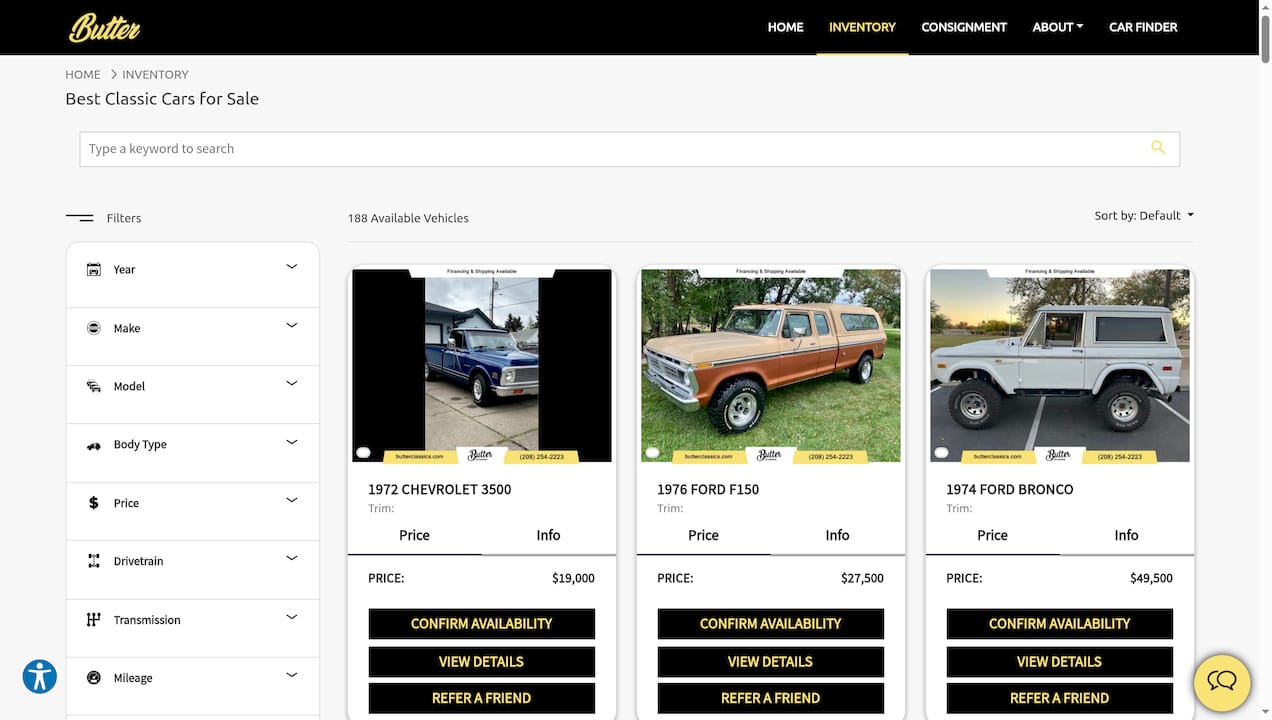
For sellers, consignment through Butterclassics means your vehicle is presented to the right audience with the documentation and transparency that high-value buyers expect. For buyers, you get the ability to schedule a test drive, review vehicle specs, and start financing pre-qualification before committing. If you are dealing with a complex title situation or need guidance on the paperwork side of a transfer, the Butterclassics team is a good first call. Browse the current inventory or reach out to start a consignment conversation at Butterclassics.
Sources
Use these official sources to verify state-specific requirements before any classic vehicle transfer:
- 1.020 Bill of Sale (VC §1652) - California DMV
- CONTRACT AND BILL OF SALE FOR AUTOMOBILE - Berkeley School of Law
- IRS: Topic No. 409 Collectibles
- Bill of sale - Cornell Law School Legal Information Institute
For final instructions on title transfer, always use the DMV website for the state where the vehicle is currently titled, not the state where you plan to register it. Those two states are sometimes different, and the titling state's rules govern the transfer.
This article is general information, not a substitute for advice from a qualified lawyer. Consult a qualified legal professional about your own circumstances before acting on anything here.