
Before you hand over a dollar or sign anything, confirm five things: a clean title signed over by the seller with a VIN that matches the car, a complete bill of sale, a lien release if one applies, a written pre-purchase inspection report, and proof of current registration or insurance. Run a VIN history check for salvage or flood brands first. Exact registration paperwork varies by state, so check your state DMV forms before you finalize anything.
TL;DR:
- Ensuring the title is clean, signed correctly, and free of brands like salvage or flood is essential before purchasing a classic car.
- The bill of sale must include full VINs, sale details, and signatures, with notarization required in some states to validate ownership transfer.
- Independent verification of VINs and lien releases through official checks and direct contact with lenders can prevent fraud and legal issues.
- State-specific documentation rules for classic and antique vehicles vary widely, often involving photographs, affidavits, or proof of original production.
- Organizing all paperwork digitally, including scans of titles, receipts, and history reports, simplifies future resale and legal verification processes.
Table of Contents
- The Complete Classic Car Documentation Checklist
- How Do State Registration Rules Differ for Classic and Antique Cars?
- How Do You Verify Title, VIN, and Title Brands Before Paying?
- Organizing and Handing Off the Documentation File
- What Butterclassics Buyers and Sellers Should Know About This Checklist
- What Emission and Safety Inspections Apply to Classic Cars?
- What Import Documents Do You Need for a Classic Brought From Overseas?
- Do You Need Proof of Classic Car Insurance for Registration?
- Which Apps Help You Track Classic Car Paperwork?
- Editorial Take: The Paperwork Beats the Polish
- Buy or Consign With the Paperwork Already Sorted
- Where to Verify Forms and Title Rules Yourself
- Sources
- FAQ
The Complete Classic Car Documentation Checklist
Every deal on a vintage vehicle comes down to paper. The car might be smooth as butter on the test drive, but if the paperwork is a mess, you're buying a headache instead of a hobby. Here's what to gather and check before money changes hands.
Title. This is the single most important document in the transaction. Confirm the owner's name matches the seller, that the VIN printed on the title matches the VIN stamped on the vehicle, and that the reassignment section is signed in the right spot. Check for brands like "salvage" or "flood" printed on the face of the title. A Certificate of Title from the New York DMV is the official proof of ownership, and most states will flatly reject titles with cross-outs, white-out, or other signs of tampering.
Bill of sale. It should list the sale date, the agreed price, the full VIN, and the complete legal names and addresses of both buyer and seller, with signatures from both parties. Some states want it notarized. Our classic car bill of sale guide breaks down what each state actually requires.
Lien release. If the seller financed the car, you need the original lien release from the lender or proof the lien was recorded as satisfied. Call the lienholder directly using contact information you find independently, not a number the seller hands you.
Odometer and damage disclosures. Required on most title applications for vehicles under a certain age, and often built into the state title-transfer packet itself.
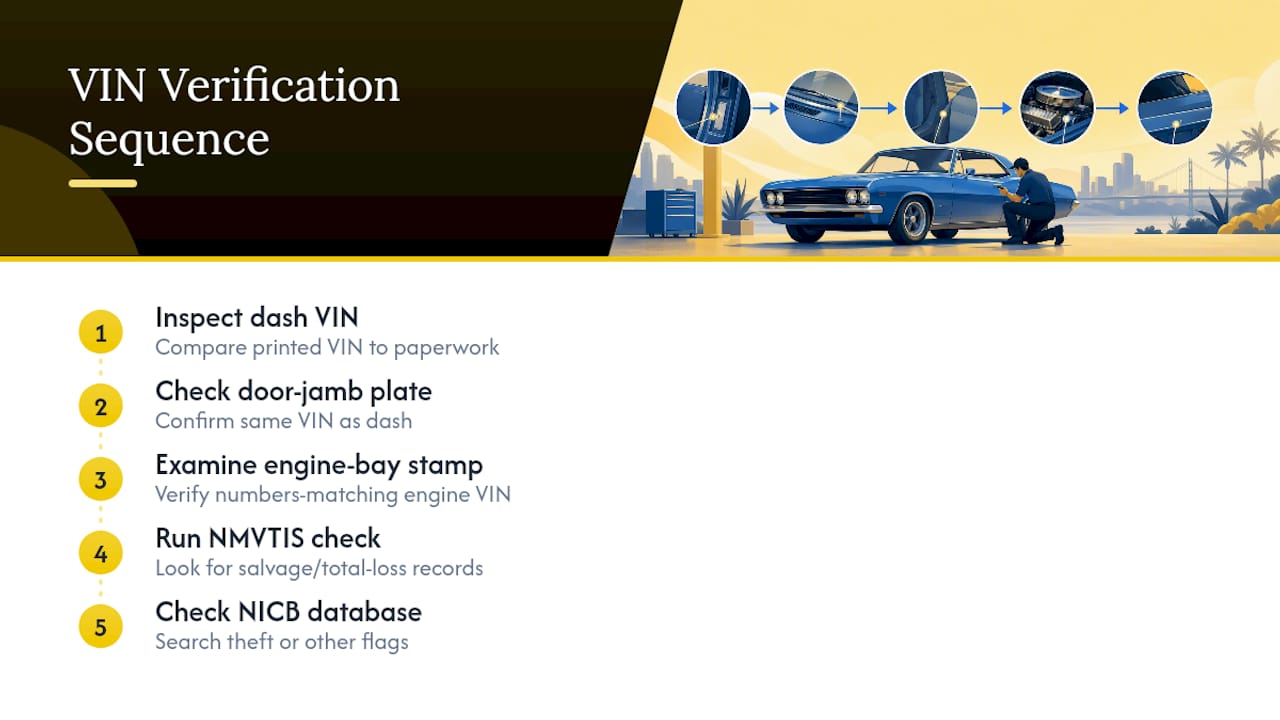
VIN verification. Check the dash, the door jamb plate, and the engine bay stamp. Then run the number through NMVTIS and check with the NICB for theft or total-loss flags. Our classic car history check guide covers common VIN mismatches on pre-1981 vehicles specifically.
Pre-purchase inspection (PPI) report. Get it in writing, covering frame condition, numbers-matching components, rust, and major mechanical systems.
Provenance. Build sheets, window stickers, service receipts, restoration photos, club registry letters, and prior auction catalog listings.
Registration and insurance. Current registration card, any specialty plate paperwork, proof of insurance, and spare keys or owner's manuals if available.
Photos. Some states require front, rear, and both side photos for special registrations.
Appraisals and prior titles. These establish the chain of ownership and support value claims down the road.
Pro Tip: Photograph every document with your phone before you leave the sale, even ones you're keeping the originals of. A blurry paper trail beats no paper trail if something gets lost in the mail to your DMV.
How Do State Registration Rules Differ for Classic and Antique Cars?
Every state draws its own line between "classic" and "antique," and the documents you need often depend on which side of that line your car falls on. Pennsylvania's antique and classic vehicle rules, for example, spell out specific criteria and can require four color photographs along with proof of the car's age or original production status.
- Age thresholds for antique or classic status range widely by state, so never assume the federal import rule applies uniformly to your state's plates.
- Specialty plates often come with mileage or use restrictions (parades, exhibitions, occasional pleasure use); your insurer needs to know about these.
- Some states demand supplemental affidavits proving the car hasn't been substantially modified from factory spec.
- Always pull the current forms directly from your state DMV site rather than relying on a dealer's summary, since these rules change.
How Do You Verify Title, VIN, and Title Brands Before Paying?
Title fraud on older vehicles is common enough that several states publish dedicated guidance on catching it, and a stepwise check takes fifteen minutes and can save you thousands.
- Match the VIN physically. Compare the dash plate, door jamb sticker, and engine stamp against the number on the title.
- Inspect the title itself. Look for alterations, mismatched fonts, missing notary stamps, or a signature that doesn't match the seller's ID.
- Run official history checks. Search NMVTIS and the NICB database, and pull a full vehicle history report to flag salvage, flood, or odometer rollback issues.
- Verify the lienholder independently. Call the bank or credit union yourself using a number from their own website, not one supplied by the seller.
- If the title is missing, stop. Follow your state's bonded-title or lost-title affidavit process before you finalize anything.
Washington State's title fraud guidance specifically recommends physically tracing VINs across multiple chassis locations, since high-value classics are frequent targets for VIN cloning. When a title carries prior salvage history, request the original salvage examination paperwork; some states require that exam before they'll re-title the car at all.
Organizing and Handing Off the Documentation File
Build a master file with five sections: title and registration, bills of sale, service and restoration records, photographs, and any appraisals or club registry letters. Scan everything as PDFs, name files consistently, and back them up to the cloud. Redact personal information like addresses before sharing scans publicly.
- At closing, the seller hands over the signed title, keys, and manuals; you file the title application with your state DMV, usually within a set deadline.
- File a release of liability with your state DMV immediately after the sale closes.
- Update your insurance the same day, not "sometime this week."
Pro Tip: Keep one printed copy of the title and bill of sale in the glove box. If you're ever pulled over in a car still titled to the previous owner during the transfer window, that paper trail matters.
What Butterclassics Buyers and Sellers Should Know About This Checklist
We build our listings around this exact checklist. Every vehicle on our platform gets its title status, VIN, and known history documented up front, so you're not chasing paperwork after you've already fallen for the car. Buying or consigning through a marketplace like Butterclassics also means a documented inspection trail and title handling support, rather than a handshake deal in a parking lot. If your paperwork's incomplete, our team can help you sort it out during test drive scheduling or consignment intake.
What Emission and Safety Inspections Apply to Classic Cars?
Most states carve out exemptions for older vehicles, but "most" isn't "all," and the cutoff isn't always the same age you'd expect. A car that's 25 years old under federal import rules might still owe an emissions test if your state's exemption threshold is set higher, say 30 or 35 years, or tied to model year rather than a rolling age calculation.
Some states exempt vehicles registered under historic or antique plates from routine emissions testing entirely, on the theory that a car driven a few hundred miles a year for shows isn't a meaningful pollution source. Others still require a one-time safety inspection, checking brakes, lights, and steering, even if emissions testing is waived. The paperwork you'll need typically includes proof of the vehicle's model year, your specialty plate application, and sometimes an affidavit about annual mileage.
Don't guess on this one. Pull your state's actual exemption rule before you register, because a rejected inspection can hold up your registration by weeks while you track down the right form. If you're buying a car that already carries historic plates from a previous owner, confirm those plates transfer with the vehicle or whether you'll need to reapply under your own name, since rules on that vary too.
What Import Documents Do You Need for a Classic Brought From Overseas?
If your classic crossed a border to get here, you're dealing with an entirely separate paper trail on top of the standard title and registration documents. You'll need the original foreign title or registration document, a bill of lading from the shipping company, and U.S. Customs entry paperwork (CBP Form 7501 for most passenger vehicles).
Depending on the car's age and origin, you may also need EPA and DOT compliance documentation, or proof the vehicle qualifies for the 25-year exemption from federal safety standards. That exemption is a federal rule, separate from any state age threshold for antique plates, so don't conflate the two.
If a freight forwarder or import specialist handled the shipping, keep every document they generated. A shipping documentation checklist built for general importers and exporters gives a useful sense of what a complete freight paper trail looks like, even though your classic car import will layer state DMV requirements on top of it. Once the car clears customs, most states still want the foreign title translated (if not in English) and authenticated before they'll issue a U.S. title, so budget extra time for that step versus a domestic purchase.
Do You Need Proof of Classic Car Insurance for Registration?
Some states require proof of insurance at the DMV counter before they'll issue plates, and specialty classic car insurance policies often carry their own documentation quirks worth knowing about upfront. Standard auto insurers typically value a classic at market rate, which can undersell a well-preserved or restored car by a wide margin.
Agreed-value classic car policies, by contrast, set the insured value in the policy itself, usually based on an appraisal, so you'll want that appraisal document in your file regardless of what your state's registration process asks for. Many classic car insurers also want to see your restoration receipts, prior appraisals, or club registry documentation before they'll write an agreed-value policy at all, since that paperwork is how they justify the number.
Keep your insurance card current and easy to produce, because a lapse can complicate not just registration renewals but also any claim you might need to file after a fender bender at a car show. If you're using specialty or seasonal plates with mileage restrictions, check whether your insurer needs proof of that limited use, since a policy written for occasional pleasure use won't cover you the same way a daily-driver policy would if you rack up unexpected mileage.
Which Apps Help You Track Classic Car Paperwork?
Paper folders get lost, coffee-stained, or left in a car that eventually gets sold. Digital tools solve that, and you don't need anything exotic to build a documentation system that actually holds up.
A basic setup works fine: scan every document as a PDF, name files consistently (something like "1969_Camaro_Title_2026.pdf"), and store everything in a cloud folder with automatic backup, whether that's Google Drive, Dropbox, or iCloud. For anyone managing more than one vehicle, dedicated garage and collection management apps track service history, mileage logs, and document storage in one place, and some let you generate a shareable provenance summary for potential buyers down the road. A complete provenance file built from original build sheets, service records, and restoration receipts can materially raise a classic's resale value, and having it organized digitally makes that case faster to prove when a buyer asks.
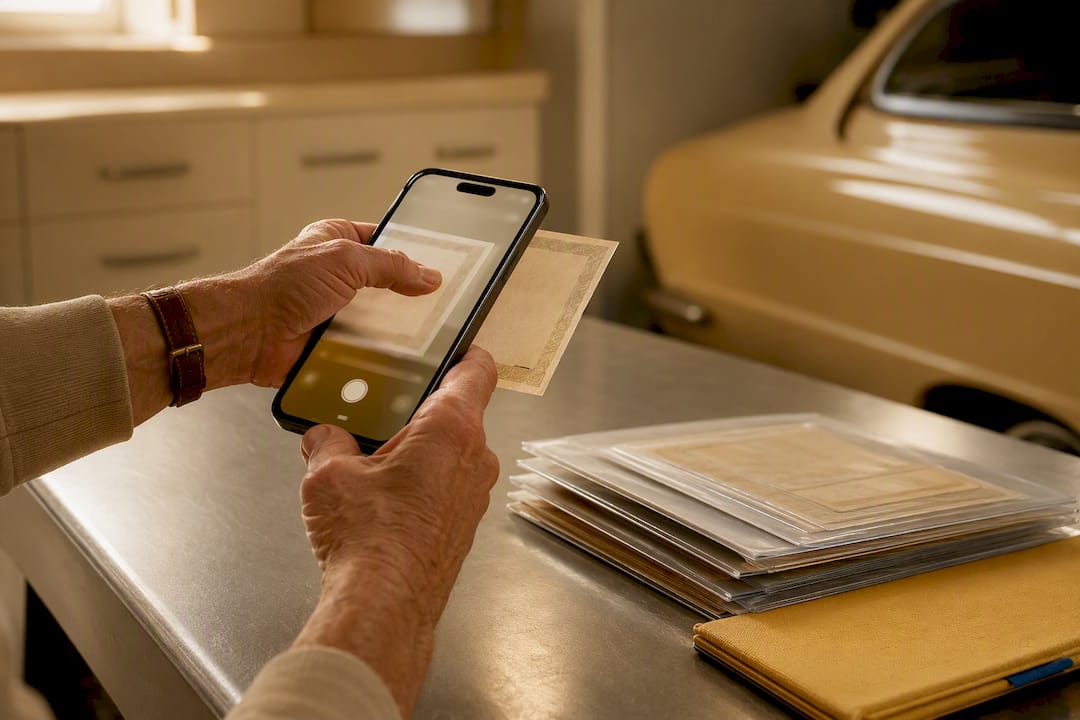
Whatever tool you use, keep a redacted version ready for public sharing. Full VINs and personal addresses don't belong in a listing photo or a forum post, even when the rest of the file is worth showing off.
Editorial Take: The Paperwork Beats the Polish
Here's the uncomfortable truth about classic car shopping: everybody obsesses over paint depth and engine notes, and almost nobody reads the title carefully. That's backwards. A rough-running car with clean paper is a fixable project. A gorgeous restoration with a clouded title is a legal problem wearing a paint job.
The conventional advice, "get an inspection," isn't wrong, but it undersells how much of the real risk sits in three sheets of paper: the title, the lien status, and the VIN history report. Mechanical problems cost money. Title problems can cost you the car entirely, sometimes months after you thought you owned it.
If you take one thing from this checklist, verify the title and VIN before you fall in love with the car, not after. Marketplaces that document title status upfront, Butterclassics included, exist precisely because so much of this industry still runs on trust and a handshake. That's charming until it isn't.
— Tony
Buy or Consign With the Paperwork Already Sorted
Butterclassics exists because chasing down a clean title, a signed bill of sale, and a lien release shouldn't be the hardest part of buying your dream car. Every listing in our nationwide inventory comes with documented title status and vehicle details, so you're evaluating the car itself, not gambling on paperwork you can't see yet.
If you're buying, browse listings with financing options and schedule a test drive once you've confirmed the documentation checks out. If you're selling, our consignment service handles title verification and paperwork as part of the process, so you're not the one fielding lien questions from a stranger's lender. Either way, the next step is the same: start with an inventory search or a consignment inquiry, and let us help you skip the paperwork headaches this checklist just walked you through.
Where to Verify Forms and Title Rules Yourself
Check your state DMV site for exact forms, confirm antique vehicle criteria in your state's code, and review flood-title consumer alerts before buying.
Sources
- Certificate of title — New York DMV
- 67 Pa. Code Chapter 67. Antique And Classic Vehicles
- Florida Title transfer procedures (TL-11)
- Attorney General Missouri — Consumer alert: flood cars
- Texas Department of Motor Vehicles — General motor vehicle information
FAQ
What Is the 30-60-90 Rule for Classic Cars?
This isn't a standard legal or DMV rule; definitions of it vary depending on the source, and no state code or federal regulation we found codifies a "30-60-90" standard for classic vehicles. Treat any version you see online as informal shorthand rather than an official threshold, and check your own state's antique or classic vehicle code for the actual age and use requirements that apply to your registration.
Is a 25-Year-Old Car a Classic or an Antique?
It depends entirely on your state, since there's no single national definition. The 25-year mark is significant federally because it's the threshold for importing a foreign vehicle without meeting current U.S. safety and emissions standards, but individual states set their own age thresholds for classic or antique registration plates, which can be higher or lower.
How Many Miles Can You Drive a Classic Car on Antique Plates?
Mileage limits vary by state and by the specific plate program, with many states restricting antique-plated vehicles to exhibitions, parades, and occasional pleasure driving rather than daily use. Check your specific state DMV's antique vehicle rules, since exceeding a mileage or use restriction can affect both your registration status and your insurance coverage.
Are 25-Year-Old Cars Exempt From Emissions Testing?
Not automatically. The 25-year mark relates to federal import exemptions, not state emissions testing exemptions, which are set independently by each state and often use a different age cutoff or require historic plates specifically. Confirm your state's emissions exemption criteria directly with your state DMV or environmental agency before assuming your car qualifies.
What Documents Does Butterclassics Verify on Its Listings?
Butterclassics documents title status and vehicle details on its listings so buyers can evaluate documentation before scheduling a test drive. For sellers, the consignment service includes support with title handling as part of the sale process.