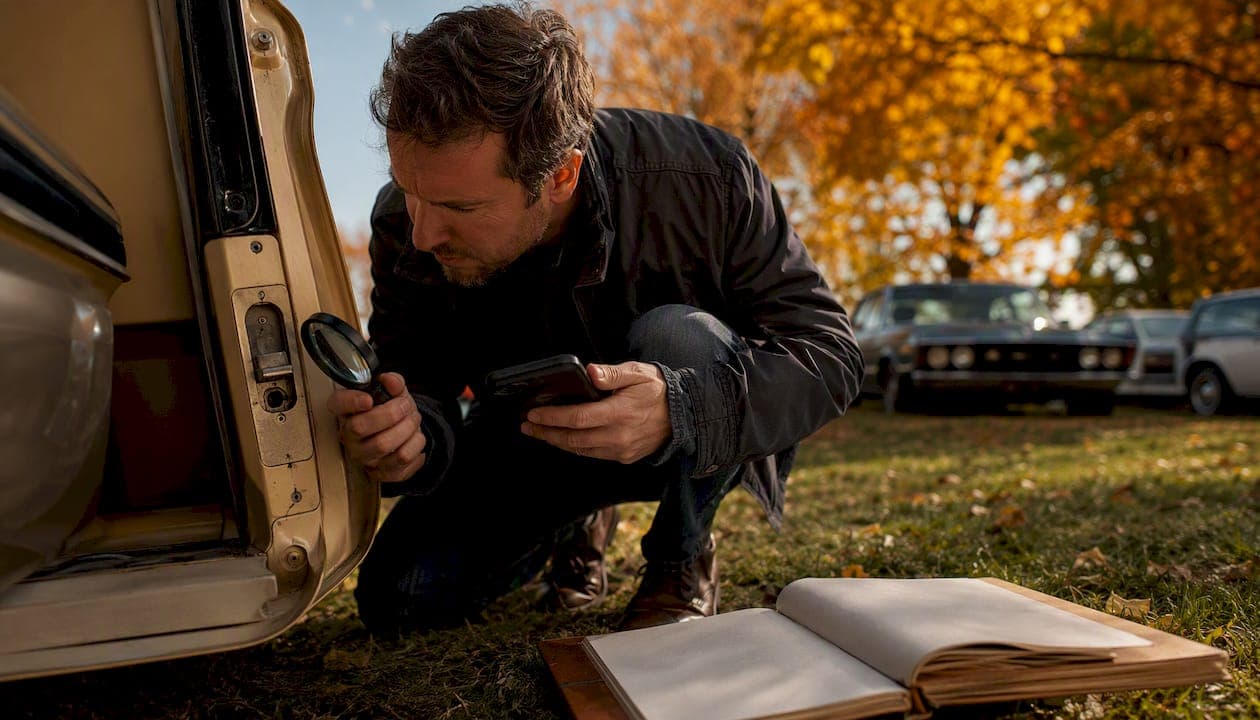
Before you wire a dollar or sign anything, run through these five actions: verify the VIN against a title in your name, demand a live video walkaround showing the VIN plate, use a vetted escrow service instead of a wire or gift card, order an independent pre-purchase inspection, and confirm the seller's identity through state business filings, not just the number they gave you. Each one closes a door that scammers routinely walk through.
- Verify the VIN and title — a mismatch almost always means a cloned or stolen vehicle.
- Insist on live, synchronous video (FaceTime or Zoom) — pre-recorded clips and staged photos can be fabricated.
- Use a reputable escrow service — it holds funds until both parties confirm delivery, cutting off the most common payment traps.
- Never wire money or send gift cards — both are effectively untraceable and unrecoverable.
- Get an independent inspection — a professional who works for you, not the seller, catches hidden damage and fraud signals before money changes hands.
Classic car scams cost victims millions every year, and the tactics keep getting sharper. The good news: most frauds share the same handful of tells, and knowing them puts you firmly in control.
Key Takeaways
Classic car fraud is organized, convincing, and growing, but every major scheme has at least one step that independent verification would have caught.
| Point | Details |
|---|---|
| Verify VIN and title independently | Run the VIN through NMVTIS or Carfax using a service you locate yourself, not a seller-provided link. |
| Live video is the strongest single check | A synchronous FaceTime or Zoom walkaround showing the VIN plate is far harder to fake than photos or pre-recorded clips. |
| Use licensed escrow for remote deals | Verify the escrow provider's license through state financial-services filings before sending any funds. |
| Report fraud within 24 hours | Contact your bank, then file with the FTC at ReportFraud.ftc.gov and the FBI's IC3 at ic3.gov immediately. |
| Hire an independent inspector | An appraiser who works for you, not the seller, catches the majority of fraud and misrepresentation before money changes hands. |
| Butterclassics vetted listings | Browsing certified inventory at Butterclassics removes several common fraud vectors before you ever contact a seller. |
Table of Contents
- Classic car scams buyers face most often
- Scams that target sellers and how to protect your listing
- Red flags and a verification checklist before you commit
- Safe payment options and escrow: what protects you
- What to do immediately if you suspect or confirm fraud
- Recent cases and trends that show how large-scale fraud operates
- A 10-step pre-purchase checklist for buying a classic car safely
- What the patterns in these cases actually tell us
- Butterclassics reduces the risks that come with buying blind
- Sources
Classic car scams buyers face most often
The collector market is a scammer's ideal hunting ground. Vehicles are high-value, documentation is irregular, and buyers frequently shop across state lines without ever seeing the car in person. That combination creates openings that organized fraud rings exploit deliberately.
Fake and nonexistent listings
The most common scheme is simple: post photos of a real car, collect a deposit or full payment, then vanish. Scammers photograph real dealer inventory and relist those cars under fake accounts on Craigslist, Facebook Marketplace, and similar platforms. Because the photos are genuine, reverse-image searches sometimes return the real dealer's site, which the scammer then claims is their own. In one documented case, two brothers ran this scheme long enough to accumulate approximately $3 million in reported losses before law enforcement intervened.
Cloned dealer websites
Fraudsters build convincing replica sites by copying a real dealership's photos, logo, and contact details, then swapping in a different phone number and bank account. A Long Island buyer wired $25,000 for a car that never existed after landing on one of these cloned sites. The real business had already reported the imposters to federal investigators, yet the fake site kept collecting victims. The BBB has documented similar cases where scammers hijacked legitimate Google Business Profiles to make their fake pages rank and look credible.
Fake escrow services
Once buyers started demanding escrow, scammers built fake escrow sites to match. The seller recommends a specific "escrow" company, the buyer sends funds, and the site disappears. A legitimate escrow provider will be licensed, verifiable through state financial-services filings, and will never be suggested exclusively by the seller.
VIN cloning and title fraud
A cloned VIN is stamped or printed onto a stolen vehicle to make it appear legitimate. The buyer gets a car with a clean-looking history report, drives it home, and later discovers it is stolen property subject to seizure. Always run the VIN through the National Motor Vehicle Title Information System (NMVTIS) or a service like Carfax and compare it against the physical VIN plate, the door jamb stamp, and the title document.
Too-good-to-be-true pricing
The FTC advises treating any seller who refuses an in-person meeting or pushes unusual payment methods as a red flag, regardless of how attractive the price looks. Emotional attachment to a specific model makes buyers rationalize the discount instead of questioning it.
Shipping and deposit traps
The seller claims to be overseas or in a remote location and offers to ship the car after a deposit. Once the deposit clears, the shipping company (also fake) demands additional "insurance" or "customs" fees. The car never ships. Never pay a deposit to a seller you cannot verify independently, and never use a shipping company the seller recommends without confirming it through independent channels.
Scams that target sellers and how to protect your listing
Sellers face a different set of threats, and the most dangerous ones arrive looking like serious buyers.
Overpayment and refund schemes
A "buyer" sends a cashier's check or money order for more than the asking price, then asks the seller to wire back the difference before the check clears. Cashier's checks can take weeks to bounce, and by then the seller has wired real money to an untraceable account. The rule is absolute: hold the vehicle until funds are irrevocably cleared, confirmed directly with your bank, not just by a deposit notification in your account.
Fraudulent ACH and mobile-banking access
Some scammers pose as buyers who need to "verify" the seller's account by sending a small test deposit, then request login credentials or one-time passcodes to "confirm receipt." That access is used to drain the account. No legitimate buyer ever needs your banking credentials or a verification code.
Fake shipping agents
A buyer agrees to the price, then sends a "shipping agent" to pick up the car before payment clears. The agent presents paperwork that looks official. Once the car leaves the driveway, it is gone. Never release a vehicle until payment is confirmed irrevocably cleared, and never allow pickup by a third party without independent verification of both the buyer's identity and the shipping company's credentials.
Restoration and consignment fraud
This one is particularly painful because it can run for years. A shop takes a deposit for a restoration or consignment sale, provides occasional progress photos and optimistic updates, and keeps requesting additional funds. FOX5 Investigates reported a Las Vegas case where a single operator defrauded classic car owners of over a million dollars this way, stringing victims along with false updates. A Henderson, Nevada investigation found at least several dozen victims in a similar consignment scheme. Require milestone-based payments tied to verifiable, in-person progress checks, and confirm the shop's state license before signing anything.
Pro Tip: Before accepting any payment, call your bank directly and ask them to confirm that the funds are irrevocably cleared, not just "pending." A deposit notification in your app is not confirmation. Scammers count on sellers not knowing the difference.
Red flags and a verification checklist before you commit
The verification steps below work in sequence. Run them in order before any money or commitment changes hands.
- Run the VIN through NMVTIS or Carfax. Cross-reference the report against the physical plate, door jamb, and title. Any mismatch is a hard stop. The FTC has previously warned that scammers sometimes manipulate or fabricate vehicle-history reports, so use a service you locate independently, not one the seller links you to.
- Reverse-image search every photo. Drag each listing photo into Google Images or TinEye. If the same images appear on a different site under a different seller's name, you are looking at a stolen listing. Hagerty recommends this as one of the most reliable quick checks available.
- Request a live video walkaround. Ask for a synchronous FaceTime or Zoom session showing the VIN plate, odometer, and the full exterior. A live video is the single most reliable check for sight-unseen purchases. Pre-recorded clips and staged photos can be fabricated; a live session is much harder to fake.
- Look up the seller or business independently. Search the business name through your state's Secretary of State filing database, not through the seller-provided website. BBB reporting shows scammers clone real business names and Google profiles, so the seller's own site is not proof of legitimacy.
- Check the asking price against market comps. Use Hagerty's valuation guide or recent Bring a Trailer sold listings to establish a realistic range. A price more than 15–20% below comparable examples warrants extra scrutiny.
- Ask for a dated, handwritten note in a new photo. Request a photo taken that day showing the car with a piece of paper bearing today's date and your name. News 12 New Jersey's BBB coverage notes that scammers sometimes produce these digitally, so follow up with live video to confirm.
Pro Tip: When examining photos, zoom into reflections in chrome, glass, and paint. Digitally edited images often show distortion or inconsistent lighting in reflective surfaces that the editor missed. It is not foolproof, but it takes 30 seconds and occasionally catches a fake immediately.
Safe payment options and escrow: what protects you
The FTC is explicit: if a seller insists on wire transfer, gift cards, or prepaid cryptocurrency for a vehicle purchase, treat it as a scam signal. These methods offer buyers almost no recourse after the fact.
How escrow works for classic car deals
A reputable escrow service holds the buyer's funds in a neutral account until both parties confirm that the car has been delivered and inspected as described. For cross-state or sight-unseen purchases, the sequence typically runs: buyer deposits funds with escrow, seller ships or delivers the vehicle, buyer has an agreed inspection window (commonly 1–5 business days), and funds release to the seller only after the buyer confirms acceptance. Escrow.com is one of the established, licensed providers in this space. Verify any escrow service by looking up its license through your state's Department of Financial Institutions and confirming the domain registration independently.
What to watch for with cashier's checks
Cashier's checks feel safe but are not. Fraudulent cashier's checks can look identical to genuine ones and may show as "cleared" in your account before the bank discovers they are fake, sometimes weeks later. For any transaction above a few thousand dollars, wire the funds only after confirming the recipient's account details through a phone number you found independently, not one provided in an email or listing.
Contract language that helps
Include two clauses in any purchase agreement: an inspection contingency (the sale is void if an independent inspector finds material misrepresentation) and an escrow completion trigger (funds release only upon buyer's written acceptance after inspection). These are standard in commercial vehicle transactions and any legitimate seller will accept them.
What to do immediately if you suspect or confirm fraud
Speed matters. The faster you act, the better the chance of recovering funds or stopping additional losses.
- Stop all further payments immediately. Do not send additional funds under any circumstances, even if the scammer claims it will release your car or refund your deposit.
- Contact your bank or card issuer within the hour. Request a wire recall if funds were sent by wire. Ask about chargeback options if a card was used. Banks have limited windows for recalls, so call before you do anything else.
- Preserve all evidence. Screenshot every message, email, listing, and payment confirmation. Save the seller's phone number, email address, and any account details they provided. Do not delete anything.
- File a report with local law enforcement. Get a case number. Some financial institutions and federal agencies require one before they will act.
- Report to the FTC at Reportfraud. The FTC aggregates reports to identify patterns and refer cases to law enforcement.
- File with the FBI's Internet Crime Complaint Center (IC3) at Ic3. IC3 handles online fraud and coordinates with federal investigators. Include all evidence you collected in step 3.
- Report to the BBB's Scam Tracker at bbb.org/scamtracker. This helps warn other buyers and sellers and creates a public record.
- Report to the platform where the listing appeared. Craigslist, Facebook Marketplace, and Bring a Trailer each have fraud-reporting tools. Removing the listing quickly can prevent additional victims.
- Contact your state attorney general's consumer protection office if the seller operated as a business or if the amount is significant. Some states have restitution programs.
- Consult an attorney if the loss exceeds a few thousand dollars or if the scammer's identity is known. Civil recovery is sometimes possible, particularly when a real business was involved.
Recent cases and trends that show how large-scale fraud operates
The cases below are not outliers. They represent a consistent pattern of organized, professional fraud targeting the collector market.
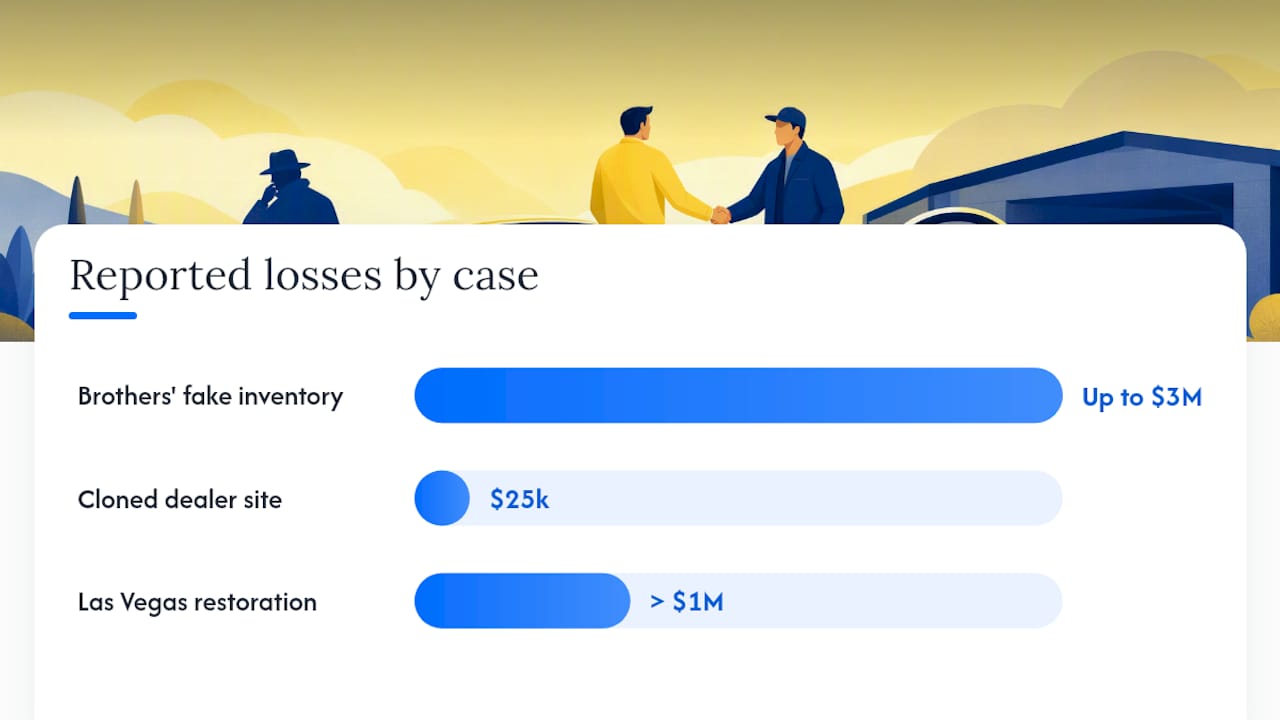
| Case | Reported Loss | Method | Source |
|---|---|---|---|
| Brothers' fake inventory scheme | Up to $3 million | Photographed real dealer inventory, listed to remote buyers | Road & Track |
| Long Island cloned dealer site | $25,000 (single victim) | Cloned real business website, collected wire | CBS News New York |
| Las Vegas restoration fraud | More than $1 million | Consignment/restoration deposits, false progress updates | FOX5 Las Vegas |
| Henderson consignment scheme | Undisclosed total, 30+ victims | Consignment deposits, no vehicles returned | Las Vegas Review-Journal |
The Road & Track investigation into the brothers' scheme revealed a detail that changes how buyers should think about photo verification: the scammers visited real dealerships in person to photograph vehicles and VIN tags. The photos were genuine. That means a reverse-image search returning a real dealer's site is not proof the listing is legitimate. It is a reason to call that dealer directly and ask if the car is actually for sale.
Cloned websites follow the same logic. CBS News documented how the fake site used the real business's photos, address, and branding so convincingly that the victim had no obvious reason to doubt it. The real business had already reported the imposters to federal investigators before the victim ever found the fake site.
Restoration fraud is the longest-running variant. FOX5's reporting shows operators can sustain these schemes for years by providing just enough communication to keep victims from filing reports. The Review-Journal's coverage of the Henderson case found victims who waited 18 months or more before concluding they had been defrauded.
Classic cars are targeted specifically because of their high values, the emotional weight buyers attach to them, and the fact that documentation standards vary widely from state to state. Auto Appraisal Group notes that this combination makes buyers more likely to rationalize red flags and less likely to walk away from a deal that feels close to perfect.
A 10-step pre-purchase checklist for buying a classic car safely
Follow these steps in order before signing, paying a deposit, or arranging shipping.
- Decode the VIN independently. Use the NHTSA VIN decoder or NMVTIS to confirm the vehicle's year, make, model, and history. Do not rely on the seller's description alone.
- Order a vehicle-history report from a service you locate yourself. Carfax and AutoCheck are widely used. Avoid clicking any history-report link the seller provides.
- Request a live video session showing the VIN plate, odometer, and full walkaround. Schedule it at a time that works for you, not the seller, to reduce the chance of a staged environment.
- Verify the seller's identity and business filings. Search the business name through the relevant Secretary of State database. Confirm the phone number through an independent directory lookup, not the listing.
- Check the asking price against Hagerty valuations and recent classic car market trends. A price significantly below market is a signal, not a bargain.
- Hire an independent inspector or appraisal professional. The inspector works for you. They check mechanical condition, body integrity, VIN consistency, and title status. This step alone catches the majority of fraud and misrepresentation.
- Confirm title and lien status with the issuing state's DMV. A clean Carfax does not guarantee a clear title. Contact the DMV directly to confirm no outstanding liens.
- Use a licensed escrow service for any sight-unseen or cross-state transaction. Verify the escrow provider's license independently before sending funds.
- Confirm the shipping company independently if the car is being transported. Never use a shipper the seller recommends without verifying their FMCSA registration and insurance.
- Include an inspection contingency and escrow completion trigger in the purchase agreement. Both clauses are standard and protect you if the car arrives misrepresented.
What the patterns in these cases actually tell us
The conventional wisdom on avoiding classic car scams tends to focus on payment method: don't wire money, don't use gift cards. That advice is correct but incomplete. The more useful lesson from the cases above is that scammers invest heavily in appearing legitimate, and the investment pays off because buyers stop checking once something looks right.
The brothers who ran a $3 million scheme did not use blurry photos or broken English. They photographed real cars at real dealerships. The Long Island fake site was convincing enough that the real business had already flagged it to federal investigators and buyers were still getting taken. Restoration fraudsters send progress photos and answer the phone. The surface presentation is designed to pass a casual check.
What actually works is verification that bypasses the seller entirely: calling the real dealership directly using a number from their official site, looking up business filings through the Secretary of State, and hiring an inspector who has no relationship with the seller. These steps cannot be faked because the scammer is not in the loop.
Emotional attachment is the other variable worth naming directly. Buyers who have spent months searching for a specific model are primed to rationalize red flags when the right car appears at a price that feels like a deal. The remedy is not less enthusiasm. It is a checklist you commit to before the search begins, so the verification steps happen automatically rather than competing with excitement in the moment.
At Butterclassics, the vetted inventory and consignment process are built around exactly this problem: reducing the verification burden on buyers by doing much of it on the front end. That does not replace an independent inspection, but it removes several of the most common fraud vectors before a buyer ever sees a listing.
Butterclassics reduces the risks that come with buying blind
Buying a classic car through an unverified listing on a general platform puts the entire verification burden on you. Butterclassics takes a different approach: listings go through a vetting process before they reach buyers, consignment vehicles follow a documented workflow, and the platform supports secure payment pathways rather than leaving buyers to sort out escrow on their own.
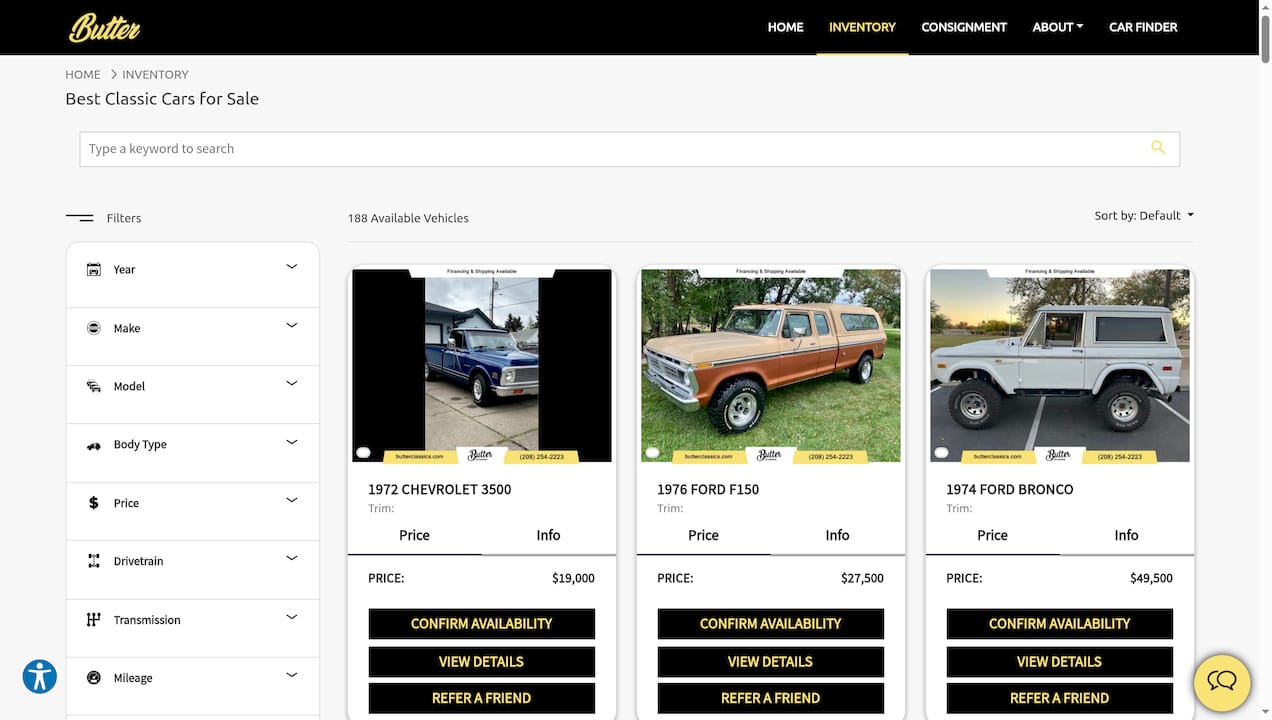
Three specific features lower your fraud exposure. First, Butterclassics-certified vehicles carry inspection documentation, so you are not starting from zero on condition and authenticity. Second, the consignment service gives sellers a structured, documented process that protects against the fake-buyer schemes described above. Third, buyers can schedule a test drive or use the Car Finder service to locate specific models through verified channels rather than chasing listings on open platforms.
Browse the Butterclassics inventory to see currently available vehicles, or submit a consignment inquiry if you are ready to sell through a process that protects you from the first contact to the final payment.
Sources
Use these resources to verify sellers, report fraud, and protect yourself before and after a transaction.
- Consumer
- Long Island man scammed by fake website months after real business reported imposters to feds - CBS News New York
- Brothers Stole Up to $3 Million from Victims in Classic Car Sales Scam: Cops — Road & Track
- 5 Tips to Spot a Classic Car Scam Online - Hagerty Media
The FTC's vehicle-history report guidance is also worth bookmarking, particularly if a seller sends you a pre-pulled report rather than letting you run one yourself.