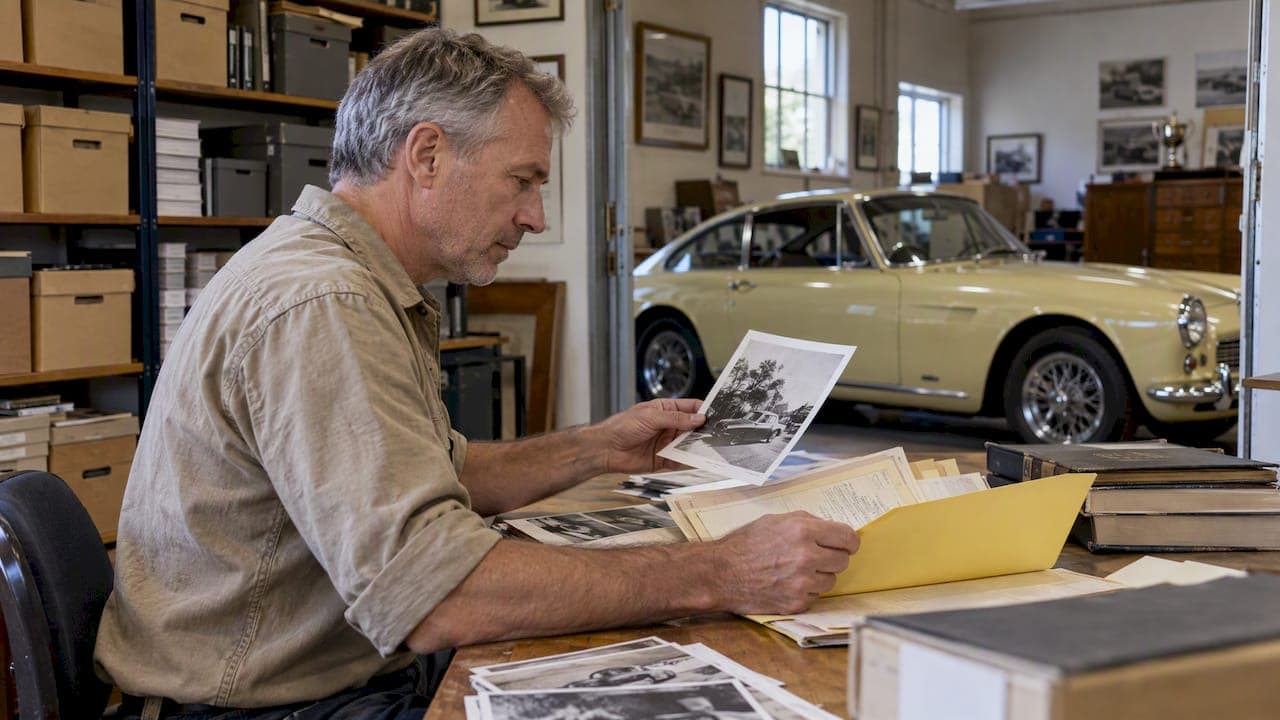
Classic car provenance is the documented identity and ownership record that proves a car is what the seller says it is. Your first move: write down the VIN, chassis and engine numbers, then run a title-history check through NMVTIS. Next, ask the seller for factory or marque archive documentation, because those two sources anchor everything else.
TL;DR:
- NMVTIS tracks title brands, total loss, and odometer history across states, but gaps in recorded history mean a clean title cannot rule out salvage.
- Compare VIN, chassis, engine, and gearbox numbers with documents; inspect stamping style and casting dates, since a matching number alone does not prove originality.
- Request factory build sheets and marque archive records early, because searches may require a full VIN or chassis number, a fee, and variable turnaround.
- Hire a marque specialist for a high value car, early history gaps, claimed racing or celebrity links, or suspected tampering that you cannot explain.
Table of Contents
- What does classic car provenance include, and why does it matter?
- Which documents and physical identifiers should you collect?
- Where can you search NMVTIS, marque archives and club records?
- How do you verify numbers-matching and spot tampering?
- When should you hire a provenance researcher or marque specialist?
- How does provenance affect value and resale?
- What is a step-by-step provenance checklist you can run today?
- Provenance versus the joy of driving
- How Butter Classics helps buyers and sellers with documented classic cars
- FAQ
- Sources
What does classic car provenance include, and why does it matter?
Think of provenance as the car's life story, backed by paper. Collector guidance from Masters of Motoring breaks it into a few pieces:
- Identity: chassis, engine and gearbox numbers that match the car in front of you.
- Ownership history: who held the car, and for how long.
- Factory specification: how the car left the plant.
- Maintenance and restoration work: invoices, photos and shop records.
- Event or competition associations: race entries, show appearances, notable owners.
This record is what lets you back up an authenticity claim. It also helps with concours eligibility, insurance conversations and resale, since each of those leans on proof, not stories.
Provenance keeps growing as long as the car does. FIVA and heritage experts treat a classic as a cultural artifact and advise owners to keep period invoices, photos and event entries, because together they substantiate its identity over time.
Which documents and physical identifiers should you collect?
Start with the metal, then chase the paper. Confirm that the VIN, chassis, engine and gearbox numbers line up with each other and with the paperwork. A mismatch isn't automatically a deal-breaker, but it needs an explanation you can document.
Then gather the paper trail:
- Title history: look for branded titles such as salvage, flood or rebuilt, and for sudden retitling in a new state.
- Factory build sheets and dealer invoices: the strongest proof of how the car started life.
- Original sales papers and service invoices: they show continuity and care.
- Restoration bills and period photos: they document what changed and when.
- Auction catalog entries: they tie the car to a prior sale and a prior description.
Component details help too. Casting dates, suffix codes and stamping marks tell you whether a part fits the car's build window.
Pro Tip: Photograph every number and every document the day you see them, so you can compare them later against the seller's story.
Want a ready-made list? Our classic car documentation checklist covers it, and our classic car history check post explains VIN quirks on older cars.
Where can you search NMVTIS, marque archives and club records?
Different sources answer different questions, so use several.
- NMVTIS: the U.S. national title database records title brands, total-loss and odometer history, and consumers reach it through approved data providers. Brands follow a vehicle across state lines, which helps expose title washing.
- Marque and manufacturer archives and registries: they can confirm factory build details and original specifications.
- Auction catalogs and club archives: event entries, photos and earlier sale paperwork often live here.
- Specialist magazines: old features sometimes show a car decades before today's owner.
When you request an archive search, expect to supply the full VIN or chassis number and possibly a fee. Turnaround varies by archive, so ask early. A clean title today still doesn't guarantee the car was never salvaged, since gaps in recorded history can hide a past.
How do you verify numbers-matching and spot tampering?
A matching number is where the work starts, not where it ends. As Hot Rod explains, experts also check casting dates, assembly codes and stamping characteristics, because blocks and components can be restamped or swapped. The strongest proof ties the numbers to a build sheet or dealer invoice.
Here's what to look for in person:
- Pad surface: a stamping pad that looks freshly ground or oddly smooth deserves a closer look.
- Font and spacing: characters that differ in style, depth or spacing from factory stamping are a flag.
- Alignment: crooked or uneven lines of digits rarely came from the plant.
- Machining marks: tool marks around the pad can suggest the surface was reworked.
Cross-check everything against build sheets, invoices and period photos. Don't let one clean-looking photo carry the whole case.
Pro Tip: Compare the engine's casting date with the car's build date. A block cast after the car was assembled raises questions.
Our numbers-matching guide walks through engine, transmission and rear axle numbers in detail.
When should you hire a provenance researcher or marque specialist?
Bring in a professional when the stakes or the doubts get big. Typical triggers: a high-value car, a gap in the early life of the car, a claimed celebrity or racing past, or any sign of tampering you can't explain.
A paid report usually includes archival document pulls, authenticated photocopies, photographic comparisons and a written opinion. That opinion is the real product. Insurers, auction houses and serious buyers lean on it because it comes from someone who knows the marque's quirks and has no stake in the sale.
You don't need a specialist for every car. For a driver you plan to enjoy and not flip, your own checklist work may be plenty. For a car where a wrong answer could be costly, the report may be worthwhile as insurance.
How does provenance affect value and resale?
Provenance moves price because it moves confidence. The big drivers are matching numbers, factory build confirmation, continuous ownership and documented competition history. Long, consistent paperwork reads as strong evidence, and buyers pay for that peace of mind.

The flip side is just as real. Thin documentation or a branded title usually makes buyers cautious, which can slow a sale or shrink offers. Treat missing paper as a cost you may have to absorb.
Use what you find. If the seller can't back up a claim, that gap is fair ground for negotiation. And when your turn to sell comes, a tidy binder of invoices, photos and archive letters does real work for you. If you're weighing a restoration, our post on original versus restored cars shows how originality and value interact.
What is a step-by-step provenance checklist you can run today?
- Record the identifiers. Write down the VIN, chassis, engine and gearbox numbers, then run an NMVTIS title-history check.
- Request seller documentation. Ask for titles, invoices, build sheets, auction references and period photos.
- Compare metal to paper. Check stampings, casting dates and component numbers against the documents.
- Photograph discrepancies. Send them to the seller and ask for further documentary proof.
- Escalate if needed. If questions remain on a high-value car, commission a marque specialist before you pay.
Keep every photo and email in one folder. If a deal falls through, you'll still have a record of what you learned.
Provenance versus the joy of driving
Here's my honest take: provenance matters most on show cars and investment cars, and a lot less on a truck you plan to haul lumber in. Decide what the car is for before you chase paper. A fully documented original can be too precious to drive, and a well-sorted driver with decent records often brings more smiles per dollar. Whatever you choose, keep every receipt and photo you uncover. The next owner will thank you.
— Tony
How Butter Classics helps buyers and sellers with documented classic cars
We list vintage cars with high-quality photos and detailed specs, so you can browse with real information in front of you. Sellers can consign their vehicle with our support. Ready to look? Browse our inventory or tell us what you want through our Car Finder.
FAQ
What is the $3000 rule for cars?
It's a loose rule of thumb, not an official standard, and definitions vary by source. Because it isn't a recognized provenance or valuation rule, rely on documented condition and history instead.
Is a 25 year old car a classic or antique?
It depends on who is defining it. Clubs, insurers, state registries and FIVA each set their own age and condition thresholds, so check the rules of the program you care about.
How do I verify a classic car's provenance?
Confirm the physical identity first, then verify the paper trail, as collector guidance recommends. Run a title check, ask for build sheets and invoices, and compare stampings to the documents.
Does a clean title prove a car was never salvaged?
No. Title washing and gaps in recorded history can hide a past loss, so treat sudden retitlings as red flags and investigate with NMVTIS and documents.
Sources
- For Consumers | VehicleHistory
- Fiva
- What Does “Numbers Matching” Mean? How to Verify a Classic Car
- Collector Vehicle Provenance Checks Explained | Masters of Motoring