
Auctions suit experienced collectors chasing rare lots who can move fast, cover a buyer's premium, and handle repairs on an as-is car. Dealers suit first-time buyers who want a test drive, financing help, and some kind of warranty backup. The real trade-off isn't just price. It's risk versus convenience, and the math only makes sense once you add fees, transport, and inspection costs into the total. We'll walk through that math, the inspection checklist, and exactly what to do next.
TL;DR:
- Buyers should include the buyer's premium, transport, taxes, and repair reserves in their total cost estimate, which can add up to 20-40% over the hammer price.
- Inspect the vehicle's VIN, title history, rust-prone areas, and request documentation before bidding or purchasing to avoid hidden costs and structural issues.
- Auction participants must get pre-approved for financing, set a maximum bid in advance, and prepare for rapid payment requirements within 24 to 48 hours after winning.
- Dealer purchases typically offer longer inspection windows, warranties, and better provenance knowledge but come with higher markup and limited inventory.
- Curated marketplaces combine the selection of auctions with dealer protections, offering detailed listings, pre-qualification, and easier selling processes.
Table of Contents
- Auction Vs Dealer Classic: The Pros and Cons
- How Much Does an Auction Really Cost vs a Dealer?
- What Should You Check Before Bidding or Buying?
- How Does the Classic Car Auction Process Actually Work?
- What Makes Buying From a Classic Car Dealer Different?
- When Should You Arrange Financing and Payment?
- Which Route Should You Actually Choose?
- Why a Curated Marketplace Beats a Binary Choice
- Browse Vetted Classics or Sell Yours the Easier Way
- Resources Worth Bookmarking Before You Buy
- Sources
- FAQ
Auction Vs Dealer Classic: The Pros and Cons
Buying a classic car at auction feels like a treasure hunt. Buying from a dealer feels more like shopping with a safety net. Both are legitimate paths, but they solve different problems, and knowing which one solves yours is the whole game.
Auctions win on selection. A single auction weekend can put a dozen rare Broncos, Corvettes, or muscle cars in front of you that a regional dealer would never stock. Hammer prices sometimes land below retail, especially on cars that aren't in peak demand that season. But that upside comes wrapped in real risk. Sales are almost always "as-is," inspection windows can be as short as a walk-around before the gavel drops, and you're often paying in full within days.
Dealers win on protection. A dealership purchase usually comes with a documented inspection window and disclosures you simply don't get at most auctions. You can test drive the car, ask questions, and walk away if something feels off. The tradeoff is markup and a smaller inventory. If the dealer doesn't have your exact model in your exact color, you wait, or you compromise.
Auction advantages:
- Wider, sometimes nationwide, access to rare or hard-to-find lots
- Hammer prices that can land below dealer retail on the right day
- Transparent bidding process, so you see exactly what competitors are willing to pay
Auction disadvantages:
- Buyer's premium adds meaningfully to the final cost
- Inspection time is often limited, and sales are typically as-is
- Payment is due fast, which limits time to arrange financing
Dealer advantages:
- Longer inspection access and the ability to test drive before committing
- Warranty or return language that reduces post-sale risk
- Help navigating paperwork, titles, and financing
Dealer disadvantages:
- Retail markup built into the sticker price
- Inventory limited to what's on the lot or in the network
- Waiting periods if the specific model you want isn't currently available
Neither format is universally "better." An auction can be smarter for a rare, well-documented lot you'd never find otherwise. A dealer can be smarter when you want certainty over discovery.
How Much Does an Auction Really Cost vs a Dealer?
Hammer price is not purchase price. That gap is where most first-time auction buyers get burned, and it's the single biggest reason a $30,000 hammer bid can turn into a $37,000 car.
Auction houses charge a buyer's premium on top of the winning bid, commonly ranges from 10% to 15% of the hammer price. On a $40,000 muscle car, that's $4,000 to $6,000 before you've paid a dime in tax or arranged transport. Add your state's sales tax, title and registration fees (which vary depending on where the car is titled and where you register it), plus transport if the car isn't local, and the picture changes fast.
Statistic Callout: All-in auction costs, once you factor in buyer's premium, transport, taxes, and any immediate repairs, can run 20% to 40% higher than the hammer price alone.
Here's a simple example. Say you win a 1969 Camaro for a $35,000 hammer price:
| Cost Item | Amount |
|---|---|
| Hammer price | $35,000 |
| Buyer's premium (10-15%) | $4,000 to $6,000 |
| Sales tax (varies by state) | ~varies by state |
| Transport (cross-country) | ~varies by distance |
| Repair reserve (as-is buffer) | ~repair reserve |
| Estimated all-in total | ~all-in auction cost |
A dealer's sticker price, by comparison, usually already bakes in reconditioning and often includes delivery coordination, so the "final" number is closer to the number you see. Compare apples to apples by calculating your all-in auction ceiling before you ever raise a paddle, not after.
What Should You Check Before Bidding or Buying?
Skipping due diligence is how buyers end up owning a rust bucket with a clean-looking paint job. Whether you're bidding online or standing on a dealer's lot, the checklist is nearly identical. Only the timeline changes.
- Pull the VIN and title history first. Check for liens, salvage or rebuilt branding, and state DMV flags before you get emotionally attached to the car. Older classics, especially pre-1981 models, sometimes have VIN formatting quirks that trip up a lazy check, so use a dedicated classic car history check rather than a generic used-car report.
- Run a recall lookup. The NHTSA recall search tool takes two minutes and flags any open safety recall tied to the VIN.
- Inspect for rust in the right places. Floors, trunk pans, frame rails, and rocker panels tell the real story. Cosmetic paint hides a lot; structural rust doesn't lie.
- Check for matching numbers and evidence of repair. Overspray, mismatched panel gaps, or a fresh undercoat over old rust are red flags worth walking away from.
- Request the paper trail. Ask for restoration receipts, service records, build sheets, and prior ownership history. A seller who can't produce any of this is asking you to trust blind.
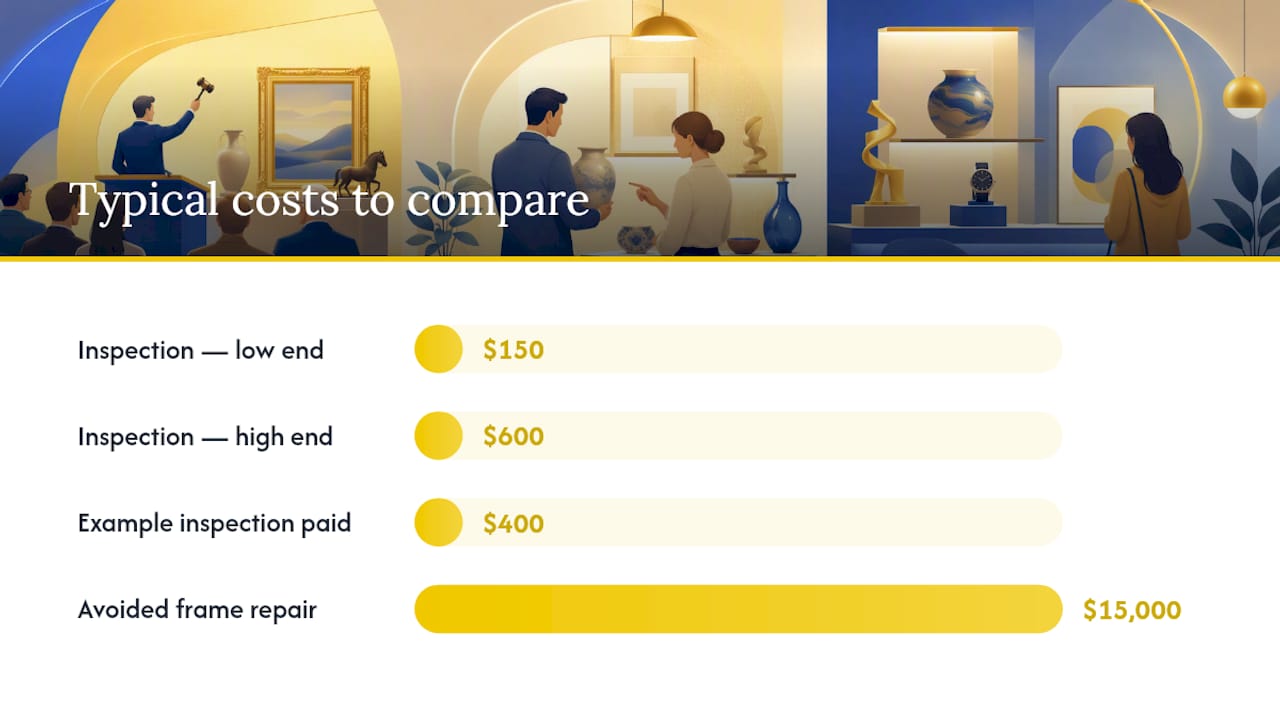
- Hire a third-party inspector for anything serious. A proper pre-purchase inspection typically runs $150 to $600 depending on travel distance and depth, and a good report covers frame integrity, compression numbers, undercarriage photos, and an honest assessment of what needs work soon.
Pro Tip: Budget the inspection cost into your all-in ceiling before you bid, not after. A $400 inspection that saves you from a $15,000 frame repair is the cheapest insurance you'll ever buy.
For deeper guidance on reading a car's condition beyond the obvious, the vintage condition evaluation guide walks through what separates a solid restoration from a cosmetic cover-up, and the investment due diligence guide is worth a read if you're buying with resale value in mind.
How Does the Classic Car Auction Process Actually Work?
Auctions come in a few distinct flavors, and each changes how much time you get to think.
- Live auctions move fast. You register, get a paddle number, preview the car in person if you can, and then compete in real time against a room full of other bidders.
- Online or timed auctions stretch the decision window over days, sometimes weeks, which reduces impulse bidding but often draws a wider, more competitive pool of bidders since online formats attract broader exposure.
- Dealer-only auctions are typically closed to the public and used for wholesale inventory turnover.
Before you bid anywhere, read the condition report carefully. Auction catalog copy is often written to highlight strengths and downplay flaws, so treat glowing language as marketing, not gospel.
Registration usually requires a refundable deposit and proof of funds. During bidding, you can raise your paddle in person, submit an absentee bid ahead of time, or bid by phone if you can't attend. The smartest move any experienced bidder makes is writing down an absolute all-in maximum before the auction starts and refusing to go a dollar past it, no matter how the room feels. If you want to sharpen that discipline further, the bidding-psychology tactics used in yacht auction strategy translate surprisingly well to car auctions, since both rely on reading real bids versus artificial momentum.
Once you win, expect a deposit due immediately and full payment within a short window, often 24 to 48 hours. After that comes title transfer paperwork and arranging transport, which can add storage fees if you're slow to schedule pickup.
What Makes Buying From a Classic Car Dealer Different?
Dealers slow the whole process down, and that's usually the point. You get time to look, ask, and reconsider.
A specialist classic dealer typically gives you a real inspection window, sometimes days or weeks, not the ten-minute preview walk you'd get at a live auction. You can request a structured test drive and actually feel how the car runs before money changes hands.
- Dealers often provide some form of warranty or limited return language, which shifts risk away from you if something surfaces after the sale.
- Negotiation at a dealer isn't just about price. You can push on included service, minor repairs, delivery, or financing terms.
- Consignment inventory (cars a dealer is selling on behalf of an owner) sometimes carries less flexibility on price than cars the dealer owns outright, so ask which category you're looking at.
- Specialist classic dealers tend to understand provenance and originality far better than a general used-car lot, and can coordinate documentation and nationwide shipping if you can't travel to see the car in person.
A general used-car dealer might not know the difference between a factory-correct interior and a reproduction kit. A specialist does, and that knowledge is worth paying a bit of markup for if provenance matters to you.
When Should You Arrange Financing and Payment?
Financing timing is where auctions and dealers diverge the most, and it catches a lot of buyers off guard.
Auctions generally expect proof of funds before you're even allowed to bid, and full payment lands within days of winning. There's no time to shop for a loan after the fact. If you know you'll need financing, get pre-approved before the auction, not after you've already committed to a hammer price you can't cover.
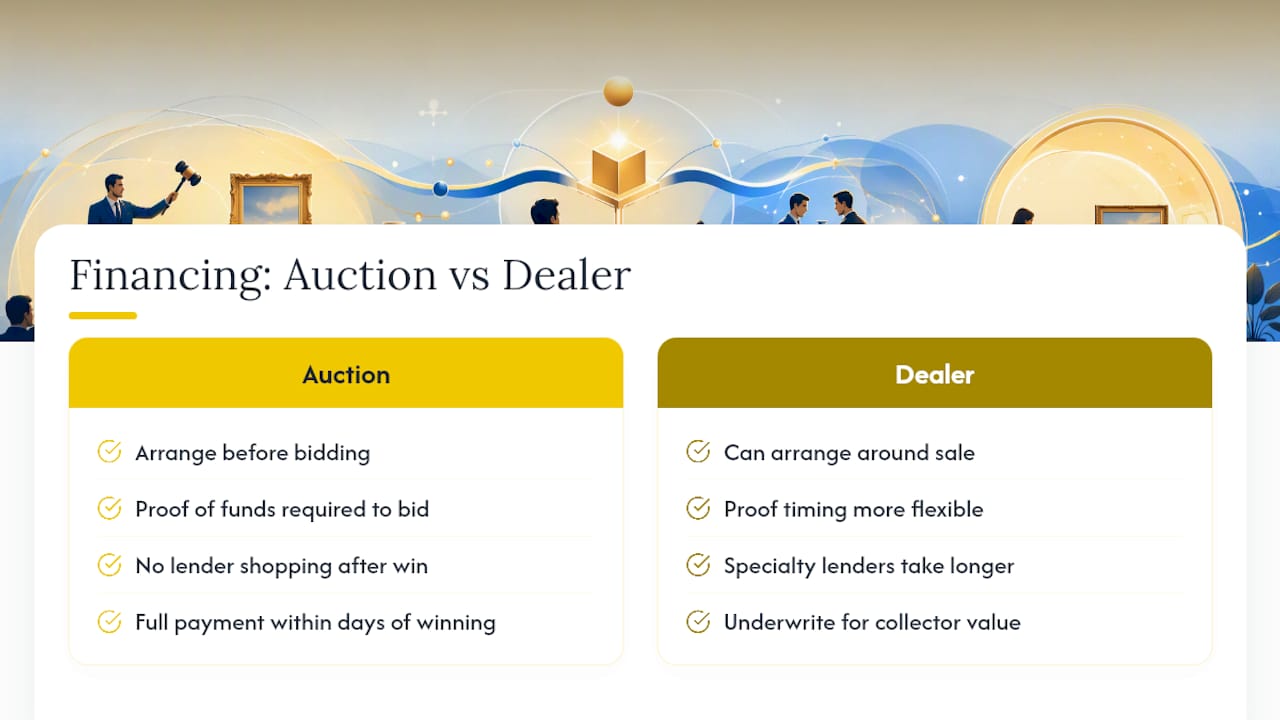
Dealers give you more runway. Specialty classic-car lenders, which differ from mainstream auto loans in how they appraise value and set terms, often take longer to underwrite because they factor in the car's collector value rather than just a standard depreciation curve. That's usually fine at a dealer, since the sale isn't racing a payment deadline.
Watch for paperwork pitfalls too. Older cars sometimes carry outdated title formats, and out-of-state registration can add friction and cost. For high-value purchases, cashier's checks, wire transfers, or a proper escrow service protect both sides far better than a personal check or cash handoff ever will.
Which Route Should You Actually Choose?
Match the channel to your tolerance for risk and your need for speed, not just your budget.
- Choose auctions if you're an experienced buyer, comfortable calculating an all-in ceiling, and chasing a specific rare lot you won't find elsewhere.
- Choose dealers if you're buying your first classic, want a test drive, need financing help, or simply want a warranty-style safety net.
- Walk away, from either channel, if the title is missing or unclear, there's no way to inspect before committing, or you spot heavy rust in structural areas like the frame or floor pans.
- If you're leaning auction, register early, study the condition report critically, and set your maximum bid in writing before the sale starts.
- If you're leaning dealer, ask directly about inspection access, warranty terms, and whether the car is consignment or owned inventory before you negotiate price.
Neither answer is permanent. Plenty of collectors use both channels over a lifetime of buying, just for different cars and different goals.
Why a Curated Marketplace Beats a Binary Choice
The auction-versus-dealer debate assumes you have to pick a lane. I'd argue that framing is outdated for anyone buying classics online in 2026.
What collectors actually want is auction-level selection without auction-level risk. Some curated marketplaces aim to bridge that gap by offering detailed listings with extensive photography, documented specifications, and a wide inventory not limited to a single dealer's lot. That's closer to how a specialist dealer coordinates documentation and shipping than to how a live auction rushes you through a ten-minute preview.
Consignment sellers get dealer-style handling of paperwork and photography instead of a single unpredictable auction day. Buyers get financing pre-qualification up front, before they've fallen for a car they can't afford, which solves the exact timing problem that trips up so many auction bidders. It's a middle path worth considering before you commit to either extreme.
— Tony
Browse Vetted Classics or Sell Yours the Easier Way
Skip the auction gamble and the dealer-lot scavenger hunt. Butterclassics gives you a nationwide inventory of classic trucks, muscle cars, Broncos, and Corvettes with detailed photos and specs, so you're evaluating real documentation instead of a rushed catalog description.
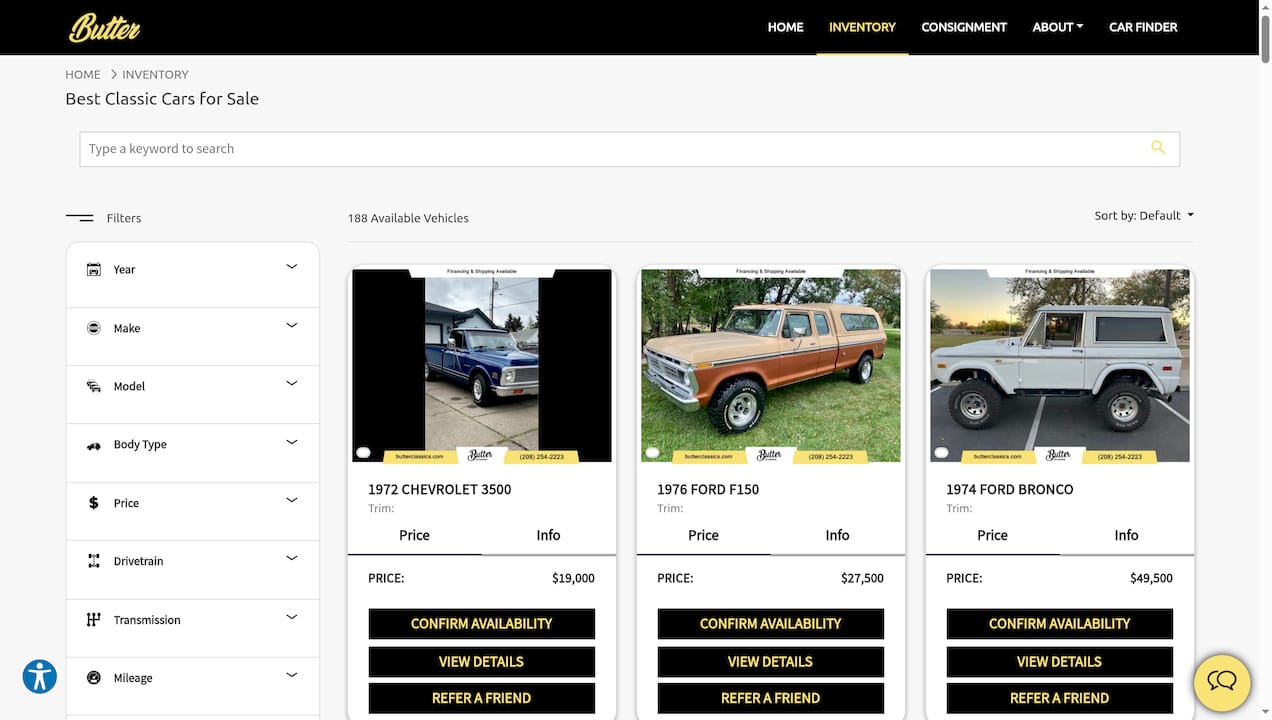
If you're selling, the Consign Your Vehicle service handles the listing, photography, and buyer outreach for you, so you're not stuck managing a one-day auction event or negotiating alone with strangers. If you're buying, get financing pre-qualified before you fall in love with a car, so you already know your ceiling the way a disciplined auction bidder would. Start by browsing the full inventory of classic cars to see what's currently available, or check how the process works from first inquiry to delivery.
Resources Worth Bookmarking Before You Buy
Before you commit real money, run the VIN through the NHTSA recall database to rule out open safety recalls. Read any auction house's buyer's premium notice in full so you know the fee structure before you register to bid. If you're weighing whether to wait for the right dealer inventory or chase an auction lot now, the market trends checklist is a useful gut check, and the dealer inspection checklist explains exactly what a reputable dealer should disclose before you sign anything.
Sources
- 12 essential tips for buying and selling a car at auction - Hagerty Media
- How to Buy a Classic Car: Should You Choose an Auction? - A Better Bid�AE Car Auctions
- The Octane guide to buying a classic car in 2026 - Octane Magazine
- NHTSA recalls
FAQ
Is It Better to Buy a Classic Car at Auction or From a Dealer?
It depends on your experience level and risk tolerance. Auctions suit collectors comfortable with as-is sales and fast payment, while dealers typically offer inspection access and disclosures that reduce risk for first-time buyers.
What Is the $3,000 Rule for Cars?
There's no universally recognized fixed dollar rule tied to classic car buying, and definitions vary depending on the source. It's best to rely on calculating your own all-in cost ceiling before bidding or negotiating.
What Are the Main Types of Classic Car Auctions?
The three common formats are live in-person auctions, online or timed auctions, and dealer-only wholesale auctions. Live auctions move fastest and create the most bidding pressure, while online formats stretch the decision window but often draw more competing bidders.
What Is the Smartest Way to Pay for a Classic Car?
For high-value purchases, cashier's checks, wire transfers, or an escrow service offer the most protection for both buyer and seller. Auctions typically require proof of funds and fast payment, so get financing pre-approved beforehand through a route like financing pre-qualification rather than scrambling after you've won a bid.
How Much Should I Budget for a Pre-Purchase Inspection?
A professional pre-purchase inspection for a classic typically costs between $150 and $600, depending on travel distance and inspection depth. Build that cost into your all-in ceiling before you bid at auction or negotiate at a dealer.