
For most U.S. classic-car sellers, a specialist consignment or white-glove marketplace gives you the best shot at a strong sale price with the least hassle. Butterclassics is our recommended option in that category, offering detailed listings, professional photography, consignment support, and financing pre-qualification all in one place. If you want to compare every major platform category before deciding, the table and platform snapshots below lay it all out.
The five marketplace categories worth knowing are specialist consignment/white-glove marketplaces, timed-auction specialists, zero-fee enthusiast auction sites, high-exposure general marketplaces, and free classifieds. Each one suits a different car, seller goal, and risk tolerance. Scroll to the comparison table for a side-by-side look, or jump straight to the platform snapshots for quick pros, cons, and "best for" tags.

Table of Contents
- How do the top classic car marketplace categories compare?
- How do you choose the right marketplace for your classic car?
- What does each marketplace category actually offer you?
- Why Butterclassics stands out as a Hemmings alternative
- Auction vs. classifieds vs. consignment: what's the real difference?
- Who's actually buying on these platforms, and where are they?
- Key Takeaways
- When a specialist marketplace actually changes the outcome
- Ready to list or consign your classic car with Butterclassics?
- Useful sources and links
How do the top classic car marketplace categories compare?
The table below covers the dimensions that actually move the needle for sellers: fees, selling model, buyer reach, listing support, protections, and timeline.

| Marketplace Category | Best For / Audience | Selling Model | Typical Seller Fees | Listing Support | Buyer Reach | Buyer Protections / Escrow | Turnaround Time | Geographic Reach |
|---|---|---|---|---|---|---|---|---|
| Specialist consignment / white-glove (e.g., Butterclassics) | Investment-grade, restored show cars, collectors wanting full service | Consignment / fixed-price listing | Commission on sale; varies by platform | High: professional photos, detailed listings, concierge | Targeted, high-intent collector audience | Escrow and inspection support available | 2–8 weeks depending on car and price | Nationwide; transport coordination available |
| Timed-auction specialists (e.g., Bring a Trailer, Hagerty) | Rare, documented, investment-grade vehicles | Timed online auction | Buyer premium; low or no seller fee | Moderate: curated listings, community Q&A | Large, serious collector community | Platform-mediated; buyer/seller dispute process | 1–3 weeks listing approval, then 7-day auction | Nationwide; international bidders common |
| Zero-fee enthusiast auction sites (e.g., Cars & Bids) | Modern classics, enthusiast cars, pre-1981 vehicles | Timed online auction | No seller listing fee | Moderate: self-submitted with platform review | Growing enthusiast community | Platform dispute process | 1–2 weeks approval + 7-day auction | Nationwide |
| High-exposure general marketplace (e.g., eBay Motors, AutoTrader, CarGurus) | Volume sellers, faster sales, broader price range | Auction or fixed-price listing | Listing fees or final value fees vary | Low: self-service listings | a very large general audience on eBay Motors | Limited; buyer-seller negotiated | Immediate listing; sale timeline varies | Nationwide; international on eBay |
| Free classifieds (e.g., Cars.com, Classic.com) | Budget-conscious sellers, hobbyist cars | Fixed-price listing | Free private listings available | Minimal: self-service | Large general audience | Minimal; buyer beware | Immediate listing; sale timeline varies | Nationwide |
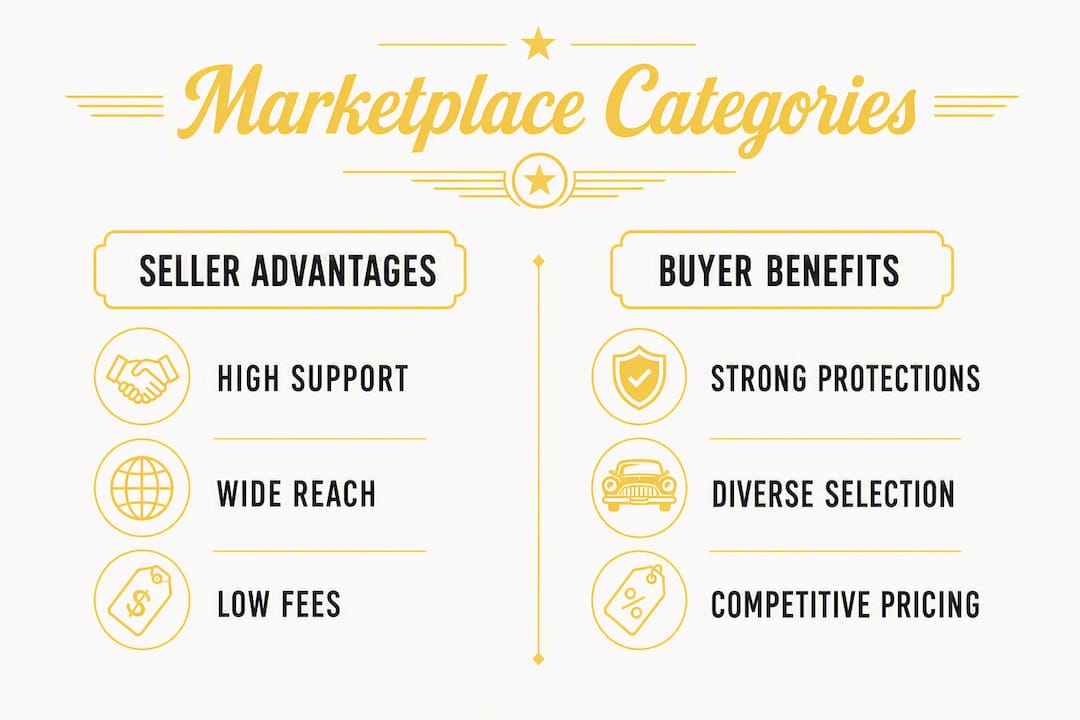
The biggest trade-off you'll face is fees versus exposure versus support. Zero-fee auction sites keep your upfront cost low, but you do all the work and compete for attention in a crowded feed. High-exposure general marketplaces give you massive reach but almost no listing support, which can hurt a rare car's perceived value. Specialist consignment platforms cost more in commission, yet they tend to attract buyers who are ready to spend, which often offsets the fee with a higher final price.
Pro Tip: Before listing anywhere, pull a current valuation from Hagerty's Price Guide or a comparable tool. Sellers who know their car's market value going in are far less likely to accept a lowball offer, regardless of which platform they use.
How do you choose the right marketplace for your classic car?
The right platform depends on three things: what you're selling, who you want to buy it, and how much time and effort you're willing to put in. A barn-find project car and a concours-restored Corvette belong on very different platforms.
Match your car to the right buyer pool
Investment-grade and pre-war collector cars attract a narrow but serious buyer pool. Those buyers expect professional photography, full documentation, and a platform they trust. Dropping a $75,000 restored muscle car onto a free classifieds site is like parking a Fabergé egg at a garage sale. Conversely, a solid driver-quality car priced under $20,000 can move quickly on a high-traffic general marketplace without needing white-glove treatment.
Five questions to ask before you list
- What fees will I actually pay if the car sells? Get the total: listing fee plus commission plus any buyer premium that could affect your net.
- Does the platform offer escrow or inspection support, and who pays for it? No escrow on a high-value transaction is a red flag.
- How many active buyers does this platform have in my car's price range? Traffic numbers alone don't tell you this; look at completed sales in your category.
- What photo and documentation standards does the platform require or encourage? Platforms that enforce quality standards tend to attract more serious buyers.
- What happens if the buyer backs out after the auction ends? Know the dispute process before you need it.
Red flags to watch for
- No escrow option on transactions above $10,000
- Listings with fewer than 20 photos for a vehicle in the $15,000+ range
- No vehicle history or documentation fields in the listing template
- Unverifiable buyer contact information or anonymous bidding with no identity check
- Platforms that list everything from parts to forums to full vehicles without a clear collector-car focus
How to prioritize based on your goal
Price-sensitive sellers who need to minimize upfront costs should lean toward zero-fee auction sites or free classifieds. Sellers chasing maximum hammer price should prioritize timed-auction specialists or consignment platforms with strong documentation standards. Sellers who need speed above all else should look at high-exposure general marketplaces, where self-posted listings go live immediately versus the 1–3 week approval window on curated platforms.
What does each marketplace category actually offer you?
Here's a quick snapshot of each category, including who it's really built for and where it falls short.
-
Specialist consignment / white-glove marketplace (Butterclassics and similar): A full-service approach where the platform handles photography, listing copy, buyer matching, and often transport coordination. Best for sellers of investment-grade, restored, or rare vehicles who want professional representation and are willing to pay a commission for it. The trade-off is that you give up some control over timing and price negotiation.
-
Timed-auction specialists (Bring a Trailer, Hagerty): These platforms attract serious collectors and have built reputations for high-quality, well-documented listings. Bring a Trailer reached $1.5 billion in sales by 2024, which tells you something about the buyer quality. The community Q&A format means knowledgeable buyers scrutinize every detail, so documentation matters enormously. Best for rare, documented vehicles where transparency drives price.
-
Zero-fee enthusiast auction sites (Cars & Bids): Cars & Bids charges sellers nothing and expanded in 2025 to accept pre-1981 classics, making it a genuinely attractive option for enthusiast-grade vehicles. The audience skews younger and more modern-classic focused. Best for drivers and enthusiast cars in the $10,000–$50,000 range where the seller wants zero upfront cost.
-
High-exposure general marketplaces (eBay Motors, AutoTrader, CarGurus): The reach here is hard to argue with. eBay Motors alone draws roughly 7.4 million monthly car shoppers, which means faster exposure and more inquiries. The downside is that most of those shoppers aren't collector-focused, so rare cars can get lost or undervalued. Best for volume sellers, dealers, or sellers with broadly appealing vehicles.
-
Free classifieds (Cars.com, Classic.com): Cars.com offers free private listings and reaches a large general audience, making it a low-risk starting point for hobbyist cars or sellers testing the market. Classic.com skews more toward collector data and aggregated listings. Best for budget-conscious sellers or buyers doing price research before committing to a platform.
-
General online auction platforms (ClassicCars.com): Sits between a classifieds site and a curated auction, with a large inventory of collector vehicles and a broad audience. Useful for sellers who want more visibility than a free classifieds site but aren't ready for the curation requirements of a timed-auction specialist.
Why Butterclassics stands out as a Hemmings alternative
Butterclassics is built specifically for classic and collector vehicles, which means every feature on the platform exists to serve that niche. You won't find it cluttered with modern sedans or salvage titles. The focus is on trucks, muscle cars, Corvettes, Broncos, and other vintage models that collectors actually want.
Here's what Butterclassics brings to the table for sellers and buyers:
- Detailed, high-quality listings: Every vehicle gets professional photography and thorough specifications, not a handful of blurry phone shots.
- Consignment services: You hand over the keys (figuratively), and the team handles the listing, buyer inquiries, and sale process.
- Financing pre-qualification: Buyers can get pre-qualified directly through the platform, which removes a common friction point and keeps serious buyers in the pipeline.
- Test drive scheduling: Buyers can schedule a test drive directly through the site, which is a feature most classifieds platforms don't offer at all.
- Quote requests: Sellers and buyers can request quotes without having to hunt down contact information.
How does that map to the decision criteria from earlier? Butterclassics sits squarely in the high-support, collector-focused category. The commission model means your upfront cost is low, and the professional listing approach addresses the documentation and photography standards that drive higher prices on specialist platforms. For sellers who want the benefits of a timed-auction specialist without the community scrutiny, or who have a car that deserves better than a self-service classifieds post, Butterclassics is a natural fit.
[Author credentials, first-hand testimonials, and internal sales performance metrics are placeholders to be filled by the Butterclassics team.]
Auction vs. classifieds vs. consignment: what's the real difference?
The selling model you choose shapes your final price, your timeline, and how much work lands on your plate. Here's the short version of each.
Timed auction: A fixed-duration bidding event where competitive buyers drive the price up. Best when you have a rare, desirable car and a motivated buyer pool. The risk is that a slow auction week can leave you with a lower-than-expected result.
Classifieds / fixed-price listing: You set the price, post the car, and wait for inquiries. You control the negotiation, but you also do all the work: photos, copy, fielding lowball offers, and vetting buyers.
Consignment / white-glove service: You hand the vehicle to a specialist who handles everything from photography to closing. You pay a commission, but you get professional representation and access to a curated buyer pool.
| Selling Model | Typical Timeline | Seller Effort | Fee Structure | Buyer Protections |
|---|---|---|---|---|
| Timed auction (curated) | 1–3 weeks approval + 7-day auction | Low (after submission) | Buyer premium; low/no seller fee | Platform-mediated dispute process |
| Classifieds / fixed-price | Immediate listing; weeks to months to sell | High (self-managed) | Free to low listing fee | Minimal; buyer-negotiated |
| Consignment / white-glove | 2–8 weeks depending on car | Very low (seller hands off) | Commission on sale | Escrow and inspection support typical |
Auctions tend to maximize price when the car is rare and the documentation is strong. A well-photographed, fully documented vehicle on a curated platform can generate competitive bidding that pushes the final price well above a private-sale estimate. Classifieds work best for steady, predictable sales on broadly appealing cars where the seller has time to manage the process. Consignment makes the most sense when the car's value justifies the commission and the seller wants professional handling from start to finish.
On buyer protections: consignment platforms and curated auction sites typically offer the most structured escrow and inspection support. General marketplaces and free classifieds leave most of that to the buyer and seller to arrange independently, which increases risk on both sides for high-value transactions. Public online auctions that handle repo and dealer consignment vehicles operate differently from collector-focused platforms and are better suited to deal-hunters than to collectors seeking investment-grade cars.
Who's actually buying on these platforms, and where are they?
Buyer demographics vary more than most sellers expect, and matching your car to the right audience is as important as picking the right fee structure.
Timed-auction specialists and consignment platforms attract the highest concentration of serious collectors. These buyers tend to be 40–65 years old, financially comfortable, and willing to pay a premium for a well-documented car. They're distributed nationally, with strong concentrations in California, Texas, Florida, and the Northeast. International bidders are common on the largest platforms, which can push prices higher on rare or desirable models.
General marketplaces like eBay Motors draw a much broader demographic. You'll find first-time classic-car buyers alongside experienced flippers, which means more inquiries but also more tire-kickers. The geographic reach is genuinely national and often international, which is useful for unusual cars that have a small but scattered buyer pool.
Zero-fee enthusiast auction sites skew younger, roughly 25–45, and tend to favor modern classics, Japanese performance cars, and European sports cars alongside traditional American muscle. That audience is engaged and knowledgeable, but it's a different crowd than the investor-grade collector market.
Free classifieds attract the most price-sensitive buyers. Expect more negotiation, more no-shows, and a longer average time to sale. The upside is that local buyers are common, which simplifies logistics for large or non-running vehicles.
Understanding which buyer pool your car fits before you list is one of the most underrated steps in the selling process. A car that looks overpriced on a general marketplace might be perfectly positioned on a specialist platform where the buyers understand its value.
Key Takeaways
The best Hemmings.com alternative for most U.S. classic-car sellers is a specialist consignment or white-glove marketplace, where professional listings, targeted buyer audiences, and escrow support consistently produce stronger outcomes than self-service classifieds.
| Point | Details |
|---|---|
| Match car to platform | Investment-grade cars belong on specialist or curated auction platforms; hobbyist cars fit general marketplaces or free classifieds. |
| Fees vs. outcomes | Zero-fee auction sites like Cars & Bids cut upfront costs, but consignment commissions often pay for themselves through higher final prices. |
| Documentation drives price | Platforms like Bring a Trailer, which reached $1.5 billion in sales by 2024, prove that serious documentation attracts serious buyers. |
| Timeline trade-offs | Curated platforms take 1–3 weeks for listing approval; free classifieds go live immediately but can take months to sell. |
| Butterclassics recommendation | For collectors wanting professional listings, consignment support, and financing pre-qualification, browse the Butterclassics inventory as your first stop. |
When a specialist marketplace actually changes the outcome
There's a version of this decision that looks purely mathematical: compare the fees, pick the lowest, list the car. That logic works fine for a $8,000 driver-quality pickup. For anything investment-grade, it tends to leave money on the table.
Two situations illustrate this clearly. A seller with a fully restored, numbers-matching muscle car lists it on a high-traffic general marketplace because the listing is free. The car gets plenty of views, but most inquiries come from buyers who don't understand the restoration cost or the provenance value. The car eventually sells below market because the platform's audience isn't equipped to appreciate what makes it special.
The second situation: the same type of car goes to a specialist consignment platform. Professional photography captures the engine bay, the VIN tag, the original paint code. The listing includes full documentation. Buyers who find it already understand what they're looking at, and the final price reflects that.
The extra listing fee or consignment commission is almost never the deciding factor in which outcome you get. Documentation and audience matching are. A platform that enforces photo standards and attracts verified collectors will outperform a free listing on a general site for any car worth more than its parts.
Pro Tip: If your car has a story, tell it in the listing. Provenance, restoration history, and original documentation are not just nice-to-haves on specialist platforms — they are the primary drivers of competitive bidding.
Ready to list or consign your classic car with Butterclassics?
Butterclassics gives you a cleaner path to selling than piecing together a listing on a general marketplace and hoping the right buyer finds it. The platform handles the details that actually move collector cars: professional photography, detailed specs, consignment management, and financing pre-qualification for serious buyers.
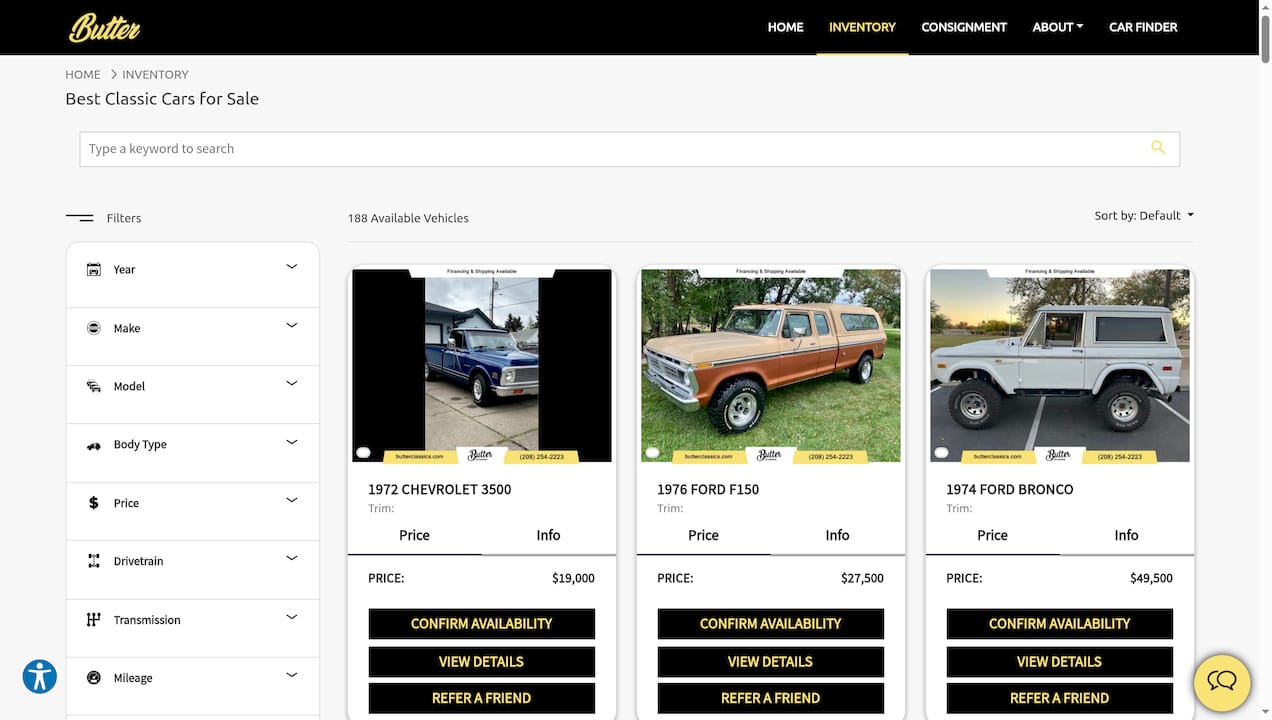
Here's what you get when you work with Butterclassics:
- Concierge-level listings with high-quality images and full vehicle specifications
- Consignment support so you're not managing buyer inquiries on your own
- Financing pre-qualification that keeps qualified buyers engaged through to closing
Whether you're ready to list today or still figuring out which car to sell first, browse the current inventory to see how Butterclassics presents collector vehicles, or use the car finder if you're on the buying side and want help locating a specific model. Either way, the next step is one click.
Useful sources and links
These are the core sources used to build this comparison. The methodology compared platforms across five dimensions: traffic and buyer reach, seller and buyer fees, listing support quality, buyer protections and escrow availability, and typical sale timelines.
- Top 6 hemmings.com Alternatives & Competitors — SEMrush: Comparative traffic snapshots used to assess relative buyer reach across platforms.
- Top Hemmings Motor News Alternatives, Competitors — CB Insights: Used to justify including consignment, insurance, and transport considerations in the decision criteria.