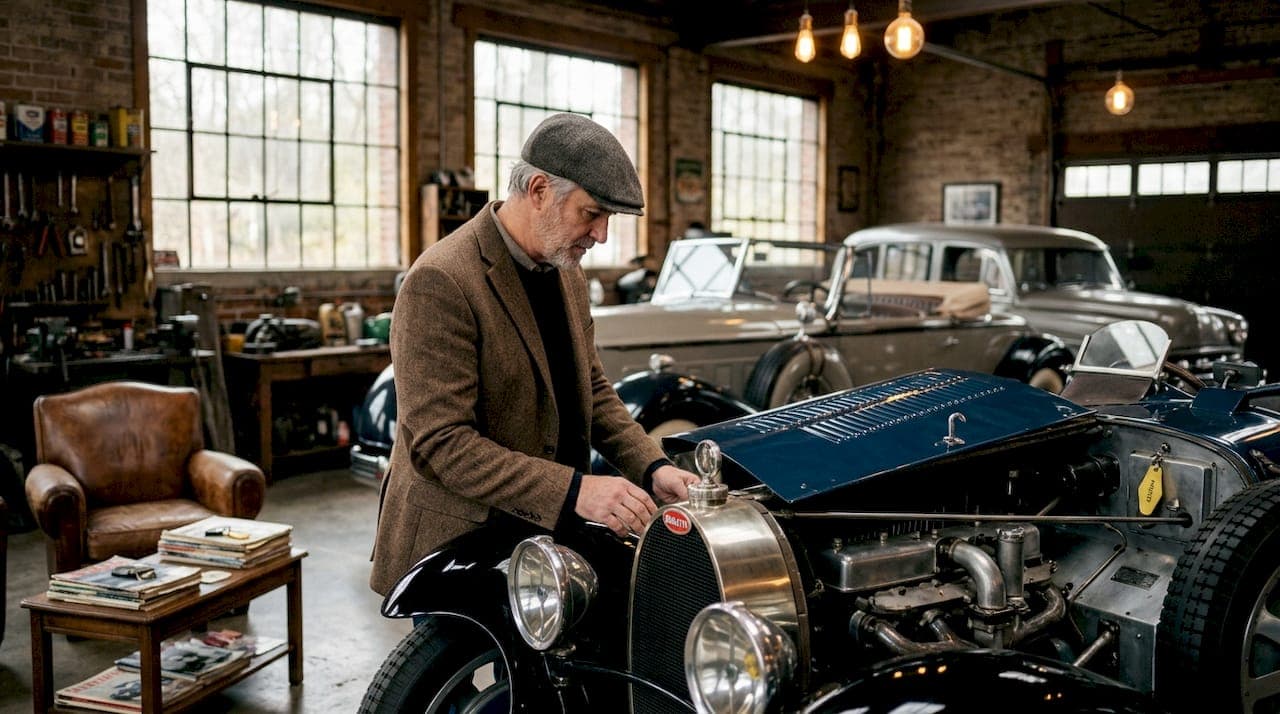
Pre-war collector cars are defined as fine automobiles built between 1915 and 1948, prized for their rarity, handcrafted coachwork, and historical significance. The Classic Car Club of America formally recognizes this era as the golden age of the "Full Classic," a designation that covers legendary machines like the Duesenberg Model J, the Alfa Romeo 6C 2300B Mille Miglia, and the Rolls-Royce Phantom I. These cars represent a period when automakers treated every vehicle as a rolling work of art, with custom bodywork ordered from independent coachbuilders and engines engineered to impress royalty and racing drivers alike. If you are exploring examples of pre-war collector cars for acquisition, restoration, or pure historical appreciation, this guide covers the most important models and what makes each one worth your attention.
1. Alfa Romeo 6C 2300B Mille Miglia
The Alfa Romeo 6C 2300B Mille Miglia is one of the most coveted pre-war collector cars in the world, and the numbers back that up. Only 107 units were produced, most wearing Berlinetta or Spider coachwork by the legendary Carrozzeria Touring of Milan. That production figure means genuine examples rarely surface at auction, and when they do, bidding is fierce. The car's racing pedigree from the Mille Miglia road race adds a layer of provenance that pure luxury cars simply cannot match.
The twin-cam inline-six engine, paired with a supercharger on select variants, delivered performance that embarrassed far more expensive machinery of the era. Collectors prize the Berlinetta body style above all others for its aerodynamic lines and lightweight aluminum construction. If you find one, verify the coachwork number against factory records before making any offer.
2. Duesenberg Model J Limousine by Willoughby
The Duesenberg Model J is the benchmark for American pre-war luxury, and the Willoughby-bodied limousine variant sits at the very top of that hierarchy. Only four Willoughby limousines are known to survive today, making this one of the rarest pre-war automobiles on the planet. The straight-eight engine produced 265 horsepower in supercharged form, a figure that would not look out of place in a sports car built decades later. Willoughby's coachwork combined formal proportions with precise detailing that reflected the tastes of America's wealthiest families.
Surviving examples certified by the Auburn-Cord-Duesenberg Club carry a Category 1 authenticity rating, confirming correct components throughout. This certification matters enormously at concours d'elegance events and directly affects resale value. A Model J without documented provenance is worth a fraction of a fully authenticated car.
Pro Tip: When evaluating any Duesenberg, request the car's AACA or Auburn-Cord-Duesenberg Club certification paperwork. Uncertified cars may have replaced major components, which reduces both historical value and auction performance significantly.
3. Rolls-Royce Phantom I and Phantom II
Rolls-Royce produced the Phantom I from 1925 to 1931 and the Phantom II from 1929 to 1935, and both models remain among the most recognizable classic pre-war cars in any collection. The Phantom I introduced a new overhead-valve six-cylinder engine that replaced the aging Silver Ghost platform, while the Phantom II added a new chassis that allowed coachbuilders like Park Ward, Barker, and Hooper to create some of the most dramatic bodies of the era. Neither model was produced in large numbers, and surviving examples with original coachwork command serious premiums.
What separates Rolls-Royce pre-war cars from most competitors is the depth of the factory's own records. Rolls-Royce maintains detailed build records for most surviving cars, which means provenance verification is more straightforward than with many other marques. For collectors who want a pre-war car that combines historical prestige with a documented ownership trail, the Phantom series is a logical starting point.
4. Bugatti Type 35
The Bugatti Type 35 is the most successful racing car of the pre-war era, with over 1,000 race victories recorded between 1924 and 1930. Ettore Bugatti designed the Type 35 around a supercharged 2.3-liter straight-eight engine and a chassis so refined that it influenced racing car design for a generation. The distinctive polished aluminum wheels, cast as a single piece, are instantly recognizable and remain one of the most copied design elements in motorsport history. Fewer than 400 Type 35 variants were built across all specifications, and road-legal examples are exceptionally rare.
Collectors value the Type 35 for both its racing history and its mechanical elegance. A car with documented race history, particularly from the Targa Florio or Grand Prix de France, can command multiples of a standard example's value. Bugatti's factory in Molsheim kept meticulous records, so chassis number verification is reliable.
5. Delahaye 135 and 165
Delahaye produced the Type 135 from 1935 to 1954, and it stands as one of the finest examples of French coachbuilt artistry in the pre-war period. The 135 used a 3.5-liter inline-six engine and was offered with bodies by Figoni et Falaschi, Henri Chapron, and Franay, each more dramatic than the last. The 165, produced in even smaller numbers, used a V12 engine and was designed specifically for the 1939 New York World's Fair. Both models represent the height of Art Deco automotive design and attract collectors who prioritize visual drama alongside mechanical substance.
French pre-war cars like the Delahaye often carry lower name recognition than their German or American counterparts, which historically created buying opportunities for informed collectors. That gap has narrowed considerably as auction results from RM Sotheby's and Gooding & Company have pushed top Delahayes into seven-figure territory.
6. Talbot-Lago T150 SS
The Talbot-Lago T150 SS, nicknamed the "Teardrop" for its flowing Figoni et Falaschi coachwork, is widely considered the most beautiful pre-war automobile ever built. Production was extremely limited, with fewer than 20 examples of the true teardrop body style completed before World War II interrupted manufacturing. The 4.0-liter inline-six engine gave the T150 SS genuine performance credentials alongside its extraordinary appearance. Major museums including the Mullin Automotive Museum in Oxnard, California, and the Petersen Automotive Museum in Los Angeles display examples, which tells you everything about the car's cultural standing.
Owning a T150 SS places you in a very small group of collectors worldwide. Parts are essentially unobtainable through normal channels, so any acquisition must come with a thorough mechanical inspection and a realistic budget for specialist fabrication work.
7. Packard Super Eight and Twelve
Packard built some of the most accessible top-tier pre-war automobiles in America, and the Super Eight and Twelve series from the 1930s represent the brand's peak. The Twelve used a 7.8-liter V12 engine and was available with custom coachwork from LeBaron, Dietrich, and Rollston. Production numbers were higher than European competitors, which means more survivors exist today and parts availability is comparatively better. This makes Packard one of the more practical choices among top-tier pre-war collector cars.
Pro Tip: Packard's factory production records are well-preserved and accessible through the Packard Motor Car Foundation. Cross-referencing the body tag, engine number, and factory order sheet before purchase takes less than a week and can confirm or disqualify a car's claimed history.
8. Ford Model A
The Ford Model A, produced from 1927 to 1931, is the entry point for collectors new to vintage pre-war automobiles. Ford built over four million Model A vehicles, which means parts are plentiful, restoration specialists are easy to find, and prices remain accessible compared to European or luxury American alternatives. The Model A is not a rare car, but it is a historically important one. It represents Ford's first major redesign after the Model T and introduced features like a sliding-gear transmission and hydraulic shock absorbers to a mass-market audience.
For collectors on a tighter budget, the Model A offers a genuine pre-war driving experience without the six-figure acquisition costs or specialist-only maintenance demands of rarer models. Roadster and Phaeton body styles are the most popular among collectors, with Tudor and Fordor sedans offering more practical daily usability.
9. Classification: what makes a pre-war classic car?
Understanding what qualifies as a pre-war classic car helps you shop and evaluate with confidence. The CCCA defines a Full Classic as a fine automobile built between 1915 and 1948 with limited production and custom coachwork. Beyond that formal definition, collectors use a broader set of era classifications to organize the field:
- Veteran (pre-1905): The earliest automobiles, often chain-driven and unreliable by modern standards.
- Edwardian (1905 to 1918): Early motoring era with improving reliability and the first purpose-built sporting cars.
- Vintage (1919 to 1930): The transition to modern automotive standards, covering cars like the Bugatti Type 35 and early Rolls-Royce Phantoms.
- Post-Vintage (1931 to 1945): The mature pre-war period, home to the Duesenberg Model J, Delahaye 135, and Packard Twelve.
These era classifications shape collector events and directly influence insurance categories and maintenance expectations. A Vintage-era car and a Post-Vintage car may look similar but require different approaches to preservation and valuation. Pre-war classics also need specialized maintenance distinct from postwar vehicles. Mechanics who understand magneto ignition systems, vacuum-operated fuel pumps, and non-synchromesh gearboxes are a smaller group than general classic car specialists, and finding one before you buy is smart planning.
10. Comparison of top pre-war collector cars
The table below compares five of the most discussed pre-war collector cars across the factors that matter most to buyers: production numbers, estimated value range, and restoration complexity.
| Model | Est. production | Approx. value range | Restoration complexity |
|---|---|---|---|
| Duesenberg Model J (Willoughby) | 4 known survivors | $2M+ | Very high, specialist only |
| Alfa Romeo 6C 2300B Mille Miglia | 107 units | $500K to $1.5M | High, Italian specialist required |
| Rolls-Royce Phantom I / II | Several hundred each | $150K to $600K | Moderate, good parts network |
| Bugatti Type 35 | Under 400 total | $800K to $2M+ | Very high, factory records essential |
| Packard Super Eight / Twelve | Several thousand | $50K to $300K | Moderate, strong parts availability |
Low production numbers correlate directly with market value and collector demand. This means the Duesenberg and Bugatti sit at the top of both the rarity and price scales, while Packard and Rolls-Royce offer more accessible entry points without sacrificing historical prestige. The Porsche 356B offers useful comparative context on how limited European production runs drive long-term collector premiums, a pattern that holds equally true for pre-war marques.
Key takeaways
Pre-war collector cars reward buyers who prioritize provenance, certified authenticity, and specialist knowledge over price alone.
| Point | Details |
|---|---|
| Rarity drives value | Cars like the Duesenberg Model J and Alfa Romeo 6C 2300B command premiums because of extremely low production numbers. |
| Certification matters | Auburn-Cord-Duesenberg Club and CCCA certifications confirm authenticity and protect resale value at auction. |
| Era classifications guide buying | Veteran, Edwardian, Vintage, and Post-Vintage designations shape insurance, events, and maintenance expectations. |
| Accessible entry points exist | Ford Model A and Packard Super Eight offer genuine pre-war history with better parts availability and lower costs. |
| Specialist maintenance is non-negotiable | Pre-war cars require mechanics familiar with era-specific technology, not general classic car shops. |
Why pre-war cars still get under your skin
I have spent a lot of time around collector cars across every era, and nothing quite compares to the experience of sitting behind the wheel of a genuine pre-war machine. There is a directness to these cars that modern vehicles, and even most postwar classics, simply do not have. The steering talks to you. The engine sounds like it means it. Every control requires intention.
What I find most interesting is how the provenance conversation has changed. Ten years ago, a well-restored pre-war car with a murky history could still find a buyer at a reasonable price. Today, serious collectors will walk away from a beautiful car the moment the paperwork does not add up. The term "classic car" was originally coined specifically for pre-war vehicles, and that original meaning carries real weight in today's market. Buyers are not just purchasing a car. They are purchasing a documented piece of automotive history.
My honest advice: if you are new to this segment, start with a Ford Model A or a mid-tier Packard. Learn the mechanical language of the era. Attend a CCCA event. Talk to the people who have been doing this for decades. The knowledge you build on an accessible car will serve you well when you are ready to step up to a Duesenberg or an Alfa. And when that day comes, you will know exactly what questions to ask.
— Tony
Find your pre-war classic at Butterclassics
If you are ready to move from research to ownership, Butterclassics makes that step smooth as butter.
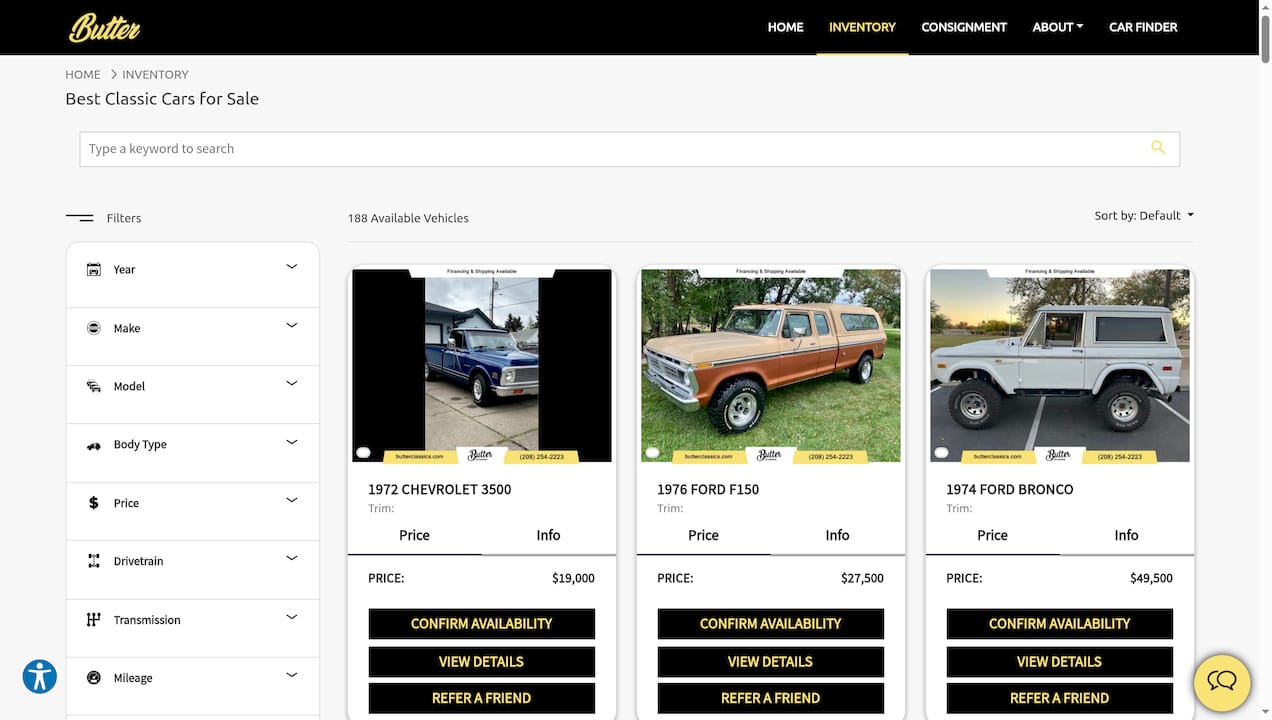
Butterclassics specializes in classic and vintage vehicles across every collector era, with detailed listings, high-quality photography, and transparent vehicle histories. The Butter Certified program gives serious buyers added confidence, covering quality assurance on select inventory so you know exactly what you are getting before you commit. Whether you are hunting for an accessible entry-level pre-war car or a concours-ready showpiece, the Butterclassics inventory is worth a look. Browse current listings, request a quote, or get financing pre-qualification started today.
FAQ
What is a pre-war classic car?
A pre-war classic car is a fine automobile built between 1915 and 1948, as defined by the Classic Car Club of America. These vehicles are characterized by limited production, custom coachwork, and engineering that reflects the craftsmanship standards of their era.
What are the most valuable pre-war collector cars?
The Duesenberg Model J, Bugatti Type 35, and Alfa Romeo 6C 2300B Mille Miglia consistently rank among the most valuable pre-war collector cars at auction. Rarity, racing provenance, and certified authenticity are the primary drivers of their high values.
Are pre-war cars hard to maintain?
Pre-war cars require specialized maintenance distinct from later vehicles, including knowledge of magneto ignition, non-synchromesh transmissions, and era-specific fuel systems. Finding a qualified specialist before purchase is strongly recommended.
What is a good pre-war car for a first-time collector?
The Ford Model A and Packard Super Eight are widely recommended for new collectors because of strong parts availability, accessible pricing, and well-documented histories. Both offer genuine pre-war driving character without the extreme restoration costs of rarer European models.
How do I verify a pre-war car's authenticity?
Cross-reference the chassis number, engine number, and body tag against factory records or marque-specific club registries such as the Auburn-Cord-Duesenberg Club or the Rolls-Royce Owners' Club. Certification from a recognized club is the strongest indicator of authenticity and directly supports resale value.