Proof of funds (POF) for a classic car is an official, recent document from your bank or brokerage that shows you have enough liquid money to pay for the car. The strongest version is a bank letter or a current statement that names you, names the institution and shows a balance that covers the price. If you are financing, a loan preapproval does much of the same work. We built our financing pre-qualification so you can know your number before you call dibs on a car.
This guide covers what counts, how to get the letter, what to hide, how sellers check it, and where it stops being enough.
TL;DR
- Proof of funds shows a seller that your money is real, liquid and available. Cash in bank or brokerage accounts counts. Retirement accounts and life insurance generally do not.
- Ask your bank for a verification of deposit (VOD) or balance-confirmation letter. Timing runs from same day in a branch to several business days by mail.
- Share only the last four digits of account numbers, and make redactions permanent.
- A letter is not a guarantee. Sellers should verify it with the bank and wait for funds to clear before releasing the title.
- Financing the car? A preapproval and a down payment you can document often matter as much as a bank letter.
Table of Contents
- What proof of funds actually proves
- What counts as proof of funds
- How to get a proof of funds letter from your bank
- Protect your privacy when you send it
- How sellers verify your funds
- Does proof of funds guarantee the deal?
- Cash buyer or financed buyer: which route fits you
- Perspective
- Ready to shop with your number in hand
- FAQ
- Sources
What proof of funds actually proves
Proof of funds is evidence that a buyer has sufficient, accessible money to complete the proposed purchase. Investopedia describes it as typically made up of bank or investment statements, meant to show the funds are real and available.
For a classic car, that matters because the sale is often between strangers in different states. A seller with a clean, numbers-matching car may hear from many people. A buyer who opens with a credible POF stands out from the tire kickers.
What it does not prove: that you will follow through, or that the money is free to spend on this car. It is a snapshot of one day.
Liquid means liquid
Proof of funds should point to liquid capital, mainly cash. Investopedia notes that retirement accounts, mutual fund accounts and life insurance generally do not qualify. If most of your wealth sits in those, plan to move what you need into a checking, savings or brokerage cash position before you ask for a letter.
What counts as proof of funds
Sellers see a handful of document types. Here is how they stack up for a classic-car deal.
| Document | What it shows | How sellers tend to view it |
|---|---|---|
| Bank verification of deposit or balance letter | Balance confirmed by the bank | Strongest for a cash deal |
| Recent official bank statement | Balance, account holder, institution, activity | Solid when official and recent |
| Official investment-account statement | Liquid holdings | Accepted as an alternative to a bank letter |
| Screenshot of online banking | Balance on a screen | Weak, easy to alter and hard to verify |
| Loan preapproval | A lender's view of your budget | Strong for a financed deal |
| Cashier's check or wire at closing | Actual payment | The real thing, not a preview |
A bank statement works as POF when it is official, recent, names the institution and the account holder, and shows an adequate balance. LegalClarity adds that official investment-account statements showing liquid holdings may be accepted instead of a bank letter, and that screenshots are weak evidence because they are easy to manipulate and difficult to verify.
A balance letter also is not the same as a bank commitment. For high-value vehicle auctions, LegalClarity notes the bank may need to commit to honoring a check or wire, not just confirm that an account exists. If you are buying a six-figure car, ask the seller early which one they expect.
If you are financing
When a loan covers part of the price, the seller cares about two things: that your down payment exists and that your lender is on board. Lenders typically want to see down-payment funds, proof of income, vehicle and seller information, insurance and purchase paperwork. Our guide to classic car loan requirements walks through that list, and setting your budget with a preapproval shows how to get your number first. For the cash side, see our down payment target.
How to get a proof of funds letter from your bank
- Decide what the seller needs. Ask whether they want a balance letter, a statement, or a preapproval. A letter showing a balance at or above the purchase price is the usual ask.
- Move your money first. Get the funds into the account the letter will cover. The letter reflects the balance on the day it is issued.
- Request a verification of deposit. Banks call this a VOD. Asking for it by name routes the request correctly and may avoid getting a printed statement instead. You can also ask for a balance-confirmation or proof-of-funds letter. Requests can usually be made through online banking, by phone or at a branch, and typically need identity authentication, per LegalClarity.
- Allow for timing. It depends on the bank and the channel. Chase says consumer verification requests can take 5 to 10 business days, and it routes them through a third-party vendor, BankVOD. Elsewhere, electronic delivery commonly takes one to two business days and standard mail three to seven, according to LegalClarity. One guide reports branch requests can be same day.
- Expect a small fee. One guide says most US banks issue the first letter free or for about $5 to $15, with rush or repeat letters costing more (HowToChangeGuide). Your bank's current schedule is the number that counts.
- Check the letter before you send it. Make sure your name, the bank's name and the date are right and the balance covers the price.
If you are bidding or negotiating against a clock, start this step the day you get serious about a car, not the day the seller asks.
What a good letter includes
A proof-of-funds letter should generally carry your full legal name, the institution's name, the issue date, the available balance, the account type or asset, confirmation that the funds are accessible, a masked account number, and the name, title, signature and contact information of an authorized representative (RequestLetters).

One more detail: a bank confirmation letter is specific to a single transaction and cannot be reused for another deal. Investopedia explains that if you pick a different purchase, a new letter is generally required. So if you lose out on one car, expect to request a fresh letter for the next.
Protect your privacy when you send it
A classic-car deal can involve strangers across the country. Share what proves the point and nothing more.
- Mask account numbers. Show only the last four digits. Fannie Mae's published guidelines for mortgage asset statements ask for at least the last four digits of the account number along with the institution, account holder, covered period and ending balance, as summarized by Truss Financial.
- Hide what is irrelevant. One guide recommends redacting routing numbers and unrelated secondary accounts to guard against unauthorized ACH debits and check forgery.
- Do not strip the useful parts. Keep the institution's name and the transaction history that supports the balance (LegalClarity).
- Redact for real. Drawing a black box over PDF text may leave the information recoverable by copy and paste, LegalClarity warns. Use a true redaction tool or ask the bank to issue a clean copy.
- Send it securely. Sensitive banking information should go only to verified recipients through encrypted channels, and Amerisave recommends secure document-sharing platforms over regular email or text.
How sellers verify your funds
A smart seller will not take a PDF at face value, and you should welcome that. It protects you from fake buyers who muddy the market.
Here is what a careful check looks like:
- Recency and coverage. The letter is current, names the buyer on the agreement and covers the price plus closing costs.
- A call to the bank. The seller phones the bank using a number found independently on its official website, not the one printed on the letter. A guide from SimplySoldOhio lays out this step.
- Cashier's checks. Meet at the buyer's bank to watch it being issued, or call the issuing bank using a number from its website to confirm the check number, amount and payee (LegalClarity).
- Wires. Wait until the bank confirms the funds have arrived, and do not sign over the title while payment is pending (Car-nection).
Red flags sellers watch for
If you are a buyer, avoid these. If you are a seller, look for them:
- A missing or blacked-out name, or funds in someone else's name
- A balance that barely covers the price
- A letter that shows up only after signing, or a refusal to let the bank confirm it
- Overpayment followed by a request for a refund
- Pressure to release the car before payment clears
- Insistence on an unfamiliar escrow site
The last three come from LegalClarity's guide to accepting payment when selling a car. The first three appear in SimplySoldOhio's checklist.
Sellers should also be wary of wire instructions that arrive by email at the last minute. NWI Buyers notes the CFPB recommends against acting on them. Call to confirm any instructions using a number you trust.
Does proof of funds guarantee the deal?
No. It shows capacity on a given day, nothing more. The sale is secure only when the money has cleared and the paperwork is right. I could not find a US rule that requires every private classic-car buyer to show proof of funds. In practice it is a seller's request, and the terms are whatever the two of you agree to in writing. Lenders, auction houses and dealers set their own requirements, so ask each one what it wants before you start.
A few steps protect both sides once the POF checks out:
- Put the price, payment method and timing in a written agreement. Our overview of the classic car bill of sale covers what to include.
- Confirm the title is clean and matches the car. If you are buying remotely, read about avoiding title scams when buying sight unseen.
- Verify the car before the money moves. Our guides on provenance and NMVTIS checks and numbers-matching cars cover what to look at. If the car is an import, checking a used car's history works the same way: confirm the record before you pay.
- Gather your paperwork in one place with the documentation checklist.
For bigger purchases, our due diligence guide pairs well with a funds check.
Cash buyer or financed buyer: which route fits you
Paying cash. Your proof of funds is a bank letter or statement at or above the price. Add a cushion for transport, taxes, registration and insurance. Ask the seller whether they want a letter or a bank commitment for the payment itself.
Financing. Your proof is a preapproval plus evidence of your down payment. This route also tells you your ceiling before you fall for a car you cannot close on. Classic Vehicle Financing is one of the services we offer, and you can start with pre-qualification on our site.

Mixing both. Many buyers pay a down payment from savings and finance the rest. Show the seller both: the preapproval for the loan and the statement for the cash.
Perspective
Every week, buyers and sellers come to classic cars with the same worry: is the other side for real? Proof of funds is how you settle that worry early, so everyone can get back to the fun part.
Our view is simple. Know your number before you shop. Whether you pay cash or finance, a clear budget and documents that are ready to go make you a buyer sellers want to work with. That is why we put financing pre-qualification right alongside our inventory.
We built Butter Classics for enthusiasts and collectors, not ordinary used car shoppers. Our nationwide inventory is not tied to a single lot, our listings come with detailed photos and specifications, and we offer a Worry Free Guarantee on Butter Certified vehicles. If you are selling, our consignment service puts your car in front of serious buyers.
Get your paperwork in order, pick the car you love, and let's make it smooth as butter.
Tony
Ready to shop with your number in hand
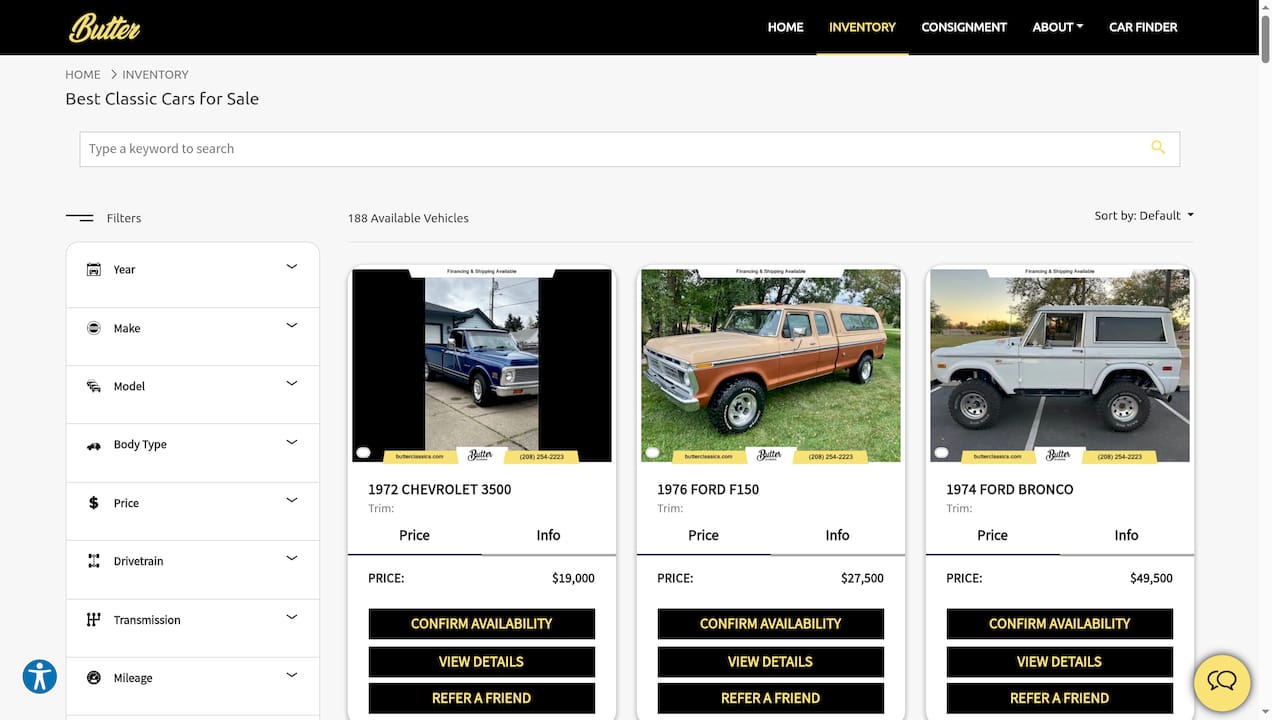
Once your funds are lined up, the next step is the car. Browse our classic car inventory by price or type, from muscle cars and vintage trucks to Broncos and Corvettes. You can schedule a test drive or request a quote, and you can start financing pre-qualification so you know your budget up front. If you are on the other side of the deal, consign your vehicle with us.
Have a car in mind and a budget set? Our how it works page walks through buying 4x4s and the rest of our inventory step by step.
FAQ
What can be accepted as proof of funds for a classic car?
A bank verification of deposit or balance letter is the most common. A recent official bank or brokerage statement showing liquid holdings is often accepted too. Retirement accounts and life insurance generally do not count, per Investopedia. If you are financing, a lender preapproval plus documented down payment typically fills the role.
Can I use my bank statement as proof of funds?
Yes, if it is official and recent, names you and the institution, and shows a balance that covers the price. Mask all but the last four account digits and keep the institution's name visible. Screenshots of online banking are weak evidence, according to LegalClarity, so download the official PDF.
How do I get a proof of funds letter from my bank?
Ask for a verification of deposit, balance-confirmation or proof-of-funds letter in a branch, by phone or through online banking. You will need to verify your identity. Timing runs from same day to about ten business days depending on the bank and channel, so request it as soon as you are serious about a car.
Can I reuse the same letter for another car?
Generally no. A bank confirmation letter is tied to a single transaction, and a different purchase usually needs a new one, per Investopedia. Keep the date in mind too, since sellers want a recent balance.
How should I send my proof of funds safely?
Mask account numbers to the last four digits, remove routing numbers and unrelated accounts, and make redactions permanent. Use a secure document-sharing platform rather than regular email or text, as Amerisave advises.
Sources
- Investopedia: Proof of Funds (POF)
- Investopedia: Understanding Bank Confirmation Letters
- LegalClarity: What a proof of funds letter includes
- LegalClarity: How to buy at a vehicle auction
- LegalClarity: How to get a bank letter
- LegalClarity: Accepting payment when selling a car
- Chase: Consumer Verification Information Center
- HowToChangeGuide: How to get a bank letter
- Real Estate Skills: Proof of funds letter
- RequestLetters: Proof of funds letter samples
- Truss Financial: Preparing a proof of funds letter
- BankXLS: How to redact a proof of funds letter
- Amerisave: Proof of funds letter essentials
- SimplySoldOhio: Verifying a cash buyer's proof of funds
- Car-nection: Screening buyers of a classic car
- NWI Buyers: Proof of funds checks for sellers
- Top Secret Autos: Checking a used car's history