
To qualify for a classic car loan, you generally need a credit score that lenders consider sufficient, verifiable income, a clean vehicle title, a professional appraisal or documented market comparables, agreed-value insurance naming the lender as loss payee, and typically a down payment. These are the nonnegotiable items most specialty lenders and credit unions check before approving collector car purchase financing.
Here's a quick checklist of what to have ready:
- Credit report and score (pull yours free at AnnualCreditReport.com before applying)
- Proof of income (recent pay stubs, W-2s, or two years of tax returns for self-employed buyers)
- Government-issued ID and proof of U.S. residency
- Vehicle title or bill of sale with a clear VIN
- Professional appraisal report or documented auction/market comparables
- Agreed-value insurance binder naming the lender as loss payee
- Storage and usage plan (climate-controlled garage, limited annual mileage)
- Vehicle history report (Carfax or equivalent) and any restoration documentation
Start by pulling your credit report, lining up a certified appraiser, and getting prequalified with a specialty lender or credit union. Those three steps tell you exactly what you're working with before you negotiate a purchase price.
Key Takeaways
| Point | Details |
|---|---|
| Credit and DTI first | A score of 680+ and DTI below 43% puts you in the competitive rate tier for most lenders. |
| Appraisal is non-negotiable | Most specialty lenders require a certified appraisal; loan amount is set to the lower of appraised value or purchase price. |
| Agreed-value insurance | Standard auto coverage won't work; you need a specialty policy naming the lender as loss payee before funding. |
| Term flexibility is real | Specialty lenders offer terms from 24 to 180 months, far beyond the 72–84 month cap on standard auto loans. |
| Butterclassics simplifies the search | Browse curated inventory and start financing prequalification at Butterclassics before you negotiate a purchase price. |
Always verify your lender's registration at NMLS Consumer Access before signing anything, and compare total loan cost (APR plus fees) rather than monthly payment alone.
Table of Contents
- What classic car loan requirements look like on the borrower side
- How lenders decide whether your vehicle qualifies
- What classic car loan terms and rates actually look like
- What lenders require for collateral, title, and insurance
- How the application process works, step by step
- Where can you actually get a classic car loan?
- How to improve your approval odds and avoid common red flags
- What the data shows about classic car loan terms and rates
- What experienced buyers should actually prioritize
- Butterclassics makes financing your next classic smoother
- Sources
What classic car loan requirements look like on the borrower side
Most lenders weigh four borrower metrics: credit score, debt-to-income ratio (DTI), income stability, and residency. Getting a clear picture of where you stand on each one before you apply saves a lot of back-and-forth.
Credit score is the first filter. A score below 600 will close most collector-loan doors outright. Scores in the 600–679 range may qualify, but expect higher APRs and stricter LTV caps. The sweet spot is 680–739, where rates become competitive. At 740 and above, you're in the tier where lenders like Star One Credit Union advertise rates as low as 4.75% APR for well-qualified applicants.
DTI matters almost as much as your score. Most lenders want your total monthly debt payments (including the new loan) to stay below 43% of gross monthly income. Some specialty lenders stretch to 50% for borrowers with strong assets, but that's the exception. If your DTI is already at 40%, paying down a credit card before applying can make a real difference.
Income documentation varies by employment type. W-2 employees typically provide two recent pay stubs and the last two years of W-2s. Self-employed buyers need two years of federal tax returns, a current profit-and-loss statement, and often 12–24 months of business bank statements. Lenders want to see consistency, not just a good year.
Residency and ID requirements are straightforward: U.S. residency and a valid driver's license. If your credit is marginal, a co-signer with strong credit or a larger down payment (20%–30%) can offset the risk in a lender's eyes.
Pro Tip: Before you apply, pull your credit report from all three bureaus and dispute any errors. Even one incorrect derogatory mark can drop your score 20–40 points. Paying a revolving balance from 70% utilization down to under 30% can move the needle faster than almost anything else.
How lenders decide whether your vehicle qualifies
Lenders don't use Kelley Blue Book or NADA for classics. They judge the vehicle by age, rarity, condition, provenance, and market comparables, which is a fundamentally different process than standard used-car underwriting.

Most lenders define a "classic" as a vehicle typically over two decades old, with exact age requirements varying by program. Condition grades matter: a vehicle must typically be in operable, roadworthy condition. Some credit unions, like Redwood Credit Union's classic car program, specify minimum age thresholds and require the vehicle to be in running condition. Minimum loan amounts often start in the low thousands, with some lenders requiring higher minimums for collector-grade vehicles.
A formal in-person appraisal is required by most specialty lenders and many credit unions whenever the vehicle is unusual, heavily modified, or valued above a certain threshold. For more straightforward examples with strong auction comparables, some lenders accept documented market comps from sources like Hagerty Valuation Tools or Barrett-Jackson results. Either way, the lender sets the loan amount against the lower of the appraised value or the purchase price, which protects them if you overpay.
Loan-to-value caps vary widely depending on the lender and vehicle, with some lenders offering higher limits for well-documented collectors. Specialty lenders tend to allow higher LTVs for well-documented, high-value collectors.
| Dimension | What lenders typically require |
|---|---|
| Vehicle age | 20–30+ years old (varies by program) |
| Condition | Operable, roadworthy; no salvage or rebuilt title |
| Appraisal | Required for unusual, modified, or high-value vehicles |
| Minimum loan amount | $5,000 depending on lender |
| LTV cap | varies widely depending on lender and vehicle |
| Provenance docs | Title, VIN verification, restoration records |
According to collector-loan guides, appraisal, agreed-value insurance, vehicle documentation, and mileage/storage expectations are the clearest differentiators between classic car financing and a standard auto loan.
Pro Tip: Matching-numbers proof (original engine, transmission, and body panels documented to the VIN) can dramatically speed up the appraisal and reduce perceived risk. Bring restoration receipts, dated photographs, and any auction sale records for comparable vehicles. That paper trail is worth real money in the underwriting room.
You can dig deeper into what makes a vehicle investment-worthy in Butterclassics' guide on investment-grade classic car valuation.
What classic car loan terms and rates actually look like
Terms and rates can vary significantly for collector car financing compared to other auto loans. Specialty lenders commonly offer terms from about 24 months up to 180 months, while standard auto loans typically have shorter maximum terms. That flexibility is one of the main reasons collectors seek out specialty financing.
| Term band | Typical APR range | Who tends to offer it |
|---|---|---|
| 24–60 months | 5%–10% | Credit unions, regional banks |
| — | 6%–12% | Credit unions, national banks |
| 24 to 120 months | 7%–14% | Specialty lenders |
| up to 180 months | 8%–16%+ | Specialty lenders (high-value vehicles) |
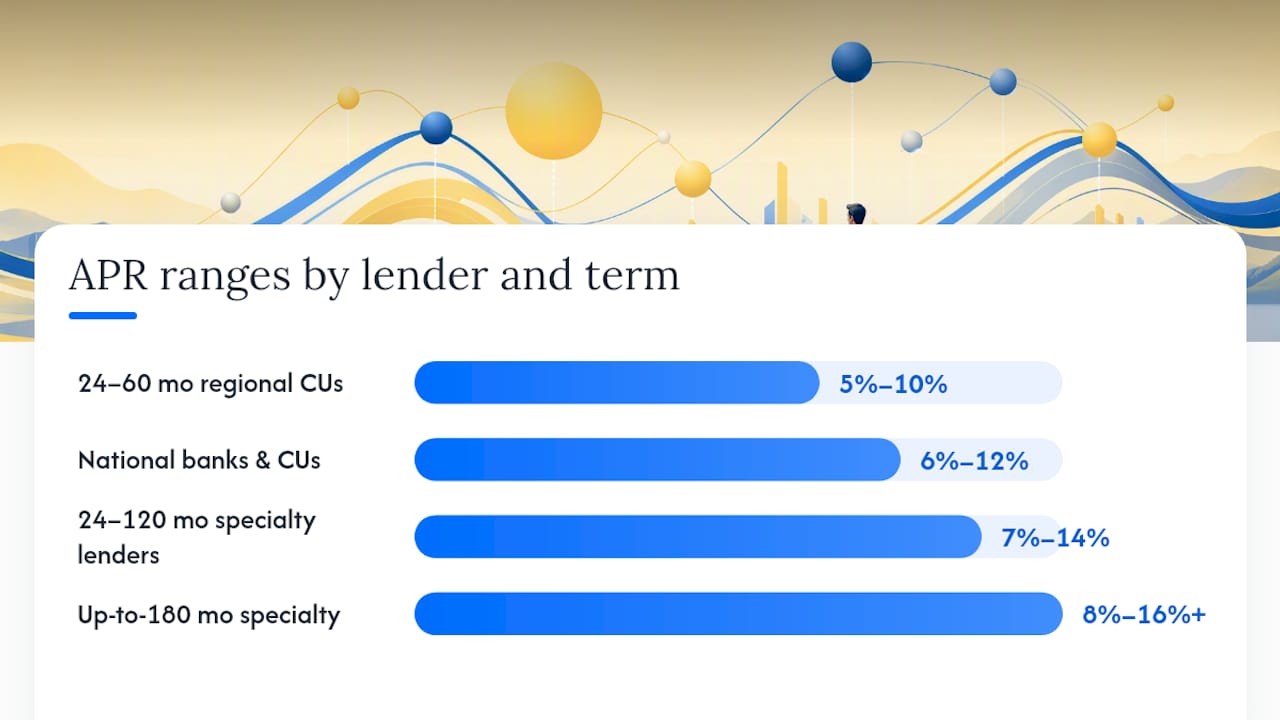
APR ranges above reflect general market observations. Credit union rate tables show that APRs can start in the mid-single digits for well-qualified borrowers but climb substantially with longer terms or lower credit scores.
Sample payment scenarios help illustrate the trade-offs:
- Conservative: $40,000 loan at 7% APR over 60 months = roughly $792/month in principal and interest.
- Extended term: $40,000 loan at 10% APR over 120 months = roughly $529/month, but total interest paid nearly triples compared to the conservative scenario.
A larger down payment generally helps secure better rates and longer loan terms because it reduces the lender's LTV exposure. Some specialty lenders may offer balloon-payment options for certain high-value vehicles, where you pay a lower monthly amount and settle a lump sum at the end of the term.
A professional appraisal can cost several hundred dollars depending on the vehicle and appraiser. Agreed-value insurance premiums depend heavily on vehicle value and usage patterns, but plan for them as a real line item in your total cost of ownership.
Specialty lenders sometimes treat well-documented classics like appreciating collateral, which is why some offer terms up to 180 months for high-value vehicles. That's more than double the maximum term on a standard auto loan.
This long-term flexibility is explored further in LegalClarity's breakdown of classic car loan terms.
What lenders require for collateral, title, and insurance
A clean, transferable title and proof of agreed-value insurance naming the lender as loss payee are non-negotiable before any lender releases funds. These two items are where deals fall apart most often, so getting them right early saves everyone time.
Title requirements:
- The title must be in your name (or transferred to you at closing) with no existing liens, unless the lender is paying off a prior loan as part of the transaction.
- Lenders register a first-lien security interest on the title, meaning they hold a legal claim on the vehicle until the loan is paid off.
- Salvage, rebuilt, or bonded titles are deal-killers at most traditional lenders. A vehicle with a salvage title is typically ineligible for collector financing because its value is too uncertain and its insurability is compromised.
- Bonded titles (used when original paperwork is lost) may be accepted by some specialty lenders, but expect additional scrutiny and documentation.
Insurance requirements:
- Standard auto insurance (actual cash value) is not acceptable for most collector loans. Lenders require agreed-value coverage, which pays the full insured amount in a total loss rather than depreciated market value.
- The insurance binder must name the lender as loss payee before funding. This is typically non-negotiable.
- Agreed-value policies from specialty insurers (Hagerty, Grundy, and similar providers) are designed for exactly this purpose and are widely accepted by collector lenders.
Usage and storage expectations are often embedded in the insurance policy rather than the loan agreement itself, but lenders know what to look for. Most agreed-value policies require limited annual mileage (often 2,500–5,000 miles per year) and secure, climate-controlled storage. If your vehicle lives outside or racks up daily-driver miles, you may not qualify for the coverage the lender requires.
Pro Tip: When you request an insurance binder, ask the insurer to include the lender's full legal name, address, and loan number in the loss-payee clause. Lenders are specific about this wording, and a binder that doesn't match their requirements will delay funding by days.
How the application process works, step by step
Apply for preapproval before you negotiate a purchase price. Knowing your rate and maximum loan amount gives you real leverage at the table and prevents the frustrating scenario of falling in love with a car you can't finance.
The standard application sequence:
- Prequalify or preapply (1–3 days): Submit basic income, credit, and vehicle information. Most specialty lenders and credit unions offer online prequalification. You'll get a rate estimate and loan ceiling without a hard credit pull.
- Identify the vehicle and get an appraisal (3–10 days): Once you have a purchase agreement, order a professional appraisal. Some lenders have preferred appraisers; others accept any certified appraiser. Budget 3–7 business days for the report.
- Secure the insurance binder (1–3 days): Contact your agreed-value insurer with the vehicle's VIN, appraised value, and lender information. Request a binder naming the lender as loss payee.
- Submit the full application (1–2 days): Upload all documents. The lender's underwriting team reviews the appraisal, title, insurance, and your financial profile.
- Final underwriting and approval (2–5 days): The lender may request additional documentation. Once approved, you'll receive a loan commitment letter.
- Funding and title transfer (1–3 days): For dealer purchases, funding is usually direct. For private-party sales, many lenders use an escrow service to protect both buyer and seller during the title transfer.
Total timeline: Credit unions and specialty lenders typically fund in 7–21 days from application to disbursement. Banks with less experience in collector lending can run longer.
| Document | Purpose |
|---|---|
| Government-issued ID | Borrower identity verification |
| Pay stubs / tax returns | Income and employment verification |
| Bank statements (3–12 months) | Asset verification and cash flow |
| Vehicle title or bill of sale | Ownership and VIN confirmation |
| Professional appraisal report | Collateral valuation |
| Agreed-value insurance binder | Loss-payee and coverage confirmation |
| Vehicle history report | Provenance and accident history |
| Restoration records / photos | Condition and authenticity documentation |
Rizz Lending's collector financing guide emphasizes that having appraisal, agreed-value insurance, and documented provenance ready before you apply is the single most reliable way to shorten the funding timeline. For a deeper look at pre-purchase due diligence, Butterclassics' classic car investment due diligence guide walks through the inspection and documentation checklist in detail.
Where can you actually get a classic car loan?
Specialty lenders and collector-focused credit unions are your best starting point for long terms and underwriters who understand what a numbers-matching 1969 Camaro is worth. Here's how the four main lender categories break down:
Specialty classic car lenders are purpose-built for this market. They understand agreed-value insurance, accept longer terms (up to 180 months), and know how to evaluate provenance. The trade-off is that they often require higher minimum loan amounts and more documentation than a standard bank.
Credit unions with classic vehicle programs offer competitive rates and member-friendly service. Some publish dedicated rate tables for collector vehicles with defined age and condition requirements. Star One Credit Union, for example, advertises classic car financing starting at 4.75% APR for well-qualified members. Membership eligibility varies by institution, so check whether you qualify before counting on a specific credit union's program.
National and regional banks can finance older vehicles, but their underwriting systems are built for standard used cars. Expect more friction, lower LTV tolerance, and shorter maximum terms. They're a reasonable fallback if you have an existing banking relationship and a straightforward vehicle.
Unsecured personal loans from lenders like OneMain Financial are an option when a secured collector loan isn't available, typically for lower-value vehicles or buyers with credit challenges. The rates are higher and terms shorter than secured collector loans, but there's no appraisal or title-lien requirement. Use this route only when secured options are genuinely off the table.
Decision factors to compare across lender types:
- Maximum loan amount and LTV cap
- Minimum and maximum term length
- Whether a formal appraisal is required
- Agreed-value insurance requirement
- Membership or eligibility constraints (credit unions)
- Approval speed and funding timeline
- Origination fees and prepayment penalties
For a broader overview of vintage car financing options, Butterclassics has a dedicated guide that maps lender types to buyer profiles.
How to improve your approval odds and avoid common red flags
The highest-impact levers are better documentation, a lower LTV through a larger down payment, and stable income with a clean DTI. Most declines come down to one of those three areas.
High-impact actions before you apply:
- Gather all restoration receipts, dated photographs, and any auction sale records for comparable vehicles.
- Obtain a professional appraisal from a certified appraiser (AACA, ASA, or similar credential).
- Secure agreed-value insurance quotes from at least two specialty insurers before applying.
- Clear up any title issues: confirm the title is clean, in the seller's name, and free of liens.
- Pay down revolving credit balances to below 30% utilization.
- If self-employed, have two full years of tax returns and a current P&L ready.
Common red flags that lead to declines:
- Salvage or rebuilt title on the vehicle.
- Incomplete or inconsistent provenance (VIN doesn't match documentation, missing title history).
- Major undisclosed modifications that affect value or insurability.
- Inconsistent restoration records (claimed full restoration with no receipts).
- Unstable or unverifiable income (gaps in employment, first year of self-employment).
- High DTI with no compensating factors (strong assets, large down payment).
Mitigation tactics when your application isn't quite there:
- Add a co-signer with strong credit and stable income.
- Increase your down payment to 25%–30% to reduce LTV and demonstrate commitment.
- If the vehicle is mid-restoration, look for a specialty lender that offers staged restoration financing. This is a different product with its own documentation requirements, but it exists for exactly this situation.
The Butterclassics guide on buying investment-grade classics covers provenance documentation in depth, which directly supports the appraisal and underwriting process.
What the data shows about classic car loan terms and rates
The market data on collector financing tells a clear story: specialty lenders offer dramatically more flexibility than standard auto lenders, and that flexibility comes with a documentation premium.
Specialty lenders commonly offer terms from 24 months up to 180 months, compared to the 72–84 month ceiling on most standard auto loans. That's a 15-year maximum term, which exists because some lenders treat well-documented classics as appreciating assets rather than depreciating ones.
The rate picture is equally wide. Published rate tables from credit unions show APRs starting in the mid-single digits for well-qualified borrowers on shorter terms, climbing to double digits for longer terms or lower credit tiers. The 4.75% APR floor advertised by Star One is a real market data point, not a teaser, but it requires excellent credit and typically a shorter term.
Key implications from the data:
- Longer terms reduce monthly payments but increase total interest paid substantially. A 120-month term at 10% APR costs roughly twice the total interest of a 60-month term at 7%.
- Appraisal requirements correlate with longer terms: lenders offering 84+ month terms almost always require a formal appraisal because the collateral needs to justify the extended exposure.
- Rate bands by lender type are consistent: specialty lenders offer the widest term range but not always the lowest rates; credit unions often win on rate for shorter terms.
For more context on how classic car financing programs are structured across lender types, Butterclassics' dedicated explainer breaks down the APR and term options in detail.
What experienced buyers should actually prioritize
Here's an opinion that runs counter to how most people approach collector financing: the loan terms matter less than the documentation you build before you apply.
Most buyers fixate on the monthly payment. Experienced collectors focus on provenance, agreed-value insurance, and a conservative LTV. Why? Because a well-documented vehicle with a clean title and proper insurance is a fundamentally different asset than an undocumented one, both in what you can borrow against it and in what you can recover if something goes wrong.
The trade-off between a lower monthly payment and total interest paid is real, and longer terms are genuinely useful for preserving cash flow on a six-figure collector. But every month you extend the term, you're paying interest on an asset that may be appreciating. That's a different calculation than financing a depreciating daily driver, and it's worth running the numbers both ways before committing to 120 or 180 months.
There's also a case for paying cash or using dealer-secured financing when the vehicle is priced below $30,000 and the loan costs (origination, appraisal, insurance premium differential) eat a meaningful percentage of the purchase price. At that price point, the friction of a specialty loan can outweigh the benefit of preserving liquidity. Above $50,000, the math usually flips.
Butterclassics makes financing your next classic smoother
Finding the right classic car and lining up financing at the same time is a lot to manage. Butterclassics connects you with a curated inventory of collector-ready vehicles and lets you start the financing prequalification process in one place, so you're not juggling a dozen browser tabs when you find the car you want.
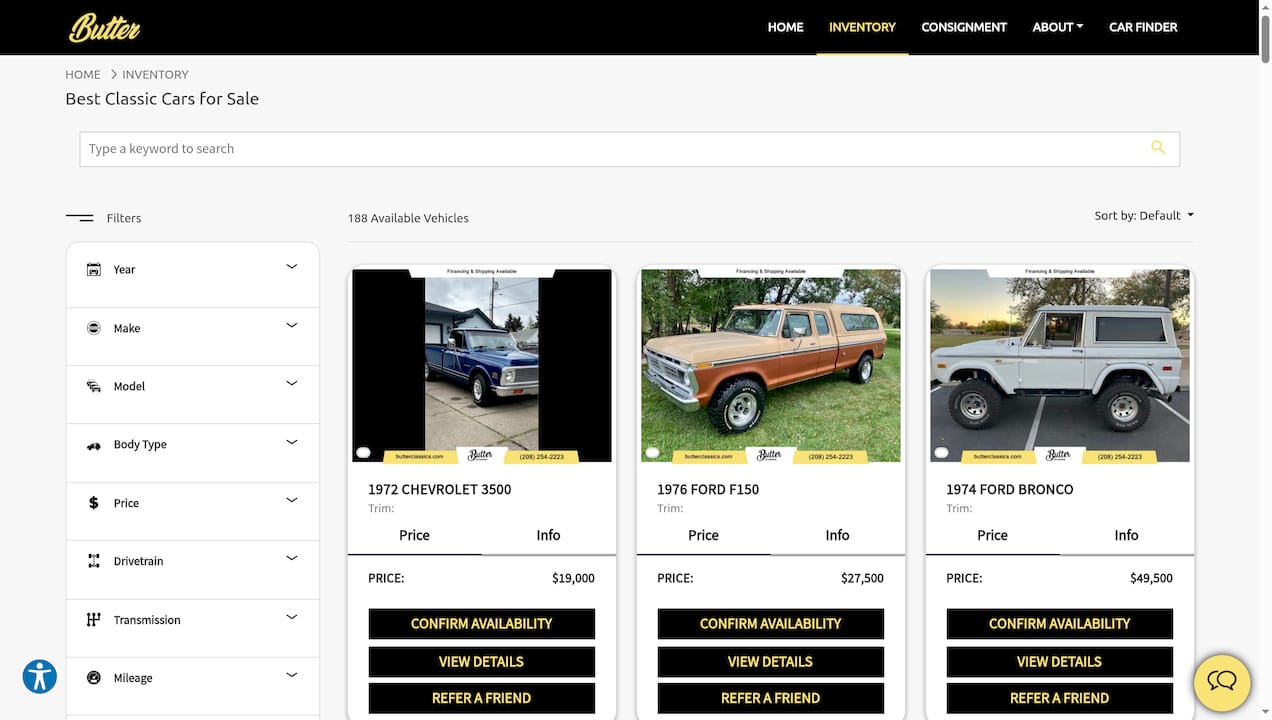
Here's what Butterclassics offers that directly reduces friction in the loan process:
- Financing prequalification right from the inventory page, so you know your budget before you fall for a car.
- Curated classic inventory with detailed specs, high-quality photos, and VIN information ready for your lender.
- Consignment services if you're selling a current classic to fund your next purchase.
- Test drive scheduling so you can verify condition before committing to an appraisal.
Ready to find your next collector car and get prequalified? Browse the Butterclassics inventory and start your financing prequalification today. Butterclassics connects you with the vehicle; you choose your lender independently based on the criteria in this guide.
Sources
Before you commit to a lender, spend ten minutes checking their credentials and reputation. Here's where to look:
- How Long Can You Finance a Classic Car: Loan Terms & Rates | LegalClarity
- Classic Car Rates | Truliant Federal Credit Union
Use NMLS to confirm every lender is properly registered before you share financial documents. A lender that can't be found in NMLS is a lender to avoid.
This article is general information, not a substitute for advice from a qualified financial advisor. Consult a qualified financial professional about your own circumstances before acting on anything here.