Vintage car financing is defined as a category of specialized loans and funding structures designed specifically for collectible and classic vehicles, operating under different rules than standard auto loans. Whether you're eyeing a 1967 Shelby GT500 or a pristine 1970 Chevelle SS, the path to ownership runs through lenders like Woodside Credit, J.J. Best Banc & Co., and LightStream, each offering products built around appraisal-based underwriting rather than standard depreciation schedules. This vintage car financing options overview covers every major loan type, what lenders actually require, and how to pick the right structure for your situation.
1. specialty classic car loans
Specialty classic car loans are the gold standard for financing a vintage vehicle purchase. Lenders like Woodside Credit and J.J. Best Banc & Co. underwrite these loans based on a professional appraisal rather than a standard book value, because vintage cars are illiquid assets that often appreciate rather than depreciate. That distinction changes everything about how the loan is structured and approved.
These loans typically offer longer terms and competitive rates compared to personal loans. Loan terms span from 36 to 84 months, with some specialty lenders extending terms up to 180 months for high-value collector vehicles. Longer terms lower your monthly payment but raise total interest paid, so you need to weigh cash flow against total cost.

2. personal loans as an unsecured alternative
Personal loans give you fast access to funds without using the vehicle as collateral. Lenders like LightStream offer unsecured personal loans that can be used for antique car financing, often with same-day or next-day funding. The tradeoff is a higher interest rate compared to secured specialty loans.
This option works best when you're buying a lower-value vehicle, need speed, or want to avoid the appraisal process entirely. The absence of a lien also means no insurance coordination with a lender, which simplifies the purchase. For vehicles under $30,000, a personal loan can be the most practical path.
3. open-end leases for collectors
Open-end leasing is a structure that functions similarly to a balloon-note loan, where a residual value is set at the start and your monthly payments cover only the difference. Open-end leases lower monthly payments but create residual risk at term end, meaning you are responsible for the gap if the car's market value falls below the agreed residual.
This structure suits collectors who rotate their inventory or plan to sell before the lease ends. Sales tax treatment varies by state, so check your local rules before committing. For high-value vehicles where capital efficiency matters, an open-end lease can free up significant monthly cash flow.
4. balloon loans for strategic buyers
A balloon loan sets a large lump-sum payment at the end of the term, with lower monthly installments throughout. This structure is popular among collectors who plan to refinance, sell the vehicle, or use appreciation to cover the final payment. It delivers the cash flow benefits of a lease with the ownership structure of a traditional loan.
The risk is straightforward: if the car's value drops or your financial situation changes, that balloon payment becomes a problem. Evaluating the end-of-term financial impact, including tax and residual value considerations, is non-negotiable before signing. Balloon loans work best when you have a clear exit strategy.
5. restoration financing and lines of credit
Restoration financing covers vehicles that are purchased as projects rather than turnkey collectibles. Some specialty lenders offer lines of credit or staged disbursement loans that release funds as restoration milestones are reached. This prevents you from borrowing more than you need upfront while keeping the project funded.
A line of credit is the most flexible tool here. You draw funds as needed, pay interest only on what you use, and repay as the project progresses. This structure is ideal for buyers who know the final value will exceed the purchase price but need capital spread across months of work.
6. what lenders look for in vintage car loan approval
Lender approval for classic car loans follows a specific checklist that differs from standard auto lending. The process centers on three pillars: vehicle valuation, borrower creditworthiness, and insurance alignment.
Here is what lenders typically require:
- Professional appraisal. The appraisal must use market comparable sales and a physical inspection. Lenders apply loan-to-value caps, and LTV ratios typically run between 70% and 90% of the lower of purchase price or appraised value.
- Complete documentation. Required documents include proof of income, government ID, vehicle photos, bill of sale, and appraisal. Missing any one of these delays funding.
- Agreed value insurance policy. The policy must name the lender as loss payee and reflect the appraised value. A standard auto policy does not satisfy this requirement.
- Clean title. Lenders will not fund a vehicle with title issues, liens, or salvage history.
- Down payment. Down payments typically range from 10% to 20%, and can reach 30% depending on the vehicle and borrower profile.
Pro Tip: Get your appraisal from a certified appraiser who uses actual comparable sales, not just asking prices. Lenders who see defensible comparable sales approve larger loan amounts with fewer conditions.
7. comparing vintage car loan types side by side
Choosing between loan structures comes down to your monthly budget, exit strategy, and risk tolerance. Here is a direct comparison of the four main structures:
| Loan Type | Monthly Payment | End-of-Term Risk | Best For |
|---|---|---|---|
| Fixed-rate installment | Higher | None | Long-term owners wanting predictability |
| Balloon loan | Lower | Large lump sum due | Collectors planning to sell or refinance |
| Open-end lease | Lowest | Residual value gap | Inventory rotators, capital-conscious buyers |
| Personal loan (unsecured) | Variable | None | Lower-value vehicles, fast funding needs |
Fixed-rate installment loans are the most straightforward. You pay the same amount every month, own the car outright at term end, and carry no residual risk. The tradeoff is a higher monthly payment compared to balloon or lease structures.
Secured loans (specialty classic car loans) consistently offer lower rates than unsecured personal loans because the vehicle serves as collateral. The agreed value insurance requirement is the price of admission for that lower rate. For vehicles worth $50,000 or more, the rate difference makes the extra paperwork worth it.
Pro Tip: Longer loan terms reduce monthly payments but increase total interest paid. Run the full amortization numbers before choosing a 120-month or 180-month term just to lower your monthly outlay.
8. choosing the right option for your situation
The right financing structure depends on your collector profile, vehicle type, and financial goals. Here is how to match your situation to the best option:
- High-value collector ($75,000+): A balloon loan or open-end lease from a specialty lender like Woodside Credit gives you capital efficiency. Work with lenders who understand classic car markets and offer flexible terms built around asset uniqueness.
- Budget-conscious buyer: Choose a shorter fixed-rate installment loan. You pay more per month but less total interest, and you own the car free and clear faster.
- Restoration project buyer: A line of credit or staged restoration loan keeps your borrowing aligned with actual project costs. Avoid borrowing the full estimated finished value upfront.
- Multiple vehicle collector: Some specialty lenders offer portfolio lending or blanket loans across several vehicles. This simplifies administration and can improve your overall rate.
- Buyers with credit challenges: Secured specialty loans are more forgiving than personal loans because the vehicle's appraised value supports the underwriting. A strong appraisal and a 20%–30% down payment can offset a lower credit score.
Coordinating your insurance policy with the lender before closing is the single most common source of deal delays. Get the agreed value policy in place and confirm the lender is named as loss payee before you submit your final loan application.
Key takeaways
The most effective approach to vintage car financing is matching your loan structure to your exit strategy, vehicle value, and insurance readiness before you apply.
| Point | Details |
|---|---|
| Specialty loans beat personal loans on rate | Secured classic car loans from lenders like Woodside Credit offer lower rates than unsecured alternatives for vehicles over $30,000. |
| Appraisal drives approval | Lenders cap loans at 70%–90% of appraised value, so a credible appraisal directly determines how much you can borrow. |
| Insurance must be in place first | An agreed value policy naming the lender as loss payee is required before funding, not after. |
| Balloon and lease structures cut monthly costs | These structures lower your monthly payment but require a clear plan for the end-of-term lump sum or residual. |
| Down payments range from 10% to 30% | Your vehicle profile and credit strength determine where in that range your lender will land. |
What i've learned about vintage car financing after years in the market
The biggest mistake I see buyers make is treating a classic car loan like a standard auto loan. They walk in without an appraisal, present a seller's asking price as the vehicle's value, and then wonder why the lender comes back with a smaller approval and a higher down payment requirement. Lenders who specialize in collector cars are not being difficult. They are protecting themselves against an illiquid asset with a thin resale market.
The second most common problem is insurance timing. Buyers get approved, find the car, and then scramble to get an agreed value policy in place. That scramble costs days or weeks. Get the policy framework sorted before you even start shopping. Call your insurer, confirm they write agreed value coverage for collector vehicles, and know your premium range. When you find the right car, you can close fast.
My honest recommendation: work exclusively with lenders who specialize in classic and vintage vehicles. They understand that a 1969 Camaro Z/28 does not depreciate like a 2019 Camry. They offer terms that reflect that reality. General banks and credit unions rarely do. The rate difference may be small, but the flexibility in underwriting and the understanding of the asset class is worth far more than a quarter point on your rate.
If you are considering a balloon or open-end lease structure, model the end-of-term scenario before you sign. Know what the car needs to be worth for the math to work. If you plan to sell, know your market. If you plan to refinance, know your credit trajectory. These are not scary questions. They are the questions that keep a great purchase from becoming a financial headache.
— Tony
Find your next classic at Butterclassics
Ready to put this knowledge to work? Butterclassics makes financing a vintage vehicle purchase as smooth as butter. The Butterclassics inventory features a curated selection of investment-grade classic cars, from muscle cars and Corvettes to vintage trucks and Broncos, each with detailed specs and high-quality photos to support your appraisal process.
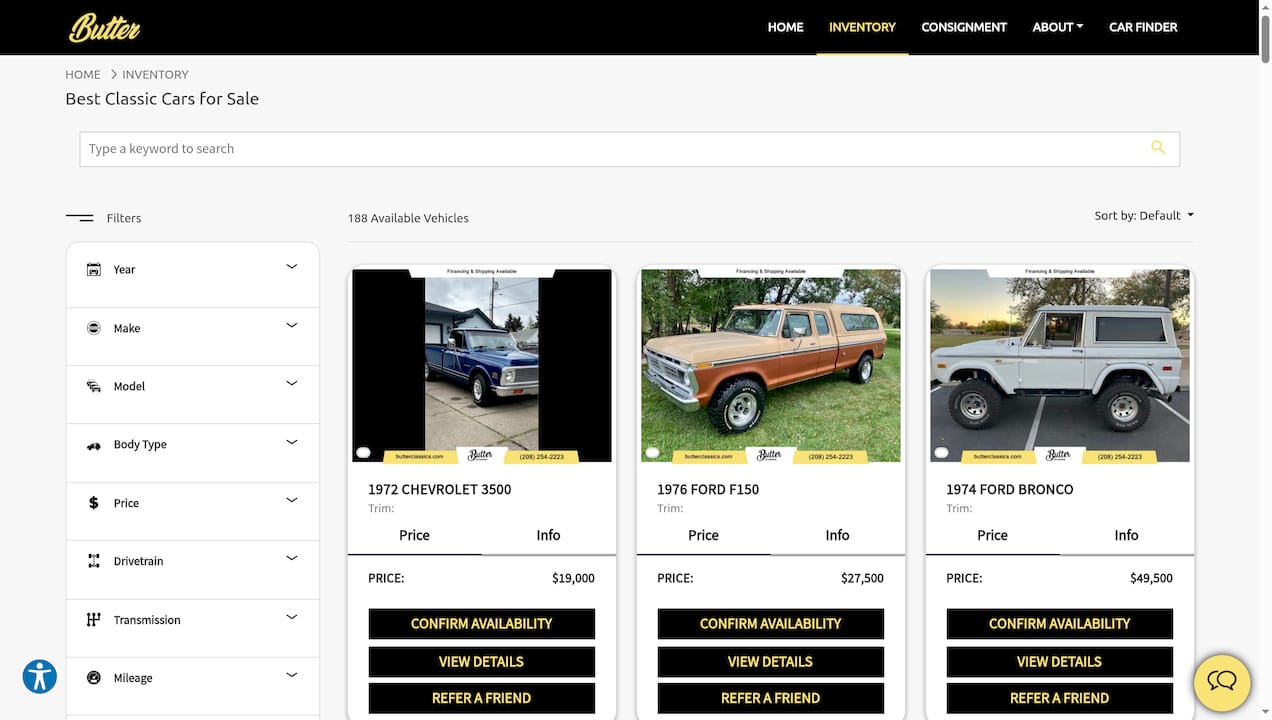
Butterclassics connects buyers with specialty financing programs designed for collector vehicles, so you are not trying to fit a classic car into a standard loan box. Browse the Butter Certified collection for vehicles that have already cleared quality and documentation standards, making the loan approval process faster and cleaner. Reach out to the Butterclassics team for personalized guidance on matching the right vehicle to the right financing structure.
FAQ
What is the minimum down payment for a classic car loan?
Classic car lenders typically require a down payment between 10% and 20%, with some lenders asking up to 30% depending on the vehicle's condition and the borrower's credit profile.
Do i need a special insurance policy to finance a vintage car?
Yes. Lenders require an agreed value insurance policy that names them as loss payee. A standard auto policy does not meet this requirement and will delay funding.
How does loan-to-value work for vintage vehicles?
Lenders apply an LTV cap of 70%–90% to the lower of the purchase price or appraised value. A strong, credible appraisal directly determines your maximum loan amount.
Can i finance a classic car restoration project?
Yes. Some specialty lenders offer lines of credit or staged disbursement loans for restoration projects, releasing funds as milestones are completed rather than as a single lump sum.
What is the difference between a balloon loan and an open-end lease?
A balloon loan gives you ownership with a large payment due at term end, while an open-end lease sets a residual value and charges you only for the depreciation during the lease period. Both lower monthly payments but carry end-of-term financial obligations you need to plan for in advance.