
J.J. Best. That range shows lenders you're serious, and it keeps your loan aligned with guidance from the CFPB on avoiding an upside-down loan. Put more down and you'll usually finance less, qualify for a better rate, and sleep easier if the market shifts.
TL;DR:
- Down payments should primarily cover the vehicle's base price, excluding taxes, registration, transport, or seller fees, which need separate funds.
- A larger down payment reduces the financed amount, improves your borrowing rate, and decreases the risk of owing more than the car’s value if market prices decline.
- Loan terms often extend beyond five years, increasing total interest paid, so it’s essential to compare overall costs rather than just monthly payments.
- Borrowed funds or vehicle trade-ins can fast-track your down payment, but require thorough documentation like bank statements and wire transfer receipts.
- Qualifying with pre-approved, independent lenders and gathering all necessary vehicle and financial paperwork helps control negotiations and speeds up approval.
Table of Contents
- What lenders expect: eligibility, down payment, and paperwork
- How your down payment shapes your rate, term, and risk
- Practical ways to fund your down payment
- Your readiness checklist before you apply
- How Butter Classics supports down payment and financing prep
- Down payment ranges by vehicle value and age
- Trade-offs I use when advising classic-car buyers
- Start here: pre-qualify and browse by price with Butter Classics
- Sources
- FAQ
What lenders expect: eligibility, down payment, and paperwork
Specialty classic car lenders look at more than your down payment. Credit score matters a lot: many want to see 700 or higher, though some will work with borrowers around 670, according to LendingTree. Debt-to-income ratio matters too. Lenders generally prefer your total debt payments to stay under roughly 40% to 41% of your income, per the same LendingTree guidance.
Minimum loan amounts come into play as well. Lenders set these thresholds partly because smaller loans cost about the same to underwrite as larger ones, and partly because a low-value collateral vehicle carries more risk relative to the loan size.
Here's what usually counts, and what doesn't, when you calculate your down payment:
- Your down payment typically applies to the base purchase price of the vehicle, not the full out-the-door cost.
- Sales tax, registration, transport, and seller fees are usually excluded and need separate funding, per J.J. Best.
- Lenders will ask for proof of funds, recent pay stubs, the VIN, photos of the vehicle, and sometimes a professional appraisal.
Our collector's checklist on loan requirements walks through how to line up this paperwork before you apply.
How your down payment shapes your rate, term, and risk
A bigger down payment does three things at once. It shrinks the amount you finance, it can help you negotiate a better rate, and it lowers your odds of owing more than the car is worth if values dip.
Classic car loans often stretch longer than a typical auto loan, sometimes 60 to 180 months. A longer term lowers your monthly payment, but it stretches out interest payments too, which is exactly why the CFPB recommends comparing total loan cost rather than just the monthly number.
Longer terms mean more total interest paid over the life of the loan, even when the monthly payment looks smaller, according to CFPB guidance on auto financing. Before you sign anything, ask your lender for the full payoff amount at your quoted rate and term, not just the payment breakdown.

Practical ways to fund your down payment
You've got several legitimate routes to a down payment, and each comes with its own trade-offs.
- Savings and cash work best when you keep an emergency reserve intact rather than draining every account you have.
- Trading in another vehicle can be quick, while a private sale often nets more money but takes longer. Our trade-in evaluation checklist helps you estimate value either way.
- Borrowed funds, including personal loans or documented gifts from family, are sometimes accepted, but lenders usually want a paper trail showing where the money came from.
- Tapping investments or refinancing another asset can raise cash fast, though it carries tax and opportunity-cost considerations worth reviewing with a tax professional first.
Whichever route you choose, keep your paperwork tight: bank statements, cashier's checks, wire receipts, and any escrow documents. J.J. Best notes it requires proof of down payment in forms like cashier's checks or wire transfers, and other specialty lenders expect similar documentation.
Pro Tip: Keep every receipt and bank confirmation tied to your down payment in one folder before you apply. Lenders move faster when they don't have to ask twice.
Your readiness checklist before you apply
Getting your financing lined up before you fall in love with a specific car puts you in control of the negotiation instead of the other way around.
- Get preapproved with an independent lender first, so you know your real budget before talking to a seller or dealer.
- Confirm your down payment target based on the vehicle type. Standard classics usually sit at 10% to 20%, while hot rods and kit cars often require closer to 30%, per J.J. Best.
- Book a professional inspection or appraisal, and gather the VIN, photos, and service history your lender will want to see.
- Decide upfront which out-the-door costs, like tax and transport, you'll cover in cash versus roll into the loan.
- Ask any lender you're considering for a clear breakdown of the APR and total payoff, not just the payment amount.
- Pull together your documentation packet: proof of funds, ID, pay stubs, proof of residence, and vehicle paperwork.
If you're financing a project car that needs restoration work, our guide on covering the first 90 days walks through how to budget for repairs without draining your down payment.
How Butter Classics supports down payment and financing prep
The site offers financing pre-qualification, browsing inventory by price, quote requests, test drive scheduling, and vehicle consignment services. Getting pre-qualified before you shop gives you a real number to work with, and it's useful leverage if a dealer tries to push you toward financing that isn't competitive.
If raising a down payment means selling something first, consigning your vehicle through Butter Classics can turn a car sitting in your garage into the cash you need to move on the next one.
Down payment ranges by vehicle value and age
Down payment targets shift depending on what you're buying, so a flat percentage only tells part of the story. J.J. Best keeps your monthly payment manageable without tying up too much cash.
Move into mid-range collector cars, roughly $30,000 to $75,000, and lenders still tend to land in that same 10% to 20% window, though they'll scrutinize your credit score and debt-to-income ratio more closely at higher loan amounts, according to LendingTree.
Hot rods, kit cars, and heavily modified builds are where the math changes. J.J. Best. Older vehicles with limited service history can trigger similar caution, since appraisers have less to go on. Our market trends checklist breaks down how value retention varies across eras and body styles, which is worth a look before you settle on a target.

Trade-offs I use when advising classic-car buyers
Liquidity matters more than a big down payment when you're buying a project car that needs real restoration work. Save the extra cash for parts and labor instead.
For a well-documented, turnkey classic, a larger down payment usually pays off. Collector values hold up reasonably well, but they're not guaranteed, so stay inside your budget and keep your emergency fund untouched.
— Tony
Start here: pre-qualify and browse by price with Butter Classics
Once you know your target down payment, the fastest way to see what fits is to browse Butter Classics inventory filtered by price and start pre-qualification before you fall for a specific listing.
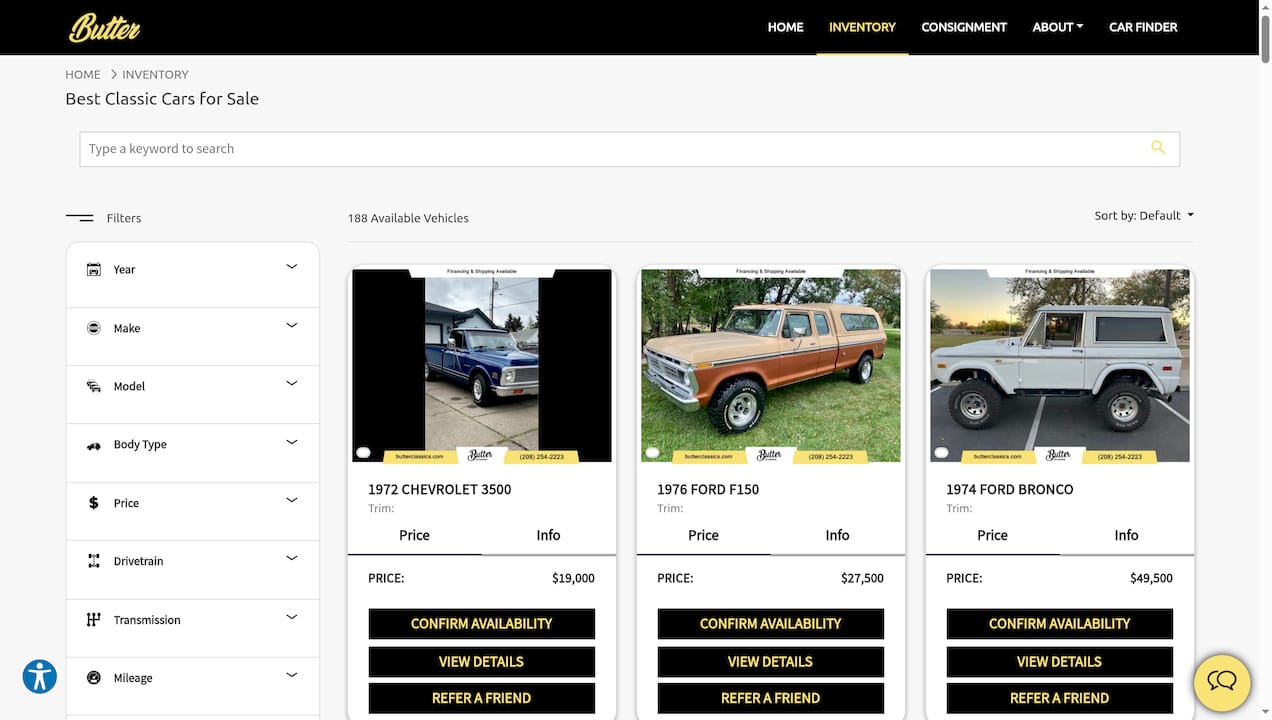
You'll get a real financing number to work with, whether you're ready to request a quote, schedule a test drive, or just see what's available in your range. Browse the full lineup and start pre-qualifying at Butter Classics' inventory.
Sources
- Classic Car Loans & Collector Vehicle Financing | J.J. BEST BANC & CO.
- How does a down payment affect my auto loan? | Consumer Financial Protection Bureau
- How to finance a classic car | LendingTree
- Classic Car Financing | LightStream by Truist
FAQ
What is the $3,000 rule for cars?
This isn't a standard lending rule referenced by major auto lenders or regulators, and definitions vary depending on who's using the phrase. If you've seen it applied to classic car financing specifically, treat it as informal advice rather than a lender requirement, and confirm actual down payment expectations directly with your lender.
What's a good down payment for a $30,000 car?
J.J. Best. That puts your cash down at a typical 10% to 20% of the base purchase price, excluding tax, registration, and transport costs.
Will banks give loans on 20-year-old cars?
Yes, many specialty lenders finance vehicles well over 20 years old, and some unsecured lenders like LightStream place no age restrictions on the vehicle at all. Approval depends more on your credit profile and the loan terms than on the car's age alone.
Are classic cars dropping in value?
Value trends vary a lot by make, model, and era, and no single figure applies across the whole collector market. Check our market trends checklist for a closer look at how different segments are holding up before you buy.