
If you're buying a running, roadworthy classic and you plan to keep it long term, a specialty classic-car loan almost always beats a personal loan on cost and structure. If you're moving fast on a driver-quality car, a project that won't qualify for specialty underwriting, or a purchase under roughly $100,000, a personal loan is often the more practical tool. The choice between classic car financing vs. personal loan really comes down to how the lender treats your vehicle: as collateral worth appraising, or as a number on your credit application.
Here's the trade-off in three lines:
- Collateral and rate: Specialty lenders secure the loan against the car itself, often unlocking longer terms and lower payments; personal loans skip the lien but usually charge more for the privilege.
- Speed vs. scrutiny: A personal loan like LightStream can fund the same business day with no appraisal, while classic-car lenders need days or weeks to value the car properly.
- Credit sensitivity: Personal loan pricing swings harder with your credit score since there's no asset backing the debt; classic-car lenders lean partly on the vehicle's value to offset that risk.
Cash still rules this market. Fewer than 3% of Hagerty-insured cars are financed at all, according to Muscle Car Fan's breakdown of financing options, which tells you something: most serious collectors treat financing as a tool for cash flow management, not a necessity.
Specialty classic-car lenders underwrite the vehicle itself, not just the borrower, using appraisals and market comparables the way a home lender uses a house appraisal. That single difference explains almost every other gap between the two loan types.
Key Takeaways
Specialty classic-car loans generally cost less over time for high-value vehicles held long term, while personal loans win on speed and simplicity for smaller or faster purchases.
| Point | Details |
|---|---|
| Match loan type to price | Specialty loans typically fit purchases above $100,000; personal loans suit smaller or faster deals. |
| Valuation drives everything | Ask how the lender values the car before comparing rates or terms. |
| Insurance is not optional | Agreed-value coverage with the lender as loss payee is standard on secured classic-car loans. |
| Compare total interest, not payment | A lower monthly payment on a longer term can still cost more overall. |
| Butterclassics simplifies the search | Browsing verified inventory first makes lender conversations faster and more specific. |
Consult a financial advisor if you're weighing financing against paying cash outright, especially on six-figure purchases where the opportunity cost of tied-up capital matters.
Table of Contents
- Classic Car Financing vs. Personal Loan: The Numbers Side by Side
- How Do Specialty Classic-Car Loans Actually Work?
- How Personal Loans Cover a Classic Car Purchase
- How Do You Choose Between the Two?
- Three Real-World Cost Scenarios
- What Other Financing Routes Exist?
- Are There Tax Considerations With Classic-Car Financing?
- What Collectors Actually Do, and Why
- Ready to Shop? How Butterclassics Fits Into Your Financing Plan
- Where to Verify Details Before You Apply
- Frequently Asked Questions
- Sources
Classic Car Financing vs. Personal Loan: The Numbers Side by Side
The two loan types diverge sharply once you line up the details lenders don't always volunteer up front.
| Factor | Classic-Car Loan (Secured) | Personal Loan (Unsecured) |
|---|---|---|
| Collateral / LTV | Vehicle serves as collateral; typically up to 80% of appraised value | None; approval based on income and credit |
| Typical APR range | Varies by credit and lender | Varies by credit and lender |
| Typical loan term | Up to 180 months | Up to 84 months |
| Typical loan amount | $15,000 to roughly $150,000 | Varies by lender |
| Approval / funding speed | Days to a few weeks (appraisal required) | Often same-day to a few business days |
| Required documentation | Title, bill of sale, photos, appraisal, sometimes provenance | Income proof, credit check, ID |
| Insurance requirement | Agreed-value policy with lender as loss payee | Standard auto policy, no loss-payee requirement |
| Best for | High-value collector cars held long term | Drivers, project cars, fast or smaller purchases |
Three rows decide most people's choice. APR spread matters because a five-point difference on a $60,000 loan adds up to thousands over a multi-year term. Term length matters because classic-car lenders will stretch to 180 months specifically to keep monthly payments manageable on six-figure cars, something no personal-loan product offers. And funding speed matters at auction, where a personal loan's same-day turnaround can save a bid that a two-week appraisal process would lose.
Before signing anything, run through this short list:
- Ask the lender exactly how it values the car, comparable sales, agreed value, or a flat percentage of asking price.
- Confirm whether agreed-value insurance is required and get a quote before you commit to the loan.
- Compare the total interest paid over the full term, not just the advertised monthly payment.
How Do Specialty Classic-Car Loans Actually Work?
Specialty lenders don't lend against a depreciation curve the way a bank does for a new sedan. They lend against what the car is worth to a collector today, and that changes everything about the process.

Woodside Credit explains that classic-car underwriting starts with valuation, not a VIN lookup and a depreciation table. Lenders pull comparable sales, sometimes referencing Cars of Particular Interest (CPI) data, and factor in condition, originality, and documented provenance. A numbers-matching 1969 Camaro Z/28 with a paper trail appraises very differently than a driver-quality clone, even if both look identical in photos.
That valuation directly sets your loan-to-value ceiling. Star One Credit Union advertises financing up to 80% of average CPI value with fixed rates and terms stretching to seven years, a fairly typical structure among credit unions that specialize in this niche. J.J. Best Banc & Co. provides specialty lending with extended terms and typically requires down payments that are a significant portion of the purchase price, but the eligibility bar matters just as much as the numbers: most specialty lenders require the vehicle to be in running, roadworthy condition, which limits financing options for non-running project cars..
Typical qualification differences from a standard auto loan:
- Credit score expectations often run higher than mainstream auto lending, though exact thresholds vary by lender.
- Down payments commonly land between 10% and 20%, sometimes more for unusual or high-mileage vehicles.
- The car generally needs to be operational; heavy project cars often get routed to personal loans or restoration-specific financing instead.
- Agreed-value insurance with the lender named as loss payee is standard, not optional, protecting both sides if the car is totaled.
Hagerty and its affiliate Broad Arrow Capital describe a lending landscape where specialty players focus on the collector-market dynamics that generic banks simply don't track, according to Hagerty's financing overview. Meanwhile, generalist channels like LendingTree aggregate options across categories, and personal-loan products from LightStream or OneMain sit at the opposite end of the spectrum, fast, unsecured, and indifferent to whether your car is a numbers-matching original or a well-done restomod.
Pro Tip: Get a written explanation of the lender's valuation method before you apply. If they can't describe it beyond "we'll look it up," that's a sign they don't specialize in collector vehicles the way their marketing suggests.
One more thing worth knowing before you compare offers: reading the fine print on our classic car loan requirements checklist can save you a rejected application after you've already fallen in love with a car.
| Underwriting Factor | Specialty Classic-Car Loan |
|---|---|
| Valuation basis | Appraisal, comparable sales, CPI-style data |
| Typical LTV cap | Up to 80% of appraised value |
| Vehicle condition requirement | Generally running and roadworthy |
| Insurance requirement | Agreed-value policy, lender as loss payee |
How Personal Loans Cover a Classic Car Purchase
A personal loan skips the appraisal entirely. Approval hinges on your credit score, income, and debt-to-income ratio, not the car's provenance or condition, which is exactly why project cars and unusual builds often end up financed this way.
LightStream, a Truist brand, can fund approved applications the same business day, according to its classic-car financing page, with no lien placed on the title and no appraisal requirement. OneMain Financial markets personal loans for purchase, repair, or restoration with fixed monthly payments and fast prequalification, per its classic car loans page, while LendingTree functions more as a comparison hub than a direct lender, letting you shop multiple personal-loan offers at once through its financing guide.
The trade-off shows up in the rate. Because there's no collateral backing the loan, APR for personal loans generally exceeds those for secured classic-car loans for similar borrowers, especially once you drop below excellent credit tiers. Terms also cap out lower, usually 84 months at the outside, which pushes monthly payments up fast on anything priced above $50,000 or so.
Where personal loans fall short for serious collectors:
- No agreed-value protection tied to the loan itself; your insurance and your financing are entirely separate conversations.
- Total interest paid can exceed a comparable classic-car loan once you account for the shorter term and higher rate.
- Most personal-loan products cap out well below what a six-figure investment-grade car requires, making them impractical for top-tier purchases.
- Because approval leans entirely on your income and credit, a thin credit file can shut the door even if the car itself is a safe bet.
For a $15,000 driver-quality truck or a project car that needs work before any lender will appraise it, a personal loan solves the problem cleanly. For a $150,000 numbers-matching Corvette, it usually doesn't fit.
How Do You Choose Between the Two?
Run through this checklist before you talk to a single lender:
- Define your price range. Under roughly $100,000, personal loans are often viable. Above that, specialty lenders typically make more financial sense.
- Assess the car's condition. A running, titled, roadworthy vehicle qualifies for specialty underwriting; a project car usually doesn't.
- Decide your timeline. If you're bidding at auction next week, a personal loan's speed may outweigh the rate difference.
- Check your comfort with a lien. Specialty loans put the lender on the title until payoff; personal loans leave your title clean immediately.
- Compare preapproval offers from at least two lenders in each category before committing, since rates and LTV caps vary more than most buyers expect.
When you do talk to lenders, ask these questions directly:
- How exactly do you value this car, appraisal, comparable sales, or a flat percentage of purchase price?
- Is agreed-value insurance required, and do you have a preferred provider?
- Are there prepayment penalties if I pay the loan off early?
- Does the loan include a balloon payment at the end of the term?
- What's your typical timeline from application to funded purchase?
Watch for vague answers on valuation methodology, undisclosed prepayment penalties, or fuzzy language around insurance and loss-payee requirements. According to Woodside Credit, a lender that can't clearly explain its valuation process is usually a lender without real collector-market expertise, no matter how polished its website looks.
If you're planning to bid at auction, get conditional preapproval before the gavel drops, not after. A specialty lender who has already reviewed comparable sales data for your target model can turn a conditional approval into final funding far faster than starting cold once you've won the bid.
Pro Tip: Call your top two lender candidates the same week and ask them to quote you on the exact same hypothetical car. The spread in their answers tells you more about their real expertise than any marketing page will.
Three Real-World Cost Scenarios
Numbers make this easier than adjectives. Here are three purchase scenarios at different price points, each showing how loan structure changes the monthly payment and total interest.
These figures use rounded, illustrative rates within the ranges specialty lenders and personal-loan providers commonly publish; your actual quote will depend on credit, lender, and the specific vehicle.
A few things stand out. The driver-quality scenario works fine as a personal loan because the amount is modest and the shorter term keeps total interest manageable. The mid-range collector car benefits from the specialty loan's longer term, the monthly payment stays comfortable even though the total interest climbs. The high-value investment car is where the gap becomes obvious: stretching to 144 months keeps the payment livable on a $180,000 purchase, something no personal-loan product realistically offers at that principal.
- Longer terms lower monthly payments but increase total interest paid over the life of the loan.
- A larger down payment on a specialty loan reduces both the monthly payment and the lender's risk exposure.
- Always compare the total cost of the loan, not just the payment, when weighing offers side by side.
What Other Financing Routes Exist?
Neither option is the only path. Collectors use several alternatives when a specialty loan or personal loan doesn't fit the situation.
A home equity line of credit (HELOC) lets you borrow against equity in your house, often at a lower rate than an unsecured personal loan, but it puts your home at risk if payments lapse and the rate is usually variable. Borrowing against an existing collection, sometimes offered by the same specialty lenders who write classic-car loans, works similarly to a HELOC but uses other vehicles as collateral instead of real estate. Dealer or auction-house financing exists too, though terms vary enormously and rates are often less competitive than going directly to a specialty lender or credit union. Balloon loans, where you pay a smaller amount monthly and a lump sum at the end, show up occasionally in specialty lending and can lower payments short term at the cost of a large final bill.
- HELOC: often lower rates, but your home is the collateral, not the car.
- Collection-secured loans: useful if you already own qualifying vehicles, but risks cross-collateralization.
- Dealer/auction financing: convenient at the point of sale, but shop the rate against a specialty lender first.
- Balloon structures: lower monthly payments now, larger obligation later.
Cross-collateralizing your home or an existing car collection to finance a new purchase should be a deliberate decision, not a default one. If the specialty loan or personal loan math works on its own, there's rarely a reason to put a second asset at risk.
Are There Tax Considerations With Classic-Car Financing?
Interest paid on a personal loan or a specialty classic-car loan used for a personal collector vehicle generally isn't tax deductible, the same rule that applies to most consumer auto financing in the United States. That changes if the vehicle is used in a business context, say, displayed as part of a dealership's inventory or used in a documented business capacity, where interest treatment can differ significantly. Sales tax also applies at purchase in most states regardless of how you finance the car, and how that tax is calculated can vary depending on trade-in credits or private-party sale structures.
Down the road, when you eventually sell, the tax picture shifts again. Classic cars that appreciate in value can trigger capital gains tax on the profit, a topic worth understanding well before you sign any financing paperwork, since it affects your real return regardless of which loan type you used to buy the car. Our guide to capital gains tax on classic cars breaks down how that works for collectors. None of this is a substitute for advice from a tax professional familiar with your state and your specific situation, but it's worth factoring into your financing decision from day one rather than treating it as an afterthought.
What Collectors Actually Do, and Why
Most buyers who come through Butterclassics fall into a pattern once you watch enough transactions: high-value purchases, generally anything north of $75,000 to $100,000, tend to go through specialty classic-car lenders, while faster or smaller purchases lean on personal loans. That split isn't accidental. It tracks almost exactly with where the math favors each product.
What surprises newer buyers is how much the insurance conversation shapes the financing decision, not the other way around. A specialty lender's agreed-value insurance requirement often turns out to be a good thing collectors would want anyway, since it protects the car's true market value rather than a generic depreciated payout. Skipping that step to save time with a personal loan can leave you underinsured on the exact asset you just spent months finding.

My practical recommendation for most Butterclassics shoppers: get preapproved through two or three lenders in whichever category fits your price range before you start seriously negotiating on a car. A preapproval in hand changes your negotiating position at a private sale and can be the difference between winning and losing a bid at auction.
Ready to Shop? How Butterclassics Fits Into Your Financing Plan
Butterclassics is built for exactly the decision this article just walked through: browsing real inventory while you sort out financing, not guessing at values from listing photos alone. Every vehicle on the platform comes with detailed specifications and high-quality images, so you can walk into a lender conversation, whether it's a specialty classic-car loan or a personal loan, with a specific car and a specific price already in hand.
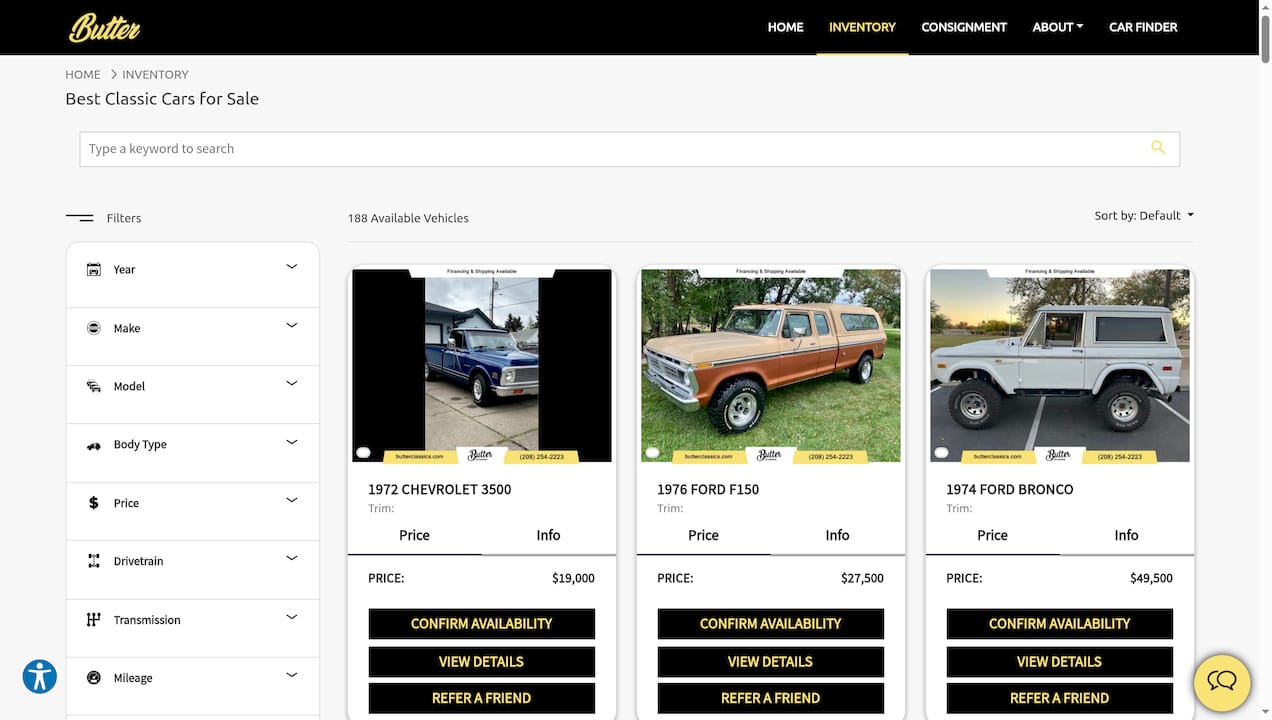
Start by browsing the current classic car inventory, where you can filter by price range and get a real sense of what fits your budget before you request preapproval anywhere. If you know the general type of car you want but not the exact model, the car finder tool narrows the search for you. And once you've settled on financing and found a car worth pursuing, scheduling a test drive is the natural next step before you commit. Whichever loan type you land on, having the vehicle details locked down first makes the whole process move faster.
Where to Verify Details Before You Apply
- Star One Credit Union's classic car page shows real published LTV caps and term lengths for credit-union financing.
- LightStream's classic car financing page details same-day funding and no-lien personal loan terms.
- NMLS Consumer Access lets you verify any lender's registration and complaint history before you apply.
- LendingTree's financing guide is a useful starting point for comparing multiple personal-loan offers at once.
Verifying a lender's NMLS registration takes five minutes and can save you from a lender that doesn't actually specialize in what its marketing claims.
Frequently Asked Questions
Is a personal loan or classic car financing better for a first-time buyer? It depends mostly on price and the car's condition. A personal loan works well under roughly $100,000 for a running vehicle; above that, a specialty classic-car loan usually offers better terms.
Do classic-car loans require an appraisal? Most specialty lenders require some form of valuation, whether a formal appraisal or a comparable-sales review, before approving the loan and setting the LTV.
Can I use a personal loan to buy a project car that doesn't run? Often yes, since personal loans don't require the vehicle to meet a condition standard the way specialty classic-car loans typically do.
Will agreed-value insurance cost more than standard auto insurance? It can, but it protects the vehicle's true market value rather than a depreciated payout, which matters more as the car appreciates.
How long does it take to get approved for a classic-car loan versus a personal loan? Personal loans can fund in as little as one business day with some lenders; specialty classic-car loans often take days to a few weeks due to the appraisal step.
This article is general information, not a substitute for advice from a qualified financial advisor. Consult a qualified financial professional about your own circumstances before acting on anything here.
Sources
- How to Finance a Classic Muscle Car in 2026: Every Option Compared | Muscle Car Fan
- Classic Car Loan vs. Standard Auto Loan: What’s the Difference? — Woodside Credit
- Classic Car Financing | LightStream by Truist
- Classic Car Financing Options & Tips — Rizzlending