When you sell a classic car for more than you paid, the IRS wants a cut. That profit is a capital gain, and how much you owe depends on how long you owned the vehicle and what you can prove you spent on it. Here is the short version before we dig in:
- Taxable gain = sale price minus your adjusted cost basis (purchase price plus documented major restorations)
- Short-term gains (held under one year) are taxed at ordinary income rates, up to 37% federally
- Long-term gains (held over one year) are capped at 20% federally, with a possible 3.8% Net Investment Income Tax on top.
- Classic cars are not classified as collectibles by the IRS, so the 28% collectibles rate does not apply
- State taxes vary widely and can push your combined rate well above the federal ceiling
- Reporting goes on Schedule D and Form 8949
- No gain, no tax. Most everyday cars depreciate, so this only bites when your classic actually appreciates
How the IRS defines a classic car for tax purposes
The IRS does not assign a specific age threshold to call a vehicle a "classic car." There is no magic number like 25 years or 30 years that automatically changes how your car is taxed. What actually matters is how you use it and why you own it.
The IRS looks at ownership intent. Are you holding the car as an investment asset, driving it as personal property, or flipping cars regularly as a business? Each classification carries different tax treatment. A collector car held as an investment is treated as a capital asset. A car you drive daily is personal property. A car you buy and sell repeatedly for profit may get you reclassified as a dealer.
One misconception worth clearing up: classic cars are not classified as "collectibles" under IRC Section 408(m), which covers items like coins, art, and stamps. That distinction matters because collectibles carry a 28% capital gains rate. Classic cars currently avoid that higher rate and fall under standard long-term capital gains rates instead. Documented evidence of your investment intent, such as insurance policies covering agreed value, appraisals, and storage records, strengthens your position if the IRS ever questions your classification.
How to calculate your capital gains on a classic car sale
Your taxable gain is straightforward once you know your numbers. Subtract your adjusted cost basis from your net sales price, and the difference is what gets taxed.

Your cost basis starts with what you originally paid for the car. From there, you can add the cost of major documented restorations and improvements. Routine maintenance, oil changes, and minor repairs do not count. Only capital improvements that add to the car's value or extend its useful life qualify. The IRS requires itemized receipts for any improvement you want to include in your basis.
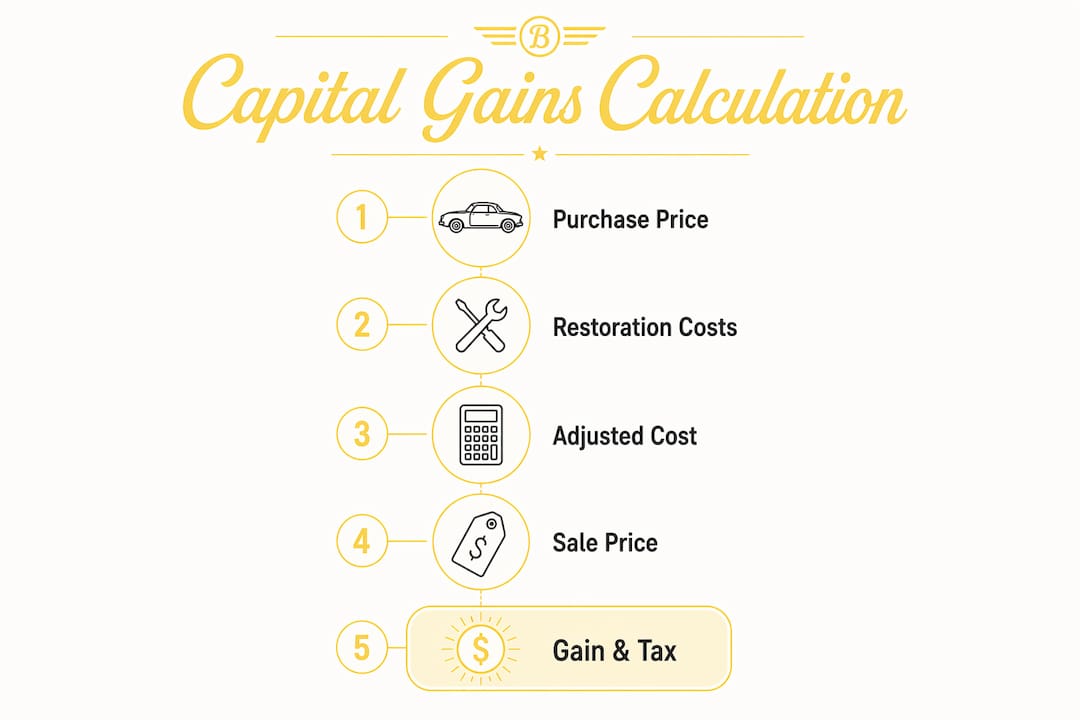
Here is a concrete example: you buy a 1969 Camaro for $40,000 and spend $20,000 on a documented frame-off restoration, giving you a $60,000 adjusted cost basis. You sell it three years later for $100,000. Your taxable gain is $40,000. Because you held it over a year, long-term rates apply.
| Tax Scenario | Federal Rate | NIIT (if AGI exceeds threshold) | Potential Combined Federal Rate |
|---|---|---|---|
| Short-term gain (under 1 year) | Ordinary income rates | Net investment income tax applies if income thresholds met | Combined rate varies |
| Long-term gain (over 1 year) | Long-term capital gains rates | Net investment income tax applies if income thresholds met | Combined rate varies depending on state taxes |
| Long-term + California state tax | Long-term capital gains rates plus state tax | Net investment income tax applies | Combined rate may be significantly higher due to state tax |
The 3.8% NIIT kicks in when your adjusted gross income exceeds $200,000 for single filers or $250,000 for joint filers. For high-income collectors, that extra layer adds up fast. Pair that with California's state rate, and your combined bill can exceed 37% even on long-term gains.
What triggers a taxable gain, and what gives you relief
The tax clock starts ticking the moment you realize a profit. A sale or exchange that produces a gain is the most common trigger. Gifting, trading, and inheriting a classic car each carry their own rules.
When you sell or exchange a classic car at a profit, that is a taxable event. Full stop. But several situations either eliminate or defer the tax:
- Selling below your cost basis produces no taxable gain and no reporting obligation. Most regular cars depreciate, which is why the average car owner never thinks about capital gains tax.
- Losses on personal-use vehicles are nondeductible. You cannot use a loss on your daily driver to offset a gain on your collectible.
- Like-kind exchanges (1031 exchanges) let you defer the gain by rolling proceeds into another qualifying collector car. An accommodator handles the transaction, your basis transfers to the new vehicle, and you postpone the tax until you eventually sell without reinvesting.
- Gifting a classic car transfers your cost basis to the recipient. They inherit your holding period and your basis, so the tax liability moves with the car.
- Inherited cars get a stepped-up basis to fair market value at the date of death. That step-up can wipe out decades of appreciation, making inheritance one of the most tax-efficient ways to pass on a valuable vehicle.
- Charitable donations of appreciated classic cars can generate a deduction, though the rules around vehicle donations are specific and require a qualified appraisal for cars valued over $500.
Additional tax considerations every classic car owner should know
Good recordkeeping is not optional. If the IRS audits your return and you cannot substantiate your cost basis, they will use a lower number, and your taxable gain grows accordingly. Keep every receipt for the original purchase, every invoice from restoration shops, and any appraisals you have commissioned. A dedicated folder, physical or digital, organized by vehicle makes this manageable.

Pro Tip: Photograph your restoration work at each stage and attach those images to your invoices. Visual documentation paired with itemized receipts gives you a much stronger case during an audit than receipts alone.
Reporting your gain requires Schedule D and, in most cases, Form 8949. You list each vehicle sale separately, noting the acquisition date, sale date, proceeds, and adjusted basis. The IRS matches these against 1099-B forms when brokers or auction houses report sales, so accuracy matters. Knowing what documents you need before the sale closes saves headaches at tax time.
A few more considerations worth keeping on your radar:
- Dealer reclassification risk: Buying and selling classic cars frequently can cause the IRS to classify you as a dealer. Dealer profits are taxed as ordinary income, not capital gains, and are also subject to self-employment tax. The line between collector and dealer depends on frequency, regularity, and your stated intent.
- State tax variations: California taxes capital gains as ordinary income at relatively high rates. Other states like Florida and Texas have no state income tax, making them far friendlier for collectors who sell frequently.
- Estate planning: Holding appreciating classics until death triggers the stepped-up basis benefit. Gifting during your lifetime transfers your original basis and can create a tax burden for the recipient.
- Gift tax: Gifts above the annual exclusion ($18,000 per recipient in 2025) require filing IRS Form 709, though gift tax is rarely owed until lifetime exemptions are exhausted.
Expert insights on managing classic car capital gains tax
Tax professionals who work with collectors consistently flag the same tension: the best time to sell from a market standpoint is rarely the best time from a tax standpoint.
That tension is exactly why timing and structure matter so much. Holding a car past the one-year mark to qualify for long-term rates is the single most accessible tax move available to collectors. Beyond that, here are the practices tax professionals recommend most:
- Document investment intent from day one. Insurance policies with agreed value coverage, storage receipts, and appraisals all signal that you hold the car as an investment, not a hobby or personal toy.
- Plan around the NIIT threshold. If your AGI is near $200,000 single or $250,000 joint, a large car sale could push you over the line and add 3.8% to your bill. Spreading income across tax years or using a 1031 exchange can help.
- Use 1031 exchanges strategically. Deferring gains by rolling into another collector car keeps your capital working without an immediate tax hit. The deferred gain does not disappear, but it gives you time and flexibility.
- Avoid the dealer trap. Keep records that show your intent is collecting, not trading. Limit the frequency of sales in any given year and document your personal use and enjoyment of each vehicle.
- Work with a tax professional who knows collectibles. General CPAs often miss the nuances of classic car taxation. A specialist familiar with IRS rules on capital assets and investment property will save you more than their fee.
Many misconceptions about classic car taxation come from mixing up U.S. rules with those from other countries or applying outdated regulations. The IRS rules are specific, and getting current U.S.-focused guidance is worth the effort before any significant sale.
Key Takeaways
Classic car capital gains tax in the U.S. is triggered by profit on a sale, taxed at long-term rates capped at 20% federally when held over one year, with the 3.8% NIIT applying to high-income sellers.
| Point | Details |
|---|---|
| Long-term rate advantage | Holding a classic car over one year caps your federal rate at 20%, versus up to 37% for short-term gains. |
| Adjusted cost basis | Your taxable gain shrinks when you add documented major restorations to your original purchase price. |
| NIIT threshold | Single filers above $200,000 AGI and joint filers above $250,000 AGI owe an extra 3.8% on investment gains. |
| 1031 exchange deferral | Rolling sale proceeds into another collector car defers the gain and transfers your basis to the new vehicle. |
| State tax impact | California's rate can significantly increase your total long-term capital gains tax bill for top earners. |
Ready to find your next investment-grade classic? Browse the Butterclassics inventory for a hand-picked selection of collector vehicles, or explore Butter Certified cars that come with the documentation and peace of mind serious collectors want.