
You can finance a project car, but only with a plan: finance the purchase or the restoration selectively, and always keep cash in reserve for the first phase of work. A specialty collector loan or a personal loan covers most realistic scenarios. Your next move is simple: price out your phase-one budget or get prequalified before you fall in love with a listing.
TL;DR:
- Specialty collector loans typically have terms of 144 to 180 months with minimum amounts around $6,000 to $10,000, making the total interest higher over the long run.
- Most lenders require proof of ownership, restoration plans, and agreed-value insurance, with prequalification speeding up approval and negotiations.
- Budget for at least 15 to 20 percent contingency, and finance only the purchase while paying for restoration phases with cash or short-term loans tied to milestones.
- Avoid borrowing if your income isn't stable or you lack sufficient cash reserves, and watch out for red flags like balloon payments, prepayment penalties, or unverified appraisals.
- Use tools like pre-purchase inspections, documentation packs, and phased budgeting to prevent stalls, and consider turn-key marketplaces for easier planning and financing.
Table of Contents
- Realistic Financing Options for U.S. Project and Classic Cars
- How to Prepare and Qualify for Project Car Financing
- Budgeting and Phased Financing to Avoid Stalling a Project
- When Not to Borrow, and How to Spot a Bad Loan
- Butter Classics Checklist and Practitioner Guidance for Funding a Project
- Rules of Thumb from Real Restorations
- How Butter Classics Helps You Move From Plan to Purchase
- Sources
Realistic Financing Options for U.S. Project and Classic Cars
Financing a project car works differently than financing a daily driver, and the sooner you understand why, the less time you waste applying to the wrong lender.
Standard dealership and new-car loans are built around vehicles that run, drive, and pass inspection. A car sitting on jack stands with no engine rarely qualifies. That's where specialty collector lenders come in. They underwrite based on documentation, restoration plans, and agreed value, not just a blue-book comp, which makes them a much better fit for an incomplete or unusual build.
Here's how the main routes stack up:
- Specialty collector/classic car loans: Built for vintage vehicles, often with terms stretching 144 to 180 months and minimum loan amounts frequently starting around $6,000 to $10,000. Longer terms mean lower payments but more interest paid over time.
- Personal loans: Unsecured personal loans work well for smaller restoration phases since there's no collateral risk to the car itself, though rates run higher than secured options.
- Home equity loans/HELOCs: These offer larger sums at lower rates, but your house becomes the collateral. Default on the restoration loan and you're not just losing the car.
- Credit cards/BNPL: Fine for a $400 carburetor rebuild kit, dangerous for financing an entire engine swap given the interest rates involved.
Read our breakdown of vintage car financing options for a deeper look at how these programs compare by lender type.
How to Prepare and Qualify for Project Car Financing
Lenders want proof you're not buying a money pit with no plan. Getting that proof together before you apply speeds up approval and often gets you a better rate.
Most lenders, whether a specialty collector shop or a credit union, will ask for a similar documentation package:
- Clear title or bill of sale confirming ownership history.
- Photos and a written condition report covering the body, frame, and drivetrain.
- Restoration scope and shop estimates outlining what work remains and what it costs.
- Proof of insurance, ideally an agreed-value policy rather than standard actual cash value coverage.
Specialty lenders frequently require agreed-value insurance as a loan condition, since it protects both sides if the car is damaged mid-restoration. Standard policies that pay depreciated value won't satisfy most collector-loan underwriters.
Getting prequalified before you shop gives you a real number to negotiate with and keeps you from falling for a seller's optimistic financing promises. Credit score and debt-to-income ratio still matter here, and a cosigner can help if your DTI is borderline. Our classic car loan checklist walks through exactly what to gather before you call a lender.
Pro Tip: Get your prequalification letter before you make an offer, not after. Sellers take a buyer with financing lined up far more seriously than one who's "still figuring it out."
Budgeting and Phased Financing to Avoid Stalling a Project
Nothing kills a project car faster than running out of money halfway through teardown. Sizing your budget correctly upfront is the difference between a finished build and a driveway ornament.
A realistic first-90-days budget should cover the pre-purchase inspection, initial mechanical diagnostics, and any immediate safety repairs. Skipping the inspection to save a few hundred dollars is how buyers discover a rusted frame after they've already spent their restoration budget on chrome.
Full restorations vary enormously in cost:
- Basic mechanical refresh and cosmetic touch-ups: a few thousand dollars.
- Mid-range restorations: typically $40,000 to $120,000, with labor as the biggest line item at $100 to $175+ per hour at a quality shop.
- Frame-off, concours-level builds: can exceed $200,000.
Build in a contingency of at least 15 to 20% above your estimate. The smartest structure for most buyers is a hybrid: finance the purchase itself, then pay for restoration phases with cash or a separate short-term loan tied to specific milestones. That keeps your monthly payment predictable while giving you flexibility on the restoration side. For general budgeting steps before you even buy, see our classic car buying guide.
When Not to Borrow, and How to Spot a Bad Loan
Borrowing to fund a hobby project only makes sense when your income is stable and you have reserve cash beyond the loan itself. If a job loss or emergency expense would force you to stop mid-restoration, wait and save instead.
Watch for these red flags before signing anything:
- Balloon payments that spike your final bill.
- Prepayment penalties that punish you for paying off early.
- Appraisals you can't independently verify.
- No mention of title or lien checks in the loan paperwork.
Before you borrow against a car that's already been in a shop, check for existing liens or unpaid mechanic bills attached to the title. A shop lien can surface after purchase and complicate your ownership. Unfinished vehicles are frequently excluded from standard auto loans precisely because lenders can't verify what state they're really in.
If borrowing feels shaky, save in stages, finance only part of the build while keeping a cash reserve, or bring in a cosigner rather than stretching for a risky loan.
Butter Classics Checklist and Practitioner Guidance for Funding a Project
Butter Classics built its marketplace around the reality that project car buyers need more than a listing page. You can filter inventory by price and condition, run financing pre-qualification before you commit to a car, and use consignment services if you're selling one build to fund the next.
Before you apply anywhere, run through this checklist:
- Get a pre-purchase inspection, even on an "as-is" project car.
- Request a written restoration estimate from a shop, not a verbal guess.
- Assemble your documentation pack: title, photos, condition report, insurance quote.
- Build a phased budget template covering purchase, phase one, and contingency.
Our guide on financing programs for collectors and this inspection checklist resource cover the details step by step.
Rules of Thumb from Real Restorations
Three rules hold up across most builds. Finance the car, but keep phase-one cash untouched. Skip the HELOC unless you're fully confident in your income and timeline. Lock in agreed-value insurance before, not after, the loan closes.
One pattern shows up constantly: buyers who finance the purchase but underfund the first 90 days end up stalled by month four. The emotional pull of a project car is real. That's exactly why the budget has to be the boring, unglamorous part you nail down first.
— Tony
How Butter Classics Helps You Move From Plan to Purchase
Butter Classics is the direct route for readers ready to turn this planning into an actual car in the driveway. Instead of piecing together financing research and inventory searches across a dozen sites, you get both in one place, with vehicle listings, price filters, and financing pre-qualification built into the same browsing experience.
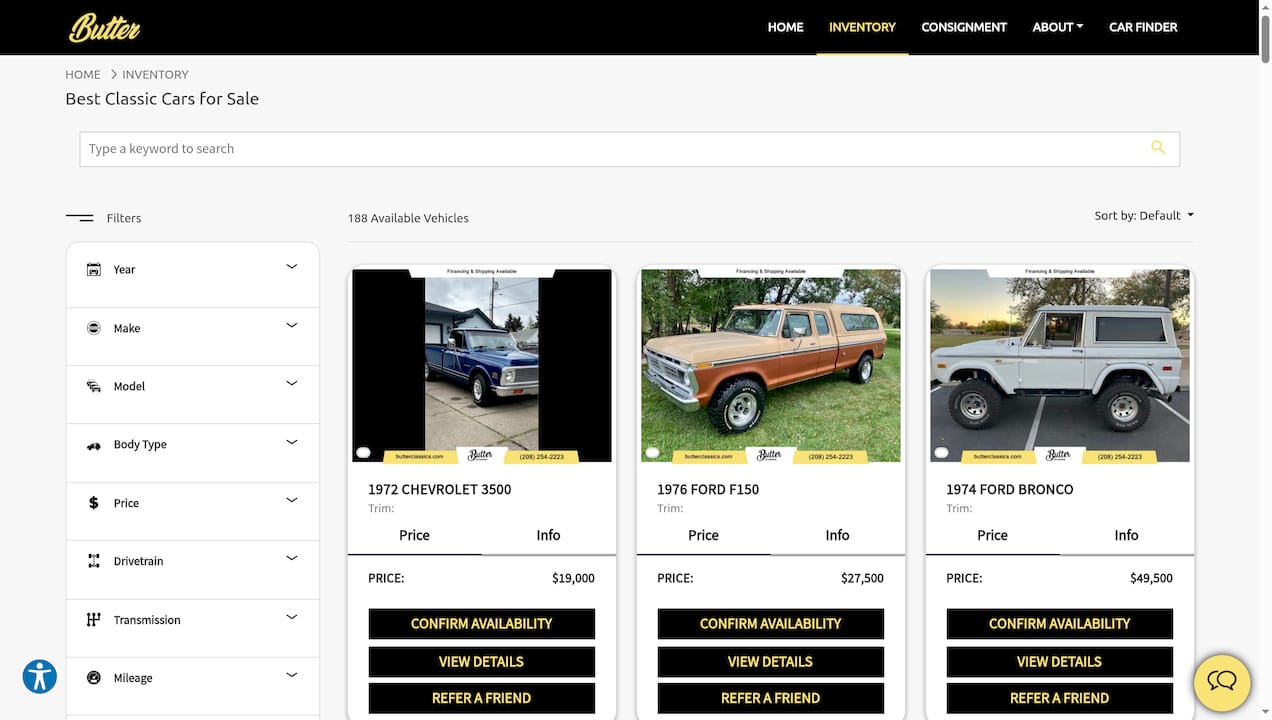
Start by browsing the current inventory filtered by price and body style, whether you're after a truck, a Bronco, or a muscle car project. If you already know the general type of build you want, the Car Finder tool narrows the search for you. And if your plan involves selling a finished restoration to fund the next one, our consignment page walks through how that works. Run financing pre-qualification on your next candidate before you make an offer. It costs you nothing to check and it puts you in a stronger negotiating position the moment you find the right car.
Sources
- Financing a Classic Car: What Are My Options? | SoFi
- Classic Car Restoration Loans: Ultimate Guide 2026 - SuperMoney
- Shop auto loan financing | Consumer Reports