A pre-purchase inspection (PPI) is when an independent expert goes over a classic car before you pay, and it is the best money you will spend on the whole deal. A good one checks for rust, hidden bodywork, frame damage, mechanical problems and whether the car is really what the seller says it is. It also gives you something solid to use in price talks. Below, we cover what to ask for, what it costs, how to find an inspector, and where a history report fits in.
TL;DR
- A classic car PPI should cover body and paint, frame and undercarriage, engine and drivetrain, electrical, authenticity (VIN and component codes) and paperwork.
- Budget roughly $150 to $600 for a typical inspection, more for a rare car or a marque specialist who has to travel.
- Hire someone who knows your make and era, not a general used-car shop, and never use an inspector the seller picked.
- A Carfax-style report is no substitute: it only shows what was reported, and many classics predate the standard 17-character VIN.
- Inspect first, negotiate second, pay last.
Table of Contents
- What a classic car PPI actually covers
- A classic car inspection checklist you can use yourself
- What you want from the test drive
- PPI vs. Carfax for classic cars
- What a classic car inspection costs
- How to find and book a qualified inspector
- Special cases: trucks, 4x4s and specific models
- What we do differently: our view
- Shop with the inspection already on your mind
- Before you pay: a final checklist
- FAQ
- Sources
What a classic car PPI actually covers
A modern used-car check leans on computer codes and recall data. A classic has none of that. The inspector uses eyes, hands, a lift, a magnet and a paint gauge, plus a lot of experience with how old cars fail.
A solid classic inspection covers these areas:
- Body and paint: rust, filler, mismatched panels, uneven gaps, repaint overspray.
- Frame and undercarriage: rot, cracks, bent or repaired rails, patched floors.
- Engine and drivetrain: leaks, compression or running condition, transmission, rear end, driveshaft.
- Suspension, steering and brakes: worn bushings, play in the steering, brake condition.
- Electrical: lights, gauges, switches, wiring that has been spliced or hacked.
- Authenticity: VIN, body tags, engine and transmission codes, build records.
- Paperwork: title history, service receipts, restoration records.
That list matches what a classic and collector inspection form lays out: body rust and filler, frame and undercarriage, VIN and component codes, build records, mechanical and electrical systems, title history and restoration records.
It also tells you what the inspection can't do. An inspector can say what he sees and hears on the day. He can't promise nothing will break next month. Think of the report as a snapshot, and a very useful one.
A classic car inspection checklist you can use yourself
You should walk the car yourself before you hire anyone. It costs nothing, and it helps you decide whether the car deserves a paid inspection at all. Our own guide to evaluating vintage car condition goes deeper. Here is the short version.
Body and paint
Start in good daylight. Look down the sides for waves, and check panel gaps at the doors, hood and trunk. Uneven gaps often point to a past hit or a poor restoration.
Bring a paint thickness gauge and a small magnet. Both are standard tools for finding filler, and the inspection form above uses a paint gauge along with a magnet test for exactly this. A magnet that stops sticking on a rocker panel or lower fender means plastic filler is hiding something. Check the usual rust spots: lower fenders, rocker panels, door bottoms, trunk floor, and the corners around the windshield and rear glass.

The vintage car care checklist from a mobile dent repair company is a handy read if you want to judge whether small dings and bumper blemishes are a cheap fix or a sign of something bigger.
Frame and undercarriage
Get the car on a lift if you can. If not, bring a bright flashlight and a mat. Look for flaking, fresh undercoating that hides something, weld seams that look new, and cracks near suspension mounts. A shiny top half with a tired underside is a red flag.
Engine and drivetrain
Check fluids, belts and hoses. Look for oil seeping from gaskets and seals. Cold starts tell you more than warm ones, so ask the seller not to run the car before you arrive. Smoke at startup, hard starting or rough idle are all worth writing down.
Electrical and interior
Test every light, the wipers, the heater, the horn and every gauge. Old wiring causes more headaches than most buyers expect. Look under the dash for a rat's nest of added wires. Check the seats, headliner and carpet for water stains, which often mean leaks.

For a broader, general-purpose list, this car inspection checklist covers the basics of what a shop looks at on any vehicle, and it works as a starting point before you add classic-specific items.
Originality and records
Match the VIN on the title to the VIN on the car. Look at body tags and engine stamps. If the seller says "numbers matching," learn what that means for your model first. Our guide to verifying numbers matching classic cars explains how to do it before you pay.
Ask to see the title and service receipts. As Popular Mechanics puts it, a thorough service history shows proper maintenance and verifies mileage. For a classic, restoration photos and invoices matter just as much.
What you want from the test drive
A test drive is part of any good inspection, and you should do your own even when a pro has done one. One buyer's advice quoted by Popular Mechanics is to rely mostly on the drive, listening for odd noises, steering wheel jiggle and suspension rattles.
For a classic, add a few things:
- Test the brakes early, at low speed. Hagerty suggests seeing how far the pedal travels before the brakes engage and making sure it doesn't sink to the floor.
- Does the car track straight? Does it wander or pull?
- Does the transmission shift cleanly, and does the clutch engage smoothly?
- Does the temperature gauge stay steady after 15 to 20 minutes?
- Any clunks over bumps or whines from the rear end?
We wrote a full walkthrough in our classic car test drive checklist. Print it and take it along.
PPI vs. Carfax for classic cars
People ask us this a lot, and the answer is simple: they do different jobs, and for a classic the history report is the weaker tool.
A vehicle history report pulls from reported events: title records, registrations, some accident and service data. But accidents can be missed if they are not reported, and not all body shops share their data. A fender bender fixed with cash at a small shop leaves no trace.
Classics add another wrinkle. Cars built before 1981 don't carry the standardized 17-character VIN, so database matches can be spotty or absent. We cover that in our guide to the classic car history check.
| Pre-purchase inspection | History report | |
|---|---|---|
| What it checks | The physical car today | Reported records |
| Finds hidden rust and filler | Yes | No |
| Finds unreported repairs | Often | No |
| Verifies originality | Yes, with a knowledgeable inspector | Rarely |
| Works on pre-1981 cars | Yes | Limited |
| Typical use | Final decision before payment | Early screening |
Autoweek's advice is to take a test drive and get a pre-purchase inspection, your own or through a third party, alongside the report. We agree. Use the report as a cheap first filter, and the inspection as the real answer.
What a classic car inspection costs
Prices vary with the car, the inspector and how far he has to drive. In our experience across U.S. buyers, a typical inspection lands in the range we outline in our guide to classic car inspection costs: about $150 to $600. A rare or complex car, or a marque specialist who has to travel to reach it, can cost more.
What moves the price:
- Depth: a basic walk-around and test drive costs less than a lift inspection with photos and a written report.
- Rarity: a one-of-a-kind car needs a true specialist.
- Distance: travel time and fuel get added to the bill.
- Extras: compression or leak-down tests, paint thickness readings and a written appraisal.
Compare that to the stakes. Rust repair, a rebuilt engine or a respray can run into the thousands. A few hundred dollars to avoid that is cheap insurance. If the inspection finds problems, the report also becomes your leverage to lower the price or walk away.
How to find and book a qualified inspector
This part trips up a lot of buyers, especially when the car is across the country. A generic used-car inspection chain may not know the difference between a correct and a reproduction part on a 1968 muscle car. Forum veterans say the same thing: look for a classic car specialist who can tell you what parts are original and which are reproductions.
Here is a simple way to book one:
- Ask in the owners' world. Marque clubs and online forums for your model know who the trusted local specialists are.
- Call local restoration or rebuild shops. Many will do a PPI for a fee, or at least point you to someone who does.
- Pick someone near the car, not near you. The inspector needs to be where the car sits.
- Choose your own inspector. Never use one the seller recommends. You want independence.
- Agree on scope in writing. Ask for photos, a lift check, a test drive and a written report.
- Get the seller's OK. Reasonable sellers let a buyer's inspector look. If a seller refuses, treat that as information.
- Ask for the report before you wire money. Then decide.
When a buyer can't make the trip, Hagerty's buying advice is to send someone you trust who knows cars to look at the car in your place.
Special cases: trucks, 4x4s and specific models
Some vehicles have their own weak points. Early Broncos and old 4x4s hide frame rust and tired drivetrains. Muscle cars may have swapped engines or cloned trim. Our model-specific guides help you prepare:
- Classic 4x4 buying guide, with cost traps to watch for.
- Chevelle SS inspection checklist for 1968 to 1972 cars.
- BMW E30 buyer's guide for what to check before you buy.
If you are buying a show car, expectations change. According to Hagerty's inspection basics, a show-bound car should have pristine condition and original equipment and specifications. A driver can wear its age. Tell your inspector which one you want, so he grades the car against the right standard.
What we do differently: our view
We see a lot of classic cars, and the biggest buying mistakes are almost always the same. Buyers fall for photos, skip the inspection because the price felt like a bargain, and find rust a month later. We would rather you be a little slower and a lot happier.
That is why we build our listings around detail: lots of photos, clear specs and straight answers about condition. It is also why we promote our Butter Certified vehicles and our Worry Free Guarantee. We believe a buyer should feel confident, and that confidence comes from information. Even so, we never mind when a buyer wants an independent set of eyes on a car. A good car holds up to a second look.
Our rule of thumb: get the paperwork first, a pro's inspection second and a test drive in between. If all three line up, you can relax and enjoy the car. If one doesn't, you have found out cheaply.
— Tony
Shop with the inspection already on your mind
We list classic cars, vintage trucks, muscle cars and 4x4s from across the country, so you aren't limited to one lot. Every listing has detailed photos and specs to help you decide which cars deserve a closer look. When you find one, you can ask us about test drives, quotes and financing pre-qualification, and we will help you set up your inspection plan.
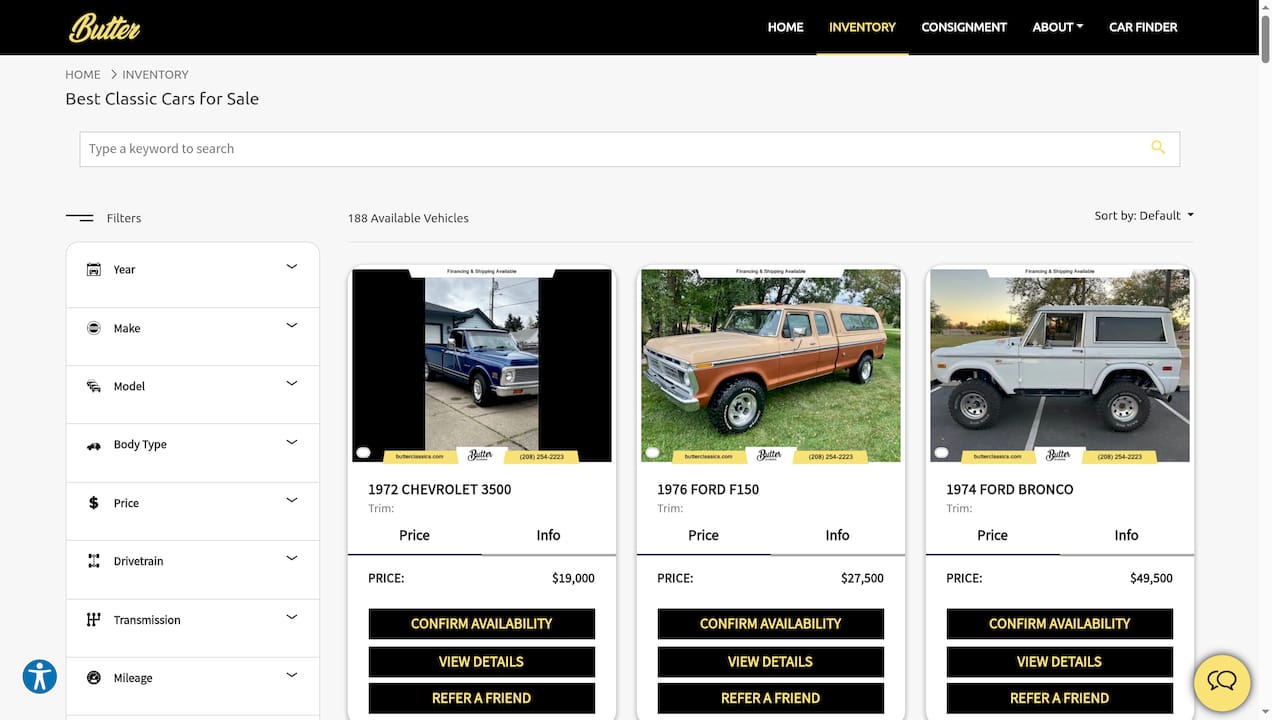
Browse our classic car inventory and pick the one you want to look at in person. Selling instead? You can also consign your vehicle with us.
Before you pay: a final checklist
Put it all together before you send a dollar:
- You have walked the car or had a trusted person do it.
- The VIN and tags match the title and the paperwork.
- You have seen service receipts and restoration records.
- An independent specialist has inspected the car and given you a written report.
- You have done your own test drive.
- Any issues are priced into the deal or fixed by the seller.
- You know what the car is worth and what you are willing to pay.
If you also need a sense of what a dealer reviews on their side, our explainer on the dealer inspection checklist for classics shows it. Selling a car you own now? The trade-in evaluation checklist shows how a buyer will look at yours.
FAQ
Is a pre-purchase inspection worth it for a classic car?
Yes, almost always. Classics hide rust, filler and old repairs that photos and history reports won't show. A few hundred dollars is small next to a bill for frame or body repair.
Can I do the inspection myself?
You can do a good first pass with a flashlight, a magnet and a checklist. For a high-value or rare car, still hire a specialist who knows the model. He will spot things you would not know to look for, like incorrect parts or odd weld seams.
Should I trust a Carfax report on a classic?
Use it as an early filter only. Reports show what was reported, and unreported accidents or repairs won't appear. Pre-1981 cars also lack standard 17-character VINs, so records can be thin.
How long does an inspection take?
Plan on a couple of hours for a thorough one, including a lift check and a test drive. Complex or rare cars can take longer. Ask your inspector for a time estimate when you book.
What if the seller won't allow an inspection?
Take it seriously. A seller with nothing to hide usually welcomes one. If the answer stays no, we suggest walking away and looking at the next car.
Sources
- How to Buy a Used Car Without Getting Burned, Popular Mechanics
- Classic and Collector Inspection Form
- Collector Vehicle Inspection Basics, Hagerty
- What to Know Before Inspecting Your Classic Car, Hagerty
- How to Buy a Collector Car, Hagerty
- Be Vigilant When Purchasing Vehicle History Reports, Autoweek
- Buying a classic car discussion, Bogleheads forum