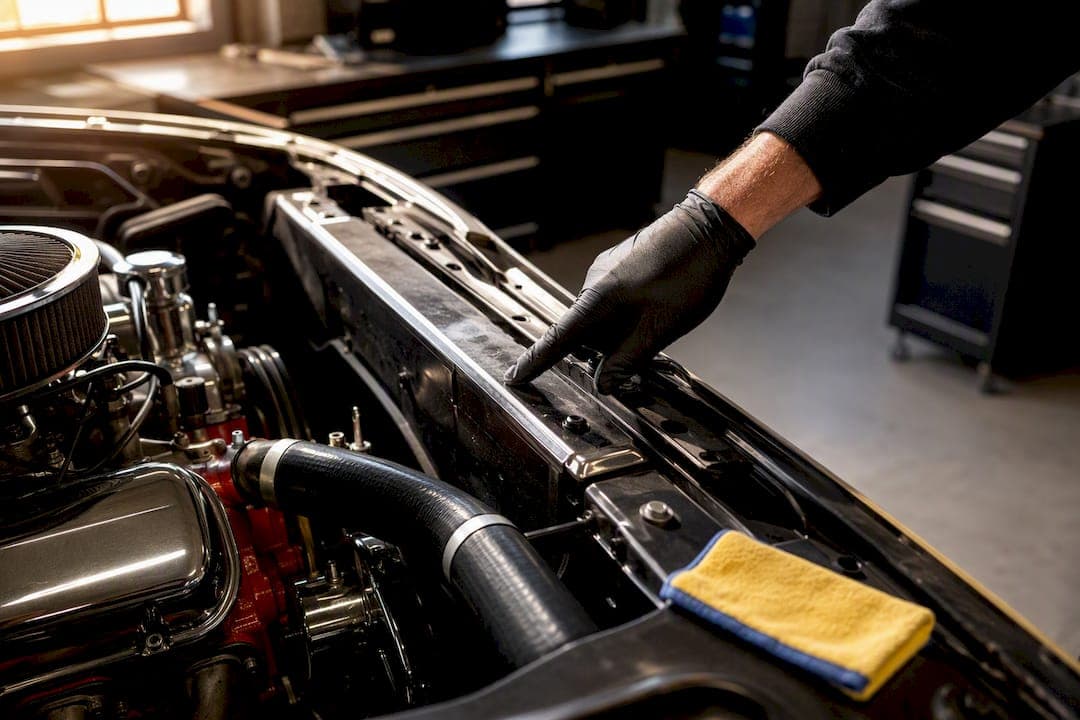
If you want the highest collector value in a 1968-72 Chevelle SS, target a 1970 LS5 or LS6 454. If you want value and a lower entry price, look at 1968 or 1972 models instead. Either way, the rule stays the same: verify authenticity and structural soundness before you fall in love with the paint. Confirm the VIN and build sheet match, then schedule a pre-purchase inspection before a single dollar changes hands.
TL;DR:
- A 1970 Chevelle SS with LS6 or LS5 engines commands a premium, but lower-cost options are available with 1968 or 1972 models if originality is less critical.
- Verifying authenticity through VIN, build sheet, and Protect-O-Plate is essential, as many cars are clone or modified and look similar externally.
- Rust typically appears first in floor pans, torque boxes, inner wheelhouses, and around rear windows, making thorough inspection in these areas vital.
- A comprehensive pre-purchase inspection covering engine, suspension, brakes, electrical, and body is crucial and can save thousands in future repairs.
- Auction and sales data set market expectations, but condition and documentation ultimately determine the real value of a Chevelle SS.
Table of Contents
- Chevelle SS Buying Guide: Which Years and Engines to Target
- How Do You Verify a Chevelle SS Is Authentic?
- Where Do Chevelle SS Cars Rust First?
- What Should Be on Your Chevelle SS Inspection Checklist?
- How Much Should You Pay for a Chevelle SS?
- Negotiating and Closing the Deal Safely
- How Butter Classics Helps You Buy With Confidence
- What I've Learned From Years of Chevelle Inspections
- Ready to Find Your Chevelle SS?
- Sources
- FAQ
Chevelle SS Buying Guide: Which Years and Engines to Target
Every Chevelle SS buying guide worth reading starts with the same question: which year actually matters? The honest answer is that 1970 sits at the top of the pile, and it's not close. That year brought the LS5 (360 horsepower) and the legendary LS6 (450 horsepower) 454 big blocks, and both remain the benchmark for collector demand. Hagerty's buyer's guide identifies 1970 as the single most sought-after year in the whole 1968-72 run, largely because the LS6 had such a short production window and such a specific cultural moment behind it.
That desirability comes at a price. A documented, numbers-matching 1970 SS 454 will cost you a premium over a comparable 1968 or 1972 car, with pricing varying depending on condition and options. If your goal is ownership rather than investment, that premium may not be worth chasing.
Here's how the trade-offs typically shake out:
- 1968 SS396: the first year of the second-generation Chevelle, with cleaner lines and lower demand than 1970, which usually means a friendlier price for a driver-quality car.
- 1969 SS396: a transitional year, mechanically similar to 1968 but with more available options; values sit in a similar range to 1968.
- 1970 SS396/SS454: the peak year for both performance and collector interest, with the LS6 454 as the crown jewel.
- 1971 SS454: horsepower ratings dropped due to lower compression, but the SS package and body style carried over, keeping it a solid middle-ground buy.
- 1972 SS: the last year of this body style before GM's emissions and safety changes reshaped the muscle car market, often the most affordable entry point into a genuine SS.
Engine codes move price more than almost anything else on the build sheet. An L34 396 (350 horsepower) or L78 396 (375 horsepower) commands more than a base small block, and the LS5 or LS6 454 sits well above both. Cowl induction hoods, four-speed manual transmissions, and factory bucket seat interiors with console shifters also push values up, sometimes by thousands, because they're harder to fake convincingly and buyers know it.
How Do You Verify a Chevelle SS Is Authentic?
This is where a Chevelle SS buying guide earns its keep, because the SS badge alone tells you almost nothing. GM built plenty of cosmetic SS clones over the decades, and some are convincing enough to fool a casual look. Verifying the VIN, the Fisher body plate, and the original build sheet is the only reliable way to separate a genuine SS from a well-dressed impostor.
Work through these steps before you take anyone's word for it:
- Locate the VIN plate. On 1968-72 Chevelles, it sits on the driver's side dash, visible through the windshield. The fifth character in the sequence should decode to an SS-specific engine code.
- Find the Fisher body tag. This is usually on the firewall or cowl area under the hood. It lists the body style, trim, paint code, and build date, and it should align with the VIN's model year and plant.
- Request the original build sheet. These thin paper sheets were often tucked under the seat springs or in the gas tank at the factory and occasionally survive decades later. A build sheet lists every factory-installed option, which is nearly impossible to fake convincingly.
- Ask for the Protect-O-Plate. This small metal card, given to original owners, confirms VIN, engine, and warranty details in one document.
- Cross-check engine and transmission stampings against the VIN. Numbers that don't match aren't automatically disqualifying (many original engines were swapped decades ago) but they change what you should be paying.
- Look for aftermarket cosmetic add-ons like reproduction cowl hoods, incorrect stripe kits, or SS badging bolted onto a base Malibu. These are the calling cards of a dressed-up clone.
A genuine SS with incomplete paperwork isn't worthless, but it should never command a numbers-matching premium. Most surviving Chevelle SS cars have been modified over the past five decades, so a fully original, documented example is genuinely rare, and that rarity is exactly why paperwork matters more than polish.
Where Do Chevelle SS Cars Rust First?
Rust is the silent killer of Chevelle SS values, and it hides in predictable places. MotorTrend's buying advice puts rust inspection ahead of nearly everything else, and for good reason: cosmetic issues cost money, but structural rust costs money and safety.
Check these zones specifically, not just a glance at the rocker panels:
- Floor pans and trunk floor, especially around the seams where carpet and trunk liner hide early corrosion.
- Torque boxes, the structural boxes behind the front wheels that anchor the front suspension. Failure here affects handling and safety, not just looks.
- Inner wheelhouses and quarter panel lower sections, common spots for bubbling paint that signals rust underneath.
- Rocker panels and door bottoms, easy to patch badly and easy to spot if you look for wavy metal or mismatched texture.
- Rear window and windshield channels, where trapped moisture eats away at sheet metal for years before it shows.
A vinyl roof adds another layer of risk. Moisture trapped under vinyl trim attacks the roof turret and rear pillars from the inside out, and by the time you see bubbling, the metal underneath is often already compromised. Budget accordingly if the car you're looking at has a vinyl top and any visible bubbling near the pillars.
Watch for poor welds, visible body filler (a magnet won't stick over filled areas), mismatched sheet metal thickness, and overspray on rubber trim or door jambs. These are the fingerprints of a rushed repair.
Pro Tip: Bring a small refrigerator magnet to any in-person inspection. It won't catch every repair, but a magnet that won't stick to a rocker panel or quarter panel is telling you something the seller isn't.
What Should Be on Your Chevelle SS Inspection Checklist?
A proper pre-purchase inspection checklist covers five systems, and skipping any one of them is how buyers end up with expensive surprises. This is the core of any serious Chevelle SS buying guide, and it's worth writing down before you ever see the car in person.
- Engine and drivetrain. Check compression across all cylinders, oil pressure at idle and under load, and look for leaks at the rear main seal, valve covers, and intake. Blue smoke on startup suggests worn valve seals; white smoke suggests a coolant issue. Compare engine and transmission casting numbers against the VIN to understand whether you're looking at original components or a later swap.
- Suspension and steering. Excessive play in the steering wheel, clunking over bumps, or uneven tire wear point to worn bushings, tie rods, or ball joints. Check shock and spring condition, since sagging rear springs are common on cars that have sat for years.
- Brakes. Inspect pad thickness, rotor or drum condition, and brake lines for rust or cracking. Soft pedal feel often means air in the lines or a failing master cylinder.
- Electrical system. Test the charging system under load, check for corroded or spliced wiring under the dash, and confirm every gauge actually works. Aftermarket wiring harnesses spliced into the factory system are a common shortcut and a fire risk if done poorly.
- Interior and body fit. Check seat pan floors for rust (a frequent spot beneath worn carpet), inspect the dash for cracks, and check door and trunk fit for gaps that suggest previous collision repair or welding.
- Documentation and history. Ask for a clean title with no salvage or flood brands, request service records, and search for prior auction listings that might reveal condition details the seller left out.
Buyers commonly underbudget for the mechanical work a Chevelle SS needs right after purchase, and a professional pre-purchase inspection typically runs $150 to $600 depending on scope. That's a small price against a five- or six-figure purchase. If the seller resists a third-party inspection, resists letting you check the VIN against the body tag, or can't produce a title matching the seller's name, walk away. Those aren't negotiating points; they're reasons to find a different car.
How Much Should You Pay for a Chevelle SS?
Price in this market swings hard based on documentation, originality, and condition, which is exactly why auction and sales data matter more here than in most classic car categories. Two visually similar 1970 SS454s can differ by tens of thousands of dollars once you factor in whether the engine is original, whether the build sheet survived, and whether it's a coupe or a convertible.
Rough value bands look like this across the 1968-72 range:
- Driver-quality cars with some repaint, minor rust repair, and a non-original engine sit at the entry point of the market.
- Good condition cars with solid original sheet metal, correct drivetrain, and decent but not concours paint occupy the middle tier.
- Show-quality, numbers-matching cars, especially 1970 LS6 454s and any documented convertible, command the steepest premiums and the most bidding competition at auction.
Convertibles across all five years carry a meaningful premium over coupes simply because far fewer were built. LS6-powered cars sit in a category of their own given how limited that production run was.
Auction results are useful reference points, but they're not gospel. A single high-profile sale of a perfect LS6 convertible doesn't set the market price for a driver-quality SS396 coupe. Use auction data as a ceiling reference and let condition and documentation set your actual offer.
Budget beyond the purchase price too. Safety-related repairs (brakes, suspension, wiring) should come before cosmetic restoration work, and that order matters more than most first-time buyers expect.
Negotiating and Closing the Deal Safely
Come to the table with specific questions: how long has the seller owned it, do they have the build sheet or Protect-O-Plate, has it ever been in a collision, and is the title clean and in their name? Vague or shifting answers to any of these are worth treating as red flags.
- Insist on a pre-purchase inspection before finalizing price, not after.
- Use an escrow service or staged deposit for long-distance purchases rather than wiring the full amount up front.
- Confirm shipping logistics and timing before you send any deposit.
- Get the title, bill of sale, and any factory documentation transferred at the same time you complete payment.
Pro Tip: Never let a seller talk you out of a PPI by claiming "it's already sold as-is" or "there's another buyer waiting." A real seller with nothing to hide will wait a few days for an inspection.
How Butter Classics Helps You Buy With Confidence
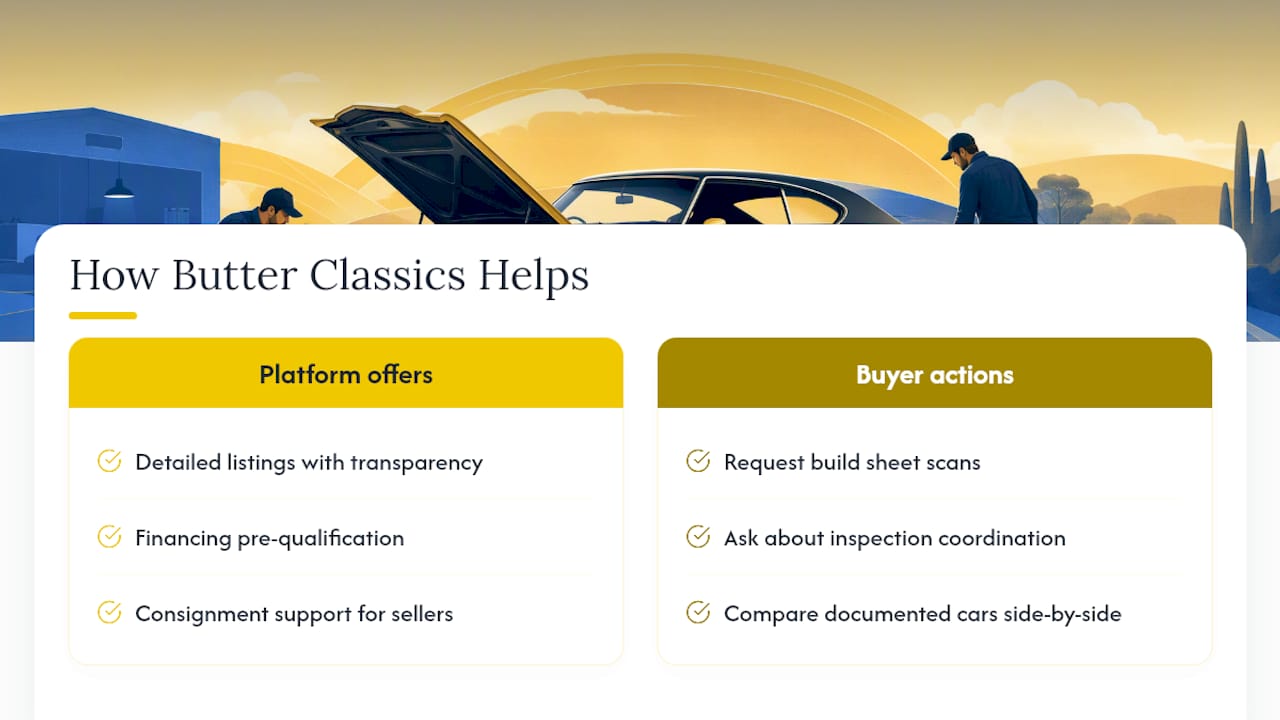
Butter Classics built its inventory around the kind of transparency this guide recommends: detailed listings, financing pre-qualification, and consignment support for sellers who want their car properly documented before it goes to market. When you're evaluating a Chevelle SS, you can request build sheet scans, ask about inspection coordination, and use the platform's tools to compare documented cars side by side instead of guessing from a handful of photos.
What I've Learned From Years of Chevelle Inspections
Buyers consistently over-index on paint and under-index on paperwork. A flawless respray tells you nothing about the torque boxes underneath it, but a build sheet tells you everything about what the car actually was in 1970. I've watched buyers walk past a rough-looking, fully documented SS454 to chase a shinier clone. Paint fades. Documentation doesn't.
— Tony
Ready to Find Your Chevelle SS?
You've got the checklist. Now you need a car worth running it against. This marketplace provides features that many private-party listings don't: documented inventory, financing pre-qualification, and consignment sellers who understand that buyers like you actually check the build sheet.
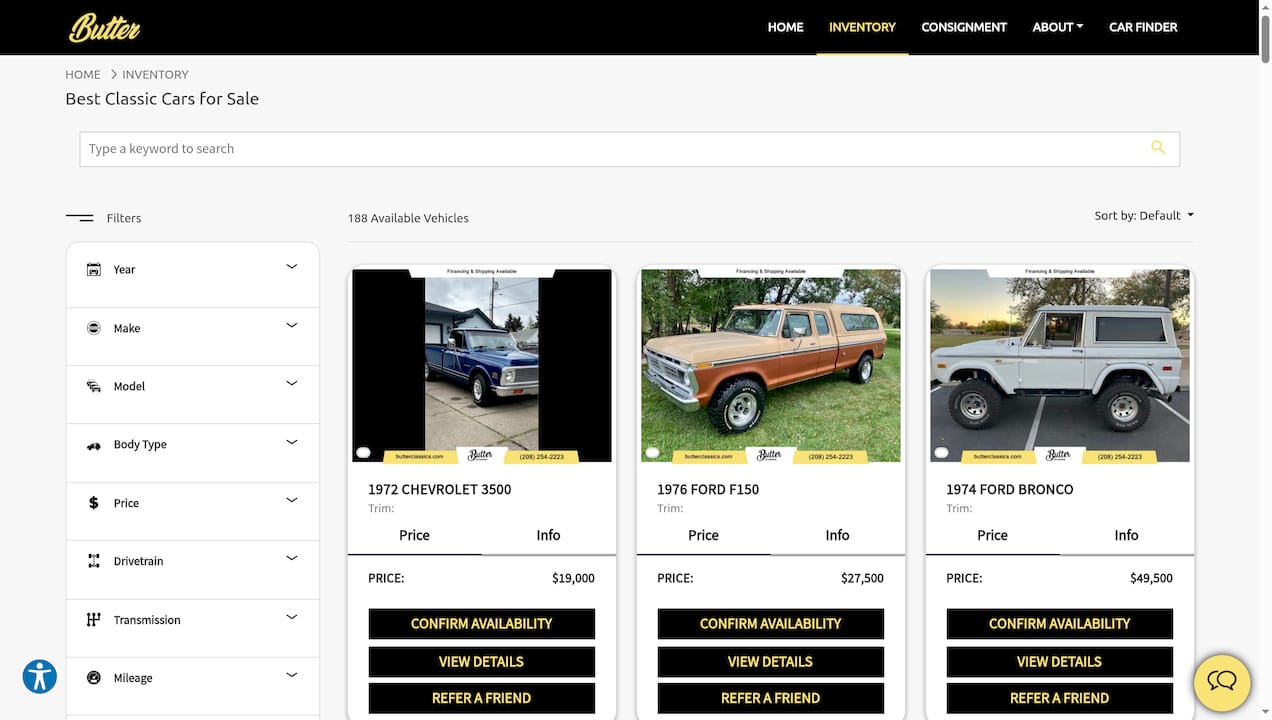
Start by browsing the current inventory for Chevelle SS listings with documented history, then request build sheet or Protect-O-Plate scans directly from the seller before you commit to a viewing. If you know the exact year, engine, and body style you want, the car finder tool can narrow the search instead of you scrolling through cars that don't match your criteria. And whichever car you land on, treat inspection as non-negotiable. A comprehensive pre-purchase inspection costs far less than discovering torque box rust after the title's already in your name. This marketplace is a platform, not a guarantee. Your paperwork and your inspector are still doing the real work here.
Sources
- Your definitive 1968–72 Chevelle SS buyer's guide
- Tips and Tricks on How to Buy a Chevelle
- Chevrolet Chevelle SS: Buyer's Guide UPDATED 2026
FAQ
Which Year Is Considered the Best to Buy a Chevelle SS?
1970 is generally considered the best year for collector value, thanks to the LS5 and LS6 454 engine options, though 1968 and 1972 offer lower entry prices for buyers who prioritize value over investment potential.
What Are Some Common Problems With Chevelle SS Cars?
Rust in the floor pans, torque boxes, and inner wheelhouses is the most frequent structural problem, alongside mismatched engine or transmission numbers on cars that have been swapped or modified over the decades.
Is a Chevelle SS a Good Investment?
A documented, numbers-matching Chevelle SS, especially a 1970 LS6, has historically held or gained value, but condition, paperwork, and originality drive that outcome far more than the SS badge alone.
How Can I Tell if a Chevelle SS Is a Clone?
Cross-check the VIN, Fisher body plate, and build sheet together rather than relying on badges or stripe kits, since cosmetic clones are common but rarely survive a full paperwork and stamping cross-check.
What Should I Budget for a Pre-Purchase Inspection?
A professional inspection typically runs $150 to $600 depending on scope, and it's one of the few expenses in this process that consistently pays for itself.