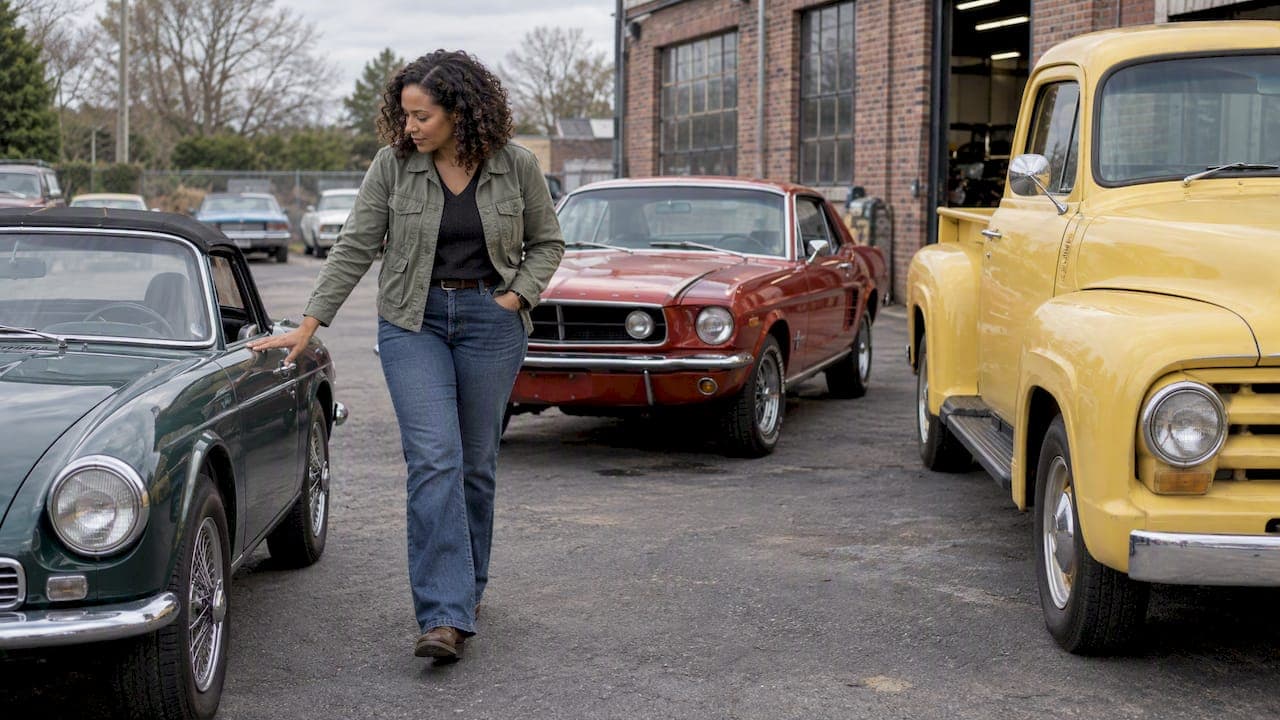
Classic car prices fall into four rough tiers: starter cars under $10,000, enthusiast cars from about $10,000 to $50,000, serious collector cars from $50,000 into the low six figures, and a top tier where rarity and provenance set the price. Those lines are blurry. Condition can move one car across two tiers. This guide shows what each tier gets you, what to watch for, and how to avoid paying top-tier money for a middle-tier car.
TL;DR
- Many usable classics sit below $10,000, and popular models often run $10,000 to $50,000.
- Condition matters as much as the model. A #3 "Good" car and a #1 "Concours" car of the same model can be worlds apart in price.
- "Investment grade" describes desirability, not a promise the car will go up in value.
- The top tier is driven by rarity, provenance and competition between buyers. Headline sales are outliers, not appraisals for your restored Mustang.
- Budget for insurance, storage, transport and upkeep on top of the purchase price.
Table of Contents
- Why price tiers help before you shop
- Tier one: entry-level classics under $10,000
- Tier two: enthusiast classics from $10,000 to $50,000
- Tier three: collector cars from $50,000 up
- Tier four: blue-chip and trophy cars
- Condition: the multiplier inside every tier
- Our perspective: buy the tier you will actually enjoy
- The costs that sit on top of the price tag
- How Butter Classics can help
- A quick way to place any car in a tier
- FAQ
- Sources
Why price tiers help before you shop
A classic car search can feel like a maze. A 1960s coupe might be $12,000 or $120,000, and both can be "for sale" the same afternoon. Tiers give you a first filter. Pick the tier that fits your budget and goals, then dig into the models inside it.
We use four tiers in this guide. They are our own working framework, not an official industry standard, and the dollar lines move with the market. Use them to get oriented, then check current numbers for the exact year, trim and engine you want.
| Tier | Typical range | Who it fits | What drives the price |
|---|---|---|---|
| Starter | Under $10,000 | First-time buyers, weekend tinkerers | Parts availability, condition, mass production |
| Enthusiast | About $10,000 to $50,000 | Drivers who want a nice car to use and show | Model popularity, options, restoration quality |
| Collector | About $50,000 to low six figures | Serious collectors, long-term holders | Performance packages, documentation, originality |
| Blue chip and trophy | Well into six figures and beyond | Investors, museum-level collectors | Rarity, provenance, competition history |
Tier one: entry-level classics under $10,000
This is where most people start, and it is a good place to be. Hagerty notes that many hatchbacks and two-door convertibles from the era can still be picked up for less than $10,000.
Progressive's starter-classics guide gives model-specific examples. First-generation Miatas can be found under $10,000, and Camaro IROC-Z examples commonly land between $8,000 and $20,000. Those are examples, not a universal price floor. A tired car of a desirable model can cost more than a clean car of a forgettable one.

What you are really buying at this level
At this price you are usually buying a driver, not a showpiece. Expect age-related flaws. Expect to spend some money after the sale. The upside is real: parts are often easy to find, repairs are forgiving, and you learn what you like without risking a fortune.
Hagerty also flags the things first-timers should weigh: parts availability, safety tradeoffs compared with a modern car, and reliability. A 40-year-old car does not have modern airbags or stability control. Decide that with your eyes open.
How to shop this tier
- Pick one or two models and learn their weak spots.
- Look for the best-condition car you can afford rather than the cheapest one.
- Budget for fresh tires, brakes, fluids and the small things that always turn up.
- Get an independent inspection when you can't see the car in person.
Our guide to evaluating vintage car condition before you buy walks through what to look at on a walkaround.
Tier two: enthusiast classics from $10,000 to $50,000
This is the busiest part of the market. It is where muscle cars, vintage trucks, Broncos and classic Corvettes show up in numbers, and where good-condition cars start to look special.
Progressive cites good-condition classic Corvettes at about $15,000 on average, while restored 1960s examples run $30,000 to $50,000 depending on history, rarity and engine size. That one model spans a large part of the tier, which shows how much the details matter.

A real data point
Hagerty's valuation tool is a handy reality check. As of October 2026, it shows a 1968 Ford Mustang coupe with the 289 V-8 at a Price Guide value of $34,500 in #3 Good condition, with a range of $29,200 to $37,933. That is a classic sitting in the middle of the enthusiast tier. Values change, so check the current figure for your exact car.
What moves a car up or down
Within this tier, three things separate a $20,000 car from a $45,000 one:
- Engine and drivetrain. Original big-block or performance engines, and the right transmission and rear axle, carry a premium. Factory options often decide muscle car value more than paint does.
- Originality versus restoration. A well-done restoration costs real money, and an unrestored survivor has its own appeal. We cover the tradeoff in original vs. restored classics.
- Paperwork. Build sheets, service records and ownership history make a car easier to price and easier to resell.
Tier three: collector cars from $50,000 up
Here a car stops being just a nice classic and becomes a collectible. Buyers in this tier are paying for specific attributes: a rare performance package, a special paint code, a limited interior, documented history. A base car in great spec can sometimes outpace a better-known model in a dull spec.
This is also where "is it correct?" gets expensive. Wrong carburetor, replaced numbers-matching engine, repainted in a non-original color: any of those can take thousands off the price. If you are new to the tier, read what makes a car collectible and our definition of a collector car.
Tier four: blue-chip and trophy cars
The top tier is not just a pricier version of the tiers below. Exceptional rarity, documented provenance, competition history, originality and buyer competition drive it. Sports Car Market's Pocket Price Guide ranks cars from A to D on desirability. A-grade cars combine style, performance, historical significance, rarity and competition history. Its A-grade examples include the Ferrari 250 GT SWB, the Mercedes-Benz 300SL and the 1963 Chevrolet Corvette Z06.
The record books sit far above that. Autocar reports that the 1955 Mercedes-Benz 300 SLR Uhlenhaut Coupé sold for $135 million in 2022. That is a one-of-a-kind outlier. Don't use it, or anything like it, to guess what a restored classic is worth.
Want the definition of this top end? See our explainer on blue chip classic cars.
Investment grade is not a guarantee
Sports Car Market is clear that "investment grade" is a desirability ranking, not a forecast. A desirable car can still lose money once you count purchase, restoration, storage, insurance, transport, auction fees and selling costs. If you are thinking about returns, our classic car vs. stock market comparison and what makes a car investment worthy lay out the tradeoffs. Talk to a licensed financial adviser before you treat a car as part of your retirement plan.
Condition: the multiplier inside every tier
A price tier tells you the neighborhood. Condition tells you which house you are looking at. Hagerty grades condition on a 1 to 6 scale, where lower is better:
- Concours: flawless and almost never seen outside major judged shows.
- Excellent: like new.
- Good: a presentable driver with minor age-related flaws.
- Fair: visibly deteriorated but generally running.
- Project car: needs serious work.
- Parts: valuable mainly for its components.
Most enthusiast-owned cars are closer to #3, which can look great from 10 feet and show age up close, according to Hagerty. Sellers often rate their own cars higher than a buyer would. The practical rule is simple: don't pay #1 money for a #2 or #3 car.
So a $40,000 car can be a strong driver or a poor project, depending on condition, originality, options, provenance and documentation. The model year alone doesn't tell you.
Our perspective: buy the tier you will actually enjoy
We see the same mistake again and again. Buyers stretch for a higher tier, then can't afford to drive the car, insure it properly or fix the first surprise. A clean car one tier down is almost always the happier purchase.
Here is how we think about it at Butter Classics:
- Start with how you'll use it. Weekend cruises and car shows call for a different car than a long-term hold.
- Look at the whole picture. Photos, specs and history should all line up. That is why we focus on detailed listings with plenty of photos.
- Don't chase the headline. The big auction numbers are exciting, but they say little about the car in your price range.
- Plan the ownership costs. The price tag is the entry fee, not the total.
If you have a car to sell, the same logic runs in reverse. A fair price starts with an honest read on condition and originality.
— Tony
The costs that sit on top of the price tag
The purchase price is only the first line. Plan for transport, registration, storage, insurance and maintenance.
Insurance
Classic-car insurance can cost less than a regular daily-driver policy, but only if the car qualifies. State Farm's Classic+ program offers agreed-value coverage on vehicles that aren't driven daily. Its eligibility example calls for a car at least 10 years old, or a replica of one, in good or better condition unless it is under active restoration. It also has to be used on a limited basis, and it can't be your primary vehicle.
The lower rate comes with those restrictions. If you plan to commute in your classic, don't assume a classic policy will apply. Check with your insurer before you buy. For more, read about agreed value coverage and appraisals and agreed value vs. stated value.
Maintenance
Older cars need regular attention, and the bill grows with the tier. European and high-performance cars tend to cost more to keep running. A look at Porsche maintenance costs gives a feel for the yearly budget a performance car can need. Set aside money before you buy, not after the first repair.
Detailing and storage
Paint and chrome hold value when they are cared for. Keep the car garaged, covered or climate controlled if you can. Good storage protects both your investment and your insurance eligibility.
How Butter Classics can help
If you are ready to shop, you can browse our classic car inventory by price or type, from vintage trucks and muscle cars to Broncos, Mustangs and Corvettes. Our listings include detailed specs and extensive photos, so you can compare cars across tiers without guessing. Not sure what to look for? Try our Car Finder. If you need help paying for a car, financing pre-qualification is available.
Selling instead? You can consign your vehicle with us and reach buyers nationwide. Pricing your car at the right tier from day one is the fastest way to a clean sale.
A quick way to place any car in a tier
When you spot a car you like, run through these five checks:
- Find the model-and-trim value. Use a price guide for the exact year, engine and body style.
- Grade the condition honestly. Use the 1 to 6 scale and assume the seller is a notch optimistic.
- Check the options. Engine, transmission, axle and special packages matter more than people think.
- Ask for paperwork. Documentation can make a car easier to price and easier to resell.
- Add ownership costs. Include insurance, storage, upkeep and transport before you decide.
If the car clears those five checks, you have a number you can defend, and that is what keeps you from overpaying in any tier.
FAQ
What is the least expensive classic car?
There is no single cheapest classic, because price depends on model and condition. Many usable classics sell for under $10,000, including first-generation Miatas. Shop for the best condition you can afford, since fixing a cheap car can cost more than buying a better one.
Is classic car insurance less expensive?
Often, yes, but it depends on the insurer, driver, storage, mileage, condition and agreed value. The lower price comes with limits on how you use the car, and it usually can't be your daily driver. Ask your insurer about eligibility before you buy.
What does "investment grade" mean?
It is a desirability ranking. According to Sports Car Market's guide, A-grade cars combine style, performance, rarity, historical significance and competition history. It does not promise the car will rise in value.
How much does condition change a classic's price?
A lot. A #1 Concours car is flawless and rarely seen outside judged shows, while a #3 Good car is a presentable driver with visible age. Avoid paying #1 prices for a car that is really a #2 or #3.
Sources
- Do Classic Cars Make Good First Vehicles? | Hagerty
- What Does a Car's Condition Really Look Like? | Hagerty
- Classic, Truck & Motorcycle Values | Hagerty Valuation Tools
- 2024 Pocket Price Guide | Sports Car Market
- The most expensive cars ever sold | Autocar
- State Farm Classic+ driven by Hagerty