
Most classic car lenders want to see a score in the high 600s or better, and that is the part you can plan for. Many specialty programs start around 660 to 670 FICO, and the stronger your score, the better your odds and the lower your rate. The score is not the whole story, though. Lenders also weigh your income, your existing debt, your down payment and the car itself.
This guide walks through what "good enough" credit looks like for a classic, what else gets reviewed, what a payment can look like, and how to check where you stand before you fall in love with a truck.
TL;DR
- Plan on a score of about 660 to 670 or higher for most specialty classic car loans. Lower scores can still get financing elsewhere, usually at higher rates.
- Credit is one piece. Income, debt-to-income ratio, down payment, the car's condition and its title all count too.
- Expect to put down roughly 10% to 20%, sometimes more for heavily modified builds.
- Prequalifying typically uses a soft inquiry, so you can learn your range before a hard pull.
- Get your numbers first, then shop. A preapproval turns you into a buyer who can move fast on the right car.
Table of Contents
- What credit score do you need for a classic car loan?
- Why the number is only part of the decision
- What a classic car loan can look like
- How old does the car have to be?
- Down payment, condition and paperwork
- Other ways to fund a classic
- Does prequalifying hurt your credit?
- How to tune your credit before you apply
- Our take
- Ready to shop with your numbers in hand?
- FAQ
- Sources
What credit score do you need for a classic car loan?
The short answer is 660 or better for the best shot. One credit union says its classic car loans require a minimum 660 score, and notes that other vehicle loan options may exist below that line. A financial-services company blog says favorable classic car rates may need 660 or higher, and that lower scores generally mean higher rates because lenders see more repayment risk.
A national loan marketplace puts the typical bar a little higher: many classic car lenders look for good credit, commonly 670 or above.
Here is how that breaks down in plain terms:
| Score range | What to expect |
|---|---|
| 740 and up | Strongest approval odds and the best rates the program offers |
| 670 to 739 | Meets the usual "good credit" bar for many specialty lenders |
| 660 to 669 | Qualifies at some lenders, with less room to negotiate on rate |
| Below 660 | Specialty programs get harder; expect a larger down payment, a different loan type or a co-borrower conversation |
Those bands are a planning guide built from the lender requirements above, not a promise. Each lender sets its own line.
Why the number is only part of the decision
The lenders in this niche say it out loud. One specialty classic car lender says no single credit score determines eligibility and that it reviews credit history, income, existing debt, down payment, loan amount and the vehicle. Another says it does not decide on score alone and looks for an established good credit history and comparable credit experience.
That is good news if your score is decent but your file is thin or unusual. It also means you can improve your odds on things other than the score:
- Debt-to-income ratio. One marketplace review lists a debt-to-income ratio below 41% among the typical requirements. Paying down a card balance before you apply can help.
- Verifiable income. Pay stubs for employees. Self-employed buyers may be asked for two years of signed tax returns and a personal financial statement, according to one lender's FAQ.
- Down payment. More cash in means less risk for the lender.
- The car. Title, condition and value all matter, which we cover below.
Our own classic car loan requirements checklist puts these items in one place so you can gather them before you apply.
What a classic car loan can look like
Specialty classic car financing is built differently from a regular used car loan. Published programs show a wide spread:
- A specialty lender reports loans from $6,000 to $2 million with terms up to 84 months, for classic or collector cars built before 2000.
- Another lender's loans run from $10,000 to $600,000 with terms up to 144 months, depending on purchase price.
- Credit unions run their own programs. One lists classic car loans at 6.75% APR for up to 48 months for cars over 25 years old, per its rate sheet effective October 1, 2025. Another lists rates as low as 8.00% APR for up to 48 months, with a $10,000 minimum loan, on its sheet effective November 1, 2026.
- A credit union that publishes a score-tiered grid lists classic rates of 10.49% to 18.00% for 36 to 60 months on cars 20 or more years old.
That last spread is the point. The same car, the same loan size, and a very different rate depending on who you are as a borrower.
What a $30,000 loan costs per month
Here are two published examples for a $30,000 loan over 60 months. They are illustrations from each lender's own page, not offers for you.
| Lender type | APR | Term | Estimated payment |
|---|---|---|---|
| Credit union, standard auto rate page (Nov. 4, 2026) | 5.54% | 60 months | $573.61, zero down, before taxes, insurance and fees |
| Credit union, classic-car rate grid | 10.49% | 60 months | About $645 |
The gap is roughly $71 a month, or more than $4,200 across the five years. That is what a few points of APR do, and why your credit profile is worth tuning before you apply. Keep in mind the first row is a regular auto rate, so classic-specific rates may sit higher.
How old does the car have to be?
Age rules decide which program you land in, and your credit gets reviewed inside that program.
- Ordinary bank and credit union auto loans often cap age. One credit union considers vehicles no older than 13 model years with under 150,000 miles. Another sets a general maximum of 15 years.
- Credit union classic programs commonly begin at 20 or 25 years. One advertises vehicles 20 model years or older, another describes classic loans as models 25 years or older.
- One credit union also accepts specialty vehicles that are at least 25 years old or unique enough to be expected to appreciate.
- A specialty lender generally finances personal-use cars and trucks built before 2000. It excludes daily drivers, commercial vehicles, race or military vehicles, LLC purchases and vehicles with fewer than four wheels.
So a 1994 pickup and a 2008 muscle car can sit in different lanes. Check the age line before you check your rate.
Once you own a high-value older vehicle, protecting its finish is part of keeping its value. If that is on your mind, read this piece on protecting a high-value car.

Down payment, condition and paperwork
Credit gets you in the door. The car and the file close the deal.
Down payment. A specialty lender generally asks for 10% to 20% down, with up to 30% possible for hot rods, kit cars and heavily modified vehicles. Our classic car down payment guide shows how to set that target.
Condition. The same lender says the car must be running, capable of being titled and not in disrepair. It does not have to be show-quality, but the interior and exterior cannot need immediate restoration. That is why a bare project is a different financing question. We cover it in project car financing for U.S. buyers.
Documents. Plan on a short stack:
- The seller's title
- A purchase agreement
- Proof of insurance naming the lender as loss payee
- Proof of your down payment
- Proof of income
- Your driver's license
Those items come from one lender's FAQ. Insurance is a bigger deal on a collector car than most people expect, so see our note on agreed value classic car insurance. On older cars, a clean title story also helps, which is where a classic car history check earns its keep.
Other ways to fund a classic
A specialty loan is not the only route, and the right one depends on your credit and the car.
- Hobby-specific financing. Built for this kind of vehicle, with terms that suit it.
- Credit union or local bank loans. Often good rates if the car meets their age rules.
- Personal loans. One guide notes that personal loans may be limited to around $5,000 in this context, and that home-equity borrowing puts your home at risk if you default.
- Unsecured collectible-car loans. A 2021 magazine report described one bank-division program of $5,000 to $100,000 with no lien on the car. Programs and rates change, so confirm the current terms.
- Leasing and refinancing. Leasing may come with mileage restrictions, according to a financial-services guide.
For a side-by-side, see classic car financing vs. a personal loan, our financing programs explained for collectors and the vintage car financing options overview. If lower monthly payments matter, there is also the classic car balloon loan.
Does prequalifying hurt your credit?
Usually not. Prequalifying typically uses a soft inquiry, and soft inquiries do not affect your credit scores. The same source adds that "prequalification" can mean different things at different lenders, so ask whether a form triggers a soft or hard pull before you submit it.
A hard inquiry comes with a formal application. A single one usually takes fewer than five points off a FICO score for up to a year. Multiple auto loan applications made while rate shopping can count as a single inquiry if done within a set window, which can be as short as 14 days on some scoring models and up to 45 on newer FICO versions, per the same page.
What to compare before you apply:
- APR, not just the monthly payment
- Term length and whether there is a prepayment penalty
- Minimum and maximum loan size
- Vehicle age and use rules
- Down payment required
- Whether the lender wants an appraisal or a physical inspection
Our guide to classic car loan preapproval helps you set a budget before you shop.
How to tune your credit before you apply
You do not need perfect credit. You need a clean, explainable file.
- Pull your reports. Look for errors and old accounts reported wrong.
- Lower card balances. That helps both your score and your debt-to-income ratio.
- Hold off on new credit. Skip new cards and loans in the weeks before you apply.
- Collect proof of income. Have it ready, especially if you are self-employed.
- Save the down payment. Aim for the 10% to 20% range at the least.
- Prequalify, then compare. Get a range first, then decide how hard to push on a specific car.
Our take
Here is how we see it. Credit gets too much of the blame. Plenty of buyers think a classic is out of reach because their score is not perfect, when the real work is getting the file in order and picking the right program for the car.
That is why we built Butter Classics around the whole process. You browse a nationwide inventory that is not stuck on one lot, with detailed listings, extensive photos and specs. You can pre-qualify for financing, schedule a test drive or ask for a quote, all in one place. Our Butter Certified vehicles come with our Worry Free Guarantee, and we offer personalized delivery or pickup, so the buy feels smooth as butter.
Our advice is simple. Know your range, set your budget, then go find the one you can't stop thinking about. When you do, call dibs.
Tony
Ready to shop with your numbers in hand?
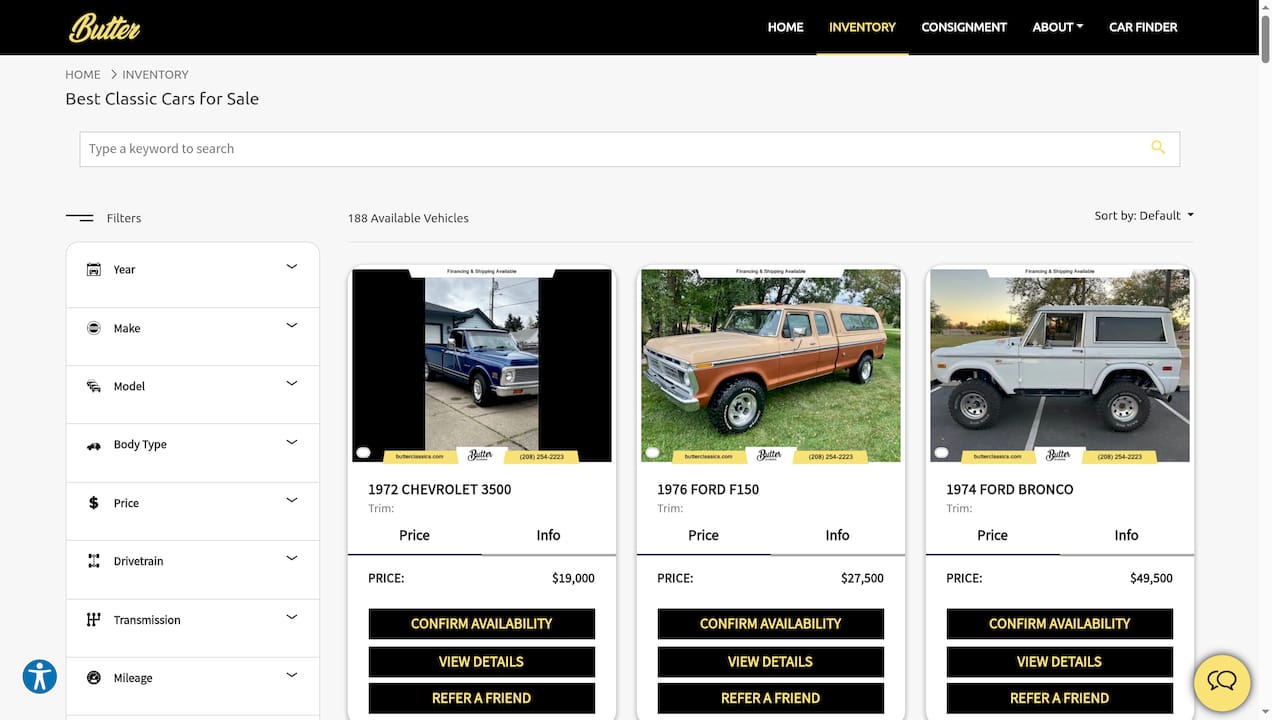
If you know your budget, the next step is finding the car. Browse the Butter Classics inventory for classic trucks, muscle cars, 4x4s, Broncos and more, and start your pre-qualification through our classic vehicle financing options.
Have a classic to sell? You can also consign your vehicle with us and reach buyers across the country. To see how buying with us works from start to finish, check out how it works.
FAQ
What credit score do I need for a classic car loan?
Many specialty lenders look for about 660 to 670 or higher. Some credit unions set a 660 minimum, and a loan marketplace says 670 or above is common. Lenders also review income, debt, down payment and the car, so the score is not the only factor.
Can I get a classic car loan with bad credit?
It is harder, but not always impossible. Some lenders say they do not decide on score alone, and other vehicle loan types may be open to you below the usual line. Expect a higher rate, a larger down payment or both, and start by prequalifying to see your range.
Does prequalifying for a classic car loan hurt my credit?
Typically no. Prequalification usually uses a soft inquiry that does not affect your scores. A hard inquiry happens when you formally apply, and it usually costs fewer than five points. Ask the lender which kind it runs first.
How much down do I need on a classic car?
Plan on 10% to 20% of the purchase price. Some lenders go up to 30% for hot rods, kit cars and heavily modified vehicles. A larger down payment can also help your approval odds.
How old does a car have to be to count as a classic for a loan?
It depends on the lender. Credit union programs commonly start at 20 or 25 years, and some specialty lenders focus on cars built before 2000. Ordinary auto loans often cap vehicle age well below that, so a classic usually needs a specialty program.
Sources
- Credit union classic car loan requirements, minimum 660 score
- Financing a classic car: your options
- Best classic car loans and typical requirements
- Specialty classic car financing and eligibility
- Collector car loan FAQs on credit
- Classic car loan FAQs, titles and documents
- Classic car loan down payment and condition
- Collector car financing review
- Credit union rate sheet, October 2025
- Credit union auto loan rates, November 2026
- Credit union auto loans and classic rate grid
- Credit union auto loan rates, $30,000 example
- Credit union auto loan vehicle age limits
- Vehicle loan checklist, maximum age
- Credit union classic auto financing
- Credit union auto loans, classic models 25 years or older
- Specialty vehicle loans
- Classic car financing options
- How to finance your next classic car purchase
- Does prequalification affect your credit scores?
- What is a hard inquiry and how does it affect credit?