
A classic car balloon loan gives you smaller monthly payments now and one large lump sum at the end of the term. You own the car the whole time. When the balloon comes due, you pay it in cash, refinance it, sell the car, trade it in or, if your contract allows, hand the car back. It can be a smart tool for a collector who has a clear plan for that last payment. It gets expensive fast for anyone who doesn't.
Here's how the structure works, what the numbers look like on a real-sized classic, and how to set up the payoff before you sign anything.
TL;DR
- A balloon loan lowers regular car payments by pushing a large lump sum to the end of the term. That final payment can be as much as half the vehicle's value.
- You own the car during the loan, with no lease-style mileage or condition limits. Miss the final payment and your credit and the car are both at risk.
- Decide how you'll pay the balloon before you choose the loan: cash set aside, refinance, sale or trade.
- Ask any lender or dealer for the full terms in writing, including the total cost and the exact balloon amount.
- Get pre-qualified first so you know your budget before you shop.
Table of Contents
- What a balloon loan is, in plain terms
- A worked example with classic-car numbers
- Why collectors consider balloon loans
- The risks, and how to manage each one
- What to do when the balloon comes due
- How lenders look at classic car loan applications
- Balloon loan, standard loan or personal loan?
- Insurance and the rest of your budget
- A checklist before you sign
- Perspective: how we see it
- Ready to shop with a plan?
- FAQ
- Sources
What a balloon loan is, in plain terms
A standard auto loan spreads the whole balance evenly over the term. By the last payment, you owe nothing. A balloon loan splits the balance in two parts: the regular payments cover most of the interest and only part of the principal, and the rest comes due at the end as one big payment.
LendingTree's U.S. guide explains that a traditional auto loan pays the debt down evenly, while a balloon loan leaves a much larger final balance, and reports typical balloon auto loan terms of 24 to 72 months. That final amount is set when you sign. It's not a guess about what the car will be worth later.
Two things people mix up:
- A balloon loan is not a lease. Under balloon financing the car is yours. You can drive it, show it, store it and modify it as you please, and the usual lease limits on mileage and condition don't apply, according to the same LendingTree guide.
- A balloon loan is not UK-style PCP. You may see "PCP" in articles from overseas. In the U.S., what matters is the contract in front of you: whether it lets you return the car at the end, or whether you must pay, refinance or sell.
A worked example with classic-car numbers
Numbers make this click. The figures below are our own illustration, not a quote from any lender. Rates and terms vary by borrower and vehicle.
Say you're buying a $60,000 classic and putting 20% down ($12,000). You finance $48,000 over 60 months at 9% APR.
| Standard loan | Balloon loan (balloon of $18,000) | |
|---|---|---|
| Amount financed | $48,000 | $48,000 |
| Term | 60 months | 60 months |
| Monthly payment | about $996 | about $758 |
| Payment at the end | $0 | $18,000 |
| Total of monthly payments | about $59,800 | about $45,500, plus the $18,000 balloon |
The balloon version saves you roughly $238 a month. But you'll owe $18,000 on the last day, and because you carried a bigger balance the whole time, the total interest is higher. In this example, the balloon loan adds up to about $63,500 paid on the financed amount against about $59,800 for the standard loan.
That's the trade. Lower payments today, a bigger bill later, and a higher total cost.
The math behind this is a standard formula: the monthly payment equals the principal minus the balloon discounted back at the loan's periodic rate, then spread across the number of payments. Any decent loan calculator handles it. What matters is that you plug in the real balloon amount and compare the total cost, not just the monthly figure.
Why collectors consider balloon loans
Classic cars are a different kind of purchase than a daily driver. A few reasons a balloon structure appeals:
- Cash flow. A lower payment leaves room for storage, insurance, maintenance or the next project.
- A known exit. If you plan to sell the car in a few years, a balloon lines up with that plan.
- Expected cash events. A bonus, a business sale or a maturing investment can cover the final payment.
- Values that may hold. Many collector cars don't lose value the way new cars do. That can make the final payment feel more manageable, though no one can promise a car's future value.
That last point deserves care. The balloon amount is fixed. The market value of the car is not. Build your plan so that you can cover the balloon even if the car is worth less than you hoped. For a look at what moves values, our classic car market trends checklist is a good place to start.
The risks, and how to manage each one
LendingTree lists the main risks: a large final payment, a potentially higher overall cost, trouble refinancing if the car is worth less than the balloon, and credit damage and repossession after a missed payment. Sale proceeds may not cover the balance either.
Colorado State University Extension makes a related point. Balloon structures reduce periodic payments by leaving part of the principal due as a lump sum, and many borrowers must refinance that lump sum and may find it difficult. In other words, you haven't erased the principal. You've moved it to a maturity date.
Here's how to handle each risk like a careful buyer.
The balloon is bigger than the car's value
This is the big one. Keep the balloon well below what you could realistically sell the car for, and test it against a conservative value, not the best case. A larger down payment shrinks the amount financed and gives you a cushion. We cover typical targets in our guide to the classic car down payment.
Refinancing isn't guaranteed
Don't count on refinancing as your only plan. Lenders look at your credit, the car's value and condition at that time. Keep a second route open, such as savings or a planned sale.
Missing the final payment
Missing even the last payment can damage your credit and lead to repossession, according to LendingTree. Put the due date on your calendar a year ahead, and again 90 days ahead.
Autopay deserves a warning. The CFPB's July 2024 supervisory report found that some auto-loan servicers failed to debit final payments or to notify autopay borrowers they had to pay manually, which led to late fees. For a balloon, confirm with your servicer in writing how the final payment will be collected and what payoff figure applies.
Hidden terms in the pitch
Low monthly payments can hide the lump sum. The FTC has taken action against dealers it said deceptively advertised low monthly payments while consumers would owe a final balloon payment of over $10,000, and the agency said material financing terms should be disclosed clearly and conspicuously. Take that as your checklist: if the balloon isn't clearly stated, ask until it is.
What to do when the balloon comes due
You typically have four or five paths at maturity, and the contract decides which are open to you:
- Pay cash. Cleanest option. Works best if you've been setting money aside each month.
- Refinance. Roll the balance into a new classic car loan. You'll need to qualify again.
- Sell the car. Use the proceeds to pay off the loan. Confirm the car's value well ahead of time.
- Trade it in. Apply the trade value toward the payoff, often as part of buying your next car.
- Return it. Only if your contract permits. Don't assume.
Those are the options LendingTree lists for the final balloon, and the last one comes with the "only if your contract permits" condition for good reason.
A simple habit makes this easy: open a savings account on day one and move the difference between the balloon payment and a standard payment into it each month. In our example, that's about $238 a month. Over 60 months it adds up to roughly $14,300 before interest, which covers most of the $18,000 balloon. You've kept the cash-flow flexibility and built a payoff fund.
How lenders look at classic car loan applications
Classic car lenders often look at more than a credit score. They tend to consider the car's age and condition, whether it has a clear title, your credit history and your payment record. A car that is operational and well documented is easier to finance than a non-running project.

Condition drives value, and value drives both the loan and the exit. If you're buying something rare, it helps to understand what serious collectors weigh when a repair or restoration comes up. These rare vehicle repair considerations are worth a read before you commit to a car that needs work.
For a full rundown of what lenders ask for, use our classic car loan requirements checklist. If the car you want is a project, see how to cover the first 90 days of project car financing.
Balloon loan, standard loan or personal loan?
There's no single right answer. Match the structure to your plan.
| Your situation | What usually fits |
|---|---|
| Keeping the car long term, want it paid off | Standard loan, longer term |
| Planning to sell or upgrade in 3 to 5 years | Balloon loan with a conservative balloon |
| Expecting a specific cash event | Balloon loan with a written payoff plan |
| Buying a lower-priced car outside typical classic loan minimums | Compare against a personal loan |
Our breakdown of classic car financing versus a personal loan walks through the trade-offs, and the financing programs explained for collectors piece shows the common structures side by side. For a wider view, see the vintage car financing options overview.
Insurance and the rest of your budget
Whatever loan you pick, your lender will want the car insured. For collector cars, agreed value coverage is common, and it needs proper appraisals and photos. Our guide on agreed value classic car insurance covers what to gather. Budget for storage, maintenance and registration too, so the lower balloon payment doesn't give you a false sense of room.
A checklist before you sign
- The exact balloon amount and due date, in writing.
- The APR, the total of payments and the total finance charge.
- Whether you can return the car, and under what conditions.
- Whether there are prepayment penalties if you pay the balloon early.
- How the final payment is collected and who to call if autopay doesn't run.
- Your own payoff plan, with a backup.
- A conservative estimate of the car's value on the due date.
Perspective: how we see it
We love classics, and we want you to enjoy yours without a surprise at the end of the loan. Here's our honest take.
A balloon structure is a tool. Used well, it lets a collector keep monthly costs in check while a plan for the final payment builds in the background. Used without a plan, it's a bill that arrives on a day you can't move.
That's why we start every financing conversation with your budget, not the car. Get pre-qualified, see what you can comfortably carry, then shop. Our listings come with detailed photos and specifications, and our Butter Certified vehicles carry our Worry Free Guarantee, so you can focus on the loan terms, not on guessing about the car.
Our advice: set the payoff plan before you fall in love with the steering wheel. Then enjoy the drive. It should feel smooth as butter, right to the final payment.
Tony
Ready to shop with a plan?
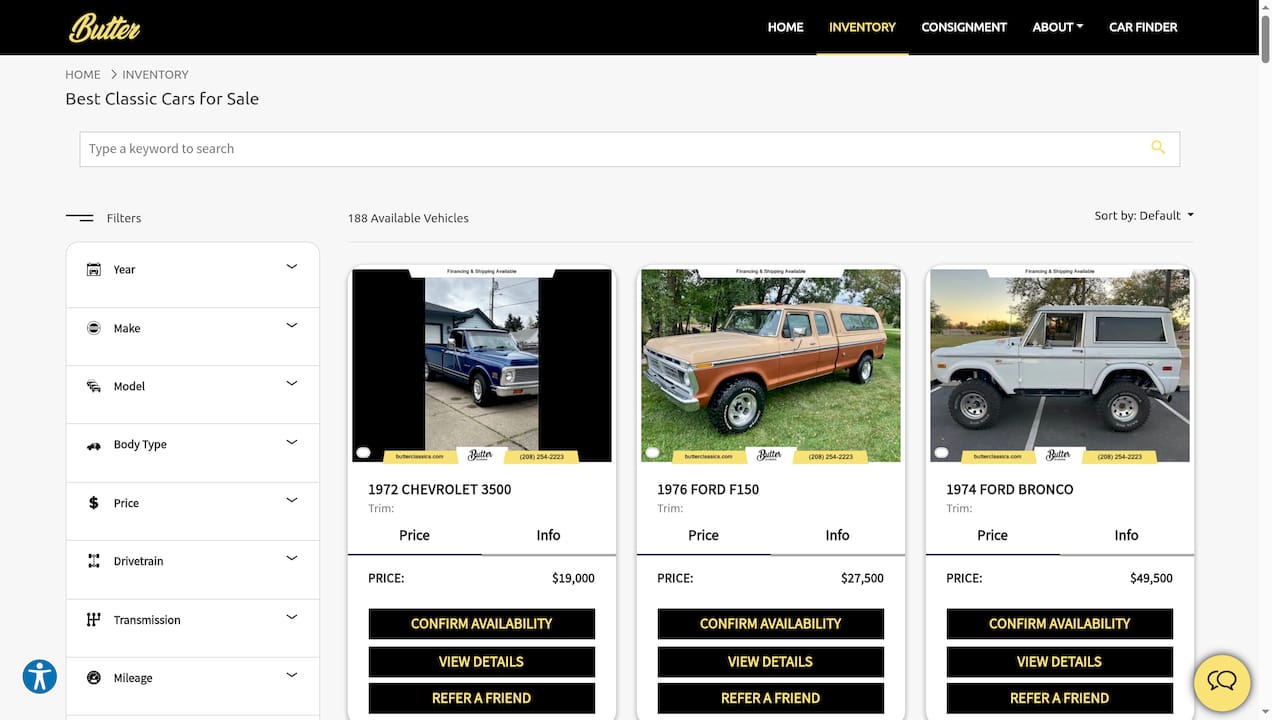
Our marketplace lists classic cars, vintage trucks, muscle cars, 4x4s and collector vehicles from across the country, with financing pre-qualification and test drive scheduling built in. Start by seeing what you can afford, then browse the inventory and find the car that fits your budget.
Prefer to see a car in person first? You can schedule a test drive. If you already own a classic and want to sell it, consign your vehicle with us. For help getting a budget in place, read our guide to U.S. classic car loan preapproval, or start at Butter Classics and ask about financing.
FAQ
Can you get a balloon loan on a classic car?
Sometimes. Availability depends on the lender, the car and your credit, and not every lender offers balloon structures on collector vehicles. Ask for the structure by name, get the balloon amount in writing and compare it to a standard loan before you decide.
How big can a balloon payment be?
LendingTree notes the final payment can be as much as half the vehicle's value. Your own lender sets the real limit. A smaller balloon is safer, because it's easier to cover if the car's value changes.
What happens if I can't pay the balloon?
Your options usually include refinancing, selling the car or trading it in. Missing the payment can damage your credit and lead to repossession. Contact your lender well before the due date if you see a problem coming.
Is a balloon loan cheaper than a regular loan?
The monthly payment is lower, but the total cost is usually higher because you carry more principal for longer. Compare the total of payments plus the balloon, not only the monthly figure.
Sources
- What is a Car Balloon Payment and How Does It Work? (LendingTree)
- Long Term Loan Repayment Methods (Colorado State University Extension)
- Supervisory Highlights: Servicing and Collection of Auto Loans (CFPB, July 2024)
- FTC Announces Sweep Against 10 Auto Dealers (FTC, 2014)
- Rare Vehicle Repair Considerations for Serious Collectors