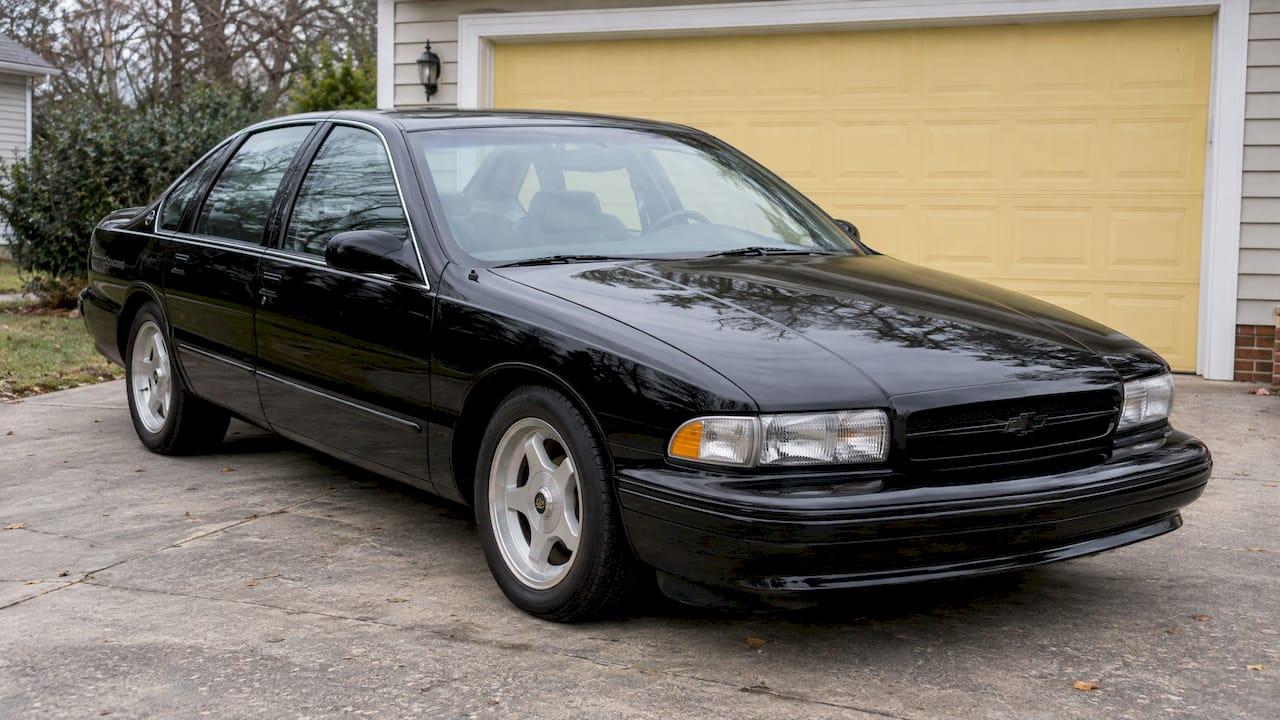
The Impala SS you want is almost certainly the 1994–1996 rear-drive sedan with the 260-hp LT1 V8. Buy the best, most original example you can find, and confirm it is a real SS before you talk money. The three model years differ in color, shifter and gauges. The usual trouble spots are well known and easy to check. Prices run from under $10,000 for tired cars to $40,000 and up for the best ones.
We love these cars. Here is how we would shop for one, step by step.
TL;DR
- The classic Impala SS is the 1994–1996 model: a rear-drive, police-derived B-body sedan with a 260-hp V8.
- 1994 was black only with a column shifter. 1995 added Cherry and Dark Green. 1996 added a floor shifter and analog gauges with a tachometer.
- Match the dash VIN to the trunk SPID label and confirm the WX3 code. A BU4 code means a Caprice.
- Check for rust, leaks, transmission wear, fuel pump problems, fragile odometers and aging interior plastics.
- Condition, originality and low miles drive value. Stock, well-kept cars bring the most.
Table of Contents
- What makes the 1994–1996 Impala SS special
- Model year differences: 1994, 1995 and 1996
- Step 1: Confirm it is a real SS
- Step 2: Inspect the common trouble spots
- Step 3: Understand value and prices
- Not the car you are picturing? Later Impalas
- Perspective
- Ready to start shopping?
- FAQ
- Sources
What makes the 1994–1996 Impala SS special
Chevrolet built the Impala SS for just three years, with nearly 68,000 sold. It is based on the police-car model and uses a Corvette-derived engine rated at 260 hp. That is a big, comfortable, rear-drive sedan with real V8 muscle, and it came along when most of its rivals had gone front-drive.
The hardware under the skin explains a lot of the appeal. DrivingLine describes the shared police-package-derived parts as heavier suspension, extra cooling, larger brakes and a limited-slip differential. In plain words, it was built tougher than a regular family sedan.
Forbes calls the Impala SS usable and family-friendly, with a contemporary driving feel, anti-lock brakes, speed and lots of interior room. You can drive it to a cruise-in on Saturday and take the kids to practice on Monday.
Model year differences: 1994, 1995 and 1996
Knowing what changed each year is your first defense against a mislabeled or modified car. Hagerty's buyer's guide lays out the key changes.
| Year | Color | Shifter and gauges | Notes |
|---|---|---|---|
| 1994 | Black only, gray interior | Column-shifted four-speed automatic | 6,303 sold, the lowest-volume year |
| 1995 | Black, plus Cherry and Dark Green | Column shifter | Mirror and C-pillar revisions |
| 1996 | Same palette as 1995 | Floor shifter, analog gauges with tachometer | Final year of the rear-drive B-body |
The last row is worth a pause. DrivingLine notes that 1996 was the final year for the Impala SS, the Caprice and the rear-drive B-body platform. That end-of-the-line status is part of why the 1996 with its floor shifter and tach is a favorite with many shoppers.
Which year fits you?
- 1994: The lowest production and the purest first-year look. A good pick if you like the all-black idea and the rarity.
- 1995: More color choice. If you want a Cherry or Dark Green car, this is the year.
- 1996: The most driver-friendly cockpit, with the floor shifter and a tachometer. It is also the last of the line.
All three share the same basic character, so pick on condition first and year second.
Step 1: Confirm it is a real SS
The Impala SS and the Caprice share a lot of body and chassis hardware, so identity checks matter. Do these before you fall in love with the photos.
- Read the dash VIN and write it down exactly.
- Find the SPID label in the trunk and match the VIN on it to the dash VIN.
- Look for the WX3 code. Hagerty explains that WX3 marks the Impala SS, while BU4 denotes a Caprice.
- Check the original color under the dash and compare it to the SPID and the paint on the car. A color change is not a deal breaker, but you should know about it and see it priced in.
- Read the driver-door label for the wheel and tire specifications, and compare them to what is on the car.
We walk through this kind of paperwork-first routine in our VIN-first checklist for classic car listings and our guide to decoding classic car VINs. The same habits apply here.
Dig into originality and history
The Impala SS Clubs of America publishes year-specific VIN registries for 1994, 1995 and 1996, plus an Impala SS handbook, sales brochures, diagrams, part numbers and technical service bulletins. That combination makes it a handy place to check what a car should have looked like when it left the factory.
If you want a second set of eyes, this is where mobile pre-purchase car inspections can help. An inspector who comes to the car can compare its numbers against year-specific references and report what they find before you commit, even when the car is in another state.
For more on documentation, see our guides to verifying numbers-matching cars and running a classic car history check.
Step 2: Inspect the common trouble spots
Every car of this age has things to look at. The good news is that the Impala SS's weak points are well documented, so you know exactly where to look. Hagerty and Forbes both point to the same short list.
Body and frame
- Quarter panels: Rust is a known issue here. Check the lower edges and wheel arches closely.
- Frame: Get the car on a lift if you can and look at the frame rails for corrosion or repairs.
- Paint and panels: Look for uneven gaps, overspray and mismatched paint that could suggest accident repair.
Engine and cooling
- Water pump and seal leaks: Hagerty flags these. Look for coolant residue around the front of the engine and on the floor after a drive.
- Opti-Spark moisture issues: The ignition setup on the LT1 can suffer from moisture. Ask when it was last serviced and what was replaced.
- EGR: Hagerty lists the EGR system as a check item. Make sure the engine idles and pulls cleanly.
Transmission
The four-speed automatic is a 4L60E. Both Hagerty and Forbes mention 4L60E wear as a point to check. On the test drive, watch for slow or harsh shifts, slipping, and delays when you put it in gear. Ask for service records, including fluid changes.
Fuel system and electrical
- Fuel pumps and senders: Both sources list these. A fuel gauge that wanders or a car that hesitates under load deserves a closer look.
- Power-window tracks: Forbes names them as a common weak point. Run every window up and down.
- Odometer: Hagerty notes that the odometers can be fragile. If the mileage looks too good, ask for records that back it up.
Interior
Aging plastics are the other recurring item. Check the dash, door panels and trim for cracks, warping and broken tabs. Interior plastics can be hard to find in great shape, so a clean cabin is worth paying for.
A quick test-drive checklist
- Cold start, then idle for several minutes while watching temperature.
- Smooth shifts through all gears, both gentle and firm.
- Straight tracking, no pulling or vibration under braking.
- Every gauge, window, lock and switch working.
- No leaks on the ground after you park.
Step 3: Understand value and prices
Condition, mileage, originality and modifications all affect what a car is worth. Hagerty says well-preserved stock examples bring the most money. Its snapshot, with prices as of 2018, put low-mileage #1 cars approaching $40,000, #2 cars averaging $23,500, #3 cars at $15,500 and #4 cars below $10,000.
More recently, Forbes reports that concours-quality cars sell for more than $40,000 and driver-quality Condition 3 cars roughly bring $13,000 to $23,000. It also says the Impala has risen in value over the past decade.
| Condition | Hagerty (2018 snapshot) | Forbes (2024) |
|---|---|---|
| #1 / concours | Approaching $40,000 | More than $40,000 |
| #2 | Averaging $23,500 | Not listed |
| #3 / driver | $15,500 | About $13,000 to $23,000 |
| #4 | Below $10,000 | Not listed |
What moves the price
- Originality: Stock paint, stock wheels and an unmodified drivetrain are what top buyers want.
- Mileage and records: Low miles matter most when the paperwork backs them up.
- Color and year: Rarer combinations can draw extra attention, but condition still leads.
- Modifications: Upgrades can make a car more fun to drive, but a stock car is usually the easier one to sell later.
For the bigger picture, our classic car market trends checklist shows how to read the market before you buy.
Not the car you are picturing? Later Impalas

If a listing says "Impala SS" but the car is much newer, it is a different animal. DrivingLine says the Impala returned after 1996 as a front-drive unibody car, unlike the rear-drive V8 sedan of 1994–1996. Later SS models can be good cars, but they belong in a different shopping conversation, and the checks above, such as WX3 and the B-body frame, are specific to the 1994–1996 sedan.
Perspective
We think the Impala SS is one of the easiest modern classics to fall for. It looks the part, it drives like a car you can actually use, and the people who own them are a friendly bunch.
What we tell every buyer is simple: start with the car, not the price. A clean, honest, well-documented SS is smooth as butter to live with. Get the numbers to match, get the records, and take your time.
That is why we built Butter Classics around detailed listings with lots of photos and full specs, a nationwide inventory that is not stuck on one lot, and delivery or pickup that fits your schedule. You should be able to see what you are buying, whether it is across town or across the country.
If you are on the selling side, we can help with that too. Consigning with us puts your car in front of serious collectors who know what they are looking for.
Tony
Ready to start shopping?
When you are ready to look, you can browse our classic car inventory by price or type, request a quote or schedule a test drive. We also offer financing pre-qualification so you know your budget before you start. Learn more about classic vehicle financing on our site.
If you already own an Impala SS or another classic and are thinking of selling, take a look at how to consign your vehicle with us.
FAQ
Which Impala SS year is best?
There is no single best year. The 1996 adds a floor shifter and analog gauges with a tachometer, and it was the final year of the rear-drive platform. The 1994 is black only and has the lowest volume, with 6,303 sold, and the 1995 adds Cherry and Dark Green. Choose the best-condition car in the year you like most.
How do I tell a real Impala SS from a Caprice?
Match the dash VIN to the SPID label in the trunk, then look for the WX3 code. BU4 denotes a Caprice. Also check the original color under the dash and the wheel and tire specs on the driver-door label.
What should I look at first on an Impala SS?
Start with rust on the quarter panels and frame, then look for water-pump or seal leaks and Opti-Spark moisture issues. On the drive, pay attention to how the 4L60E shifts. Finish by checking the fuel gauge, power windows, odometer and interior plastics.
How much does an Impala SS cost?
It depends heavily on condition. Hagerty's 2018 snapshot put #4 cars below $10,000 and top cars approaching $40,000. Forbes in 2024 reported driver-quality cars at roughly $13,000 to $23,000 and concours cars above $40,000.
Where can I research an Impala SS's originality?
The Impala SS Clubs of America offers VIN registries for each year, a handbook, brochures, diagrams, part numbers and technical service bulletins. Use them alongside the car's paperwork and a close look at the car itself.
Sources
- Your definitive 1994-1996 Impala SS buyers guide, Hagerty
- Chevy's Legacy: Iconic Impala, Chevrolet
- Back in Black: How the '94-'96 Chevy Impala SS Became One of America's Great Modern Classics, DrivingLine
- Accessible Collectibles: 1994 to 1996 Chevrolet Impala SS, Forbes
- Resources, Impala SS Clubs of America
- Mobile pre-purchase car inspections and VIN swapping