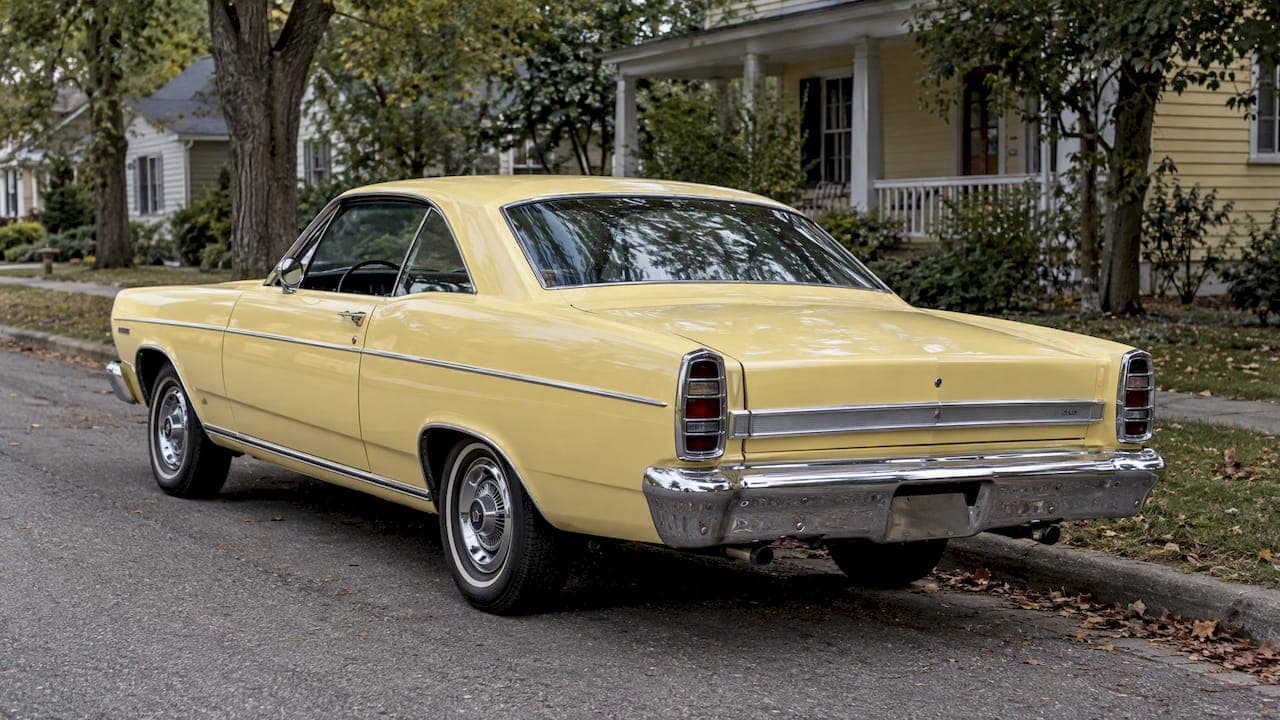
The Ford Fairlane ran from 1955 to 1970, and the best one for you depends on what you want it to be: a full-size 1950s cruiser or a 1960s intermediate with muscle-car options. Pick the generation first, then the engine, then the condition level. Check the numbers and the paperwork before you pay. Do those four things in that order and you will avoid most of the mistakes first-time Fairlane buyers make.
We sell and consign classic cars every day, so we know how quickly a good-looking listing can turn into a long repair list. This guide walks you through it.
TL;DR
- The Fairlane covers seven generations from 1955 to 1970, and it changed from a full-size car to an intermediate in 1962.
- Engine choice drives value: six-cylinder cars tend to trade as projects and parts donors, while V8 and performance cars draw collectors.
- Water is the main enemy. Check the cowl vent, trunk seals and rear wheel wells first.
- Confirm the VIN, engine and transmission numbers, and any option package (like the GTA) against paperwork before you commit.
- Get a title history report and an independent pre-purchase inspection, even on a car sold as certified.
Table of Contents
- The seven Fairlane generations at a glance
- Engines and transmissions: what to look for
- What a Fairlane is worth in the United States
- Project, driver, restored or modified?
- Rust and body: where Fairlanes hide problems
- Verify identity, originality and title
- Records and inspections before you commit
- Perspective from the Butter Classics team
- Find your Fairlane, or sell the one you have
- Buyer's checklist you can take along
- FAQ
- Sources
The seven Fairlane generations at a glance
Ford built the Fairlane in North America from the 1955 to 1970 model years, across seven distinct generations of full-size and intermediate cars. The generation breakdown looks like this:
| Generation | Years | Size class | What it means for a buyer |
|---|---|---|---|
| 1st | 1955–1956 | Full-size | Early flagship look, a favorite for 1950s cruisers |
| 2nd | 1957–1959 | Full-size | Longer, lower styling of the late 1950s |
| 3rd | 1960–1961 | Full-size | Moved down to a base trim level for fleet use |
| 4th | 1962–1965 | Intermediate | Smaller platform, small-block V8s arrive |
| 5th | 1966–1967 | Intermediate | Big-engine and GTA territory |
| 6th | 1968–1969 | Intermediate | Cobra Jet engines available |
| 7th | 1970 | Intermediate | Final year of the nameplate |
The name started as a premier full-size luxury offering in 1955. By 1960 to 1961 it was a base trim level used for fleet cars. In 1962 it came back as an intermediate competitor. That history matters when you shop, because a 1956 and a 1966 are really two different kinds of car.
Which generation fits you
Want chrome, fins and cruise-night presence? Look at the first three generations. These are full-size cars with the styling most people picture when they hear "fifties Ford."
Want something smaller with more performance options? Look at the 1962 to 1970 intermediates, especially 1966 and 1967, when the factory engine list grew the longest.
Want the easiest parts and community support? The 1966 models are a good bet. A front disc brake conversion on a 1966 is common, well supported and reversible, which makes it easier to improve stopping power without committing to a permanent change.
Engines and transmissions: what to look for
Fairlane powertrains changed a lot over fifteen years. According to one engine-by-year reference, the lineup ran from inline-sixes and Y-block V8s through 1961, small-block V8s from 1962, 390 FE and 427 V8s in 1966 and 1967, and 428 and 429 Cobra Jets from 1968.
Here is how to read that list as a buyer:
- Inline-six: Fine for a budget cruiser, but see the value section below. These cars usually trade as projects or parts donors, not as collector pieces.
- Y-block and small-block V8: The sweet spot for most drivers. Parts are easy to find and the cars are fun on the road.
- 390 and 427 (1966 to 1967): The headline engines. They bring the highest interest and the highest need for proof that the car is what the seller says.
- Cobra Jet (1968 onward): Strong period performance, and another area where documentation matters.
Transmissions
Using 1966 as an example, the factory offered a three-speed manual, an optional three-speed overdrive on the 289 only, a four-speed manual, and an automatic. If a seller claims an overdrive with a different engine, ask for documentation. It may be a later swap, which is fine for a driver but changes the originality story.
What a Fairlane is worth in the United States
Value comes down to four things: condition, year, body style and originality. A convertible with the right engine sits at the top. A six-cylinder sedan sits near the bottom.
Hagerty's valuation for a 1966 Fairlane 500 convertible gives a useful picture of how steep the condition ladder is. It lists the car at $33,800 in #1 condition, $24,300 in #2, $16,000 in #3 and $9,900 in #4. That is a gap of nearly $24,000 between a concours car and a rough driver on the same model.

Collector interest in the muscle-oriented years has been solid too. Hagerty reported in May 2024 that values for 1966 to 1967 Fairlane muscle trims had risen by roughly 8% overall. Values move, so use current guides and recent sales for the exact car you are considering.
How to use the condition numbers
- #1 (concours): Show-ready. Only worth paying for if you will show it or want a trophy.
- #2 (excellent): Looks and drives like a top car with minor flaws. Best for people who want to drive without worrying.
- #3 (good): A solid driver with visible wear. Most buyers should shop here.
- #4 (fair): Runs, but needs work. Price it like a project, because it is one.
A cheap car with hidden rust can cost more than a #2 car once you pay for bodywork. We say it often to buyers: buy the best condition you can afford.
Project, driver, restored or modified?
These four labels get used loosely in listings, so pin them down before you talk price.
Project. Needs major work. Six-cylinder cars often land here, since they trade as projects and parts donors rather than collector cars. Budget for the full restoration cost, not just the purchase price.
Driver. Runs and drives, shows honest wear, and may have some non-original parts. This is the most practical way into Fairlane ownership.
Restored. Brought back to a high standard. Ask who did the work, ask for photos from during the build, and ask for receipts. A restoration is only as good as the metalwork underneath the paint.
Modified. Anything changed from factory spec: engine swaps, disc brakes, new wheels, custom finishes. Modifications can make a car better to drive, but they can lower value to buyers who want originality. If you plan to personalize a driver yourself, from wheels to finish, vehicle appearance customization options are worth a look before you commit to a permanent change.

Rust and body: where Fairlanes hide problems
Cars from this era rust, and water usually finds a few predictable paths. Two stand out on the mid-1960s cars:
- The cowl vent under the windshield. It collects leaves and drains water into the firewall and floors. Pull back the carpet and look at the floor pans and firewall seams from both sides.
- The trunk seals. When they fail, they can leak and rot the rear wheel wells. Lift the mat, check the corners, and look at the inner wheel wells with a flashlight.
Also check lower fenders, door bottoms, rocker areas and the rear quarter panels. Fresh undercoating or thick paint on one area can hide repairs. Bring a small magnet and a flashlight, and go slow. Our guide to classic car rust spots explains which problems are routine to fix and which ones should make you walk away.
Mechanical and electrical basics
On the test drive, listen for knocks, watch for smoke on startup, and feel for pulling under braking. Check that gauges, lights, wipers and the heater all work. Old wiring and old bulbs go bad. A long list of small electrical faults can signal a deeper wiring problem. Use our classic car test drive checklist so you do not forget anything while the seller chats you up.
Verify identity, originality and title
This is where the real money is won or lost, especially with high-value packages.
Find the right VIN
On a 1966 Fairlane, the official VIN for title and registration is stamped on the vertical face of the left front fender apron near the top, not on the warranty plate. Ford's shop manual for 1965 gives the same warning: do not use the warranty number on the warranty plate for title or registration. If the number on the title does not match the number on the car, stop and ask why.
Check the numbers and the option packages
Specialist checks should confirm that engine and transmission numbers match factory records, and inspect chassis and body tags for authenticity of option packages like the GTA. For a GTA or other collectible package, buyers should also review factory build sheets, dealer invoices and warranty cards, and consult marque-specific appraisers.
Two of our own guides go deeper on this: how to verify numbers matching classic cars and how classic car authentication works for collectors. For cars from before 1981, our classic car history check guide explains why older VIN formats can cause trouble.
Records and inspections before you commit
Before you wire money, do these three things.
- Get a title history report. The Illinois Attorney General's consumer guide advises buyers to obtain a title history report, such as one from Carfax or NMVTIS, and have an independent mechanic do a pre-purchase inspection. Keep in mind that older VINs may not return complete data, so also ask for the paper trail.
- Hire an independent inspector. The same office says an independent mechanical inspection matters even when a vehicle is advertised as certified or comes with a warranty, because it is meant to show the vehicle's real mechanical condition. For a Fairlane, pick someone who knows 1950s or 1960s Fords.
- Collect the paperwork. Ask for build sheets, dealer invoices, warranty cards, restoration receipts and photos. A seller with a thick folder is usually a seller who has cared for the car.
Perspective from the Butter Classics team
Here is how we look at a Fairlane. Buyers often start with the badge and the price. We start with the story of the car: what is it, can it be proven, and will it still make you smile in three years?
That is why we put so much weight on detailed listings with plenty of photos and clear specifications. When you can see the cowl area, the trunk corners and the underside before you travel, you waste less time and make better choices. Our Butter Certified approach and our Worry Free Guarantee are built around that same idea: confidence before you commit.
Our advice is simple. Decide whether you want a driver or a showpiece, buy the strongest body you can afford, and verify the numbers. A V8 car with honest paperwork will usually serve you better than a flashy one with gaps in its history. And if you are not sure, ask us. We love talking classics.
Tony
Find your Fairlane, or sell the one you have
Ready to shop? Our inventory covers classic cars, vintage trucks, muscle cars, 4x4s and other collector vehicles from across the country, with detailed photos and specs. Browse classic cars for sale and filter by price or type. When a car catches your eye, you can schedule a test drive, request a quote or pre-qualify for financing.
Have a Fairlane or another classic sitting in the garage? Our vehicle consignment service puts it in front of serious buyers without you handling every call and every tire-kicker.
Buyer's checklist you can take along
- Confirm the generation and body style match the ad.
- Locate the VIN on the fender apron and compare it with the title.
- Check engine and transmission numbers against the claim.
- Lift carpets and trunk mats. Look at the cowl, floors and rear wheel wells.
- Ask for build sheets, invoices and restoration photos.
- Run a title history report.
- Book an independent inspection.
- Compare the price with condition-based value guides.
FAQ
What is the best year for a Ford Fairlane?
It depends on your goal. For 1950s styling, look at the 1955 to 1959 full-size cars. For performance and collector interest, the 1966 and 1967 cars are the focus, since muscle-oriented trims saw values rise about 8% according to Hagerty in 2024. For an easy daily driver, a V8 car in #3 condition is a smart place to begin.
How much does a classic Ford Fairlane cost?
It varies widely by year, engine and condition. A 1966 Fairlane 500 convertible, for example, is listed at $9,900 in #4 condition up to $33,800 in #1. Check a current valuation guide and recent sales for the specific car you are considering.
Is a six-cylinder Fairlane worth buying?
It can be, as a budget driver or a base for a build. Just know that six-cylinder cars are generally treated as projects and parts donors rather than collector pieces, so do not expect the same appeal as a V8 car.
How do I know a Fairlane GTA is real?
Check the VIN, the engine and transmission numbers, and the chassis and body tags. Then ask for factory build sheets, dealer invoices and warranty cards, and consider a marque-specific appraiser, as specialists recommend.
Sources
- Ford Fairlane (Americas)
- 1955-1970 Ford Fairlane History
- 5th Gen Ford Fairlane (1966–1967), Octane Files
- Ford Fairlane Engines by Year (1955–1970)
- 1966 Ford Fairlane Facts
- Hagerty valuation report: 1966 Ford Fairlane 500
- Hagerty: 3 Up, 3 Down muscle cars
- 1966 Ford Shop Manual demo
- 1965 Ford Shop Manual demo
- What is a 1966 Ford Fairlane GTA worth?
- Illinois Attorney General: Consumer guide to buying a used vehicle