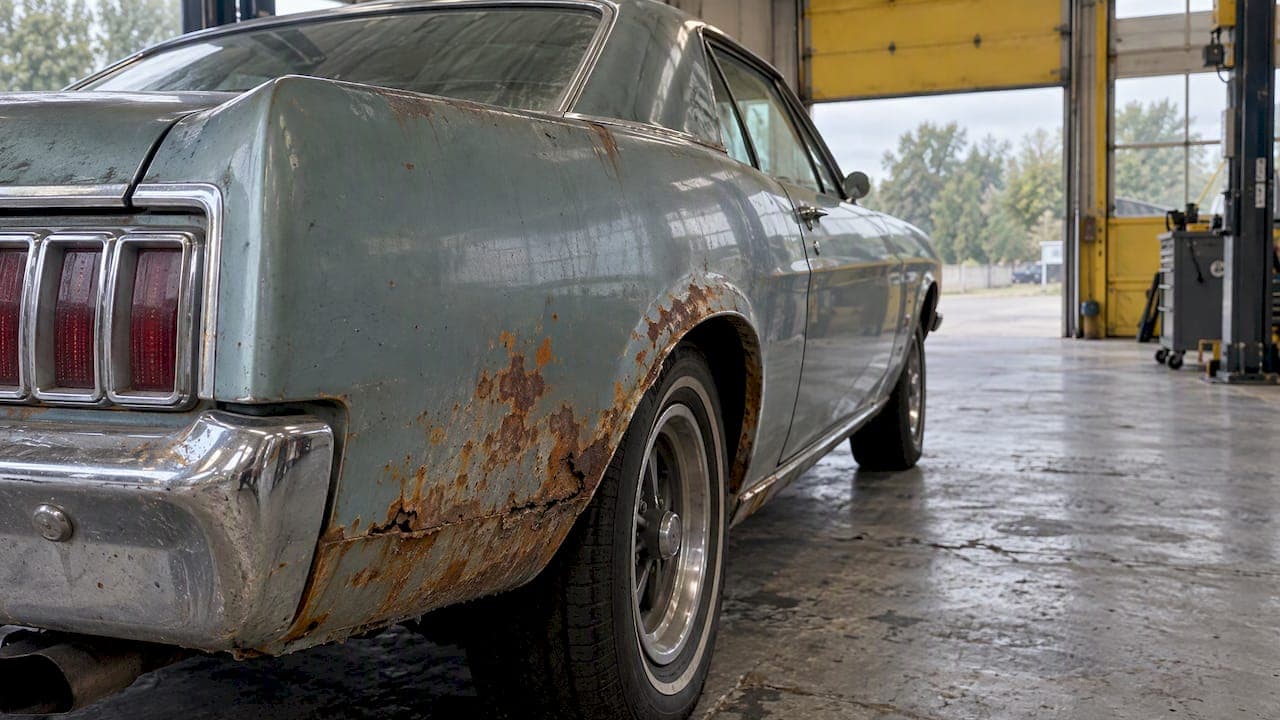
A rust spot on a classic car can mean two very different things. It might be a light bloom on the surface that you can sand out on a Saturday. Or it might be the first visible sign of metal rotting from the inside out. The difference is how deep the corrosion goes and whether it touches anything that holds the car together. This guide shows you how to tell which one you have, where to look, how to treat each stage and when a repair stops making financial sense.
TL;DR
- Surface rust sits on top of the metal and is usually a cosmetic job. Rough, pitted scale and anything with holes is a different story.
- Check the hidden places first: frame rails, rockers, floors, trunk drop-offs, and the spots behind wheels. Rust shows up there before it shows on the outside.
- Treat rust by severity. Clean it to bare metal, convert or prime it, and never seal over it. Structural metal gets replaced with correct-gauge steel and butt-welded joints.
- Whether a repair is worth it depends on the car's value, how much sound metal is left and who is doing the work. A buyer's inspection is cheap insurance.
Table of Contents
- Surface rust vs. structural rust
- How to identify and assess rust spots
- Where to check a classic car's frame for rust
- How to treat rust by severity
- Does WD-40 work on rust spots?
- Preventing rust spots from coming back
- Is it worth fixing the rust?
- Our perspective
- Buying or selling a classic with rust history
- FAQ
- Sources
Surface rust vs. structural rust
Start with the most useful question: is the rust on the metal, or in it?
Surface rust is just that. Popular Mechanics explains that it stays on the surface and is not a structural problem. Think of a paint chip on a fender edge, or an orange haze on a bare brake-line bracket.
Scale rust is the next stage. The same source describes it as rough and pitted, and says it reduces the strength of the metal. If you rub a gloved hand over it and it feels like coarse sandpaper, you are past the cosmetic stage.
Penetrating rust is the one that makes owners sit down. It eats all the way through, leaves holes, and in the wrong place can weaken frames and suspension components.
Here is a quick way to sort what you are looking at.
| Stage | What you see and feel | Where it matters | Typical response |
|---|---|---|---|
| Surface rust | Orange or brown haze, smooth under a fingertip, paint may be chipped | Anywhere | Sand or blast to bare metal, treat, prime, paint |
| Scale rust | Flaking, rough, pitted, metal looks thinner | Panels, floors, underbody | Remove scale fully, assess remaining thickness, repair or patch |
| Penetrating rust | Holes, soft spots, bubbling paint over a crumbling edge | Floors, rockers, frame, suspension mounts | Cut out and replace with fresh steel |
A lot of the confusion around the question of surface versus structural comes down to location. The same amount of rust on a roof skin and on a frame rail are not the same problem. One affects looks. The other affects whether the car holds together in a hard stop or a bump.
How to identify and assess rust spots
Walk the car slowly in good light, and bring a flashlight, a small magnet and a screwdriver with a blunt tip. You are not trying to restore anything yet. You are building a map.
Read the paint first
Paint tells you what is going on underneath. Look for:
- Bubbles or blisters. Rust is growing under the paint and pushing it up. The spot you can see is usually smaller than the area underneath.
- Cracks along seams. Lower door edges, wheel arches and panel joints trap moisture.
- Fresh, thick paint or undercoating in odd places. Sometimes that is honest maintenance. Sometimes it is a cover-up, so look at the edges of it closely.
- Waviness in a lower panel. It can point to body filler hiding repaired or rusted metal.
Use the magnet and the probe
A weak magnet gently set on a lower fender or rocker will tell you where body filler is thick, because it will let go or feel weak there. Do not drag it across paint. Lift and place it.
Then check suspect areas with the blunt end of a screwdriver, tapping lightly. Solid metal rings and feels firm. Thin or rotted metal sounds dull and may give. Use a light touch. You are testing, not poking holes in someone's floor, and on a car you do not own you should always ask first.
Look from the inside out
Pull up carpets and mats if the owner allows it. Look at the underside of the floor pans from the cabin and check whether daylight shows through anywhere. Rust that starts at the bottom of a floor often is visible on the underside first. Water leaks from bad window seals, cowl vents and weatherstripping end up exactly there.

If you are looking at a car to buy, our guide on evaluating vintage car condition before you buy walks through the whole walk-around, not just the rust.
Where to check a classic car's frame for rust
Frame rust is the one that decides whether a car is a project or a pass. Whatever the construction, the rule is the same: find the load-bearing steel and see if it is still solid.
On a body-on-frame car or truck (most trucks, many sedans, classic Broncos), look at:
- The full length of both frame rails, top, sides and bottom, if you can see them
- Body mount points, where the body bolts down
- Spring hangers and shackle mounts
- Crossmembers and the area around the steering box
- The boxed sections, which often rot from the inside
On a unibody car (many muscle cars and sedans), the structure is the body. Look at:
- Rocker panels and the pinch welds along them
- Frame rails and subframe connectors
- Torque boxes at the rear
- Floor pan edges and seat mounts
- Strut towers and shock mounts
Telling "rust on a frame" from "rotted frame"
Some orange on a frame rail is normal on a car that has lived outside. The question is how much good steel is left. Signs that worry us:
- Flaking in layers. If the rust comes off in sheets rather than dust, metal is being lost.
- Swelling at seams. Rust takes up more room than steel, so it pushes seams apart.
- Soft or crumbling spots when you tap with a screwdriver handle.
- Holes, even tiny ones, especially at weld joints and mounting points.
- Amateur repairs. Thick patches, lap welds or heavy fresh undercoating on a frame deserve a second look.
If anything on that list shows up on a rail, subframe or suspension mount, stop and get a pro. Have a qualified frame or restoration shop evaluate it before you drive the car hard or buy it. A frame is not the place for a guess.
If you are buying, a pre-purchase inspection is the right tool. We break down what one usually runs in our article on classic car inspection costs, and it is small money next to a rotted frame.
How to treat rust by severity
The order of steps matters more than the products. Rust has to be removed or converted before anything gets sealed over it.
Light surface rust
For a small, shallow spot, the usual path is to sand or media blast down to bare metal, apply phosphoric acid treatment, then prime and paint, as laid out in this muscle car rust guide. A few practical points:
- Feather the edges of the paint around the spot so the repair blends.
- Remove all the rust, including the pits. Rust left in a pit keeps working under the primer.
- Prime quickly. Bare steel can flash-rust overnight in humid air.
In a floor repair on a muscle car, Hot Rod treated the driver-side floor that had not rusted through with a rust converter, then used an encapsulator to protect good metal or cover the converter. That is a handy model for areas that are rusty but still sound.
Scale and pitting
Heavier rust needs more removal. Wire wheels, flap discs and media blasting all work. Afterward, judge how much metal is left. If the surface is pitted but thick enough, it can often be cleaned, treated and primed. If it has thinned noticeably, a patch panel is the better answer.
Holes and structural rust
Cut it out. Do not cover holes with fiberglass or filler and call it done. The same muscle car guide states that structural repairs on frame rails or subframes should use correct-gauge steel and butt-welded joints, because lap joints are not appropriate for load-bearing members. That is a job for someone with welding experience, and on a frame, a shop that does this daily.
Hot Rod's Johnny Hunkins makes a point worth repeating: get the sheetmetal solid first, then think about engine or performance upgrades. Power added to a weak body is a bad trade.
What not to do
- Do not seal over live rust. One 2026 article on undercoating warns that rigid coatings over existing rust trap moisture and speed up corrosion, and recommends penetrating oil-based products to displace moisture instead.
- Do not assume a spray-on fix will "seal it up." Forum threads full of quick fixes are written for old work trucks where looks are all that matters. A collector car needs the rust removed.
- Do not skip the hidden side. A clean outside with a rusty inside will keep rusting.
Some rust is not on body steel at all. If the corrosion is on a stainless exhaust, for example, the rules are different, and this breakdown of what works on exhaust rust helps you sort the cosmetic from the real.
Does WD-40 work on rust spots?
It helps in a limited way. Popular Mechanics says WD-40 can protect parts from corrosion, and its thin nozzle reaches tight underbody spots to displace water and corrosive grime. That makes it a good maintenance spray for hinges, latches, and hard-to-reach crevices.
It is not a repair. It will not rebuild metal that has been lost, and it will not turn a rusted panel into a sound one. Use it to slow things down and keep moisture out, then fix the rust properly.
Preventing rust spots from coming back
Hot Rod notes that oxidation can be slowed by design and coatings but not fully stopped, because steel reacts with oxygen in the air. So the goal is to keep it slow. A short routine does most of the work:
- Keep drain holes clear. Doors, rockers and cowls are built to drain. Leaves and dirt turn them into water traps.
- Store the car dry. A climate-controlled space with a dehumidifier is the ideal setup, according to the muscle car guide. We cover your options in classic car storage.
- Use cavity wax inside enclosed sections. GM's technical document says closed cavity coatings stay flexible and seep into seams, protecting hidden areas such as rockers, pillars and frame rails.
- Wash and wax regularly, especially after any exposure to road salt.
- Recoat disturbed metal. The same GM document says that after panel replacement or collision repair, accessible bare metal should be treated with metal conditioner and reprimed, and disturbed surfaces recoated properly.
For high-wear areas like lower rockers that take a constant beating from stones and road spray, some owners add a clear film after the metal is sorted. A look at rocker panel paint protection film shows what that involves. It goes on after the repair, never over rust.
Is it worth fixing the rust?
This is the question behind the "$3000 rule" people mention, the idea that a repair bill past a certain figure means it is time to walk away. For daily drivers that may fit. For classics, the math is different, because the car's value is not the same as a used sedan's. Here are the factors that really decide it.
1. Where the rust is. Cosmetic panels like fenders and hoods are easier and cheaper to fix than floors, rockers and frame sections. Structural rust costs more because it involves cutting, fabricating and welding in sound metal, then refinishing everything around it.

2. How rare the car is. A rare model with a documented history may justify serious metalwork. A common one with a rotten body may cost more to restore than it will ever be worth. Our look at the most challenging classic cars to restore shows how parts availability and body complexity change the picture.
3. Originality. Original paint and honest patina on a survivor can matter to collectors. Stripping it for a small spot could cost more value than the rust would. That is a call to make carefully, before you grind anything.
4. Who does the work. A skilled home restorer with the right tools can save a lot. A shop adds labor but also experience, which counts on structural jobs.
5. What you plan to do with the car. A weekend driver can live with a few freckles on an old fender. A show car cannot. If you plan to show, see our classic car show preparation guide.
A simple way to decide: get written estimates for the repair, then compare the total to what a solid, finished example of the same car sells for. If the gap is large, you may be better off buying the better car than building one. If the gap is small and the car is special, fix it right.
Our perspective
We see rusty cars all the time, and here is what we have learned: the spot you can see is almost never the whole story. A good car with a few honest surface spots is a great buy. A shiny car with fresh paint over thin metal is not. That is why we tell buyers to look at the frame, rockers and floors before they look at the paint, and to get an independent inspection on anything that matters.
We also tell sellers the same thing in reverse. If your car has rust, say so. Photograph it, describe it, and price it fairly. Buyers can work with honest information. They walk away from surprises. Our listings are built around detailed photos and specs for exactly this reason, and our Butter Certified approach and Worry Free Guarantee exist so that you can buy with confidence instead of crossing your fingers.
The cars we love most are the ones where somebody did the unglamorous work: cleaned out the drains, waxed the cavities, and fixed small problems before they became big ones. That habit is worth more than any single product.
— Tony
Buying or selling a classic with rust history
If you are shopping for a classic, you can browse our full classic car inventory, or tell us what you want through the Car Finder. Our listings include detailed photos and specifications so you can study the condition before you ever schedule a test drive, and we can help you with financing pre-qualification as well.
If you own one and the rust bill is more than you want to take on, you can also consign your vehicle with us and let it reach buyers across the country instead of a single local lot.
FAQ
How do I treat rust on a classic car?
Match the treatment to the depth. For surface rust, sand or blast to bare metal, treat with a phosphoric acid product, then prime and paint. For holes or thin metal, cut out the damaged section and weld in new steel, using butt-welded joints on anything structural.
Is it worth fixing rust spots on a car?
On a classic, usually yes for surface rust, because it is cheap to fix early and expensive to ignore. For structural rust, compare the repair estimate to the value of a sound example of the same car. If the repair costs close to or more than what a solid one sells for, buying a better car often makes more sense.
Can I just paint over a small rust spot?
No. Paint over rust that has not been removed or converted lets it keep growing underneath, and it will bubble through again. Take the spot to bare metal first, then prime and paint.
How can I tell if rust has reached the frame's strength?
Look for flaking layers, swollen seams, soft spots when you tap, and any holes, especially at welds and mounting points. If you see any of those on a frame rail, subframe or suspension mount, have a qualified frame or restoration shop inspect it before you drive or buy the car.
Sources
- How to Stop Rust on a Car: Rust-Repair Tips for Your Vehicle, Popular Mechanics
- Common Muscle Car Rust Issues and Fixes, The Muscle Car Vault
- Step by Step: How To Replace a Rotted-Out Floor, Hot Rod
- Anti-Corrosion Treatment and Repair, GM Genuine Parts
- Should I Undercoat My Truck to Prevent Rust?, EngineerSkill