Preserve rare, documented survivors if your goal is long-term value and history. Choose correct restoration when a car has real provenance but needs structural or concours-level work. Go restomod when you want a reliable weekend driver with modern manners, and you're willing to trade some originality for it. Your ownership goal, not the car's condition alone, should decide the path.
TL;DR:
- Preserving documented survivors provides long-term value, especially when original parts, paint, and provenance are intact and verifiable.
- Full restoration is essential for models where originality heavily influences auction prices and market perception, but poor quality work can decrease a car's worth.
- Restomods improve drivability through modern upgrades like EFI and disc brakes, appealing mainly to daily drivers rather than collectors or investors.
- Authenticity verification involves detailed documentation, matching serial numbers, and professional authentication to prevent fraud and preserve original status.
- Restoring or modifying a car can impact insurance and regulatory compliance, so understanding local rules and maintaining thorough records is crucial for future claims and legal clarity.
Table of Contents
- Originality Vs Restoration Classic Cars: Definitions That Actually Matter
- How Does Originality Affect Long-Term Classic Vehicle Value?
- When Should You Restore a Classic Car Instead of Preserving It?
- Is a Restomod Worth It for Resale Value?
- What Questions Should You Ask Before Restoring a Classic Car?
- How Do Experts Verify a Classic Car's Originality?
- What Does a Classic Car Restoration Really Cost?
- What Butter Classics Sees Across Real Listings
- Does Restoring or Modifying a Classic Car Affect Insurance?
- Which Requires More Upkeep: Original or Restored Classics?
- What Happens When a Classic Car Is Restored Incorrectly?
- Do Restomod Upgrades Create Regulatory Issues?
- Expert Takeaway: A Rule of Thumb for Classic Car Owners
- How Butter Classics Supports Your Next Move
- Sources
Originality Vs Restoration Classic Cars: Definitions That Actually Matter
Before you touch a wrench or write a check, you need to know which category your car falls into, because the market treats each one very differently. This is the core of the originality vs restoration classic car question, and getting the label right shapes every decision after it.
A survivor or original car has never been substantially disassembled or refinished. Original paint, upholstery, and mechanical components remain in place, even if worn. Butterclassics has written about what actually qualifies as a survivor car, and the short version is: patina and honest wear count for more than shine.
A correct restoration rebuilds the car to factory-accurate specification, using period-correct parts, finishes, and assembly methods. Done right, it looks and drives like it rolled off the line.
A restomod takes a classic body and blends it with modern drivetrain, brake, or suspension components. It prioritizes usability over factory accuracy.
- Survivors earn value from provenance and unbroken history.
- Correct restorations earn value from documented accuracy and workmanship quality.
- Restomods earn value from build quality and how well they drive.
How Does Originality Affect Long-Term Classic Vehicle Value?
Originality is valuable precisely because it's irreversible. Once you strip paint, swap an engine, or reupholster a seat, that piece of history is gone permanently, and no amount of money buys it back. That scarcity is what collectors pay for.
A documented original car can sell for significantly more than a visually similar replica or recreation, according to experts who authenticate collector cars for a living. Auction results consistently show this gap. Two cars can look nearly identical from ten feet away, but one carries its original numbers-matching drivetrain and factory paperwork, and the other doesn't. That difference alone can separate a sale at much higher value from one at considerably lower value.
This is also where fraud creeps in. Passing off a clone, tribute, or heavily modified car as an untouched original isn't just dishonest, it can render the car close to worthless once discovered, because trust in the seller and the documentation collapses at the same time. Protect yourself and your buyers with a few non-negotiables:
- Demand a documented chain of ownership, not just a story.
- Verify that the VIN, casting numbers, and date codes on major components actually match.
- Get independent authentication before you pay a premium for "matching numbers."
- Keep every receipt and photo from any work performed, even minor.
The Antique Automobile Club of America's Original program exists partly to formalize this. It rewards cars that have been conserved rather than rebuilt, and it explicitly states that a significantly restored vehicle loses that Original certification. That's a strong signal to the market: once you restore, you can't go back to claiming original status, no matter how good the work is.
When Should You Restore a Classic Car Instead of Preserving It?
Not every car deserves the conservation-first treatment. Some classics genuinely need restoration to be safe, usable, or valuable in their category, and treating a rusted-through frame or shot brake system as "patina" is a mistake, not a virtue.
- Structural or safety problems override preservation instincts. Frame rust, brake failure risk, or fuel system corrosion aren't originality to protect, they're hazards to fix.
- The model and market reward concours accuracy. Certain marques and years, particularly rare muscle cars, early Corvettes, and pre-war luxury models, see their highest values at concours-level correctness. If your car fits that profile, a correct restoration can outperform leaving it as-is.
- The car has already lost most of its originality. If a prior owner already swapped the engine, repainted it wrong, or gutted the interior, you're not preserving anything by leaving it alone. Restoration recaptures value that's already gone.
The catch is that restoration quality varies wildly, and a poor restoration can actually reduce a car's value compared to a well-kept original, according to analysis on restomod and restoration outcomes. Watch for red flags before hiring anyone: incorrect reproduction parts passed off as factory-original, mismatched paint codes, missing build sheets, or a shop that can't show you comparable finished work. Butterclassics has a longer breakdown of what separates a true restoration-grade vehicle from an over-restored one that actually hurts resale.
Is a Restomod Worth It for Resale Value?
A restomod makes sense when you want to drive the car, not just look at it or store it. Modern electronic fuel injection, disc brakes, upgraded suspension, and better cooling systems solve the real headaches of daily classic ownership: stalling in traffic, fading brakes on a downhill grade, overheating at a stoplight. These upgrades genuinely improve safety and drivability, but they reduce originality, and on a rare or historically significant car, that trade-off usually isn't worth it.
Who wants a restomod? Drivers and tourers who plan to put real miles on the car every year. Who avoids them? Concours judges, purist collectors, and buyers chasing investment-grade originality.
- EFI conversions cut cold-start issues and improve fuel economy.
- Disc brake upgrades shorten stopping distances dramatically over factory drums.
- Modern suspension components improve handling without changing the car's silhouette.
- Upgraded cooling systems prevent the overheating that plagues many classics in traffic.
A shop like Ozkonic Kustomz can walk you through which modernizations tend to add the most drivability for the least visual compromise. Tasteful, well-documented restomods do have their own buyer pool. Builders who keep meticulous records and retain visible original cues, like factory paint color or an untouched dash, bridge the gap between drivers and collectors more successfully than a car that's been chopped and changed with no paper trail.
Pro Tip: Keep every part you remove during a restomod build, even the "obsolete" ones. A future buyer chasing partial originality may pay extra for a car that still comes with its numbers-matching original engine, even if it's sitting in a crate instead of the bay.
What Questions Should You Ask Before Restoring a Classic Car?
Before you touch anything, get honest about what you actually want from this car. Ask yourself one question first: Am I keeping this to show, drive, or hold as an investment? Your answer determines almost everything else.
From there, work through this checklist:
- Check rarity and provenance. Search production numbers for your specific trim and year. Contact your marque's owners' club registrar, many keep detailed records tied to VINs.
- Triage condition honestly. Separate safety issues (brakes, frame rust, fuel lines) from cosmetic ones (faded paint, worn seats). Conserve what's merely cosmetic; fix what's dangerous.
- Set a realistic budget band. Conservation and stabilization cost far less than a full restoration. Get quotes before committing, and pad your estimate, because surprises are the rule, not the exception.
- Compare projected cost against projected value. If a full restoration will cost more than the car will be worth afterward, that's a decision point, not a footnote.
- Vet your restorer thoroughly. Ask for photographic documentation of past projects, itemized receipts, and proof of parts provenance for anything they claim is "correct."
Before you commit to any path, evaluate the car's actual condition in person, not just from photos. A few things worth confirming on-site:
- Does the paint show consistent wear patterns, or does one panel look suspiciously fresher than the rest?
- Do interior components show wear consistent with the odometer reading?
- Are there gaps in the ownership history you can't explain?
How Do Experts Verify a Classic Car's Originality?
"Matching numbers" gets thrown around loosely, but it specifically refers to the engine, transmission, and sometimes rear axle carrying serial numbers that correspond to the car's original build sheet. Chassis identity is the anchor. Everything else gets verified against it.
Professionals read casting marks, forged-in date codes, and stamping patterns on major components to confirm they were manufactured in the window consistent with the car's build date, not swapped in later from a donor car. Forensic authentication at this level is a specialized skill, and it's one reason serious buyers hire a third party before writing a check on a high-value car.
Documentation sources worth chasing down:
- Factory build sheets or broadcast sheets, often tucked under seats or in door panels.
- Dated service invoices showing consistent ownership history.
- Owners' club registrars, who frequently maintain independent VIN-based records.
- Auction house catalogs, which often include prior authentication notes.
If real money is on the line, hire a professional authenticator or lean on resources like the AACA's judging standards and your marque's specific registrar. A single missing digit on a casting number can be the difference between a numbers-matching original and an expensive mistake. Photographic documentation before you do any work also protects you, preserving a record of the car's condition for future appraisal even if you later decide to restore.
What Does a Classic Car Restoration Really Cost?
Budgets vary enormously depending on which path you choose, but the general order holds steady across most makes and models. Conservation and stabilization, cleaning, mechanical safety fixes, minor corrosion repair, sits at the low end. Partial restoration, addressing specific systems while leaving original paint and interior intact, runs in the middle. A full rotisserie restoration to concours standard sits at the top, and a quality restomod build often lands somewhere between partial restoration and full rotisserie cost, depending on parts chosen.
Timeline follows a similar pattern. Parts lead times can stretch a project by months, especially for rare trim pieces or discontinued mechanical parts. Corrosion repair, once you open a panel and find more rust than expected, is the single biggest schedule wrecker in the business.
Common budget traps to plan around:
- Hidden rust behind panels that looked solid from the outside.
- Discontinued parts requiring custom fabrication or reproduction tooling.
- Corrective engineering, undoing a previous owner's bad repair before you can even start your own work.
Some models are notoriously harder and pricier to bring back than others; Butterclassics breaks down which classics present the toughest restoration challenges if you want to know what you're getting into before you buy.
What Butter Classics Sees Across Real Listings
Across Butterclassics listings, the pattern holds: unrestored survivors with clean paperwork routinely draw stronger interest than heavily modified cars at similar price points, even when the modified car looks flashier in photos. One recurring case involves a documented survivor coming to market with its original invoice and dealer stickers intact. Buyers in that segment pay a premium specifically for that paper trail, not just the sheet metal.
For sellers deciding between listing a car as-is or restoring first, Butterclassics generally advises documenting everything before any work begins, then letting the buyer pool self-select. Some buyers want the drivable restomod. Others want the untouched original, warts and all. Consigning with full documentation tends to serve both audiences better than guessing which one you're targeting.
Does Restoring or Modifying a Classic Car Affect Insurance?
Insurance carriers that specialize in collector vehicles generally price policies around agreed value, meaning you and the insurer settle on a stated value in advance rather than relying on actual cash value after a loss. Originality plays directly into that number. A well-documented survivor with verified provenance typically supports a higher agreed value, because the paperwork backs up the claim.
Restomods introduce a wrinkle. Some specialty insurers price them differently because non-factory components can complicate parts replacement after a claim, and certain carriers cap coverage or exclude custom modifications unless you specifically schedule them. If you've invested in a modern drivetrain swap or aftermarket suspension, get those upgrades itemized and valued in writing before you need to file a claim, not after.
Correctly restored cars usually sit in the middle. Insurers can value them based on comparable sales and documented restoration costs, but the accuracy of that restoration matters. A sloppy or incorrect restoration can undervalue a car at claim time, even if you spent real money getting it there.
Whatever category your car falls into, keep a running file of receipts, appraisals, and photos. It speeds up claims and strengthens your position if you ever need to dispute a settlement offer. This is one area where originality, correctness, and paperwork all point in the same direction: better documentation means better insurance outcomes, regardless of which path you chose.
Which Requires More Upkeep: Original or Restored Classics?
Original, unrestored cars often demand a gentler kind of ongoing attention. Old rubber seals, aging wiring, and decades-old fluids need regular inspection, and parts that fail on a survivor can be harder to source because you're trying to match original specifications rather than just bolt in whatever fits.
Correctly restored cars typically run more predictably in the near term, since everything was rebuilt to spec recently, but they inherit the same long-term aging curve as the original components once enough years pass. A restoration doesn't stop the clock, it just resets it.
Restomods generally win on day-to-day reliability. Modern EFI systems, updated wiring, and current-generation cooling components are simply easier to maintain and diagnose than 1960s-era equivalents, and parts availability is rarely an issue since much of the drivetrain shares components with newer production vehicles.
The trade-off cuts the other way for specialized knowledge. A restomod built around a modern engine swap needs a mechanic comfortable with both eras, classic bodywork and modern electronics, which narrows your service options in some regions. A numbers-matching original, by contrast, often benefits from marque specialists who've spent decades with exactly that drivetrain and know its quirks cold.
Whichever direction you go, budget for annual inspection regardless of how little you drive the car. Stored classics develop their own problems: dried gaskets, stale fuel, seized brake components, and tires that age out well before they wear out.
What Happens When a Classic Car Is Restored Incorrectly?
The financial damage from a bad restoration can be significant, and it often isn't obvious until you try to sell. A poorly executed restoration can leave a car worth less than a well-maintained, unrestored example of the same model, because buyers are paying for correctness and craftsmanship, not just shiny paint.
The most common mistakes stack up quietly. Incorrect reproduction parts substituted for factory-original ones. Paint codes that are close but not exact. Missing or altered casting numbers from a rushed engine swap. Upholstery in the wrong material or pattern. Any one of these, spotted by a knowledgeable buyer or judge, can undercut the entire project's credibility, even if the overall build quality looks solid.
There's a permanence problem here too. Once original components are removed and replaced, you can't easily undo that decision. A car that loses its numbers-matching drivetrain during a botched restoration doesn't get that provenance back, no matter how the rest of the build turns out. That's part of why the AACA's certification structure treats significant restoration as a one-way door away from Original status.
The practical lesson: vet your restoration shop as carefully as you'd vet a surgeon. Ask for references, inspect completed work in person, and get every material and part specified in writing before the shop starts cutting metal or mixing paint. A shop that can't produce documentation of its own past work is a warning sign, not a minor gap.
Do Restomod Upgrades Create Regulatory Issues?
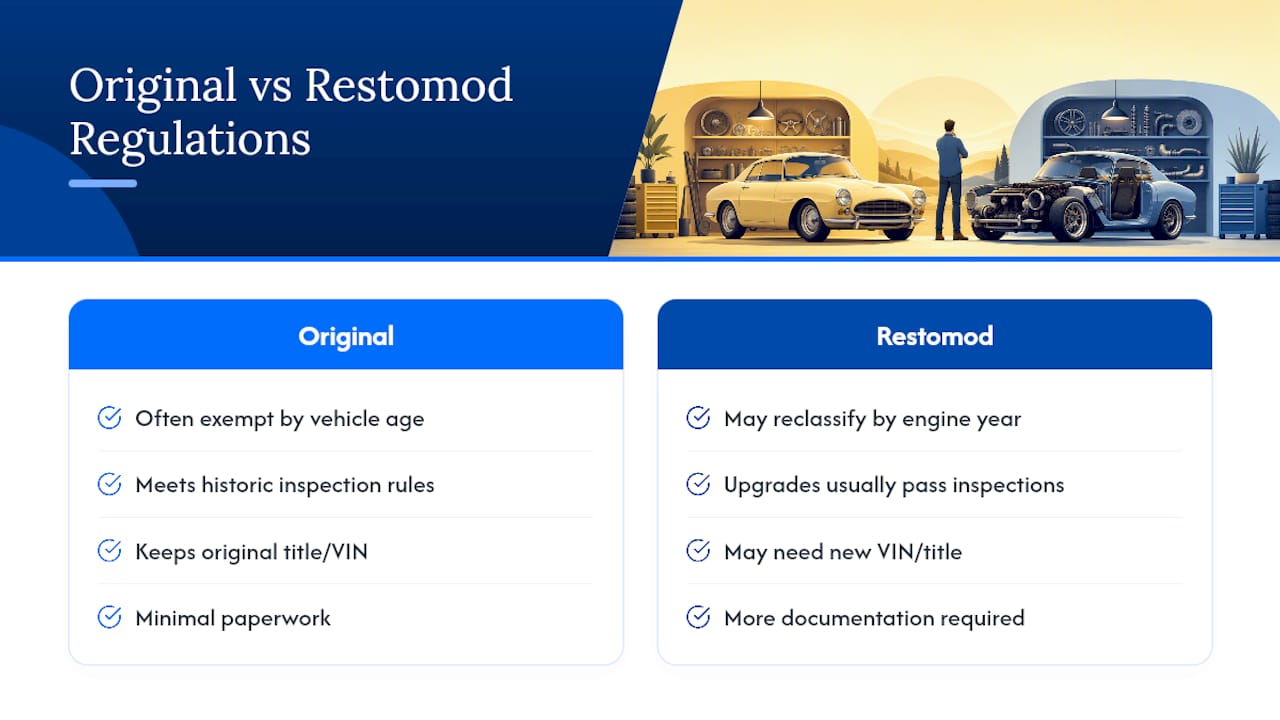
Modernizing a classic can bump it into different regulatory territory depending on what you change and where you live. Emissions rules are the biggest variable. Many jurisdictions exempt vehicles over a certain age from emissions testing entirely, but swapping in a newer engine can sometimes reclassify the vehicle based on the engine's model year rather than the body's, which may trigger testing requirements the original car was exempt from.
Safety inspections follow similar logic in some states. Adding disc brakes or upgraded suspension components generally satisfies inspectors more easily than stock components, since the upgrades meet or exceed factory performance. Title and registration paperwork can get more complicated with major drivetrain swaps, since some states require documentation proving the swap and may require a new VIN or specialty title designation for heavily modified vehicles.
Original, unmodified classics generally sidestep most of this friction. If the car retains its factory configuration, it typically qualifies cleanly for whatever historic vehicle exemptions your state or locality offers, without the paperwork trail a swap requires.
None of this should scare you away from a restomod, but it does mean homework matters before you start. Check your local rules on emissions exemptions, safety inspection requirements for modified vehicles, and title requirements for engine swaps before you commit to a build. What's a simple weekend project in one state can require substantially more paperwork in another.
Expert Takeaway: A Rule of Thumb for Classic Car Owners
If your car is rare or historically documented, preserve it. If it's a common model with damage or lost originality, restore or modernize it without guilt. That's the whole rule, and most disputes in this hobby come from applying the wrong instinct to the wrong car.
The asymmetry is what makes this decision worth taking seriously: you can always restore a preserved car later, but you can never un-restore one. Every irreversible choice should get held to that standard before you make it.
— Tony
How Butter Classics Supports Your Next Move
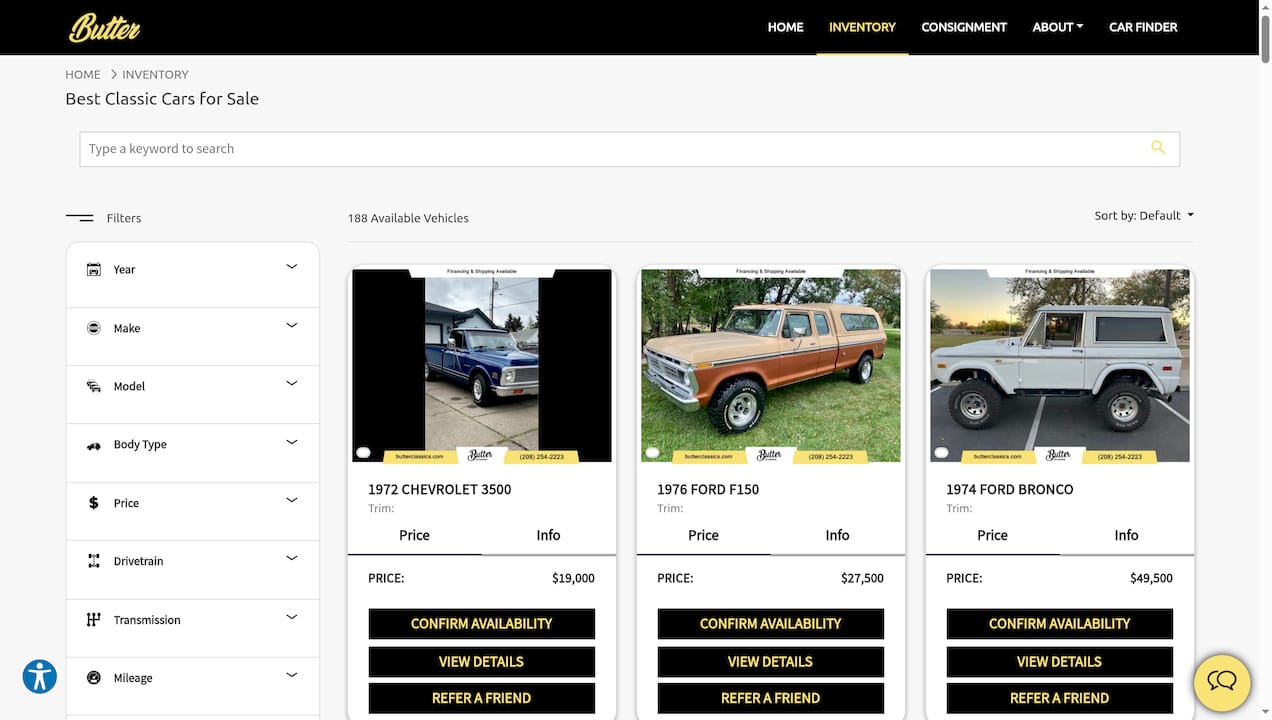
Whichever path fits your goals, Butterclassics gives you a faster, lower-effort way to act on it than sorting through scattered classified ads or gambling on an unverified private sale. If you're hunting for a documented survivor or a tastefully built restomod, browse current inventory filtered by price and type, with detailed photos and specs on every listing.
Not sure exactly what fits your goals yet? Use Car Finder to get matched with options based on whether you want to show, drive, or invest. If you'd rather see a car in person before committing, schedule a test drive directly through the listing. And if you're the one selling, whether it's an untouched survivor or a documented restoration, Butterclassics' consignment service handles the listing, photography, and buyer vetting so your car's provenance gets presented the way serious buyers expect. Start by exploring what's currently available.
Sources
For judging standards and preservation criteria, review the AACA Original program guidelines. For authentication methods, see Hagerty's forensic analysis guide. For market value comparisons between originals and replicas, read Modern Car Collector's analysis and Motorious on restomod value.
- Restomod vs. Original: Which Is Right for You?
- AACA Original program guidelines (2025)
- How the pros use forensic analysis to authenticate collector cars
- How the experts can tell a pure-bred classic car from a fake