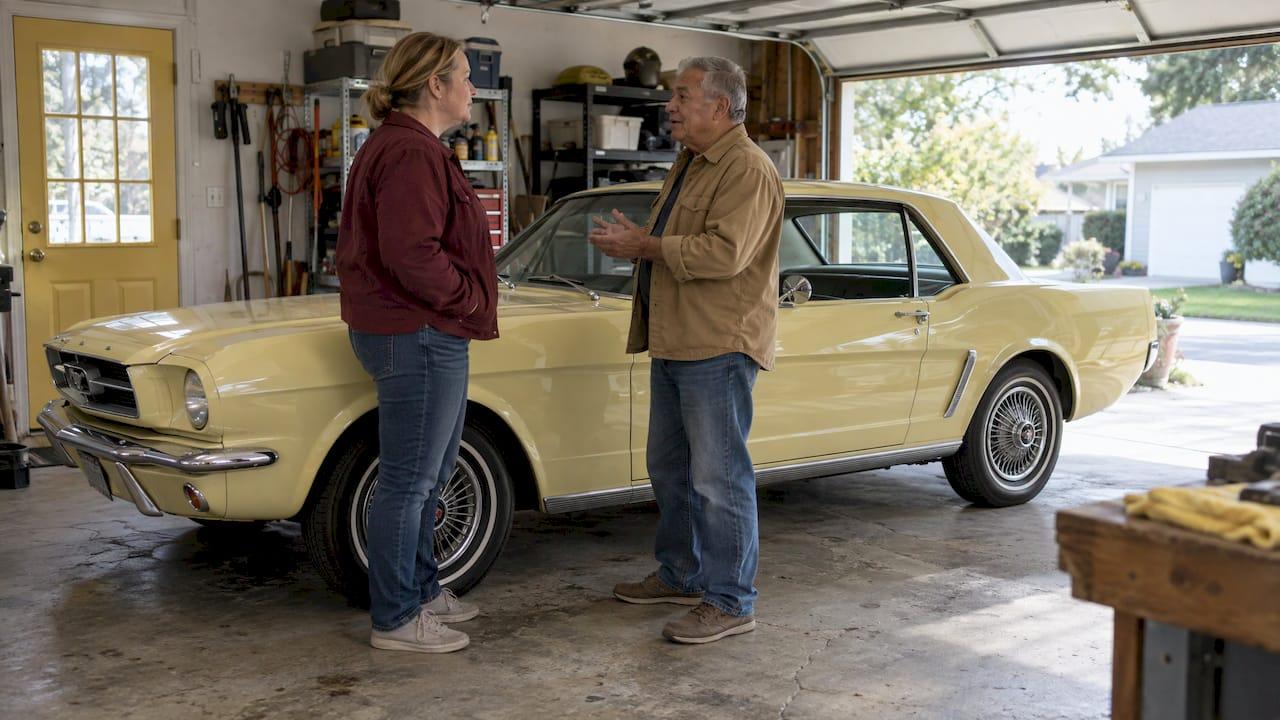
Paying cash for a classic gets you clear title on day one and no interest. Financing keeps your cash free for the next car, the restoration or the unexpected repair. For most collectors, the best answer is to price both before you bid. Get pre-qualified first, see what the loan really costs, then choose. With specialty loans, that choice is often easier to change than you'd think.
We talk to buyers about this every day. Here is how to work it out for your own situation.
TL;DR
- Cash is the simplest route: no interest, no lender, no monthly payment, and you own the car outright from the first day.
- Financing makes sense when your money can do more elsewhere, such as a second car, a restoration or a reserve fund.
- Regular bank auto loans often don't cover older cars, so look at specialty classic lenders. Expect to need roughly a 680 to 700 credit score and a down payment of 10% to 20%.
- Some specialty loans carry no prepayment penalty, so you can finance now and pay the balance down later.
- Pre-qualify before you shop. It shows your likely rate without a hard credit pull and tells you your real budget.
Table of Contents
- What you're really choosing between
- The case for paying cash
- The case for financing
- A worked example: a $60,000 classic
- Why financing a classic is different from financing a daily driver
- What lenders usually ask for
- How to decide: a five-step routine
- Mixed approach: part cash, part loan
- Where to buy once you've decided
- Ready to see your numbers?
- Our take
- FAQ
- Sources
What you're really choosing between
Paying cash means you give up the money and get the car. Financing means you put down part of the price and borrow the rest, then pay interest for the privilege of keeping your cash.
The question underneath is opportunity cost: what else could that money do for you? If it would sit in a savings account doing very little, cash is hard to beat. If it is working in a business, a portfolio or a restoration budget, borrowing against the car can be the more efficient move. Neither choice is automatically smart. Your numbers decide.

Some buyers feel paying cash is the more prudent path. Others see a loan as a tool, much like a mortgage on a house. Financing professionals interviewed by Classic Motorsports point out that everyone's relationship with money is different, and that it pays to look at every financing option before you decide.
The case for paying cash
Cash has real strengths, and you should know them.
- No interest. You skip finance charges entirely, which is the cheapest way to own a car on paper.
- No monthly obligation. The car is yours, free and clear. No lienholder, no payoff letter when you sell.
- Speed. At an auction or in a competitive private sale, a buyer who can wire funds quickly often has the edge.
- Peace of mind. For many collectors, owning the car outright is part of the joy.
Cash works best when you have ample liquidity you aren't using for something better and you still have a healthy reserve after the purchase. Classics bring surprise costs: transport, insurance, storage, brake work, a carburetor rebuild. If paying cash drains your emergency fund, the car is costing you more than its price.
The case for financing
Financing is not a sign that you can't afford the car. For a lot of serious collectors it is a planning decision.
- Liquidity stays with you. You keep cash for repairs, restoration or the next opportunity when a rare car shows up.
- You can buy more car, or two cars. A smaller down payment lets you act on a car you'd otherwise have to pass on.
- It's reversible. Some specialty lenders offer simple-interest loans with no prepayment penalty. That means extra payments or an early payoff cost nothing more. You can start with a loan and pay it down hard if your view changes.
- It can be kinder to your credit profile. One specialty lender told Classic Motorsports its loans count as recreational lending and don't show up on your credit like a standard auto loan.
If you are comparing a loan against other uses of your money, our own guide to classic car returns versus the stock market walks through that comparison.
A worked example: a $60,000 classic
Here is an illustration. The rate is an assumption for the math, not a quote.
Say you're buying a $60,000 muscle car. You put 20% down, which is $12,000, and finance $48,000 at 8% over 120 months.
| Pay cash | Finance (20% down) | |
|---|---|---|
| Cash out on day one | $60,000 | $12,000 |
| Monthly payment | $0 | About $582 |
| Interest over 10 years | $0 | About $21,900 |
| Cash kept available | $0 from this money | $48,000 |
The loan costs about $21,900 in interest if you hold it the full ten years. In return, $48,000 stays in your hands. The question is what that money does while it waits. If it covers a restoration, funds a second car or sits in an account earning more than the loan costs, financing can come out ahead. If it would sit idle, cash wins on price alone.
Because many specialty loans have no prepayment penalty, you can also cut that interest total by paying extra whenever you like. Interest is calculated on the balance, so every extra dollar early shrinks the bill.
Why financing a classic is different from financing a daily driver
This is where many buyers get stuck. Most traditional banks and credit unions won't finance vehicles older than about five years, and some treat classics as toys. That leaves specialty classic and collector lenders as the main route.
What that looks like in practice, based on figures reported in Classic Motorsports:
- Rates from a specialty lender ranged from 6.2% to 17.95%, depending on credit.
- Terms ran from 60 to 144 months.
A personal loan is another path. It can finance an older or rare car, and it is often the only practical way to fund a restoration, since traditional auto loans are built for purchases, not projects. We compare the two in classic car financing vs. a personal loan.
Rates also move with the broader market. The Federal Reserve sets the federal funds rate, and lenders' pricing follows over time. Look at a live quote when you're ready, not at a number from an article.
What lenders usually ask for
Requirements differ by lender, but the pattern is consistent. Here is what to expect:
- Credit score. Specialty classic lenders generally look for scores above 680, with the best rates above 700.
- Debt-to-income ratio. That's your monthly debt payments divided by your monthly income. Most lenders want it at 40% or less, including the new loan.
- Down payment. Most classic lenders want 10% to 20% down.
- The car itself. Lenders may ask for an appraisal to support the value of the vehicle.
We lay each of these out in our classic car loan requirements checklist, and in more detail on credit scores and down payment targets.
How to decide: a five-step routine
- Set your all-in budget. Add the purchase price, sales tax and registration, transport, insurance and a repair cushion. Dealer fees matter too, so read what classic car dealers charge and what to question.
- Decide your reserve. Pick the amount of cash you want left after closing. Many classics need work soon after purchase. A quality restoration can run $40,000 to $120,000, and show-level builds can pass $100,000. If you plan any of that work, include it in the reserve.
- Check your credit and debt-to-income ratio. Fix what you can before applying. A creditworthy cosigner can help if your own profile falls short.
- Get pre-qualified. Pre-qualification lets you preview your likely rate without a hard credit pull. It costs you nothing in credit score and gives you a real monthly payment to weigh against paying cash.
- Compare the two totals. Put the loan's total interest next to what your cash would do elsewhere. If the gap is small, take the flexibility. If it's large and you have a deep reserve, cash may suit you better.
If you're funding part of the purchase by selling another vehicle, it helps to know what your current car is worth before you set the down payment.
Mixed approach: part cash, part loan
You don't have to choose one extreme. A bigger down payment lowers the amount you borrow and the interest you pay. A smaller one keeps more cash on hand. Lenders typically want at least 10% to 20% anyway, so you're likely to land in a blend.
A few ways collectors split it:
- Put 20% down and keep the rest in reserve for the first-year work list.
- Pay cash for a lower-priced driver and finance the higher-priced investment car.
- Finance now and make a lump-sum payment when a bonus, a sale or a payout arrives.
If you're buying with an eye on value over time, our piece on what makes a car investment worthy helps you pick a car worth the capital you commit. For more on how lenders structure their offers, see our overview of classic car financing programs and the 2026 vintage financing guide.
Where to buy once you've decided
Whether you pay cash or finance, the seller matters as much as the payment method. Auction, dealer and curated marketplace each have trade-offs on fees, condition reports and speed, and we break them down in auction vs. dealer vs. a curated marketplace.
Ready to see your numbers?
At Butter Classics you can browse a nationwide inventory of classic cars, vintage trucks, muscle cars and 4x4s with detailed listings and extensive photos, and you can start financing pre-qualification online. Check your payment before you fall for a car, then decide whether cash or a loan is the better fit. When you're ready, search our classic car inventory or look at classic vehicle financing.
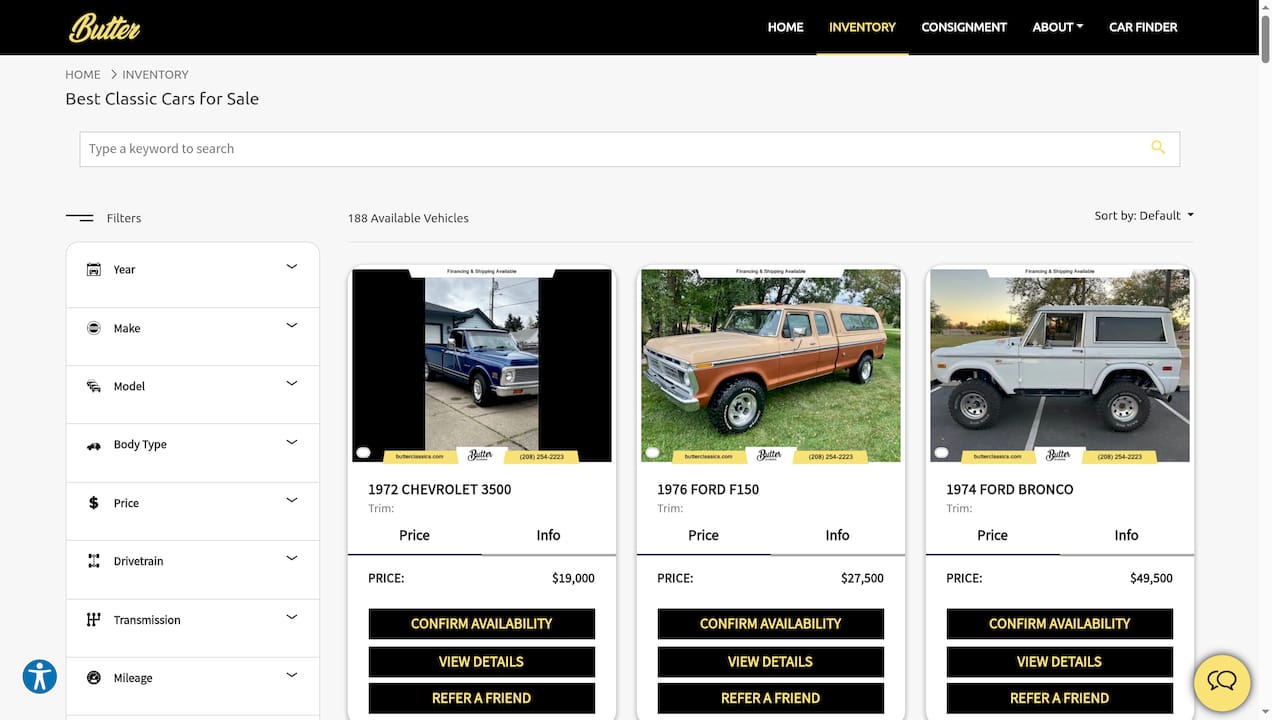
If you're on the selling side, you can consign your vehicle with us. That puts it in front of buyers whether they're paying cash or financing.
Our take
Most collectors we talk to start by asking whether they can pay cash. We'd rather you ask what you want your money to do.
A classic is a passion purchase, but the money behind it is still a plan. Pre-qualifying costs you nothing in credit score and gives you a real number instead of a guess. If the loan makes sense, you keep your cash free for the restoration, the reserve or the next great find. If it doesn't, you pay cash knowing you checked.
We built financing pre-qualification into how you buy with us for that reason. Our cars come with detailed listings, plenty of photos and specs, and our Butter Certified vehicles carry our Worry Free Guarantee. You see what you're buying and what it costs to own, then you choose.
Tony
FAQ
Is it hard to finance a classic car?
It takes a different route than a regular car loan. Most traditional banks and credit unions don't finance older vehicles, so you'll usually work with a specialty classic lender. With good credit and a down payment, it's very doable.
What credit score do I need to finance a classic car?
Specialty lenders generally look for scores above 680, and the best rates tend to go to borrowers above 700. Lenders also weigh your income and existing debt, so check both before you apply.
How much should I put down on a classic car?
Most classic lenders want 10% to 20% down. A larger down payment lowers your monthly payment and total interest. A smaller one keeps more cash available for repairs and restoration.
Can I pay off a classic car loan early?
Often yes. Some specialty lenders offer no prepayment penalty, so you can make extra payments or pay the balance off at any time. Confirm this in your loan terms before you sign.
Sources
- How to finance your next classic car purchase, Classic Motorsports
- Classic Car Restoration Loans: Ultimate Guide 2026, SuperMoney
- Best Classic Car Loans, LendingTree
- Auto Loan vs. Personal Loan, Credible
- Value My Car: How to Find What Your Car Is Worth