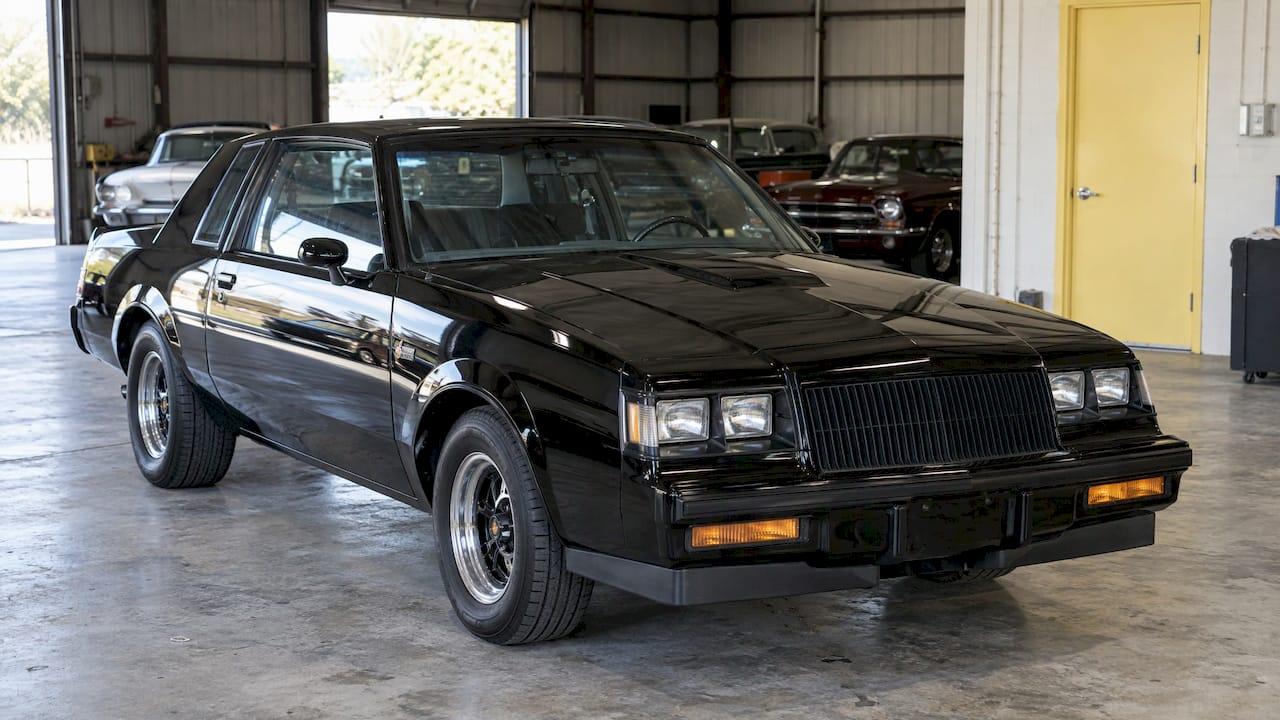
The best way to buy a Buick Grand National is to settle three things before you fall for the paint: which version you are really looking at, whether the paperwork proves it, and what a turbo V-6 that is nearly 40 years old needs to run right. Get those three right and a Grand National is one of the most rewarding 1980s muscle cars you can own. Get them wrong and a $50,000 car can turn out to be a $35,000 car with a $15,000 to-do list. This guide walks you through the versions, the paperwork, the inspection, the known weak spots and the prices, in the order you will need them.
TL;DR
- The Grand National ran 1982 to 1987, with the all-black turbocharged cars arriving in 1984. The 1987 GNX is a separate, far rarer car: 547 were built.
- A GNX wears an ordinary 1987 Grand National VIN, so the numbered dash plaque must be backed by the window sticker, dealer invoice and an unbroken ownership record.
- Watch the 200-4R automatic, the Powermaster brake system, the fuel system and the turbo. Pay for a specialist's pre-purchase inspection.
- Recent published sales for regular Grand Nationals ranged from about $35,000 to $79,000 depending on mileage and originality. GNX results run several times higher.
Table of Contents
- Which Grand National are you looking at?
- Verify the car before you fall for it
- What to inspect in person
- What a Grand National costs
- Owning one after you buy
- Where we come in
- Ready to shop, finance or sell?
- FAQ
- Sources
Which Grand National are you looking at?
The name covers more than one car, and the price gap between them is huge.
According to Hagerty's turbo Buick guide, the Grand National debuted for 1982 with 216 two-tone gray cars, most of them non-turbo 4.1-liter Regals. The all-black turbocharged version arrived in 1984. That is the car most people picture.
Here is how the main versions break down:
| Version | Years | What sets it apart |
|---|---|---|
| Early Grand National | 1982 | Two-tone gray, 216 built, mostly non-turbo |
| Turbocharged Grand National | 1984 to 1987 | All-black, turbo 3.8-liter V-6 |
| 1987 GNX | 1987 only | 547 built, revised turbo, reworked rear suspension, numbered dash plaque |
Hot Cars lists production at 2,000 Grand Nationals in 1984, 2,102 in 1985, 5,512 in 1986 and 20,740 in 1987. The 547 GNXs were converted from that 1987 run, which is why one is so much rarer than a standard car.
Power and performance
Factory power ratings vary by source, which is normal for this era. Hot Rod lists 200 hp for 1984 and 1985, 230 hp for 1986 and 240 hp for 1987, all with 300 lb-ft of torque. Hagerty's guide gives slightly higher figures for 1986 and 1987. Treat the numbers as a range, not a spec to argue over. Our piece on what vintage horsepower ratings really mean explains why.

The GNX was advertised at 276 hp and 360 lb-ft. Hot Rod reports a 4.7-second run to 60 mph and a 13.4-second quarter-mile at 104 mph, quick enough to beat the Mustang GT, Camaro IROC-Z and Corvette of its day.
Why exactly 547?
Hagerty's guide says Buick's enthusiast team first floated 200 cars, then settled on 500 to honor the Indy 500, where its turbo V-6 debuted. The dealer-relations team asked for another 47 for top-performing stores. ASC/McLaren built the cars under contract. Buick's own GNX page confirms the 547 count and the individual numbering from #001 to #547.
The GNX changes over the standard car include a revised Garrett turbo, free-flow heads, staggered 16-inch wheels, a reworked rear suspension and Stewart Warner gauges. Know these before you walk up to a car advertised as a GNX.
Verify the car before you fall for it
On a standard Grand National the VIN, the trim tag and the paperwork should all tell one story. On a GNX it matters even more.
Modern Car Collector's GNX spec sheet points out that a GNX has no VIN of its own. It wears a standard 1987 Regal Grand National VIN. The numbered dash plaque is a bolt-on part, and reproductions exist. So the plaque alone proves nothing. The same source says authentication takes the plaque matched to:
- the original window sticker,
- the dealer invoice,
- a continuous ownership record.
Then check the GNX-specific hardware: the Stewart-Warner cluster, fender vents, composite flares and blacked-out trim.
A short paperwork checklist
- Read every VIN location. Compare the dash tag against the other stampings on the car, then decode it. Our collector's VIN decoding workflow shows how.
- Ask for the window sticker or build documentation. Factory paperwork can be the difference between a car worth $50,000 and one worth many times that, as Modern Car Collector's buying guide puts it.
- Confirm matching numbers. Original engine and transmission stamps command real premiums. Here is how to verify numbers-matching classic cars before you pay.
- Walk the title chain. The Minnesota Attorney General's title-transfer guidance advises inspecting the original title and lien releases, confirming the seller is the listed owner and insisting on original documents, not photocopies. Rules differ by state, so check your own state's DMV.
- Make sure the car is not stolen. A stolen-vehicle VIN check walks through the basic idea of checking a VIN against theft records before money changes hands.
For a wider pre-purchase routine, our VIN-first listing check and classic car history check cover the places a pre-1981-style paper trail tends to break.
What to inspect in person
Modern Car Collector's buying guide calls a professional pre-purchase inspection by a marque specialist non-negotiable on any significant purchase. For a Grand National, that means a shop that knows turbo Buicks, not a general mechanic. The inspection should include:
- a lift inspection for frame and undercarriage rust,
- compression and leakdown tests,
- a check of all VIN plates and stampings,
- a test drive in varied conditions,
- a review of title history, service records and restoration receipts.
For your own walk-around before you hire anyone, start with the areas below.
Body and frame
Look at the underside first. Rust in the frame and floor changes the price more than a paint flaw does. Check panel gaps and paint edges for signs of accident repair. On a GNX, confirm the fender vents, flares and trim match the details above.

Engine and turbo
The turbo V-6 is a tough engine, and The Autopian calls the Grand National one of the more reliable 1980s turbo cars. Still, it lists valve springs, the timing chain and the turbocharger as wear items. Exhaust manifolds are known to crack, oil cooler lines commonly leak, and head gaskets fail occasionally, though the repair is cheap and easy.
Modern Car Collector adds that the original ceramic-wheel turbo is fragile and often replaced, and that a lean condition under boost can end an engine quickly. Ask what has been replaced, and ask for receipts.
Transmission
The 200-4R automatic is the weakest link behind that much torque. Rebuilt units are common. An undocumented rebuild is a question mark, so ask who did the work and when. The Autopian also notes that the transmission TV cable has to be adjusted properly, so check shift behavior on the drive.
Brakes and fuel system
The Autopian names the Powermaster brake master cylinder as the top problem on Grand Nationals. Modern Car Collector says pumps, accumulators and reservoirs can fail, and correct parts are expensive. A vacuum-booster conversion solves the problem but costs originality points. If you plan to show the car, that trade-off matters. If you plan to drive it, many owners accept it.
Fuel components age badly too: in-tank pumps, injectors and rubber lines, with ethanol-blended fuel speeding up the damage. A car that has sat needs documented recommissioning, with receipts for fuel, cooling and seal work.
Chips, mods and the rear end
Factory ECM chips were often swapped for aftermarket ones, so ask what is in the car. Modifications are not automatically bad, but they change who the car suits. The Autopian warns not to push power beyond what the stock 10-bolt rear end can handle.
What a Grand National costs
Prices move with every auction season, so read these as published results for their periods, not a quote for the car in front of you.
Regular Grand Nationals
Motorious's June 2026 comp roundup shows how much mileage and originality drive the number:
| Car | Published result |
|---|---|
| 7,000-mile original | $79,200 |
| 39,000-mile original | $60,500 |
| 59,000-mile original | $44,000 |
| Modified, 87,000 miles | $35,200 |
The same article cites Hagerty's Valuation Tool putting a #3 "Good" 1987 Grand National at $41,100. Hagerty updates that tool regularly, so pull the live figure for the car you are considering.
At the top end, American Cars and Racing reports the last Grand National built in 1987 sold at a 2022 auction for $550,000 with just 33 miles. That is a one-off, not a benchmark.
GNX
Top Speed's June 2026 report cites Hagerty values of $110,000 to $125,000 for a good-condition GNX, a $243,000 auction sale in January 2026 and a record $308,000 for a GNX with 8.5 miles in 2022. It puts realistic entry budgets in the high $90,000s to low $100,000s. Its takeaway is useful: price guides are a baseline, and auctions can tell a very different story.
How to read a price
Four things move a Grand National's value, in rough order:
- Documentation. Window sticker, invoices and a clean ownership chain.
- Originality. Matching numbers, factory-correct parts, an unmodified drivetrain.
- Mileage. Low-mile cars carry big premiums, but the sale prices above show it is not the only factor.
- Recent work. Receipts for the transmission, fuel system, brakes and turbo.
The Top Speed writer also notes the irony of GNX ownership: you either don't drive it, or you spend its value with every mile. Decide up front whether you are buying to drive, to show or to hold.
Owning one after you buy
Hagerty's Bryan Gerould calls turbo Buicks "one of the all-time great sleepers." He says that apart from deferred maintenance such as timing work, which a pro should do, these cars are highly rewarding to own and enjoy.
Budget for these items in year one:
- a transmission check or rebuild if the history is thin,
- brake system service, since parts are expensive,
- fuel system refresh,
- timing chain and valve spring work if records are missing,
- oil cooler line and exhaust manifold inspection.
If you want to make the car faster, the same wear items give you the excuse. Just keep the 10-bolt rear end in mind.
Where we come in
We built Butter Classics for people who care about what they are buying. If you are weighing a turbo Buick, the details in this guide are what we look at too: paperwork first, then the numbers, then the drive.
Our approach is simple. Detailed listings, plenty of photos and full specs let you do most of your homework before you ever travel. Our inventory is nationwide, not tied to a single lot. We offer certified vehicles with a Worry Free Guarantee, and we help arrange delivery or pickup in a way that suits you.
A car like a Grand National rewards patience and proof. We would rather you buy the right one slowly than the wrong one fast.
Tony
The quote above is a fair summary of how we think about it. Now, for the practical side.
Ready to shop, finance or sell?
If you are building a short list, browse our classic car inventory by price or type, schedule a test drive or request a quote on a car you like. We offer classic vehicle financing with pre-qualification, so you know your budget before you bid or buy.
Selling a turbo Buick or another collector car? You can consign your vehicle with us and put it in front of buyers across the country.
FAQ
Is the Grand National the same as the GNX?
No. The Grand National was built from 1982 to 1987, and the turbocharged black cars started in 1984. The GNX is a limited 1987 version, with 547 built, upgraded by ASC/McLaren with a revised turbo, reworked rear suspension and other changes. Every GNX started life as a Grand National.
How do I know a GNX is real?
The VIN will not tell you, because a GNX uses a standard 1987 Grand National VIN. Match the numbered dash plaque to the original window sticker, the dealer invoice and a continuous ownership record. Then check the GNX-specific parts, such as the Stewart-Warner cluster, fender vents and composite flares. Have a turbo Buick specialist confirm it before you pay.
What are the most common Grand National problems?
The 200-4R automatic, the Powermaster brake system, aging fuel components and the turbo come up most often. Exhaust manifolds can crack, oil cooler lines can leak, and valve springs and the timing chain are wear items. Documented repairs on all of these are a good sign.
What does a Grand National cost?
In 2026 published sales, regular cars ranged from $35,200 for a modified 87,000-mile example to $79,200 for a 7,000-mile original. GNXs sit far higher, with Hagerty's good-condition range at $110,000 to $125,000 as of mid-2026. Check the live valuation tool for the current figure.
Sources
- From T-Type to Grand National and GNX: Your Handy Buick Turbo Buyer's Guide
- The Legacy of the Iconic Buick GNX
- Buick Grand National and GNX: Everything You Need to Know
- The History Behind The Buick Grand National And GNX
- 1987 Buick GNX Collector Spec Sheet
- How to Buy Your First Collector Car: Step-by-Step Guide
- Transferring Title to a Motor Vehicle
- You Can Buy A Freaking Buick Grand National For The Price of a New GTI
- 1987 Buick Grand National: $45K eBay Listing vs. the Comps
- The Forgotten American Coupe Worth More Than A New Corvette
- A Buick Grand National Like Kendrick Lamar's Super Bowl Car