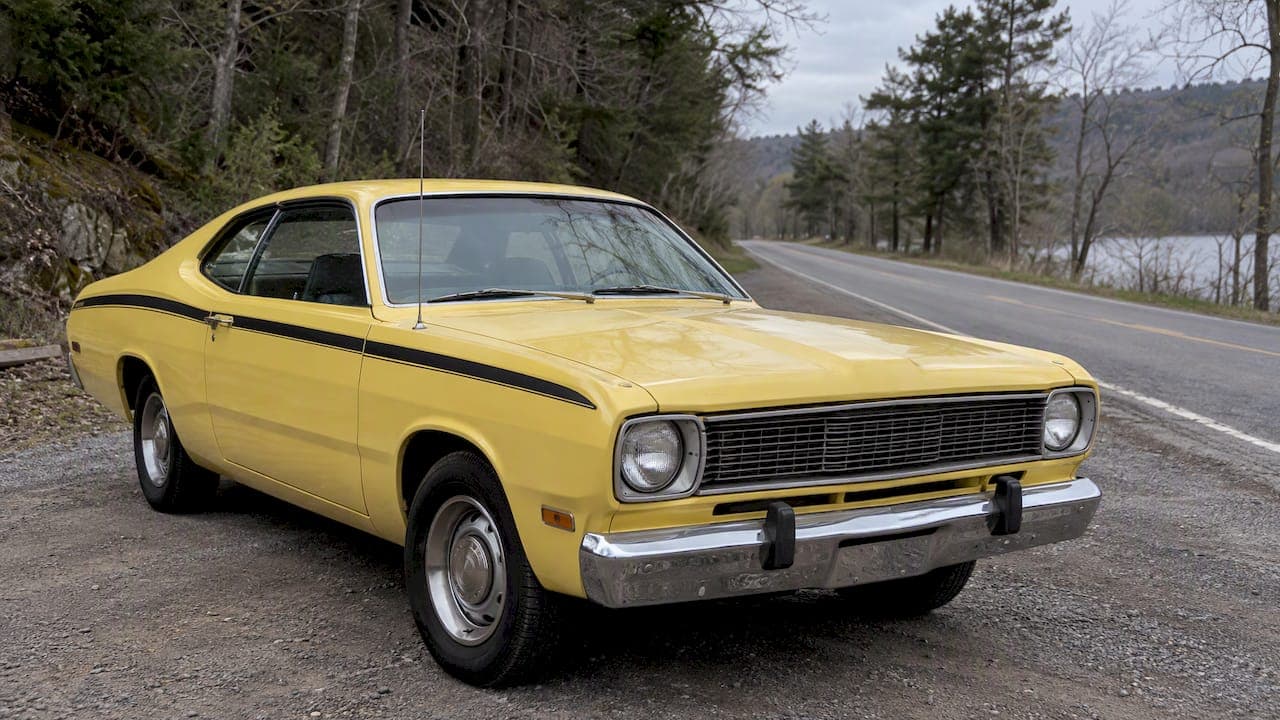
The Plymouth Duster is one of the last affordable ways into Mopar muscle, but the price range is huge. A tired slant-six coupe and a numbers-matching 340 four-speed can be a world apart in cost, so the car you pick matters more than the badge. This guide walks you through the engines, the VIN checks, the rust spots and the paperwork. You can then tell a good Duster from an expensive project.
TL;DR
- The 340 is the Duster everyone wants. The 1973 model year was its last, and only 15,731 Duster 340s were built that year, so verify what you are looking at.
- Check the VIN in two places: the radiator core support and the rear package tray. Then read the fender tag.
- Rust is the main budget killer. Floors, trunk, cowl, rockers and the tail panel come first.
- A base 318 or slant-six car can be a fun, cheap driver. A real 340 is a different market, and a restored one has sold for $159,500 at auction.
- Inspect before you pay, and get every document in hand before money moves.
Table of Contents
- Why the Duster is worth a look
- Pick your Duster: engines and trim
- Verify the car is what the seller says
- Rust: where to look first
- What to check on the rest of the car
- Restored or original?
- What does a Duster cost?
- Our take on buying a Duster
- Find your Duster with Butter Classics
- A simple buying checklist
- FAQ
- Sources
Why the Duster is worth a look
The Duster is Plymouth's sporty fastback-style coupe built on the compact A-body platform. It shares much of its hardware with the Dart and Valiant, which is good news for you. Parts are easy to find, the cars are simple to work on, and you can still find a clean one without a six-figure budget.
Production was big. In 1973 alone, 264,974 Dusters were built. That means there are plenty of cars out there. It also means most of them are not the performance versions, which is why the details below matter.
Pick your Duster: engines and trim
Start by deciding what you want from the car. There are really three kinds of Duster buyer.
| Buyer type | What to look for | What to expect |
|---|---|---|
| Weekend cruiser | Clean 318 or slant-six car, solid body, good interior | Lowest entry price, easiest ownership |
| Muscle car fan | Real 340 car with matching drivetrain | Higher price, documentation matters a lot |
| Collector or investor | Well-documented 1970-71 340, ideally four-speed | Top of the market, originality drives value |
The 340 years
The 340 is the car most buyers dream about. The 1973 model was the last year the 340 appeared in the Duster. That year brought power front disc brakes as standard and the Spacemaker Pak fold-down rear seat. Earlier cars, especially 1970 and 1971, usually get the most attention from collectors.
A lot of cars wear 340 badges, hood scoops and stripes that never left the factory that way. This is why you verify everything.
The 318 and slant-six cars
Most Dusters were not 340s. A 318 car is a perfectly good cruiser, and the slant-six is known for toughness. If you want to drive, enjoy and not worry, one of these in solid shape is a smart purchase. Just don't pay 340 money for one. Hagerty's valuation page for a 1973 Duster with the 318 lists a #3 "Good" value of $11,700 at the time we read it. Values move, so check the current number before you negotiate.
Verify the car is what the seller says
This is the step that separates smart buyers from sorry ones. Do it before you fall in love with the paint.
- Find the primary VIN. On 1963-74 A-bodies, including all Dusters, the primary VIN sits on the radiator upper core support.
- Find the secondary number. It is stamped on the rear package tray near the speaker opening, per the same MMC/ICCA white paper.
- Compare them. They should agree with each other and with the title and registration.
- Read the fender tag. It carries codes for the engine, transmission, paint and options. Our guide to trim tags in classic vehicles explains how to read them.
- Decode the VIN. Mopar enthusiasts use tools like the Lynch Road Mopar database to decode fender tags and VINs. The engine code in the VIN tells you if the car left the factory with a 340.
If the VIN is missing, welded over or looks reworked, walk away. If the numbers disagree, ask why, in writing.
What "numbers matching" really means
Numbers matching means the major components, usually the engine and transmission, are the originals stamped to the car. That is a big deal on a 340 four-speed. On a cheaper car it matters less. Pay for matching numbers only when the paperwork proves them.
Rust: where to look first
A-bodies rust, and the Duster is no exception. Water leaks from windshield and rear window seals make it worse. Bring a flashlight and a small magnet, and check these spots:
- Floor pans and the trunk floor
- Rear frame rails and the torque box area
- Lower fenders, rocker panels and the cowl
- The tail panel and the area under the rear glass
- Under vinyl tops, which often hide bubbling
- Around the windshield and rear window, where leaks start
Cars from rust-belt states deserve extra care. If one looks suspiciously clean for its history, it was probably restored, so you need to judge the quality of that work. Inspect the underside and ask for photos of the process. A car from a dry state, such as the California-built Curious Yellow 1971 Duster 340 profiled by Hot Rod, usually starts you with healthier metal. Even then, look underneath.
Owners on enthusiast forums say the same thing about budget cars: there is always more rust than you see. Treat visible rust as the tip of the iceberg when you build your budget.
For general structural thinking on any muscle car, read Structure First: Buying a Muscle Car Without a Frame Nightmare.
What to check on the rest of the car
Drivetrain
Start it cold if you can. Listen for knocking, watch for smoke, and look at oil pressure. Check for leaks at the transmission and rear axle. On four-speed cars, the clutch should engage smoothly without chatter, and the shifter should find every gear.
Suspension and brakes
A-bodies use torsion bar front suspension, so look at ride height and for sagging. Worn bushings and tired steering parts are common but cheap to fix. Check that the brakes pull straight. Front discs were standard on the 1973 Duster 340, and earlier cars may have been upgraded, so ask what was done.
Interior and trim
Cracked dashboards, split seat vinyl and missing trim all cost money, and some pieces are hard to find. Check that the gauges work and that the headliner is intact. Missing special trim for a performance model can be a pricey hunt.

Paperwork
Ask for the title, any build sheet or window sticker, restoration photos, receipts and service records. A clean title in the seller's name is a must. Our classic car test drive checklist covers the drive itself step by step.
Restored or original?
A restored car is not automatically better. Quality varies, and a cheap repaint can hide a lot. An original car with honest wear and good documentation can be worth more to the right buyer.
When a Duster needs work, the smart approach is a hybrid one. Restorers use reproduction panels such as floor pans and trunk floors, and save rare NOS parts for the pieces where authenticity counts. It keeps costs sane.
Budget for surprises too. We cover this in Original vs. Restored: Add a Roughly 30% Buffer. Even a nice car tends to need something after purchase.

What does a Duster cost?
Prices swing with engine, condition, documentation and originality. Here is how to think about it:
- Project cars. Rusty driver-grade 318 and slant-six cars sit at the bottom of the market, but rust repair can erase the savings fast.
- Good drivers. Hagerty's valuation tool lists a 1973 318 coupe in #3 "Good" condition at $11,700 when we checked. You can look up each year on Hagerty's Duster valuation page.
- Top 340 cars. A high-end restored 1971 Duster 340 four-speed sold for $159,500 including fees at Mecum Kissimmee in January 2024. That is an extreme example, not a typical price, but it shows how far the ceiling can go.
Check several recent sales, not just one listing. Compare condition honestly and don't pay a concours price for a driver.
Our take on buying a Duster
We love the Duster because it brings real Mopar fun without the intimidation. Our advice comes from how we work with collectors every day: buy the best-documented car you can afford, not the shiniest one.
Here is how we think about it:
- Paperwork first. A great story means little without a title, tags and records that agree.
- Pay for structure, not paint. Paint is easy to fix. Rusted floors and rear rails are not.
- Be honest about the engine. If you want a 340, buy a car that can prove it. If you want a cruiser, a clean 318 is a joy.
- Inspect it in person or through someone you trust. Photos help, but an inspection tells the truth.
That is why we focus on detailed listings with lots of photos and specs, and why our certified vehicles come with the Worry Free Guarantee. You shouldn't have to guess what you are buying.
— Tony
Find your Duster with Butter Classics
When you are ready to look, you can browse classic cars for sale on our inventory page. Our inventory is nationwide, not limited to one lot, and we can help with pickup or delivery. If you need funding, check out classic vehicle financing to pre-qualify. And if you have a Mopar to sell, you can consign your vehicle with us.
If you are cross-shopping other muscle cars, our guides to the Dodge Charger and the Chevelle SS use the same inspection mindset.
A simple buying checklist
- Decide your goal: driver, muscle car, or collector piece.
- Set a budget that includes a repair buffer.
- Verify both VIN locations and the fender tag.
- Inspect for rust with a light and magnet.
- Drive the car and check every system.
- Review the title and all records.
- Compare recent values before making an offer.
- Arrange insurance and transport before you pay.
FAQ
Which Plymouth Duster is the best to buy?
It depends on your goal. For value and performance, the 340 cars are the favorites, and the 340 ended after 1973. For a budget-friendly cruiser, a solid 318 or slant-six car is hard to beat. Whatever you choose, buy the best body and documentation you can afford.
How do I know if a Duster is a real 340?
Check the engine code in the VIN and compare it with the fender tag. Then confirm the primary VIN on the core support and the secondary number on the rear package tray. If the records and numbers don't agree, treat it as a clone until proven otherwise.
Are Dusters hard to restore?
They are among the easier classics to restore because of the A-body parts supply. Reproduction floor pans and trunk floors are available, which keeps costs down. Rare trim and performance pieces are the harder and pricier part.
What should I pay for a Duster?
It varies a lot. A driver-quality 318 car may be listed around $11,700 in Hagerty's "Good" condition for 1973, while documented, restored 340s can climb far higher. Look up your exact year and condition before you negotiate.
Sources
- 1973 Plymouth Duster 340: production, paint codes and options
- MMC/ICCA White Paper on A-body VIN locations
- How To Restore a 1971 Plymouth Duster 340, Hot Rod
- Steve Cabral's 1971 Plymouth Duster 340, Hot Rod
- 1973 Plymouth Duster, Hagerty Valuation Tools
- Plymouth Duster years, Hagerty Valuation Tools
- Mopar Fender Tag and VIN Decoders, Lynch Road
- Rust problem 74 Duster, For A Bodies Only forum