Yes, buying a classic truck can be a genuinely smart collectible purchase, but only when the vehicle has documented provenance, verifiable matching numbers, and a price that lines up with recent comparable sales. The trucks that hold or grow their value are the ones buyers can actually prove things about. The ones that lose money are the ones bought on gut feeling and a nice paint job.
Your next move isn't browsing listings for hours. It's narrowing the field. Pick one or two target models, set a total budget that includes transport and insurance (not just the sale price), and pull three recent comparable sales before you contact a single seller.
- Define your target: pick one or two model families you'd actually enjoy owning
- Set a real budget: sale price plus transport, insurance, and a repair cushion
- Pull three comps: recent sales in similar condition, not asking prices
- Check documentation availability: ask sellers upfront if they have titles, receipts, and history
Butterclassics keeps a working inventory of documented classic trucks with photos, specs, and history attached to each listing, which makes this comparison step a lot faster than piecing it together from scattered classifieds.
Key Takeaways
A classic truck earns its investment status through documented provenance, matching numbers, and a price grounded in real comparable sales, not sentiment.
| Point | Details |
|---|---|
| Age isn't collectibility | Twenty years qualifies a truck as "classic," but rarity, trim, and provenance determine actual value. |
| Frame before finish | Inspect frame rails, rockers, and cab corners before judging paint or interior condition. |
| Comps set your ceiling | Gather three recent sales in similar condition and adjust for documentation before making an offer. |
| Paperwork protects resale | Clean titles, service records, and trim tags add value; salvage brands cap it permanently. |
| Butterclassics simplifies verification | Documented listings, financing pre-qualification, and scheduleable inspections cut research time significantly. |
Table of Contents
- What Counts as a Classic Truck and What Collectors Value
- How Do You Evaluate a Classic Truck's Condition?
- How Do You Research Fair Pricing on a Classic Truck?
- Where Should You Buy, and What Online Red Flags Should You Watch For?
- What Paperwork Should You Verify Before Buying?
- What Should a Pre-Purchase Inspection and Test Drive Cover?
- How Should You Negotiate, Close, and Budget for Ownership?
- How Butterclassics Supports Buyers Through Every Step
- What Insurance Do You Need for a Classic Truck?
- How Do You Store and Maintain a Classic Truck After Buying It?
- What Do Restoration Costs and Hidden Expenses Really Look Like?
- Author Perspective: Common Buyer Mistakes and Practical Shortcuts
- Start Your Search on Butterclassics Today
- Sources
What Counts as a Classic Truck and What Collectors Value
Age is the easy part. Most insurers and collector organizations use 20 years or older as the baseline for "classic" status, a threshold Progressive lays out clearly. That means a 2006 truck technically qualifies today. But anyone who's shopped this market for more than a week knows age alone tells you almost nothing about whether a truck is worth collecting.
What actually drives value is a combination of rarity, originality, and story. A truck built in high volume with a base trim isn't scarce just because it's old. A truck with a desirable factory option package, a documented low-production run, or numbers-matching drivetrain components is a different animal entirely.
Here's what separates a truck collectors chase from one they pass over:
- Rarity and trim level: limited production runs, rare factory options, or special editions
- Matching numbers: engine and transmission serial numbers that align with factory records
- Provenance: a documented ownership chain, especially single-family or low-mileage history
- Historical significance: models tied to notable design shifts or manufacturing milestones
Certain families draw consistent collector attention: Ford F-series trucks (whose decades of model changes shaped an entire segment), Chevrolet C/10s from the square-body era, Dodge Power Wagons prized for early four-wheel-drive engineering, and early Ford Broncos that crossed from utility vehicle to genuine icon. None of these ranks above the others across the board. Each has its own community, price ceiling, and quirks worth researching before you commit to a lane.
One trend worth watching: younger collectors are pulling late-1970s through 1990s trucks into "collector" territory faster than the market expected a decade ago. If you're buying with resale in mind, that shift matters as much as anything from the muscle-truck era.
How Do You Evaluate a Classic Truck's Condition?
Cosmetics lie. A fresh paint job and clean interior can hide a truck that's structurally compromised underneath, so your inspection needs to work from the frame outward, not the other way around.
- Check the frame rails first. Look for rust perforation, kinks, or evidence of prior repair welds. A frame that's been patched instead of properly repaired is a major red flag, not a cosmetic footnote.
- Inspect inner rockers and cab corners. These areas rust from the inside out, so surface paint can look fine while the metal underneath is compromised. Push on them; soft spots tell the truth.
- Look at bed mounts and cross members. Rust here often signals years of moisture exposure that likely affected the frame too.
- Run the engine cold. Listen for knocking, check oil pressure at idle and under load, and watch the temperature gauge through a full warm-up cycle.
- Ask about drivetrain swaps. A non-original engine or transmission isn't automatically a dealbreaker, but it should come with documentation. Undocumented swaps make it hard to verify what you're actually buying.
- Weigh originality against restomod work. Numbers-matching, factory-original trucks generally command the strongest premiums among serious collectors. Restomods, meanwhile, satisfy buyer preference and daily-drivability more than they satisfy investment logic. Neither is wrong, but they're different purchases with different resale ceilings.
Pro Tip: Bring a magnet on your inspection. It won't stick to body filler, so running one along fenders, rockers, and quarter panels is the fastest way to find hidden bodywork before you ever open the hood.
When a truck clears your initial walk-around, bring in a specialist inspector, ideally one who works on classic trucks specifically rather than a general mechanic. Ask for a written report covering frame integrity, compression numbers, undercarriage photos, and an honest assessment of what's original versus replaced. A detailed condition evaluation before you buy costs a few hundred dollars and can save you from a five-figure mistake.
How Do You Research Fair Pricing on a Classic Truck?
Pricing a classic truck isn't guesswork if you use the right sources. Auction house results give you real transaction prices, not wishful asking prices. Price guide platforms aggregate sales data and classifieds to show ranges by condition tier. Between the two, you get a realistic picture of what buyers are actually paying, not what sellers hope to get.
Condition grading matters more than most first-time buyers realize. A truck in "excellent, unrestored original" condition and one in "good driver" condition can differ by tens of thousands of dollars for the exact same model year. Learn the grading tiers your target model uses and be honest about where the truck in front of you actually falls.
Provenance and matching numbers justify real premiums, but only when documented. A seller's claim that a truck is "numbers matching" means nothing without paperwork to back it up. Documented history consistently correlates with stronger long-term performance as a collectible, according to market analysis on classic truck sales, which is exactly why buyers should treat paperwork as part of the price, not an afterthought.
Here's the process that keeps you from overpaying:
- Gather three recent sales of the same model, year range, and condition tier
- Adjust upward for documented provenance, matching numbers, or rare options
- Adjust downward for non-original parts, deferred maintenance, or missing records
- Set a target offer based on your adjusted comps, plus a firm maximum walk-away price
Sticking to a walk-away number sounds obvious until you're three weeks into a search and emotionally attached to a truck that's priced $4,000 over market. Comps exist to keep you honest with yourself, not just with the seller.
Where Should You Buy, and What Online Red Flags Should You Watch For?
Your buying channel shapes both your price and your leverage. Auctions offer transparent pricing since you can see exactly what similar trucks sold for, but they come with time pressure and the risk of bidding past your ceiling in the moment. Private classifieds allow more room to negotiate but put the entire verification burden on you. Curated marketplaces sit in between, typically offering vetted listings and documentation support in exchange for less room to haggle.
Online marketplaces and auctions have become mainstream ways to buy classic vehicles, and for verifiable trucks with clean paperwork, they now compete directly with traditional dealer sales. That convenience comes with a catch: platform protections vary widely, so you need to know what red flags to watch for regardless of where you're shopping.
- Inconsistent or sparse photos: if a seller won't show the undercarriage or engine bay, ask why
- No visible VIN in any photo: legitimate sellers show VIN plates without hesitation
- Evasive communication: vague answers about rust, history, or accident damage
- Title anomalies: names that don't match, unexplained gaps in ownership, or "lost title" stories
- Unusual payment requests: wire transfers to unfamiliar accounts, gift cards, or "deposit before you see it" pressure
Protect yourself with a few non-negotiable steps: insist on an escrow arrangement for any long-distance purchase, request full documentation before sending a deposit, arrange an independent inspection even if the seller offers their own, and verify the VIN and title status directly with your state's motor vehicle records rather than trusting a screenshot.
What Paperwork Should You Verify Before Buying?
Title status is where classic truck deals quietly fall apart. A clean title means straightforward, unencumbered ownership. Salvage or rebuilt titles indicate the vehicle was declared a total loss at some point, which affects both insurability and resale value regardless of how good the repair looks. Bonded titles suggest a gap in ownership history that a state stepped in to resolve. Liens mean someone else has a financial claim on the truck, and you do not want to discover that after payment.
Beyond the title itself, certain documents actively add dollar value rather than just proving legal ownership:
- Service records showing consistent maintenance and honest mileage history
- Build receipts from restoration or major mechanical work, ideally itemized
- Original window stickers for trucks where these survived, which are rare and desirable
- Trim tags and assembly plates that decode factory options, paint codes, and build date
- Auction or dealer invoices from prior sales that corroborate the ownership chain
Learning to read a trim tag is one of the more underrated skills a serious buyer can develop, since it lets you cross-check a seller's claims against the truck's actual factory build sheet in minutes. Owner clubs and model-specific registries are also worth contacting directly. Many maintain production records or historical databases that can confirm or contradict a seller's story before you ever schedule a visit.
What Should a Pre-Purchase Inspection and Test Drive Cover?
A proper independent inspection takes 60 to 90 minutes and should be treated like a formal evidence-gathering session, not a quick once-over — use this pre trip vehicle inspection checklist to cover all the essentials efficiently.
- Photograph everything: frame rails, rocker panels, engine bay, undercarriage, VIN plate, and trim tag
- Record cold-start behavior: smoke color, idle smoothness, and how long it takes oil pressure to stabilize
- Test all electrical systems: lights, gauges, wipers, and any factory accessories the truck came with
- Drive at varying speeds: listen for drivetrain noise, check brake pull, and confirm steering tracks straight
- Check under load: have the inspector rev the engine and watch for smoke, and test towing capacity claims if relevant
- Document every finding in writing, including photos timestamped to the inspection date
A structured test-drive checklist keeps you from getting distracted by how fun the truck is to drive and forgetting to actually evaluate it.
Not every issue found during inspection carries the same weight. Structural frame failure, flood damage without full documented restoration, and severe internal engine damage are dealbreakers; walk away regardless of price. Worn brakes, tired upholstery, or a weak battery are negotiable repairs that belong in your offer, not your rejection pile.
Pro Tip: Get a written repair cost estimate for every issue the inspector flags before you go back to the seller. A specific number ("this needs $1,800 in brake work") is far more persuasive in negotiation than a vague complaint about condition.
How Should You Negotiate, Close, and Budget for Ownership?
Once your inspection report is in hand, build your offer around it directly. Reference specific findings and their repair costs, not general impressions. Sellers respond much better to "the inspection found $2,200 in needed brake and suspension work" than to "I think it's overpriced."
For payment, use an escrow service or a similar verified transaction method, especially for long-distance purchases. Avoid sending funds through a direct wire transfer to an account you can't verify, no matter how convincing the seller sounds on the phone.
Transport logistics deserve their own checklist:
- Choose a carrier with verifiable reviews and proper insurance coverage for classic vehicles
- Confirm insurance covers the truck's full agreed value during transit, not just a generic minimum
- Inspect the truck immediately on delivery, before signing any acceptance paperwork
- Photograph the truck at delivery to document its condition matches what left the seller
Budget beyond the purchase price too. Collector insurance, registration and title transfer fees, and a repair cushion for the maintenance items your inspection flagged should all factor into your total cost before you make an offer, not after.
How Butterclassics Supports Buyers Through Every Step
Everything covered so far, comps, documentation, inspections, is easier when the platform you're shopping does part of the legwork for you. Butterclassics builds detailed listings with high-resolution photos, full specifications, and documentation attached directly to each vehicle, so you're not chasing a seller for basic facts.
- Curated inventory across classic trucks, Broncos, and other collector vehicles with consistent listing standards
- Financing pre-qualification so you know your budget ceiling before you fall for a truck
- Consignment services for sellers, which means listings come with a documented chain of accountability
- Scheduleable test drives and quote requests to move from research to inspection without cold-calling strangers
Combine that with your own comps research and an independent inspection, and you're buying with the same rigor a seasoned collector would use.
What Insurance Do You Need for a Classic Truck?
Standard auto insurance policies often undervalue classic trucks because they price coverage based on depreciated market value, not collector value. That's a problem if your truck appreciates the way documented, well-kept classics tend to.
Classic and collector vehicle insurance policies solve this with what's called agreed value coverage. Instead of a claims adjuster deciding what your truck is worth after an accident, you and the insurer agree on a value upfront, backed by an appraisal, photos, and documentation. That agreed figure is what you get paid if the truck is totaled, not a depreciated estimate.
Most classic truck policies also come with usage restrictions. Expect mileage caps, storage requirements (often a locked garage), and limits on using the truck as daily transportation. These restrictions are the tradeoff for lower premiums compared to standard auto coverage, and most collectors find them easy to live with since a weekend classic isn't a commuter vehicle anyway.
Before you buy, get an insurance quote based on your target truck's actual value and intended use. Confirm the policy covers your specific model and condition tier, and ask whether the insurer requires a professional appraisal for agreed value coverage, since some do and some don't. This is worth doing before you finalize a purchase price, not after, since your insurance cost is a real part of your total ownership budget.
How Do You Store and Maintain a Classic Truck After Buying It?
Storage conditions have an outsized effect on a classic truck's long-term value, often more than people expect when they're focused on the purchase itself. A truck stored outdoors, even under a cover, degrades faster than one kept in a climate-controlled or at least dry, enclosed garage. Moisture is the enemy of both the frame and the interior.
A few maintenance basics protect your investment without demanding a full-time hobby:
- Run the truck regularly, even short drives, to keep seals lubricated and fluids circulating
- Use fuel stabilizer if the truck sits for more than a few weeks at a time
- Check tire pressure and rotate periodically to prevent flat-spotting from sitting still
- Keep a battery tender connected during long storage stretches
- Wax and undercoat treatments help protect original paint and prevent new rust from starting
If you're not planning to drive the truck often, consider a maintenance schedule built around time rather than mileage. Oil still degrades sitting in a crankcase, and rubber components dry out whether the truck moves or not.
What Do Restoration Costs and Hidden Expenses Really Look Like?
Restoration costs vary enormously depending on how much work a truck actually needs, and this is where inexperienced buyers most often underestimate their total investment. A truck that looks "mostly done" in photos can still carry thousands of dollars in deferred maintenance that only shows up once you own it.
Mechanical work, engine rebuilds, transmission service, brake systems, tends to be the most predictable cost category because parts availability and labor rates are relatively well known for popular models like the F-series or C/10. Bodywork and rust repair are where budgets blow up, since what looks like a small patch job can reveal much deeper corrosion once a panel comes off.
Hidden expenses tend to cluster in a few predictable places: wiring harnesses that look intact but fail under load, interior components that are harder to source than exterior trim, and glass or trim pieces for less common models that simply take longer and cost more to track down.
Author Perspective: Common Buyer Mistakes and Practical Shortcuts
The mistake I see most often isn't a bad truck. It's a good truck bought for the wrong reasons. Buyers fall for fresh paint and a tidy interior, then skip the independent inspection because "it looks great in person." Cosmetics are the easiest thing to fix and the least reliable signal of what you're actually buying.
The second mistake is treating title and branding issues as paperwork technicalities instead of value technicalities. A salvage brand doesn't just complicate insurance, it caps your resale ceiling permanently, no matter how well the truck was repaired.
If I had one shortcut to offer, it's this: confirm matching numbers and request complete receipts before you get emotionally invested, not after. Budget for transport and surprise repairs from day one. The buyers who do this calmly walk away from bad deals. The ones who skip it talk themselves into justifying anything.
— Tony
Start Your Search on Butterclassics Today
There's a real gap between browsing scattered classifieds and shopping a platform built specifically for collector-grade vehicles. Butterclassics closes that gap by putting documentation, photos, and specifications directly on every listing, so you're comparing real trucks with real histories instead of chasing sellers for basic facts.
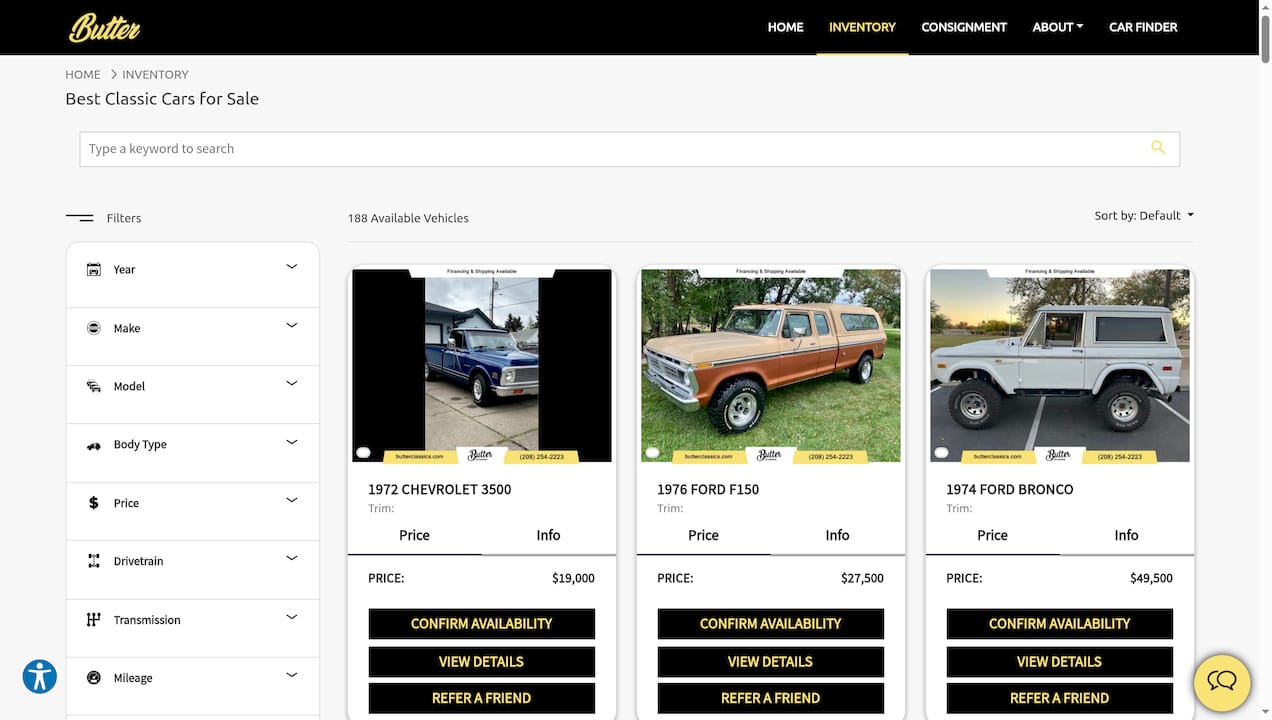
Every truck in the Butterclassics inventory comes with detailed specs and images you can use to build your own comps, exactly the process this guide walks through. Request full documentation on any listing that interests you, schedule an inspection or test drive directly through the platform, and use financing pre-qualification to lock in your budget before you fall for a truck that's out of range. If you're ready to put everything in this guide into practice, start browsing the current inventory and reach out on the listings that check your boxes.
Sources
- Progressive — How old does a car have to be to be a classic?
- The Arsenale — How to Navigate a Classic Truck Marketplace With Confidence
- Car and Driver — Ford F-Series pickup truck history