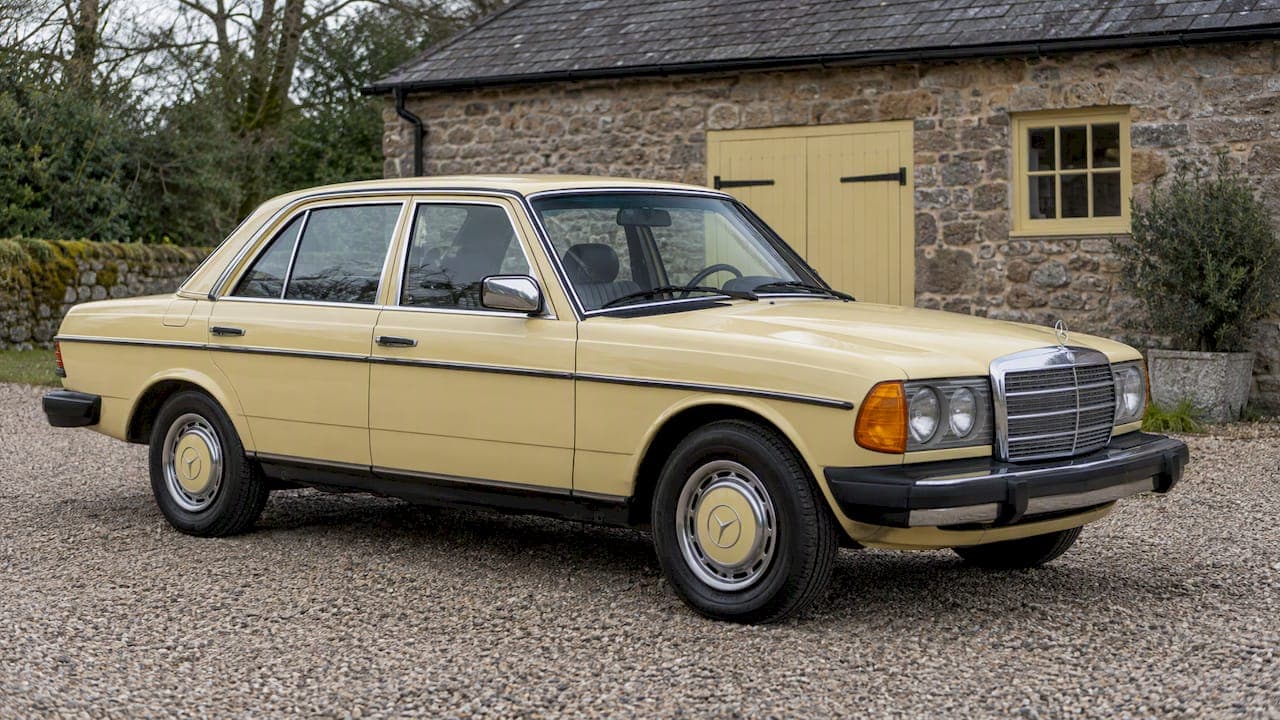
The Mercedes-Benz W123 is one of the easiest vintage Mercedes to live with, and one of the easiest to overpay for if you buy the wrong car. Buy the cleanest body you can find, pick the engine that fits how you'll drive, and don't let a shiny paint job talk you out of a proper inspection. This guide walks you through all three.
TL;DR
- Body condition beats everything else. Mechanical problems can be fixed, and rust spreads quickly if it isn't treated.
- U.S. buyers can choose from 230, 240D, 300D and 280E sedans, 280CE and 300CD coupes, and 300TD wagons, so match the body style and engine to your real use.
- Check the floor pans, fenders, wheel wells, sunroof tray and battery tray for rust, then check for a cracked dash, door-lock vacuum faults, tired suspension and rough automatic shifts.
- Bring a marque specialist for the final call. A few hundred dollars on an inspection can save you thousands.
Table of Contents
- Why the W123 is such a good first vintage Mercedes
- Which W123 should you buy in the U.S.?
- Start with the body: rust is the deal-breaker
- Inside the car: the dashboard and the door locks
- Engine and transmission checks
- Suspension and steering: the neglected part
- Service history, originality and restoration quality
- Bring in an expert before you pay
- How the W123 compares to other classics you might be weighing
- Our perspective
- Ready to find your classic?
- FAQ
- Sources
Why the W123 is such a good first vintage Mercedes
The W123 was revealed in 1975 and built through the mid-1980s. It came as a sedan (W123), a coupe (C123), a station wagon (S123), a limousine (V123) and a long-wheelbase chassis (F123), according to the Mercedes-Benz Club of America.
The club's buyer's guide calls it sturdy and reliable, and an affordable way into vintage Mercedes ownership. That matches why people love them. The cars are simple, the cabins are upright and comfortable, and a well-kept one feels solid in a way many newer cars don't.
That reputation has a catch. Because these cars are famous for lasting, buyers assume any W123 will last. A neglected one with hidden rust can cost more to fix than it's worth. The goal here is to help you find the good ones quickly and walk away from the rest.
Which W123 should you buy in the U.S.?
U.S. cars didn't get the full European lineup. The MBCA lists the American models as the 230, 240D, 300D and 280E sedans, the 280CE and 300CD coupes, and the 300TD wagon. Turbo diesels arrived in 1980 for wagons and 1981 for sedans and coupes.
The early cars are worth knowing about too. Early U.S. imports included the 240D and 300D diesels, plus the 230 gasoline model for 1977 to 1978 and the 280E gasoline model for 1977 to 1981, as summarized on Wikipedia.
Here's a simple way to think about it.
| Model type | Best for | Things to keep in mind |
|---|---|---|
| 240D / 300D sedan | Daily-style driving, long-term ownership, the classic W123 experience | Diesels are relaxed, not quick. Check for blowby and oil seepage. |
| 300D / 300TD turbo diesel | Buyers who want more pull on the highway | Turbo diesels are newer in the production run (1980 wagons, 1981 sedans and coupes). Ask for service records. |
| 280E sedan | Buyers who prefer gasoline and a smoother, quieter feel | Look hard at the fuel system history and the cooling system. |
| 230 | A simple early gasoline car | U.S. availability was limited to 1977 and 1978, so expect a smaller pool of cars. |
| 280CE / 300CD coupe | Style-first buyers | Coupes are rarer, and condition matters even more when parts are harder to find. |
| 300TD wagon | Families, road trips, anyone who wants to haul things | Wagons are popular, so expect competition. Check the rear load area and tailgate for rust. |
We'd steer most first-time buyers toward a sedan. There are more of them, so you can be choosy about condition, and that's where the real savings are. If you love wagons or coupes, be patient and hold out for the clean one.
Diesel or gasoline?
Most people picture a W123 as a diesel, and for good reason. The diesels are the cars that built the legend. But a diesel isn't automatically the better buy. Think about how you'll use it.
- Short trips and local errands: Either works, but a diesel that never gets fully warm can build up problems. A gasoline 280E may suit you better.
- Highway cruising and long ownership: A 240D or 300D fits well, and a turbo diesel adds some easy passing power.
- Hauling gear or family: The 300TD wagon is the obvious pick.
Whatever you choose, an honest, well-kept example of a "lesser" engine beats a neglected example of the one you wanted.
U.S. version quirks
U.S. W123s were modified for American safety and emissions rules. That's why you'll see big 5-mph bumpers and sealed-beam headlights that differ from European cars, as Wikipedia notes. Some buyers prefer the cleaner look of a European-spec car. If a seller says a car is a "Euro import," ask how it was brought in and whether the paperwork is in order before you go any further.
Start with the body: rust is the deal-breaker
The MBCA's advice is blunt and we agree with it: inspect the body and undercarriage for collision damage and corrosion. Mechanical issues can be repaired. Serious rust and bad bodywork are the expensive stuff.
The club names these rust spots to check:
- Floor pans
- Fenders
- Wheel wells
- Sunroof tray
- Battery tray
Here's how to check them without making a scene.
- Look at the car in daylight. Dry, bright light shows ripples, color mismatch and overspray.
- Get low. Check the floor pans from underneath, and lift the carpet and mats inside if the seller allows it.
- Open the trunk and the hood. Look at the battery tray and the corners around it. Battery acid and moisture cause trouble there.
- Check the sunroof. If the car has one, look at the headliner for stains and the tray for rust or blocked drains.
- Sight down the sides. Waves in the panels, uneven gaps and fresh paint in odd places can point to old collision repair.
- Bring a small magnet and use it gently on lower body panels. If it won't stick in places it should, there may be filler.
If you find rust, don't assume it's cosmetic. The MBCA warns it spreads quickly when left untreated, so a little bubble on the surface can be a bigger repair underneath.
Our rule: start with the cleanest body you can find, then fix the mechanicals. Doing it in the opposite order is how people end up with a mechanically perfect car that's dissolving.
For a broader walkthrough of judging overall condition, see our guide on evaluating vintage car condition before you buy.
Inside the car: the dashboard and the door locks
Two interior problems come up again and again.
Cracked dashboards. The MBCA says they are extremely common in W123s, and replacements are expensive. A small crack is easy to live with, and a dash cover or careful repair may be enough. A badly split one is a negotiating point. Build it into your offer rather than hoping it's fine.
Door locks. The central locking runs on vacuum, and the MBCA flags vacuum-related door-lock faults. Lock and unlock each door several times. If one door lags, doesn't latch, or the system clearly leaks, ask what's been done. These faults are often fixable, but they can take patience to track down.
While you're in there, run through the basics:
- Seat upholstery: tears, collapsed foam and sagging driver's seat
- Headliner: stains, sagging, signs of leaks
- Carpets: dampness or musty smell, which can point to a leak and hidden rust
- Windows, wipers, climate controls and every switch on the dash
A tidy interior is a good sign about how the car was treated. But a very fresh interior in a car with tired mechanicals can also be a flag that someone prepped it to sell. Ask what was done and when.
Engine and transmission checks
The W123 is known for durability, but that isn't a license to skip the checks. The MBCA tells buyers to look for engine blowby and oil seepage and to pay attention to how the automatic shifts.
On a cold start
Ask the seller not to warm the car up before you arrive. Then:
- Listen for how readily it starts, and watch the exhaust. Heavy smoke that doesn't clear needs an explanation.
- Check for oil around the valve cover, the front of the engine and underneath.
- With the engine running, remove the oil filler cap carefully and look for heavy puffing. That can be blowby, a sign of internal wear.
- Look at the coolant and oil for color and condition.
On the road
- The automatic should shift cleanly. The MBCA warns about rough or abrupt shifts, which can point to a transmission that needs attention.
- The car should track straight and brake without pulling or shuddering.
- Listen for knocks, whines and clunks from the driveline.
- Watch the temperature gauge on a longer drive.
For a full list of what to do behind the wheel, our classic car test drive checklist covers it step by step.
Suspension and steering: the neglected part
The MBCA specifically calls out suspension and transmission as areas often neglected. The W123's soft ride can mask worn parts. Because the car glides over bumps so nicely, a tired setup may not feel bad until you look closer.
Take a careful look at:
- Shocks, for leaks or a bouncy feel
- Springs, for sagging or cracks
- Control arm bushings and ball joints, for play
- Steering, for looseness in the center
- Tires, for uneven wear that points to alignment or suspension trouble
This kind of wear isn't a reason to walk away. It is a reason to price the repair into your offer. A car that's been maintained will show it here as well as on paper.
Service history, originality and restoration quality
A stack of receipts matters more than a glossy listing. Ask for:
- Dated service invoices, not just a summary from the seller
- Records of any rust repair, with before and after photos if possible
- Details on paint, interior or mechanical work done by a shop
- Proof of ownership and a clean title
As for originality, a W123 doesn't need to be a museum piece. Original paint and trim are nice, but a clean, honest, mostly original car with a few sensible repairs usually beats a freshly redone one with unknown quality. A cheap repaint can hide rust and bad bodywork. If the paint is perfect and the history is thin, be skeptical and ask the seller who did it.
If the car has been restored, ask what "restored" means. Was the rust cut out and new metal welded in, or was it covered with filler? Did the shop work on the mechanicals too? Photos taken during the work are the best proof.

See our guide on what to check before an inspection at a dealer for more ideas on the paperwork and condition questions that tell you what you're really looking at.
Bring in an expert before you pay
Even a careful buyer can miss things. A specialist who knows W123s will spot rust patterns, suspension wear and engine issues you wouldn't catch on a first look. The advice is the same across classic buying, from Mercedes to Italian sports cars: for a Ferrari 308, for example, an independent specialist inspection is a wise investment. A W123 is a far simpler car, but the logic holds.
What should the inspection cover?
- Body and undercarriage on a lift
- Compression or leak-down testing on the engine, if appropriate
- Transmission, steering and suspension
- Brakes and fluid condition
- Electrical, vacuum system and climate control
- A review of the records
We've written about what a classic car inspection costs in the U.S., and it's usually a small fraction of the price of the car. If the seller won't allow an independent inspection, treat that as an answer.
How the W123 compares to other classics you might be weighing
If you're cross-shopping, it helps to know what kind of checking each car needs. A Ferrari 308 is a different animal. Hagerty's guide says to check service history, warmed-up oil pressure, cam seals and rust at the sills, lower doors, arches and beltline. A continuous service record with Ferrari or reputable independent specialists is vital there and affects value.
The W123 is more forgiving. Its checks are about rust, a handful of known weak points and neglect. That's one reason it's such a friendly place to start.
Other classics have their own lists. If you're considering something different, take a look at our guides to the BMW E30 and the Porsche 944. And if you're thinking about taking on a project, our look at the hardest classics to restore will help you set your expectations.
Our perspective
We talk to buyers all the time, and the pattern is easy to spot. People who come to a W123 for the first time fall in love with how it feels, then rush. The ones who end up happiest slow down. They pass on a few cars, find one with a clean body and honest records, and pay a fair price for it.
Here's how we'd approach it:
- Pay for condition, not for a story. A seller's tale about a one-owner garage queen means little without records and a clean undercarriage.
- Don't chase the rarest version. A well-kept sedan is a better buy than a tired coupe.
- Budget for the first year. Even a good car will want fluids, tires, a few rubber parts and maybe suspension work. Plan for that so it doesn't feel like a surprise.
- Think about how you buy. A car that's been photographed thoroughly, described honestly and inspected means fewer surprises. That's how we list every vehicle, and it's why we offer Butter Certified cars backed by our Worry Free Guarantee.
The W123 rewards patience. Buy smart and it'll feel smooth as butter for a long time.
— Tony
Ready to find your classic?
If a W123 is on your list, or you're open to something similar, start by browsing our classic car inventory. Every listing has detailed photos and specs, and our inventory isn't tied to a single lot. Not sure what you want yet? Our Car Finder can help narrow it down, and we offer classic vehicle financing if you'd like to pre-qualify before you shop. Got a classic of your own to sell? You can consign your vehicle with us.
FAQ
Which W123 should I buy?
For most first-time buyers, a clean sedan is the best place to start. Choose the 240D or 300D if you want the classic diesel experience, or the 280E if you prefer gasoline. Coupes and wagons are great but rarer, so condition and price vary more.
Is the Mercedes W123 reliable?
The MBCA describes it as sturdy and reliable. That depends on how it's been maintained, though. Rust spreads fast if untreated, and suspension and transmission are often neglected, so a good inspection matters more than the badge.
What are the most common W123 problems?
Rust in the floor pans, fenders, wheel wells, sunroof tray and battery tray tops the list. Cracked dashboards, vacuum-related door-lock faults, worn suspension and rough automatic shifts are also common, according to the MBCA's buyer's guide.
Should I get a pre-purchase inspection?
Yes, especially if you're buying from out of town or can't tell how bad the rust is. A specialist can put the car on a lift and check things you can't see. Our guide to inspection costs shows what to expect.
Sources
- Buyer's Guide: Timeless Beauty, The W123 Sedan, Coupe and Wagon (MBCA)
- Mercedes-Benz W123 (Wikipedia)
- Your Handy 1976-85 Ferrari 308 Buyer's Guide (Hagerty Media)