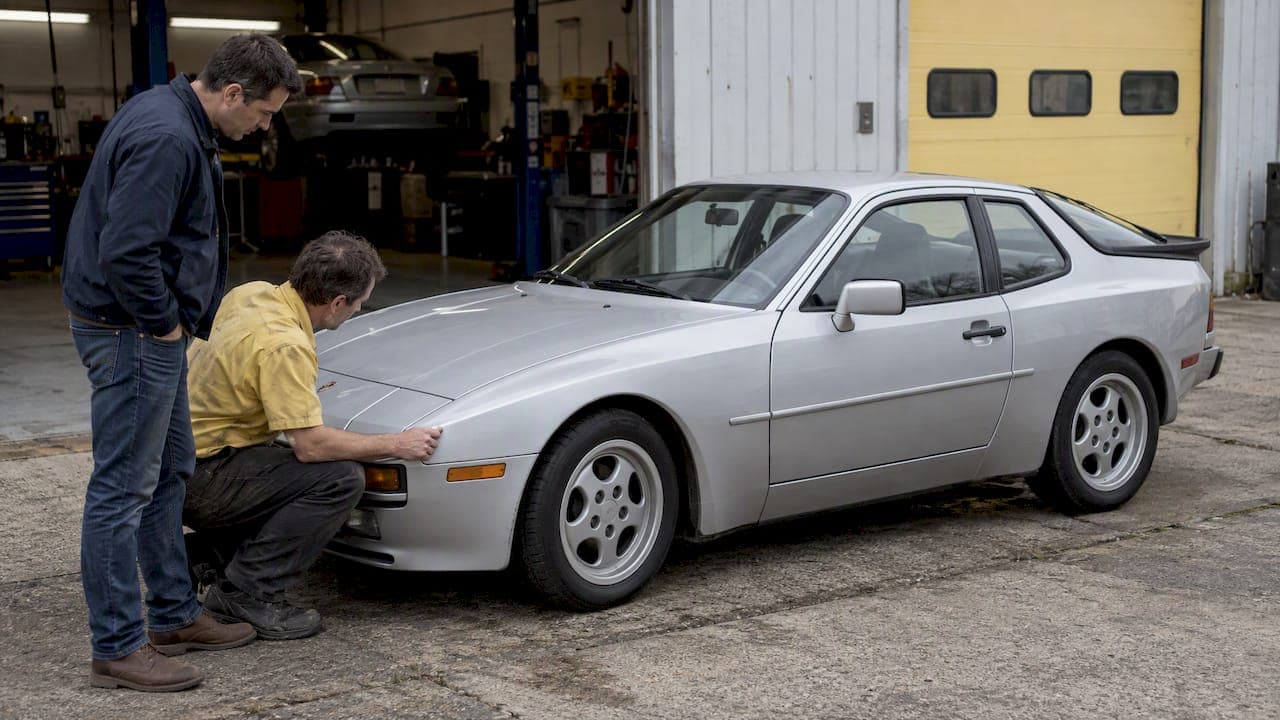
The best 944 to buy is the newest, best-documented car your budget allows, with proof the timing belt and water pump service is current and a clean report from a 944-savvy shop. Everything else, from trim to color, comes second. This guide walks you through the models, what they cost in 2026, the problems that matter, and a step-by-step way to inspect one.
TL;DR
- Buy condition and paperwork, not low mileage. A documented, well-serviced car beats a low-mileage car that sat for years.
- The timing belt and balance-shaft belt are the big one. The engine is an interference design, so a snapped belt can wreck it.
- Check the sills, rear suspension mounts and jacking points for rust, then get a pre-purchase inspection from a shop that knows transaxle Porsches.
- Budget for ownership, not just the purchase price. The 944 is no longer the cheap Porsche it once was.
- Expect roughly $12,000 to $20,000 for a solid driver-condition 1983 car, with S2 and Turbo models costing more.
Table of Contents
- Why the 944 is such a good way into classic Porsche
- Which 944 fits you
- What a Porsche 944 costs in 2026
- The timing belt: the first thing to verify
- Common issues beyond the belt
- Our take: how we'd shop for a 944
- A step-by-step way to inspect a 944
- Budgeting for the first year
- What about the 928?
- Finding and financing a classic like this
- FAQ
- Sources
Why the 944 is such a good way into classic Porsche
The 944 has a front engine, a rear-mounted gearbox and a balanced transaxle layout. Enthusiasts still praise how it handles. Period critics didn't like that it wasn't a rear-engined 911. Hagerty's valuation notes say those complaints don't hold up well in hindsight, because Porsche went on to build water-cooled 911s and front-engine SUVs.
It's also a car you can actually use. It's comfortable, it has a hatchback and it doesn't feel fragile. Car and Driver's 944 buying guide notes that every 944 has an aluminum-block four-cylinder, essentially half of a 928 V8, with twin balance shafts to calm the vibration of a big four.
That last detail explains a lot of what follows. The engine is clever, and clever engines need maintenance done right.
Which 944 fits you
There are four broad flavors. Here is how they differ for a buyer.
| Model | Character | Best for |
|---|---|---|
| Base 944 (2.5L) | The easy, balanced original. Lowest entry price. | First Porsche, weekend fun, budget-minded buyers |
| 944 S | 16-valve engine, more power, usually a bit pricier | Buyers wanting more pull without Turbo costs |
| 944 S2 | Bigger 3.0L engine, the most driver-friendly of the naturally aspirated cars | Regular drivers who want strong performance |
| 944 Turbo / Turbo S | Fastest and most collectible, with the highest prices | Collectors and enthusiasts with a bigger budget |
The short version: if you want to drive it often and keep costs sane, a late base car or an S2 is the sweet spot. If you want the car that will be most sought after later, look at the Turbo, but go in with a bigger budget for both the purchase and the upkeep.
Early vs. late cars
Later cars generally benefit from years of Porsche refinement, and more of them have had their weak points sorted by owners. Early cars can be charming and cheap, but you are more likely to find deferred work. Whatever the year, a well-kept early car beats a neglected late one.
What a Porsche 944 costs in 2026
Prices vary widely by condition, so ignore headline averages. Hagerty's 944 guide gives a useful spread:
- A 1983 944 starts at $5,000 in fair condition and can top $50,000 for a concours example. Solid #3 drivers fall in the $12,000 to $20,000 range.
- A good early Turbo needs roughly $40,000 to $55,000 in #2 (excellent) condition, with the very best approaching $80,000.
- A 944 S in excellent shape is roughly $23,000 to $33,000.
- A 1988 Turbo S is a $60,000 to $80,000 car in #2 condition.
- An S2 coupe in good condition tends to fetch $24,000 to $37,000, with excellent ones more like $43,000 to $55,000.
Those are valuation ranges, not asking prices, and the market moves. Treat them as a sanity check against any listing you're considering.
The Porsche Club of America's own members say the era of the cheap 944 is over. One PCA Mart column recalls buying an S2 for $8,000 in his twenties and notes that the same money today might get a decent 2.5-liter car with rough edges.

Buy the best car you can afford
The PCA's model guide makes the same point we'd make: the smart move is to buy the newest, best-maintained, highest-condition example your budget allows, instead of a cheap project that will need expensive repairs. A $9,000 car that needs $8,000 of work is a $17,000 car with a worse story.
The timing belt: the first thing to verify
If you remember one thing from this guide, make it this. The 944 engine is an interference design. If the timing belt or the balance-shaft belt fails, valves and pistons can collide and cause severe engine damage.
Porsche Mania puts replacement intervals at roughly 30,000 to 45,000 miles or every 3 to 5 years, whichever comes first, and says belt and idler kits run about $200 to $500 in parts alone before labor. Total service costs at specialist shops commonly land between $1,200 and $1,800 or more.
Other sources are more conservative on mileage. The Autopian mentions every 25,000 to 30,000 miles or so. The practical takeaway: judge by age as well as mileage, because rubber ages even in a garage.
What to ask the seller
- When was the timing belt last changed, and can you see the invoice?
- Were the water pump, tensioners and rollers replaced at the same time?
- Was the balance-shaft belt done too?
The water pump is driven by this system. It's a labor-intensive job, so the standard professional approach is to replace everything related while the engine is open. The PCA warns that cutting corners here often ends in catastrophic failure. If there's no paperwork, assume the job is due and price it into your offer.
Common issues beyond the belt
Rust in the sills and mounts
The 944 has a galvanized body, but that doesn't make it immune. Porsche Club GB's buyer's guide says to inspect the sills closely, since rust can start from the inside, plus the rear suspension mounting points and the front jacking points. Structural rust and the paint to go with it can easily run past $2,000 to $3,000.
Get the car on a lift. A flashlight and a quick walk-around won't show you what's happening inside a sill.

Electrical gremlins
The 944's reputation for electrical trouble mostly comes down to aging, simple parts. Classic & Sports Car notes the DME (engine computer) relay is a classic culprit. It's cheap and easy to replace, but it can strand an otherwise healthy car. Keep a spare in the glovebox.
Porsche Mania also lists cruise control wiring failure on its common-problems list, and says the computer and servo can both fail and be expensive to replace. If cruise control matters to you, test it.
Leaks
The Autopian flags a rear main seal leak as a proper pain, because the fix involves a lot of disassembly. Look underneath for oil and ask whether it has been addressed. Also check the clutch and the transaxle's operation on your test drive.
Low mileage is not always good news
A car that sat for years often has perished rubber, seized components and neglected cooling and fuel systems, according to Classic & Sports Car. A consistent service history on a higher-mileage car is usually the better buy. Paperwork beats odometer digits.
Our take: how we'd shop for a 944
We spend our days around classic cars, and the pattern is the same across makes, whether it's a Porsche, a Corvette or a muscle car. Buyers get burned when they fall for photos and a low price, then discover the real story later. The best purchases we see come from buyers who set a rule before they fall in love.
Here is the rule we'd use for a 944:
- Paperwork first. No belt receipt, no deal at the asking price.
- Pay for condition once. Paying more for a clean, sorted car is almost always cheaper than fixing a cheap one.
- Inspect before you commit. Photos and descriptions only tell you what the seller wants you to see. The PCA's own Mart columns say to always get a pre-purchase inspection, because descriptions and pictures don't tell the whole story.
- Think about how you'll use it. A weekend cruiser doesn't need Turbo money. A car you want to keep for a decade might.
The same discipline applies to any classic. We cover it in more depth in our classic car buying guide for first-time buyers and in our piece on evaluating vintage car condition before you buy. If you're comparing the 944 with the air-cooled 911 route, our classic 911 generation guide is a good next read.
— Tony
A step-by-step way to inspect a 944
- Read the records. Look for belt, water pump and tensioner invoices, plus consistent oil changes. Gaps tell a story.
- Walk the body. Check panel gaps, paint mismatch and sills. Look at jacking points and rear suspension mounts from below.
- Cold start. Ask that the engine be cold when you arrive. Listen for rattles and watch for smoke.
- Look underneath. Oil at the rear of the engine and around the transaxle area deserves a question.
- Test every switch. Windows, pop-up headlights, climate controls, cruise control. Electrical faults add up.
- Drive it properly. Check for smooth clutch engagement, clean shifts and straight tracking. Our classic car test drive checklist covers what to feel and listen for.
- Get a pre-purchase inspection. The PCA's guidance is to use a shop with experience on 944 transaxle cars, not just general Porsche knowledge. They will know to check for sills rotting from the inside, rear mount corrosion and the health of the clutch and transaxle.
Our dealer inspection checklist for classics shows what a thorough inspection looks like on any collector car, which helps you judge what a seller should be able to show you.
Budgeting for the first year
The purchase price is only the first check you write. Plan for these:
- Belt service if there's no proof it's current: $1,200 to $1,800 or more at a specialist, per the figures above.
- Spare parts such as a DME relay, which costs little and can save a tow.
- Rust or paint work if the inspection finds anything: thousands of dollars if it's structural.
- Tires and brakes, which matter more on a car that still handles as well as the 944 does.
A useful rule: set aside a cushion on top of the purchase price. If the car is cleaner than expected, you spend less. If not, you aren't stuck.
Modifications and handling
Many owners upgrade wheels, tires and suspension. If you're thinking about it, it helps to understand how wheel choice affects handling, and this explainer on wheel choice and handling is a solid primer. For a collector car, though, keep original parts if you can. Originality usually helps resale.
What about the 928?
Some readers searching for a 944 also look at the 928. The 928 is the bigger V8 grand tourer, and Car and Driver describes the 944 engine as essentially half of the 928's V8. The 944 is the lighter, simpler, more affordable entry. If you're drawn to a 928, the same rules apply: paperwork, condition and an inspection by a specialist before you buy.
Finding and financing a classic like this
At Butter Classics, we run an online marketplace for classic and vintage vehicles, with detailed listings, plenty of photos and specs, and financing pre-qualification. You can browse our inventory and schedule a test drive when something catches your eye. If you want to look at classic vehicle financing, you can pre-qualify before you start shopping.
Already own a classic and thinking of moving on? You can consign your vehicle with us.
FAQ
Is the Porsche 944 reliable?
It can be, if it has been maintained properly. The big risk is a neglected timing belt on an interference engine, which can cause severe damage if it fails. A car with a documented belt, water pump and tensioner service is a very different proposition from one with no records.
How much should I pay for a 944?
It depends on the model and condition. Hagerty's guide puts solid #3 driver-condition 1983 cars at $12,000 to $20,000, while S2 coupes in good condition run $24,000 to $37,000. Fair-condition base cars start around $5,000, but expect work.
Is a 944 a good first classic?
Yes, for a buyer who respects its maintenance needs. It's engaging and usable, but not cheap to run like a modern economy car. Buy the best example you can afford and have it inspected.
What is the most expensive 944 problem to avoid?
Engine damage from a failed timing belt is the worst case, followed by structural rust in the sills and mounts. Both are visible in paperwork or on a lift before you buy, which is why the pre-purchase inspection matters so much.
Sources
- Hagerty: Your Handy 1982-91 Porsche 944 Buyer's Guide
- Hagerty Valuation Tools: 1986 Porsche 944 Turbo
- Car and Driver: What to Buy, 1983-1991 Porsche 944
- Porsche Club of America: Model Guide, Front-engined four-cylinder Porsche sports cars
- PCA Mart: 1983 Porsche 944 column
- Porsche Mania: The 5 Most Common Porsche 944 Problems
- The Autopian: The Porsche 944 Is The Perfect First '80s Sports Car
- Porsche Club GB: Porsche 944 Buyer's Guide
- Classic & Sports Car: Buyer's guide, Porsche 944