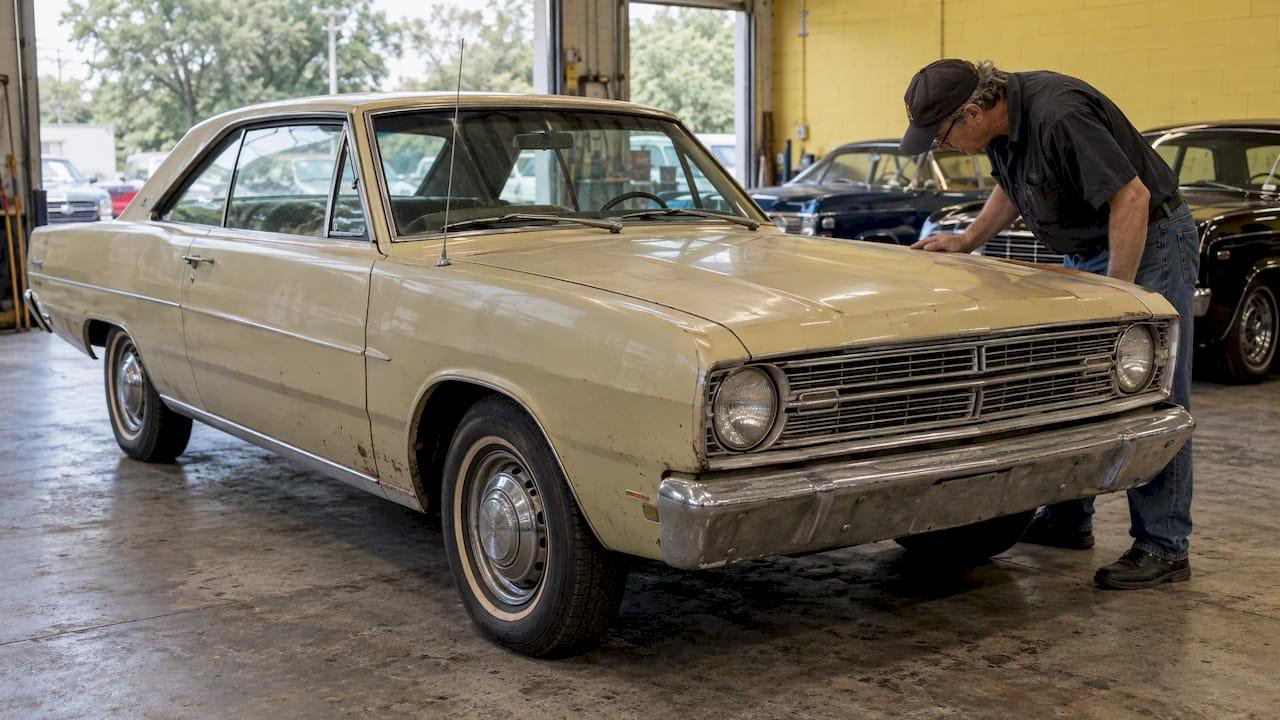
A good classic Dodge Dart is one of the most approachable Mopars you can buy, as long as you pick the right year, check the rust, and confirm the numbers match the story. This guide covers the vintage Darts (1960 to 1976), not the 2013 to 2016 compact sedan. It walks you through the generations, trims, engines, prices, inspection points, and what ownership looks like afterward.
TL;DR
- Vintage Darts run in four generations from 1960 to 1976. Most buyers shop the 1963 to 1976 cars, and the 1967 to 1976 cars have the biggest following.
- For 1967 to 1976 Darts, Hagerty puts the median #2 (Excellent) value at $14,200, but rare trims like the GTS and the Hemi cars sit far above that.
- Rust and past repairs matter more than engine size. Check floors, rockers, trunk, quarter seams and the front frame area before anything else.
- Match the VIN, fender tag and body stampings. A car that doesn't add up isn't worth the risk.
- Get a mechanic's inspection and paperwork (title, receipts, build records) before you pay.
Table of Contents
- Which Darts count as vintage
- Body styles and trims to compare
- Engines: from slant six to big block
- What a Dart costs
- Rust and body: where to look first
- Mechanical check
- Paperwork and originality
- Parts and what ownership looks like
- How we'd approach a Dart
- Find your next classic with us
- FAQ
- Sources
Which Darts count as vintage
The classic Dart came in four generations: 1960 to 1961, 1962, 1963 to 1966, and 1967 to 1976. The later 2013 to 2016 Dart is a front-wheel-drive compact sedan, a very different car, so if you're searching for classics, skip anything built after 1976.
In practice, most people shopping for a collectible Dart are looking at two groups:
- 1963 to 1966: the early, clean-lined A-body cars, including the convertible and the wagon.
- 1967 to 1976: the cars with the strongest collector pull, from the Swinger and Swinger 340 to the GTS.
The 1967 to 1976 cars are also where the performance story lives. If you want to see how Darts stack up against other budget-friendly muscle, our look at the most undervalued classic cars to buy now is a good companion read.
Body styles and trims to compare
The names change from year to year, so line up the trim you want before you start browsing. According to a classic Mopar identification guide, the breakdown looks like this:
| Years | Body styles | Trims |
|---|---|---|
| 1963 to 1966 | 2-door sedan, 2-door hardtop, 2-door convertible, 4-door sedan, 4-door wagon | 170, 270, GT |
| 1967 to 1969 | 2-door sedan, hardtop, convertible, 4-door sedan | Standard, 270, GT, GTS, Super Stock |
| 1970 to 1976 | 2-door sedan, hardtop, 4-door sedan | Standard, Custom, Swinger, Swinger 340 |
Two-door hardtops and convertibles usually attract the most attention. If you plan to drive the car hard on twisty roads, a convertible is worth a look: factory convertibles came with frame stiffeners. Four-door cars are the budget way in and are often the cleaner, less abused ones, though they won't pull the same resale numbers.
Engines: from slant six to big block
The Dart's engine menu is wide, and that's part of the fun.
The 1967 lineup. A 1967 Dart fact sheet lists a 170 cubic inch six (115 hp), a 225 six (145 hp), two versions of the 273 V8 (180 and 235 hp) and a 383 V8 (280 hp). The GTS arrived in late 1967 with the 383 B-block V8.

1968 changes. Dodge replaced the 273 two-barrel with a 318 rated at 230 bhp, and the four-barrel 273 gave way to a 340 V8 rated at 275 bhp in the Swinger and GTS, with a 383 big block as an option, according to Wikipedia's Dart entry.
The rare stuff. Only about 650 Darts left the factory with the 440 engine in 1968 and 1969 combined, against nearly 200,000 Darts of all kinds sold in 1969. Those 440 cars were built for drag racing. Hemi Darts for NHRA Super Stock were even rarer, with about 80 built.
The early 1970s. Emissions rules and insurance costs took the edge off. The same Hagerty piece notes the Dart 340 Sport was rated at 240 net hp in 1973, while the Swinger made do with a 150-hp 318.
The slant six. Don't write it off. The Chrysler slant six was in production in some form from 1960 to 2000, which means plenty of spare parts and plenty of people who know how to work on it. For a relaxed weekend cruiser, that's a smooth ride and an easy one to keep running.
What a Dart costs
Here's where the Dart shines. Hagerty reports that 1967 to 1976 Darts have a median #2 (Excellent) value of $14,200, with an average #2 value of $22,500. The average sits well above the median because the rare, high-powered cars pull it up. In the same comparison, 1968 to 1974 Chevy Novas had a median of $22,100 and 1966 to 1970 Ford Falcons came in at $13,800.
A few other reference points:
- A 1969 Dart GT with at least a 360 V8 was pegged by TopSpeed at $10,000 to $16,000 in good condition, against an original MSRP of $3,241.
- At the very top, Hagerty reported a highly original Hemi Super Stock drag car selling for $330,000, and another Hemi Dart for $159,500 two years earlier.
These are published reference values, not quotes for any specific car. Condition, engine, options, documentation and where the car sells all move the number. For a deeper look at how to read those numbers, see our guide to classic car valuation methods and the market trends checklist for 2026 buyers.
A quick way to size up an asking price
- Decide the trim and engine you want first. A Swinger 340 and a base slant-six sedan live in different price worlds.
- Pull published values for that exact year and condition level.
- Compare the asking price with what you'd spend to fix the car's flaws. A cheaper car with rust can cost more than a pricier clean one.
- Factor in paperwork. A car with receipts and a clear history is easier to buy and easier to sell later.
Rust and body: where to look first
Rust is the Dart's biggest enemy, and it's the single most important thing to check. Our own rundown of classic car rust spots covers the general picture. For Darts specifically, inspectors and owners point to the same areas again and again:
- Floor pans, rocker panels, trunk floor and quarter panels. A year-by-year Dart buying guide calls rust and underbody integrity critical.
- Front spring hangers, the top of the wheel wells and the trunk. Longtime owners on a Mopar A-body forum suggest checking all of these, plus the rear torsion bar anchors and the frame rails near the upper control arm mounts.
- Front frame rails near the radiator support. Look for poor welds, misaligned patch panels and overspray around trim and seams.
Simple tools that tell the truth
Bring a small magnet. Hagerty's inspection basics recommend using one to find body filler hiding rust, and looking at panel reflections for waviness that signals poor prep. Owners suggest wrapping the magnet in a chamois so it won't scratch the paint, and testing the front doglegs and the area behind the rear wheels.

Get under the car with a flashlight. Garage Spot's project car guide suggests poking suspicious spots with a screwdriver, because rust that looks like surface rust on top is often through-and-through underneath. It also warns that frame damage from an old accident can add thousands to a restoration and may compromise safety for good.
Finally, check panel gaps and doors. Doors should close cleanly, with strikers not pulled out of the body and hinges not worn out. Uneven gaps can point to old collision repair or a tired body.
Mechanical check
A healthy-looking Dart can still be tired underneath. Here's what to run through:
- Engine and transmission: Ask whether they're original to the car. State Farm's classic car buying guide suggests asking which parts are original, restored or aftermarket, and requesting receipts or work orders.
- Compression: One 1970 Dart guide suggests 120 to 160 psi per cylinder on a healthy engine, with big gaps between cylinders pointing to wear or valve trouble. Treat that as a rough guide and let your mechanic interpret the numbers for the specific engine.
- Common trouble spots: Brittle wiring, corroded connectors, cooling system problems, oil leaks and worn steering or suspension parts show up often on cars of this age.
- Brakes: Look for a solid pedal and dry brake drums and backing plates. Many early cars came with a single-reservoir master cylinder, and owners recommend upgrading it to a dual-reservoir design.
- Wiring: A harness covered in electrical tape or crimp connectors is a sign of past shortcuts.
- Bushings and mounts: Original rubber suspension bushings and engine or transmission mounts will likely need replacing.
Take the car on a real drive, not just around the block. Hagerty suggests varied roads to check tracking, unusual noises and whether the drivetrain feels right. Then have an independent mechanic who knows older cars go over it. The Arizona Department of Transportation's car buying checklist specifically recommends a reputable mechanic's full inspection of mechanical and electrical systems.
Paperwork and originality
A Dart without a clean paper trail is a gamble, and this is where many deals go wrong.
Title and VIN
State Farm advises you to verify the title details, confirm the seller can transfer ownership, and match the title VIN to the car's VIN tag. The Arizona checklist adds a few more steps: confirm the seller's name matches the title owner, check the VIN on the dashboard and the driver's door jamb, look at both sides of the title for alterations, and note any salvage brands or liens. Titling rules vary by state, so check with your own state's motor vehicle agency before you buy.
Fender tags and body stampings
For Darts, the fender tag tells the car's story. According to a Mopar documentation article, on 1969 and later cars the fender tag VIN should match the dash VIN. On 1968 and earlier cars, the Vehicle Order Number is stamped on the body in at least two places, usually the radiator core support and under the weatherstripping along the driver's side of the trunk extension, and should match the fender tag.
The same article warns that if the stampings don't match the tag and dash VIN, you should think hard before buying. Building and selling fake cars is fraudulent, and a buyer who knows a car is bogus and doesn't disclose it later could be held liable.
This matters most on the cars that carry a premium: GTS, 340 and 383 cars, and anything claiming to be a 440 or Hemi. Documentation is also what supports value later. A matching-numbers engine, a correct VIN and a clear history can significantly affect value and ease of resale.
Ask for receipts
If a seller says the floors were replaced or the engine was rebuilt, ask to see receipts, work orders or photos of the work. Also check interior originality: seats, upholstery, dash, radio, badges and emblems. State Farm recommends all of these, along with checking paint condition and panel alignment for signs of major welding.
Parts and what ownership looks like
The good news: common suspension parts, trim and basic interior pieces are generally easy to find for Darts, and the slant six has a deep pool of parts and know-how. The harder items are the rare ones, like correct grille pieces, original GTS badges and specific trim panels.
A few practical rules for the first year:
- Fix structure first. A sound chassis and reliable drivetrain keep long-term costs down and protect resale value, so handle rust repair and mechanical systems before cosmetics.
- Pick a shop with Mopar experience. For sheet metal, paint matching or drivetrain rebuilds, ask for references from other Dart owners.
- Refresh the wear items. Plan on bushings, mounts, brake components and wiring work for a car that's been sitting.
- Protect the paint. Once the car is sorted, a spray and rinse coating can help you wash panel by panel without streaks, which is handy on fresh bodywork.
Thinking about how a Dart compares with other affordable Mopars? Our Plymouth Duster buyer's guide and the Dodge Charger buyer's guide cover the Dart's close relatives and bigger siblings.
How we'd approach a Dart
We love a Dart because it lets more people into real Mopar ownership. You don't need a six-figure budget to get a car with style, a great engine lineup and a loyal community.
What we'd tell any buyer is to shop the car, not the badge. A clean, honest, well-documented Swinger often makes a better ownership experience than a flashy clone with a thin story. That's why photos, specs and history matter so much to us, and why we build our listings around them.
Our Butter Certified vehicles come with what we call the Worry Free Guarantee, and we handle delivery or pickup in a way that's meant to be smooth as butter. Because our inventory is nationwide rather than tied to one lot, you can look for the exact year and trim you want instead of settling for whatever is nearby.
And if you already own a Dart and are ready for the next chapter, our consignment service is built for exactly that.
Tony
Find your next classic with us
Ready to look at real cars? Browse our nationwide classic car inventory for detailed listings with extensive photos and specs. You can also pre-qualify for financing, request a quote or schedule a test drive.
Have a Dart or another classic you'd like to sell? Take a look at our consignment service and we'll walk you through how it works.
FAQ
What is the best year for a classic Dodge Dart?
It depends on your goal. Collectors tend to chase the 1967 to 1969 GTS and 340 cars, while the early 1970s Swinger 340 offers strong looks at a friendlier price. For a simple driver, a slant-six or 318 car in solid, rust-free shape is often the smartest buy.
How much does a vintage Dodge Dart cost?
Hagerty puts the median #2 (Excellent) value for 1967 to 1976 Darts at $14,200. Project cars cost less, while rare 440 and Hemi cars can be worth far more. Always compare against current values for the exact year, trim and condition.
Are classic Darts hard to find parts for?
Not for the basics. Suspension parts, common trim and simple interior pieces are generally easy to source, and the slant six has long had strong support. Rare badges, grille pieces and special trim panels cost more and take longer to find.
How do I know a Dart is a real GTS or 340 car?
Check that the VIN, fender tag and body stampings agree, and ask for build or ownership records. On 1968 and earlier cars, the Vehicle Order Number stamped on the body should match the fender tag. If the numbers don't line up, think carefully before you buy.
Sources
- Dodge Dart Generations, iSeeCars
- How to Identify Classic Dodge and Plymouth A, B, and E-Body Vehicles
- 1967 Dodge Dart Fact Sheet, Over-Drive Magazine
- Dodge Dart, Wikipedia
- Want accessible Mopar muscle? Check out Dodge's '67 to '76 Dart, Hagerty Media
- The 1967 to 76 Dodge Dart offers temptingly cheap thrills, Hagerty Media
- American muscle cars you can buy for less than $30,000, TopSpeed
- You Should Buy an Old Dodge Dart With a Slant Six, MotorBiscuit
- What year to stay away from Dodge Dart, Ryan's Auto Care
- What common issues to look for when buying, For A Bodies Only
- Complete Guide to Buying and Fixing a Project Car, Garage Spot
- Collector Vehicle Inspection Basics, Hagerty
- Dodge Dart 1970 Restoration Guide, AnUsedCar
- How To Buy a Classic Car, State Farm
- Car Buying Checklist, Arizona Department of Transportation
- Documenting Chrysler, Dodge, Plymouth and Mopar Fender Tags, Max Wedge