If you're buying a classic car through an online marketplace, do these five things first: run the VIN and history report, get an independent inspection, verify title and buyer's paperwork, secure payment through escrow or vetted methods, and plan transport and registration before you sign anything. Butterclassics and blog author Tony cover each of these steps in detail. Here's the full walkthrough, step by step.
TL;DR:
- Verifying the VIN, history report, and provenance is essential to detect salvage titles, odometer rollbacks, or tampering before bidding.
- A thorough pre-purchase inspection should examine the frame, engine, and undercarriage to identify rust, crash repair, or mismatched numbers.
- Buyers must gather and verify key paperwork, including a clear title, bill of sale, lien release, and odometer disclosure, with a legal FTC Buyer's Guide if applicable.
- Using escrow and confirming seller identity minimizes financial risks when paying for a classic car online, especially for sight-unseen transactions.
- Forming an LLC provides liability protection and estate-planning advantages but requires careful setup, dedicated insurance, and consistent recordkeeping.
Table of Contents
- What Should You Research Before Bidding on a Classic Car?
- What Should a Pre-Purchase Inspection Cover?
- What Paperwork Protects You as a Buyer?
- How Do You Pay Safely for a Classic Car Online?
- How Do You Ship and Register a Classic Car After Purchase?
- Should You Buy Your Classic Car Through an LLC?
- How Do You Set Up an LLC to Buy a Classic Car?
- What Are the Tax Implications of an LLC-Owned Classic Car?
- How Do You Insure a Classic Car Owned by an LLC?
- How Does an LLC Affect Reselling a Classic Car?
- Our Take on Buying Smart in Today's Marketplace
- Ready to Find Your Next Classic?
- Where to Verify the Rules Yourself
- Sources
- FAQ
What Should You Research Before Bidding on a Classic Car?
The best classic cars to buy are rarely the flashiest listings. They're the ones with the cleanest paper trail behind them. Before you place a bid or send an offer, dig into provenance: who owned it, where it lived, and whether the history matches the odometer and the panels. A car with three owners and a stack of dated service receipts is worth more, and safer to buy, than a "barn find" with no paper backing it up.
Run a VIN-based history check before you get emotionally attached. Look for salvage titles, odometer rollbacks, flood damage, or a VIN that doesn't match the registration state. Any of those should stop the deal cold or force a serious price renegotiation.
Next, price the car honestly. Compare recent auction results and completed marketplace sales for the same model and condition, then budget beyond the sticker: missing service history, partial restorations, storage, and classic car insurance all add real cost. Confirm whether you're buying from a licensed dealer or a private seller, since that changes your legal protections significantly.
- Ask for VIN photos from multiple angles, not just the dash tag.
- Request original receipts, build sheets, and any restoration invoices.
- Confirm mileage against service records, not just the odometer reading.
- Get the seller's return or as-is policy in writing before you commit.
Pro Tip: Ask the seller to photograph the VIN stamped on the frame or firewall, not just the dashboard plate. Mismatched stampings are one of the fastest ways to catch a rebuilt or reassembled car before you've spent a dime.
What Should a Pre-Purchase Inspection Cover?
A proper inspection is not a walk-around with a flashlight. It's a systematic check of the parts that hide problems: frame integrity, rust in the floor pans and rockers, evidence of prior crash repair, and whether the engine and body numbers actually match. Any classic car buyer skipping this step is gambling with a five-figure decision.
- Frame and structure. Check for rust bubbling, filler, or uneven panel gaps that suggest collision repair.
- Matching numbers. Compare the engine block, transmission, and VIN stampings against the title and any factory documentation.
- Fluid and mechanical health. A compression or leak-down test often reveals engine issues that a visual inspection misses entirely.
- Undercarriage. Look for fresh undercoating, which sometimes hides rust or a poorly repaired frame.
For provenance, original paperwork, factory build sheets, and expert authentication carry real weight. A car with a matching build sheet and period-correct parts commands a stronger resale price down the line.
VIN problems deserve special caution. Some states have loosened penalties for restorers who legitimately remove and reinstall a VIN plate during frame-off work, but tampering still carries legal risk in many jurisdictions, and buyers still bear the burden of verifying the VIN is intact and legitimate before money changes hands. If a VIN looks altered, re-stamped, or missing, that's your walk-away signal, not a haggling chip.
What Paperwork Protects You as a Buyer?
Federal law gives you real leverage here, and most buyers never use it. Dealers who sell more than five used vehicles in a 12-month period are legally required to post an FTC Buyer's Guide on the vehicle, and that requirement applies to online listings too. The Guide discloses whether the car is sold "as is" or with a warranty, and here's the part most buyers miss: if the Buyer's Guide and the sales contract disagree, the Guide legally controls. Insist on a corrected Guide if you negotiate any warranty terms.
Private sellers are generally exempt from the Buyer's Guide rule, which makes your own documentation habits even more important.
Collect and verify these before you wire a dollar:
- Signed, clear title (not a photocopy)
- Bill of sale with VIN, price, and date
- Lien release if the car was financed
- Odometer disclosure statement
- Any written warranty terms, matching the Buyer's Guide
Rules and taxes vary by state, so confirm requirements with your state DMV or attorney general's consumer site before you finalize anything. A documentation checklist built specifically for U.S. buyers can save you a frustrating trip back to the seller for missing paperwork.
How Do You Pay Safely for a Classic Car Online?
Financing for a classic car LLC purchase or a personal purchase works differently than financing a daily driver. Specialty lenders that focus on collector vehicles typically compare interest rates, loan-to-value ratios, allowable use restrictions (some loans bar daily driving), and whether GAP insurance is available to cover the gap between loan balance and insured value after a total loss.
For the payment itself, never wire funds directly to an unverified account. Escrow, or an escrow-like service that holds funds until the title and vehicle condition are confirmed, is the safest route for any transaction over a few thousand dollars. Insist on escrow for sight-unseen purchases especially.
- Verify the seller's identity against the title name, not just a listing profile.
- Call the bank directly, using a number you find independently, before sending wire details.
- Never send payment through gift cards, cryptocurrency, or "buyer protection" links in an unsolicited email.
- Structure a holdback: release a portion of funds only after the independent inspection clears.
Pro Tip: If a seller pressures you to skip escrow "to save time," treat that as a red flag, not a convenience. Legitimate sellers rarely object to a few extra days of protection on a high-value sale.
How Do You Ship and Register a Classic Car After Purchase?
Buying out of state adds a logistics layer that a local purchase skips entirely. Coordinate your independent inspector to act as your eyes on the ground: instruct them to test-drive the car, check cold-start behavior, and photograph anything that doesn't match the listing before you release final payment.
- Choose your transport. Open-carrier shipping costs less; enclosed transport protects paint and interior on rarer or higher-value cars.
- Confirm cargo insurance with the carrier before the car loads, and get the coverage amount in writing.
- Transfer the title at your state DMV within the window your state requires, typically 10 to 30 days.
- Register and insure the vehicle, checking whether your state requires an emissions or safety inspection for classic or antique plates.
- Activate insurance before the car ever touches public roads, even for the drive home from the transport drop-off.
Should You Buy Your Classic Car Through an LLC?
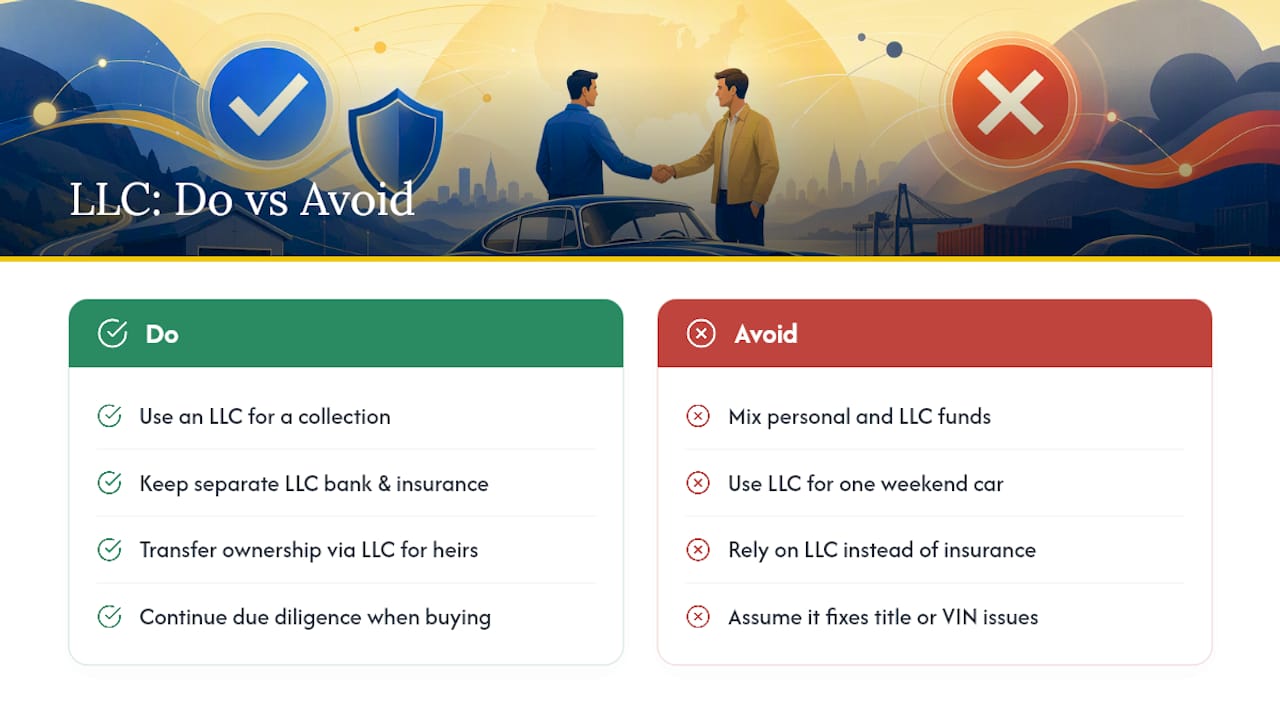
Forming an LLC to hold a classic car adds a legal buffer between the vehicle and your personal assets. If someone is injured in an accident involving the car, or a dispute arises over its condition after sale, the LLC structure generally limits exposure to the assets inside that LLC, not your home, savings, or other property. That's the core benefit collectors cite when they explore forming a classic car business entity instead of buying in their own name.
The tradeoff is complexity. An LLC needs its own bank account, its own insurance policy, and its own recordkeeping, separate from your personal finances. Courts have "pierced the corporate veil" in cases where an LLC owner mixed personal and business funds carelessly, which erases the liability protection entirely. If you're buying one car for weekend driving, the paperwork burden may outweigh the benefit. If you're building a small collection, especially one you might sell pieces of over time, the separation starts to make more sense.
There's also a practical layer collectors overlook: an LLC can simplify passing a collection to heirs or partners, since ownership interests in the LLC can transfer without retitling each individual vehicle. That's a meaningful classic car LLC benefit for anyone thinking about estate planning alongside collecting.
None of this replaces good insurance or careful buying habits. An LLC protects against certain liability scenarios; it does not protect you from buying a car with a rebuilt title or a mismatched VIN. The due diligence steps earlier in this guide still apply, LLC or not.
How Do You Set Up an LLC to Buy a Classic Car?
Starting a classic car LLC follows the same basic path as forming any small business entity, with a few collector-specific details layered in.
First, choose your state of formation. Most collectors form the LLC in their home state, since operating a business (even a passive holding company) in a state where you don't have a registered entity can trigger extra filing requirements. Next, file Articles of Organization with your state's Secretary of State office, along with the filing fee, which varies by state.
After formation, draft an Operating Agreement. This document spells out who owns what percentage, how decisions get made, and what happens if a member wants to sell their share or the LLC wants to sell the car. Skipping this step is common and risky, especially if more than one person is involved in the purchase.
Then get an Employer Identification Number (EIN) from the IRS, even if the LLC has no employees. You'll need it to open a dedicated business bank account, which is non-negotiable if you want the liability protection to hold up. Title the vehicle in the LLC's name, not your personal name, when you complete the purchase and registration.
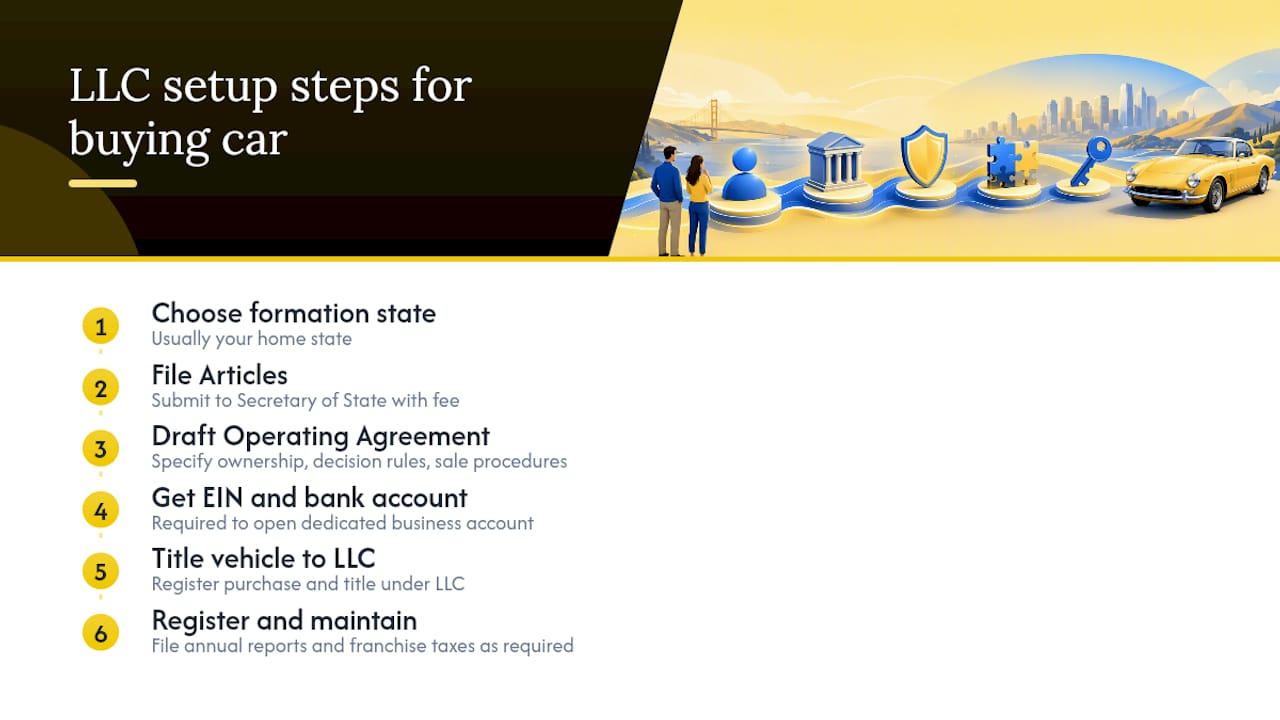
Finally, register the LLC in any state where it will "do business" if that differs from your formation state, and check whether your state requires an annual report or franchise tax filing to keep the entity active. Miss that filing, and the state can administratively dissolve your LLC, along with the liability shield you formed it for.
What Are the Tax Implications of an LLC-Owned Classic Car?
Tax treatment depends heavily on how the LLC uses the vehicle, and this is where a lot of collectors get overly optimistic. A car that sits in a garage as a personal hobby vehicle, even if titled to an LLC, generally doesn't qualify for business deductions just because an LLC owns it. The IRS looks at actual use and profit motive, not just the name on the title.
Where the tax advantages become real: if the LLC genuinely operates as a business, buying, restoring, and reselling classic cars for profit, then expenses like restoration costs, storage, transport, and even a portion of insurance can potentially offset income as ordinary business expenses. Some collectors structure their LLC as a vehicle-leasing or exhibition business, renting cars out for shows or shoots, which can support legitimate deductions tied to that activity.
Sales tax treatment also varies by state and by how the LLC is structured, particularly around resale exemptions if the LLC is genuinely in the business of buying and selling vehicles rather than holding a personal collection. A single passive holding LLC rarely qualifies for those exemptions.
This is genuinely one area where a mistake gets expensive fast. A tax professional familiar with vehicle-holding entities in your specific state can tell you whether your situation supports real deductions or whether you're just adding paperwork without any tax advantage. Treat the LLC as a liability tool first and a tax tool only if your accountant confirms it.
How Do You Insure a Classic Car Owned by an LLC?
Personal auto policies generally will not cover a vehicle titled to a business entity, which catches a lot of new LLC owners off guard after the purchase closes. You'll need a commercial auto policy or a specialty classic-car policy written specifically to a business name, and not every insurer offers that combination.
Specialty classic car insurers do write policies for LLC-owned vehicles, but expect to provide more documentation than a personal policy requires: the LLC's formation documents, proof of the vehicle's title in the LLC's name, and sometimes a description of how the LLC uses the car (storage, occasional shows, limited driving). Agreed-value coverage, where the insurer commits to a set payout rather than depreciated market value, matters even more here since replacing a rare classic at "actual cash value" rarely covers a real replacement.
Liability limits deserve a second look too. An LLC intended to shield personal assets works better alongside adequate liability coverage on the policy itself, since a lawsuit that exceeds the policy limit can still reach toward the LLC's other assets. Talk to an agent who has specifically written commercial or LLC-titled classic car policies before you assume your existing carrier can simply add the car to an existing account.
How Does an LLC Affect Reselling a Classic Car?
Selling a car titled to an LLC works differently than a private-party sale, and it can actually work in your favor. Instead of retitling the vehicle at the DMV every time ownership changes hands, you can sell membership interests in the LLC itself. The car stays titled to the same entity; only the ownership of that entity transfers.
This matters most for collectors with multiple cars in one LLC or partners who want to buy in and out of a collection over time. It also matters for succession planning, since transferring LLC membership interests to an heir avoids the probate delays that can tie up a vehicle titled in an individual's name.
The downside: buyers sometimes hesitate at a membership-interest sale because it's less familiar than a straightforward title transfer, and it can complicate financing since most classic-vehicle lenders are set up to lend against a titled asset, not an LLC ownership stake. If you're planning to sell the car itself rather than transfer LLC ownership, you'll still go through a standard title transfer, bill of sale, and the documentation steps covered earlier in this guide. Keep the LLC's records current either way, since a lapsed or dissolved LLC complicates any sale, membership transfer or otherwise.
Our Take on Buying Smart in Today's Marketplace
Most guides treat classic car buying like used-car shopping with better lighting. It isn't. The stakes are higher, the paperwork is thinner, and the sellers range from meticulous restorers to people who genuinely don't know their VIN has an issue. That gap is where buyers get burned, not from outright fraud, but from optimism outrunning verification.
The LLC question gets oversold in one direction and dismissed too fast in the other. An LLC won't fix a bad inspection or a mismatched VIN, and it won't turn a hobby car into a tax write-off just because a lawyer filed some paperwork. But for a real collection, or for anyone buying with a partner or planning to pass cars to heirs, the liability separation and the membership-transfer flexibility are worth the filing fee and the extra bookkeeping. Treat it as a structural decision, not a magic trick.
This process rewards patience and punishes shortcuts. A marketplace offering detailed photos and specs, financing pre-qualification, and coordinated inspections don't replace your own diligence, but they can remove a lot of the guesswork that trips up first-time collectors. Tony's posts on sight-unseen buying go deeper on the scam-avoidance side than most general car-buying advice ever does, precisely because they're written for this market, not the used-Camry market.
If you take one thing from this guide, take this: the five steps at the top aren't a suggestion. They're the difference between a car you're proud to own and one that quietly drains your bank account for the next three years.
— Tony
Ready to Find Your Next Classic?
Some online marketplaces offer access to curated, nationwide inventories of classic trucks, muscle cars, Broncos, and Mustangs, each listed with detailed photos and specifications rather than limited or unclear images and descriptions. This can be an advantage over hunting through scattered local listings.
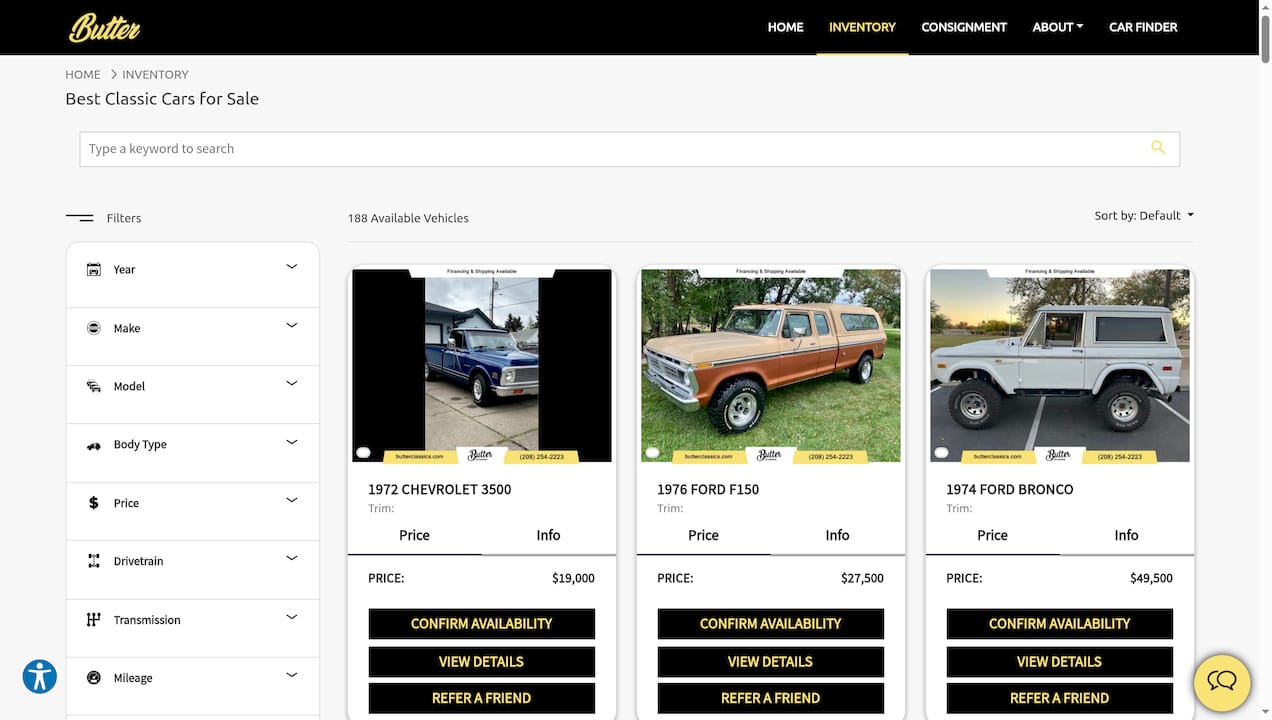
Every listing is built to support the exact checklist covered in this guide. Buyers may be able to request financing pre-qualification before choosing a car, schedule a test drive or independent inspection through the platform, and work with teams experienced in why matching numbers and clean titles are important for classic vehicles.
Ready to move forward? Browse current inventory, check financing options through the Butterclassics homepage, or if you're on the selling side, learn how to consign your vehicle with a marketplace built specifically for collector cars.
Where to Verify the Rules Yourself
Before you finalize any purchase, confirm the details independently. Start with the FTC's Used Car Rule guidance for dealer obligations, and review SEMA's reporting on VIN legislation for state-specific restorer protections. If you're ever unsure about a title or VIN, contact your state DMV or local License and Theft bureau directly.
Sources
- Dealer's Guide to the Used Car Rule | Federal Trade Commission
- VIN controversy spurs action in state legislatures | SEMA
FAQ
Do I Need an LLC to Buy a Classic Car From Butterclassics?
No. You can buy a classic car through Butterclassics as an individual just as easily as through an LLC; the marketplace process, financing pre-qualification, and inspection coordination work the same either way. An LLC only becomes relevant if you want the liability separation and estate-planning benefits described earlier in this guide.
What Documents Do I Need Before Paying for a Classic Car?
You need a signed clear title, a bill of sale listing the VIN and price, a lien release if applicable, and an odometer disclosure statement. Dealers selling more than five vehicles a year must also provide an FTC Buyer's Guide disclosing warranty terms.
How Much Does It Cost to Form an LLC for a Classic Car?
Filing fees vary by state for Articles of Organization, plus potential annual report or franchise tax fees. Check your specific state's Secretary of State site for the current fee schedule before filing.
Can I Get Financing on a Classic Car Owned by an LLC?
Some specialty classic-vehicle lenders will finance a purchase titled to an LLC, though terms and required documentation vary by lender. Butterclassics offers financing pre-qualification through its website, which is a good starting point to compare what's available for your situation.
What's the Biggest Red Flag When Buying a Classic Car Online?
A VIN that doesn't match across the title, dashboard tag, and frame stamping is the clearest signal to stop and investigate further. Combine that with a seller who resists an independent inspection or pushes you to skip escrow, and that's a deal worth walking away from.