
Yes, you can legally import a classic car to the USA, and most collectors do it through the 25-year rule. You'll still need to file DOT HS-7, submit EPA Form 3520-1, clear U.S. Customs and Border Protection, and budget for duties before the car ever touches a ship. Get the manufacture date verified first. Everything else follows from that one number.
TL;DR:
- Confirm the vehicle's manufacture date with documentation before booking shipping to ensure it qualifies under the 25-year rule.
- Complete required forms such as DOT HS-7 and EPA Form 3520-1 before the car arrives to avoid delays and extra fees.
- Verify that the bill of lading and ownership documents match exactly, especially the VIN and manufacturer date, to prevent customs issues.
- Use a customs broker when importing from uncertain origins, high-value vehicles, or if navigating complex exemptions like the 25-year rule.
- Check your state's DMV requirements in advance, including VIN validation and inspection rules, to streamline the registration and titling process post-entry.
Table of Contents
- Import Classic Car to USA: Your Pre-Shipment Document Checklist
- What Is the 25-Year Rule for Importing Classic Cars?
- How Do You Import a Classic Car Step by Step?
- How Much Does It Cost to Import a Classic Car?
- Shipping Logistics Aren't the Same as Legal Entry
- Getting Your Imported Classic Titled at the State DMV
- Do You Need a Customs Broker to Import a Classic Car?
- How Butter Classics Helps You Source Import-Ready Classics
- Where to Confirm the Rules Before You Ship
- The Real Bottleneck Isn't the Law, It's the Sequencing
- Sources
Import Classic Car to USA: Your Pre-Shipment Document Checklist
Before you book a single container slot, gather the paperwork that CBP will actually ask for at entry. Missing one piece is the fastest way to watch your car sit in a bonded warehouse racking up storage fees.
Here's what to have in hand:
- Bill of sale or commercial invoice showing purchase price and buyer/seller names
- Bill of lading matching the ownership documents exactly
- Foreign title or export certificate from the country of origin
- VIN or chassis-plate proof of the manufacturing month and year, not just model year
- Completed DOT HS-7 declaration, with Box 1 checked if the vehicle qualifies for the 25-year exemption
- Broker power of attorney, if you're using one, plus a bond plan if the entry requires it
- English translations of any foreign-language documents
- A quick pre-check call to your state DMV before the car ships
Pro Tip: Photograph the build plate or door-jamb VIN sticker before you buy. CBP and your broker will both want proof of manufacture date, and a blurry seller photo from an overseas listing rarely holds up.
What Is the 25-Year Rule for Importing Classic Cars?
The 25-year rule, created under the Imported Vehicle Safety Compliance Act, exempts vehicles from Federal Motor Vehicle Safety Standards once they hit 25 years of age from their month and year of manufacture, not the model year printed on the title. A car built in November 2000 doesn't clear the bar until November 2025, even if dealers list it as a "2001 model." That distinction has stranded more than one excited buyer at the port.
DOT and EPA run separate clocks. EPA's emissions exemption kicks in at 21 years, and it evaluates engine equivalency independently of DOT's safety exemption. A modified engine or swapped drivetrain can trigger extra scrutiny even on a car old enough to clear DOT with no issue.
If your car is younger than 25 years, you're not automatically out of options:
- Registered Importer conformity, where a DOT-registered importer brings the vehicle up to FMVSS standards
- Show-or-display, a narrow exemption for historically or technologically significant vehicles, limited to low annual mileage
- Temporary or nonresident import, useful for visitors or short-term use rather than permanent ownership
Each path has its own paperwork trail, and none is as simple as waiting for the calendar to catch up.
How Do You Import a Classic Car Step by Step?
Coordinating the paperwork with the shipping schedule is where most classic car import rules trip people up. Here's the order that actually works:
- Before booking transport: Confirm the manufacture month and year against the build plate, not the title. Pull together your bill of sale, foreign title or export certificate, and VIN documentation.
- Get a duty estimate. Ask a customs broker to review the Harmonized Tariff Schedule (HTS) classification and country of origin before you commit to a ship date.
- At booking: Make sure the bill of lading names match your ownership documents exactly. If you're using a broker, sign the power of attorney now, not after the car has sailed.
- Prepare entry instructions so your broker or you can act the moment the vessel arrives, rather than scrambling once it's dockside.
- At the port: File the CBP entry, submit the DOT HS-7 and EPA 3520-1 forms, and pay applicable duties and processing fees.
- Obtain CBP release. This is the single document that proves your car cleared federal entry.
- After release: Request stamped copies of your entry paperwork for the DMV, arrange inland transport, and start your state's title and registration process.
Pro Tip: Never treat a confirmed shipping booking as proof of legal entry. The freight company moves the car; only CBP, DOT, and EPA clear it. Those are two entirely different approvals, and collectors regularly assume one covers the other.
How Much Does It Cost to Import a Classic Car?
Duty on classic cars runs as an ad valorem rate, a percentage of the vehicle's declared value, and the rate depends on country of origin and tariff classification. On top of the base rate, additional tariff layers can shift the effective cost significantly depending on trade policy at the time of entry.
For planning purposes, importers commonly use these origin-based estimates, though you should verify current rates with a broker before committing to a purchase:
- European Union origin: planning around a typical duty rate
- Japan or United Kingdom origin: planning around a typical duty rate
Budget beyond the duty line. Factor in broker fees, a customs bond if your entry requires one, port storage charged by the day, inland trucking to your home state, plus your state's sales tax and registration fees. A car that looks like a bargain overseas can lose its edge fast once every line item lands on the invoice.
Shipping Logistics Aren't the Same as Legal Entry
Booking a container and clearing customs are two separate jobs, and treating them as one is the most common mistake we see. The freight forwarder moves your car across an ocean. CBP, DOT, and EPA decide whether it's allowed into the country at all, and one agency's approval doesn't guarantee another's.
Finish your duty estimate and entry documentation before the car ships, not after. Watch for these common snags:
- Names on the bill of lading that don't match the bill of sale or title
- A missing foreign export certificate the origin country requires
- An unverified manufacture date that turns out to be a few months short of 25 years
- A dirty undercarriage that triggers a secondary agricultural or customs inspection
Getting Your Imported Classic Titled at the State DMV
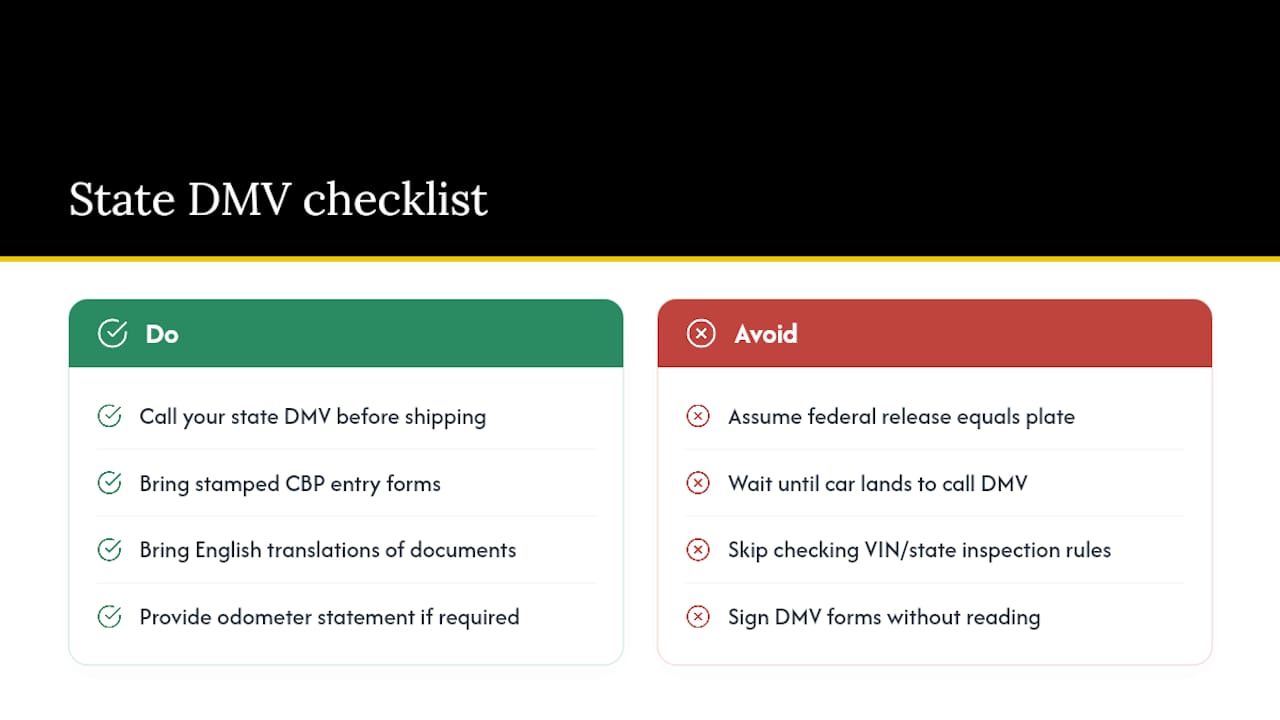
Federal release from CBP doesn't automatically get you a license plate. Some states demand a full 17-digit VIN, which older imported vehicles sometimes lack, or require an additional safety inspection even on a federally-exempt classic.
Call your state DMV before the car ships, not after it lands. Bring your stamped CBP entry forms, English translations of any foreign documents, and an odometer statement if your state requires one. Depending on your state's rules, you may end up with a bonded title, a branded title noting the import history, or a straightforward collector or antique plate. Knowing which outcome your state uses ahead of time saves a frustrating trip back to the counter, and it pays to review what title work involves before you sign anything at the DMV window.
Do You Need a Customs Broker to Import a Classic Car?
Hire a broker when the tariff picture is complicated, the car's value is high, the country of origin is uncertain, or you're navigating a sub-25-year exception. For a straightforward, well-documented classic from a common origin country, some collectors handle entry themselves.
If you do bring in a broker, ask these questions before signing anything:
- Will you review the HTS classification and country of origin before we book shipping?
- Is a customs bond required for this entry, and what does it cost?
- Do you need power of attorney, and how is that documented?
- How much experience do you have with EPA and DOT import declarations specifically?
- What's your fee structure, and how long does entry typically take once the car arrives?
- Can you provide references from recent classic car clients?
A broker's early answer on duty stacking can tell you whether to ship now or renegotiate the purchase price first.
How Butter Classics Helps You Source Import-Ready Classics
There are marketplaces available for collectors, offering detailed listings, financing pre-qualification, and consignment support. If you're weighing an overseas purchase against something already stateside, our inventory is worth a look first. Our guides on bill of sale documentation and shipping cost planning cover the practical side of getting a car to your driveway, imported or not.
Where to Confirm the Rules Before You Ship
Rules and rates shift, so confirm current requirements directly with the agencies before you commit to a purchase or a ship date:
- NHTSA's importing vehicles page covers the 25-year exemption and HS-7 form
- CBP's Help Center article on classic and antique vehicles explains entry basics for personal-use imports
- CBP's importing a car page lists required documents and entry procedures
For readers weighing a domestic out-of-state purchase instead of an overseas one, FrenzyCars' guide to buying a car out of state walks through comparable paperwork and transport logistics without the customs layer.
The Real Bottleneck Isn't the Law, It's the Sequencing
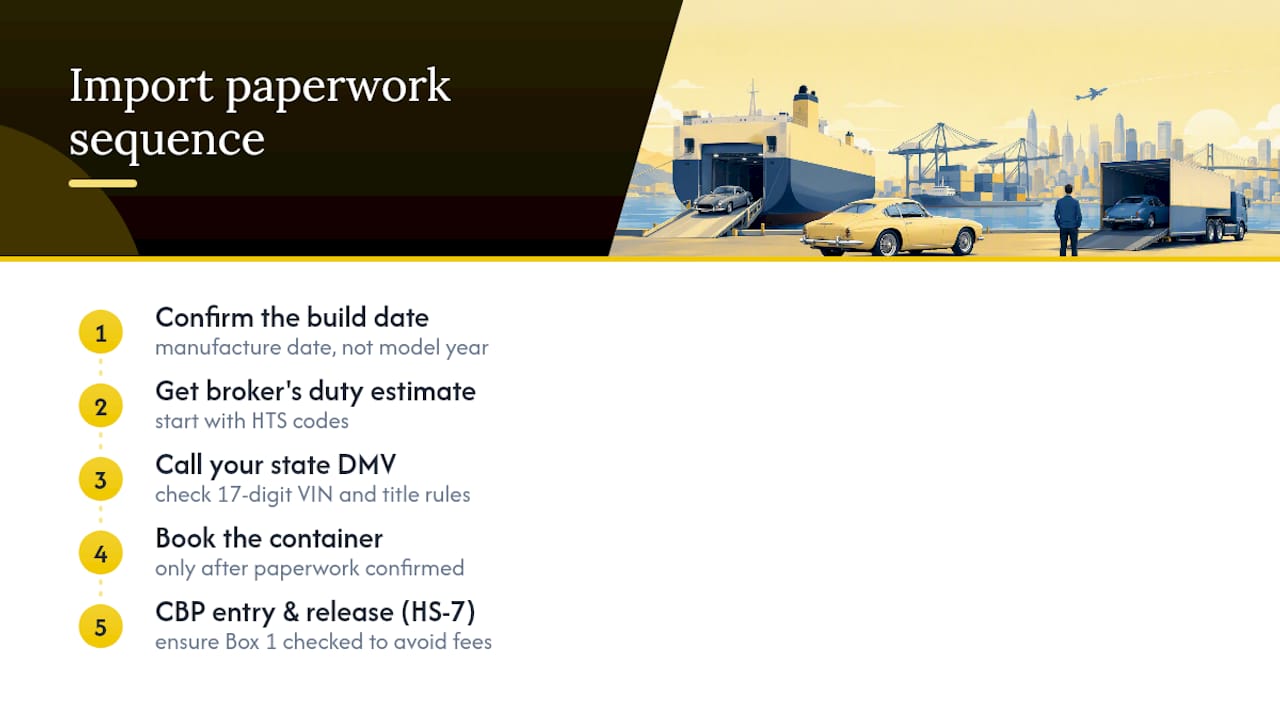
The 25-year rule itself is refreshingly simple once you understand it runs on manufacture date, not model year. What trips up most collectors isn't the law. It's the order of operations. Buyers book a ship date, get excited, and only then start calling brokers about HTS codes or discover their state DMV wants a 17-digit VIN their 1978 chassis plate never had.
Conventional advice treats DOT, EPA, and CBP as one hurdle to clear. They're three separate gates, run by three separate agencies, and clearing one tells you nothing about the other two. That's the gap most import guides gloss over.
If you take one thing from this guide, prioritize the paperwork sequence over the shipping timeline. Confirm the build date, get a broker's duty estimate, and call your state DMV, all before you book a container. A car that sits an extra two weeks at the seller's location costs you nothing. A car that sits at a U.S. port because Box 1 on the HS-7 wasn't checked costs you storage fees every single day.
— Tony
Sources
- Importing vehicles | NHTSA
- Importing classic or antique vehicles / cars for personal use | CBP Help Center
- Importing a car | U.S. Customs and Border Protection