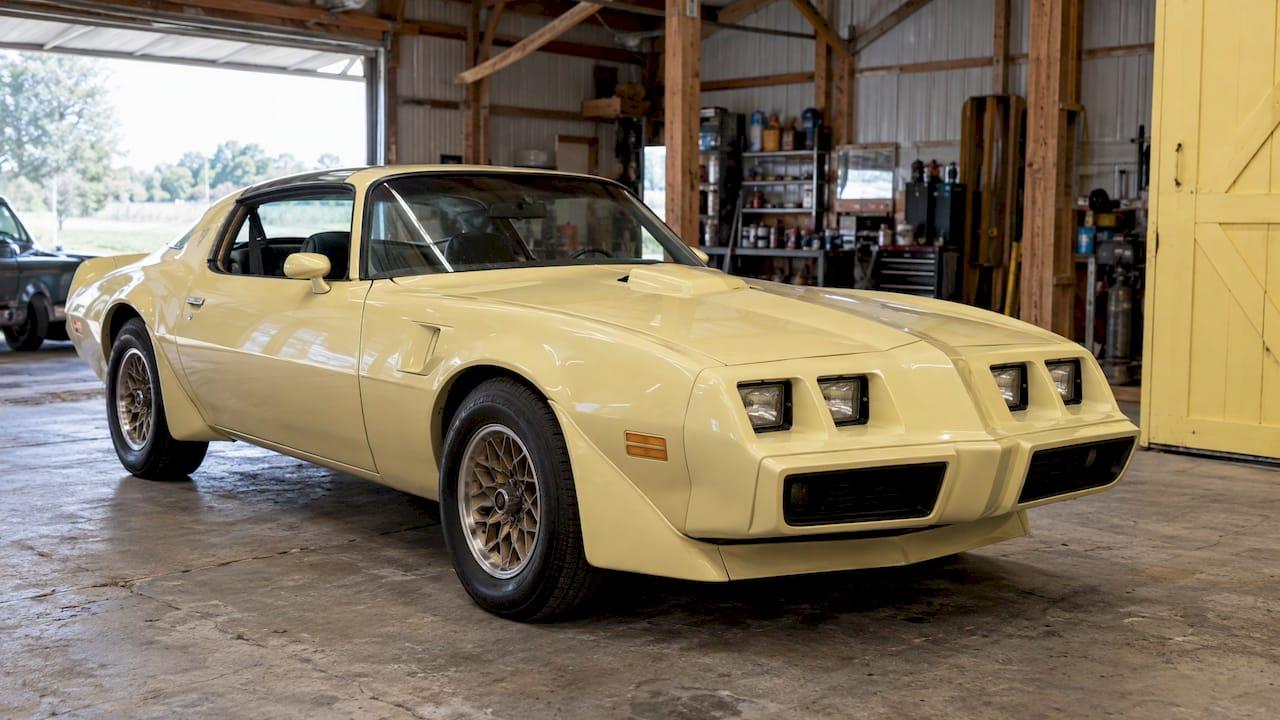
The right Firebird depends on which generation you want, and the safest one to buy is the car you can prove. Firebirds are easy to dress up as something rarer, so the paperwork matters as much as the paint. This guide covers the four generations, what each costs, where they rust and how to check that a Trans Am or WS6 is the real thing. It also has a short section on GTO buyers. If you want to see what a Butter Classics listing looks like while you read, our classic car inventory is a good place to start.
TL;DR
- Average Firebird values run roughly $21,000 (third generation), $24,000 (fourth), $46,000 (second) and $51,000 (first), but trim and documentation move a single car far above or below those numbers.
- Rust behind the rear wheels, in the floors and trunk, and around T-top cars is the first inspection priority on every generation.
- A VIN will not prove a WS6 (1996–2002) or a 1969 Trans Am. You need the SPID sticker, the body tag or factory documentation.
- Treat a car with heavy structural rust as a parts car, no matter how low the price looks.
- Buying from a seller with detailed photos, a clear history and a guarantee makes every step below easier.
Table of Contents
- The four Firebird generations at a glance
- What a Firebird is worth
- Where Firebirds rust and wear
- Verifying a Trans Am, WS6 or Ram Air car
- Quick notes for GTO and Challenger buyers
- How to buy a Firebird without regrets
- Our take on buying a Firebird
- Ready to find your Firebird?
- FAQ
- Sources
The four Firebird generations at a glance
Pontiac built the Firebird from 1967 through 2002. Each generation has its own character and its own buying risks.
| Generation | Years | What it is | Typical average value |
|---|---|---|---|
| First | 1967–1969 | Original pony car, vent windows only in 1967, Trans Am arrives in 1969 | about $51,000 |
| Second | 1970–1981 | Long-run icon, Formula, Trans Am, SD-455 | about $46,000 |
| Third | 1982–1992 | Pop-up headlights, hatchback, 5-speed manual from 1983 | about $21,000 |
| Fourth | 1993–2002 | LT1 and LS1 power, WS6 package | about $24,000 |
The averages come from a SlashGear value roundup, which notes the first-generation figure is pulled up by a handful of rare six-figure cars. Generation timelines and model notes are summarized in a HotCars generations guide.
First generation (1967–1969)
This is the collector end of the market. Many 1967 details are one-year-only, including vent windows, the 326 engine and a silver grille surround, so a car missing trim or glass can cost real money to complete, according to the First Generation Firebird club's buying notes. The 1969 Trans Am is the one to be careful with: the club notes only 689 hardtops and 8 convertibles were built, all Cameo White with blue stripes. That makes genuine ones some of the most cloned Pontiacs around.
Second generation (1970–1981)
The 1970½ car through the late-'70s Trans Am is what most people picture. The SD-455 of 1973 and 1974 was the high point, rated 290 hp (the HotCars guide calls that figure likely underrated). Below the top cars, prices vary widely with trim and condition. On a 1979 car, value is affected by trim, condition, matching drivetrain, documentation, roof type, rust and original paint, per the SlashGear piece above.
One detail for 1979 buyers: the W72 was a 400-cubic-inch Pontiac V8 rated about 220 hp, and California-registered cars got an Oldsmobile 403 instead. If a car's listing says "400 Pontiac," ask where it was originally sold.
Third generation (1982–1992)
The 1982 restyle brought pop-up headlights and a big hatchback. The 5-speed manual arrived in 1983 along with the Daytona 500 Pace Car edition, per the HotCars guide. This is the budget entry. Many 1980s and 1990s base cars sell for under $10,000. The wedge-shaped cars are a strong value if you pick a clean, rust-free one and leave the project cars alone.
Fourth generation (1993–2002)
These are the fastest Firebirds ever built. Hagerty's WS6 buyer's guide says the LS1 replaced the LT1 in every Trans Am and Formula for 1998, rated 305 hp, or 320 hp with the WS6 package. Motor Trend recorded 60 mph in 5.0 seconds and a 13.5-second, 107.4 mph quarter mile in an LS1 WS6 six-speed Trans Am. The last Firebird rolled off the line in 2002. Late cars gained a few more horsepower, and GMEFI Magazine's fourth-generation guide notes that a possible LS6 block in late WS6 cars, verifiable by cast numbers, adds rarity worth checking.

What a Firebird is worth
Three things move price more than the year on the title: trim, documentation and originality.
- Trim. A Firebird is the base car. A Trans Am is the performance package on top of it, with upgrades that carry a premium.
- Documentation. Original window stickers show what the car left the factory with, and matching numbers (engine stamp, VIN derivative, transmission date codes) matter for value, according to American Classic Appraisals.
- Originality. The same appraisal guide says original, unrestored hood decals in good condition add value, while poorly reproduced ones detract.
At the top, SlashGear estimates a 1969 Ram Air III convertible at $818,000 in good condition, a Ram Air IV convertible at $206,000 and the hardtop at $120,000. That is the extreme. A more useful rule: a documented, original car in good condition will almost always be easier to resell than an undocumented one at the same price. If you are buying as an investment, that resale ease is the whole game.
Where Firebirds rust and wear
Start with the body. Rust behind the rear tires, in the floor pans and in the trunk is the classic Firebird problem, and it is worse on cars with T-tops, per Hagerty's WS6 guide. On second-generation cars, Hagerty's 1970–81 buyer's guide advises treating a car as a parts car when frames, floors, trunk pans, fenders, rockers, window pinchwelds and firewalls are rusted beyond reasonable repair. The aftermarket is excellent, but the parts and labor to set a car right add up fast.
A short walk-around list:
- Wheel wells and rocker panels. Press on the lips and feel for bubbling or filler. A soft magnet helps find body filler, as the first-gen club suggests.
- Floors and trunk pan. Look from underneath, not just from above.
- T-tops. Check seals and look for water stains in the carpet and trunk.
- Panel backs. Look for drill holes, lots of filler or bent supports that point to accident repair.
For fourth-generation cars, Hagerty's list adds plastic front fenders that pull loose, pop-up headlights that fail stuck up or down, failing power windows, water-soaked taillights, cracked dash plastics and odometer failures. On LT1 cars, the Optispark ignition is moisture-prone, and EGRs, fuel pumps and sending units are known weak points.
If you can't see the car in person, a classic car pre-purchase inspection walks through what a thorough check covers. Our own classic car test drive checklist covers what to watch for behind the wheel.
Verifying a Trans Am, WS6 or Ram Air car
This is where buyers lose money. Firebird clones are common, so check these before you pay.
- 1969 Trans Am and other first-gen cars: Read the body tag and VIN. The first-gen club says never to buy a 1969 Trans Am without Pontiac Historical Services (PHS) documentation and a hidden VIN check. PHS is the group that holds Pontiac's factory production records.
- 1996–2002 WS6: The VIN will not show it. Hagerty says the SPID sticker (the option-code label) in the driver's door jamb must list WS6, and a missing sticker suggests paint or door replacement. WS6 wheels and hoods have long been available aftermarket, so a standard Formula or Trans Am can be made to look like one.
- Any car sold as numbers-matching: Our guide to verifying numbers-matching classic cars shows where to look. For title and VIN problems on older cars, see our classic car history check and VIN-first listing checks.
WS6 production gives you a sense of how many are out there. Hagerty reports about 2,500 of roughly 31,000 Firebirds in 1996, just under 3,900 in 1997, more than 8,000 in 2000, about 7,000 in 2001 and almost 15,000 in 2002. That 2002 total was nearly half of all Firebird sales that year. The 1996–97 cars are the scarce ones.
Quick notes for GTO and Challenger buyers
Many people searching for a Firebird guide are also weighing a GTO. The big difference is documentation. Hagerty's 1964–67 GTO guide says 1964–65 GTOs were a LeMans option with no VIN identifier, which makes them easy to clone. It recommends PHS documentation, a $75-per-car factory invoice and option-decoding letter, as the way to verify one. True 1966–67 GTOs show "42" as the second and third VIN digits on the driver's door jamb plate.

On values, Hagerty puts a 1966 Tri-power hardtop from about $43,000 and a 1967 Ram Air convertible at an average of $85,100. Rust checks center on the quarters, windshield, backlight, floors, trunk and frame rails. Test Drive Technologies' 1966 GTO guide adds that fresh spatter paint can hide old repairs, and that date codes on the engine and drivetrain parts must predate the car's build date to support an originality claim. Challenger shoppers should plan the same way: match the engine code in the VIN to the block stamp before you trust any listing.
How to buy a Firebird without regrets
- Pick your generation and budget first. Decide whether you want a driver, a show car or an investment.
- Ask for photos of the underside, trunk, wheel wells and door jamb. If a seller won't send them, move on.
- Get the paperwork. Window sticker, PHS documents, SPID sticker, service records.
- Match the numbers. VIN, engine stamp, body tag, date codes.
- Drive it. Listen for ignition and fuel issues, watch for pop-up headlight faults, and check all the electrics.
- Settle the money. Line up financing before you fall for a car.
That last step is easy to skip and costly to skip. Our classic vehicle financing lets you pre-qualify, so you know your budget before you start shopping.
Our take on buying a Firebird
Firebirds are some of the most fun cars to own, and also some of the easiest to get wrong. A real Trans Am and a good-looking copy can sit side by side on a lot, and only the paperwork tells them apart.
That's why we think detail matters. Good photos, full specs, a clear history and a straight answer on what's original. We list classic cars nationwide, not from a single lot, so you can compare more than one example before you commit. Our Butter Certified vehicles come with a Worry Free Guarantee, and we can help with delivery or pickup.
If a Firebird is your next car, buy the one you can prove. If you have one to sell, we'd love to help it find the right owner.
Tony
Ready to find your Firebird?
Browse our classic cars for sale, pre-qualify for financing, schedule a test drive or request a quote on any car that catches your eye. If you own a Firebird, GTO or another classic you'd like to sell, you can consign your vehicle with us.
Looking at other muscle cars too? Our buyer's guides for the Camaro Z28 and the Buick Grand National use the same tag-and-number approach.
FAQ
How much is a Pontiac Firebird worth?
Averages run about $21,000 for third-generation cars, $24,000 for fourth, $46,000 for second and $51,000 for first, according to SlashGear. Many 1980s and 1990s base cars sell for under $10,000. Rare first-generation cars can reach six figures.
Which Firebird has the LS1?
The LS1 replaced the LT1 in every Trans Am and Formula for 1998 and stayed through 2002, the final year, per Hagerty. It was rated 305 hp, or 320 hp with the WS6 package.
When was the last Pontiac Firebird made?
The last Firebird rolled off the line in 2002, after production that began with the 1967 model year.
Which Firebird was the fastest?
The fourth-generation LS1 WS6 cars were the quickest and fastest Firebirds built. Motor Trend recorded 60 mph in 5.0 seconds and a 13.5-second quarter mile at 107.4 mph in a six-speed Trans Am, as Hagerty reports.
Sources
- Pontiac Firebird: How Much Is The Classic Pony Car Worth (SlashGear)
- Before you buy a 1996–2002 Pontiac Trans Am WS6 (Hagerty)
- Your Handy 1970–81 Pontiac Firebird Buyer's Guide (Hagerty)
- Your definitive 1964–67 Pontiac GTO buyer's guide (Hagerty)
- Pontiac Firebird Generations Guide (HotCars)
- Buying a First Generation Firebird (First Generation Firebird club)
- Guide to the 4th Generation Pontiac Firebird (GMEFI Magazine)
- Pontiac Appraisal Guide (American Classic Appraisals)
- 1966 Pontiac GTO Buying Guide (Test Drive Technologies)